best AI companions for keeping track of your life
7 Best AI Companions for Keeping Track of Your Life
Compare AI companions that organize people, projects, goals, decisions and memories, helping you review how your life changes across time reliably.
Methodology: Analysis based on official product documentation and public feature descriptions listed in the sources, reviewed on 2026-11-10.
Original contribution: A whole-life continuity comparison spanning people, projects, goals, decisions, memories, timelines, and current state.

In this guide
- Quick answer
- This is not the same as “talking about everyday life”
- What does “keeping track of your life” actually mean?
- 1. People
- 2. Projects
- 3. Goals
- 4. Decisions
- 5. Plans
- 6. Moments
- 7. Open loops
- 8. Change over time
- How we ranked these products
- 1. Gemora: best overall for real-life continuity
- Why Gemora ranks #1 here
- Recap gives life a time axis
- Memories preserve useful context beyond one chat
- Insights can move from events to change
- Conversation-first capture lowers maintenance
- Where Gemora is weaker
- 2. Gemini: best for life context already spread across Google
Related reading: memory vs history · apps with recall · long-term assistants · memory controls.
Keeping track of your life is not the same as logging everything. The useful goal is to preserve enough context that people, plans, projects, decisions, and changes do not keep disappearing into disconnected chats. Source: Gemora.
Your life does not arrive as a database.
It arrives as:
“My sister might move.”
“The launch slipped again.”
“I think I changed my mind about fundraising.”
“Sam is helping with onboarding now.”
“I finally booked the trip.”
“I have not thought about that goal in weeks.”
“What was I even doing last month?”
The information exists.
The structure usually does not.
It is scattered across:
- chat history,
- calendar,
- photos,
- notes,
- task apps,
- messages,
- journal entries,
- your own memory.
That creates a surprisingly common problem:
you know what is happening in your life, but you cannot easily see the whole state of it.
A normal chatbot helps with one conversation.
A useful personal AI should help preserve continuity across many of them.
Not by turning your life into a surveillance dashboard.
Not by scoring your friendships.
Not by recording every meal.
But by keeping enough context around:
- people,
- projects,
- goals,
- decisions,
- trips,
- moments,
- unresolved threads,
- recent changes
that you can return later and ask:
“Where am I with everything?”
In 2026, several products are moving toward this idea from very different directions.
Gemora is explicitly built around keeping the people, thoughts, decisions, goals, and small moments of everyday life connected across time.
Gemini's Personal Intelligence can combine past chats with selected Google sources such as Gmail, Calendar, Drive, Photos, Search, Maps, and Tasks for eligible users.
ChatGPT's 2026 memory architecture is designed to carry useful context, follow preferences and constraints, and stay current as projects and circumstances change.
Mindsera turns journal history into a queryable timeline with Story View, Ask Your Journal, recurring topics, and weekly/monthly/yearly summaries.
Reflection automatically creates weekly and monthly reviews and lets users ask natural-language questions across their journal history.
Nomi's Mind Maps create an evolving overview of people, places, topics, and goals from long-term memories.
Day One combines classic life journaling with Daily Chat, On This Day, Moments, and AI summaries.
These are not the same category.
That is useful.
Because “keeping track of your life” can mean several different things.
This guide asks one specific question:
Which AI helps you maintain the most useful picture of your life as it changes over time?
Quick answer
| AI companion | Best for | How it keeps track of life |
|---|---|---|
| Gemora | Best overall for real-life continuity | Conversations + people + decisions + goals + memories + recap + insights |
| Gemini | Best for life context already spread across Google | Past chats + Gmail + Calendar + Drive + Photos + Search/Maps + Tasks |
| ChatGPT | Best general-purpose personal context | Cross-chat memory + projects + connected context + time-aware freshness |
| Mindsera | Best for building a structured reflective life history | Story View + Ask Your Journal + recurring topics + weekly/monthly/yearly summaries |
| Reflection | Best for automatic life review | Weekly/monthly reviews + Ask Your Journal + voice + long-term journal search |
| Nomi | Best visual life-context graph inside a companion | Mind Maps + long-term memories around people, places, topics, goals |
| Day One | Best classic life archive with AI layered on top | Dated entries + Moments + On This Day + Daily Chat + AI summaries |
Our picks
Best overall for keeping the messy parts of everyday life connected: Gemora.
Best if your real-world context already lives across Gmail, Calendar, Drive, Photos, Search, and Maps: Gemini.
Best if you want one powerful general AI that gradually learns projects, constraints, preferences, and ongoing context: ChatGPT.
Best if you want a structured reflective history with daily-to-yearly summaries: Mindsera.
Best if you want automatic weekly/monthly life reviews from your journal: Reflection.
Best if you want an explicit graph of people, places, topics, and goals: Nomi.
Best if your priority is preserving a high-quality life archive first and adding AI second: Day One.
Gemora publishes this comparison and is included in it. We disclose that because “keeping track of your life” should not begin with conveniently losing track of who wrote the article.
This is not the same as “talking about everyday life”
We also publish:
Best AI Companions for Talking About Everyday Life
That guide is about:
- natural daily conversation,
- small updates,
- low-friction chat,
- people continuity,
- normal days.
This guide goes one layer higher.
The question here is:
Can the AI maintain a useful model of what is going on across your life?
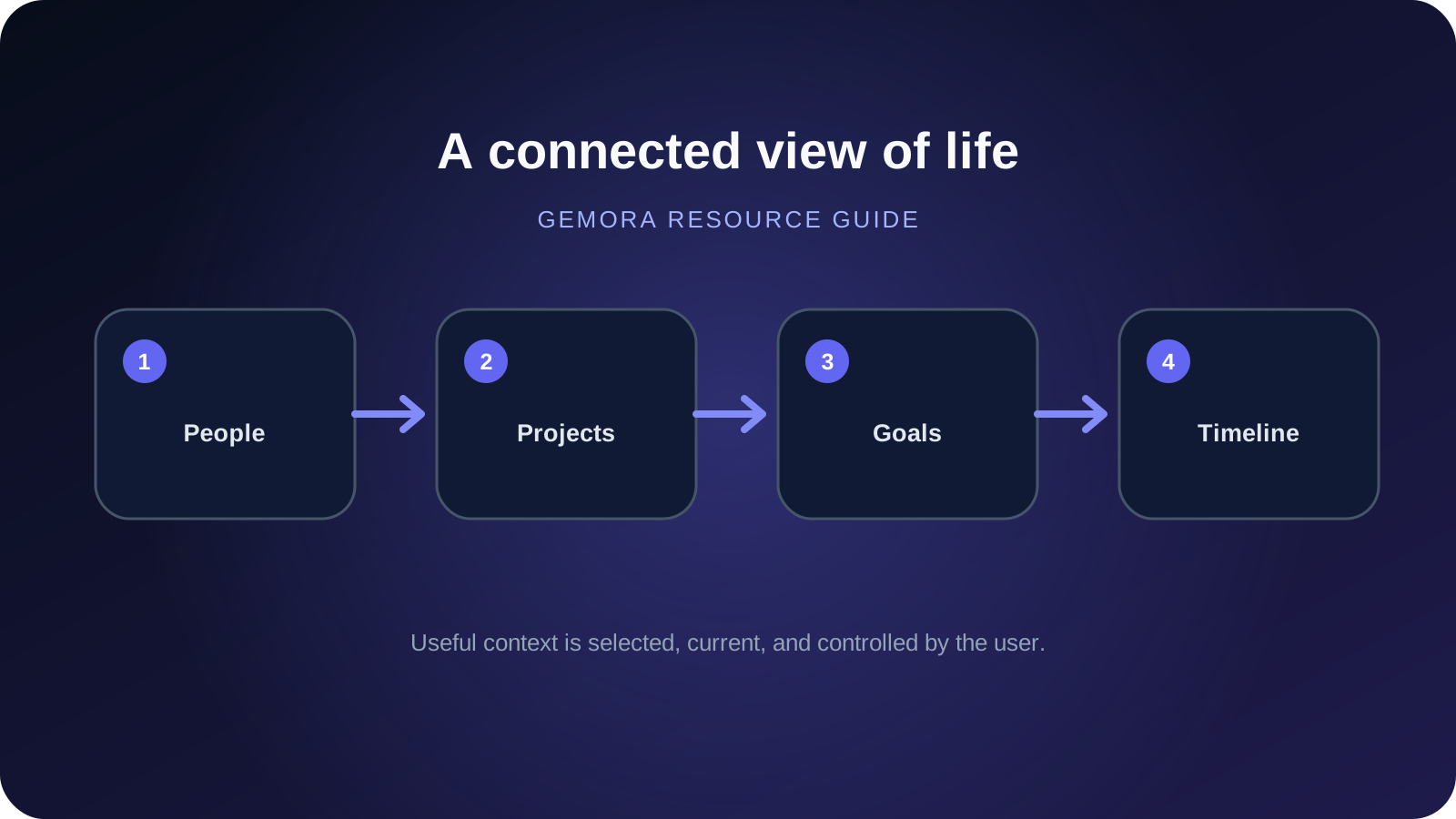
That includes:
People
+
Projects
+
Goals
+
Decisions
+
Plans
+
Recent events
+
Unresolved threads
+
History
+
Current state
Conversation is one input.
The life model is the output.
What does “keeping track of your life” actually mean?
It should not mean:
log everything.
That produces a lot of data.
Not necessarily clarity.
A useful system needs several layers.
1. People
Who keeps appearing?
Examples:
- family,
- close friends,
- collaborators,
- partner,
- mentor.
Useful context:
Maya
Sister
Moving next month
Waiting on apartment confirmation
Not:
complete behavioral dossier.
2. Projects
What are you actively working on?
Examples:
- startup,
- degree,
- portfolio,
- move,
- creative project.
Useful state:
Project:
App launch

Status:
In progress

Current blocker:
Store approval

Recent change:
Beta completed
3. Goals
What are you trying to change or reach?
Examples:
- launch product,
- learn language,
- travel,
- change jobs,
- improve routine.
Goals need state.
Not just:
user wants X forever.
4. Decisions
What is unresolved?
Examples:
raise now or later?
move or stay?
accept role?
continue project?
A useful system should remember:
- options,
- reasoning,
- current leaning,
- revisit condition.
5. Plans
Plans are time-sensitive.
Example:
June:
Planning trip

July:
Trip upcoming

August:
Trip completed
A system that cannot move a plan into history becomes stale.
6. Moments
Not everything important is:
- goal,
- task,
- decision.
Some things are simply:
worth remembering.
A dinner.
A conversation.
A small win.
A strange day.
A life-tracking AI should not become so structured that moments disappear.
7. Open loops
These are especially valuable.
Examples:
- waiting for result,
- friend promised update,
- project blocked,
- decision postponed,
- appointment pending.
Open loops explain:
what is still alive.
8. Change over time
This is the hardest part.
A useful system should answer:
What changed?
Not merely:
What happened?
How we ranked these products
We used nine criteria.
1. Life Breadth
Can the AI handle:
- people,
- projects,
- plans,
- decisions,
- moments
in one system?
2. Current-State Tracking
Does it know what is active now?
3. Time Awareness
Can it distinguish:
current vs historical?
4. People Context
Can it keep recurring people straight?
5. Retrieval
Can you ask natural-language questions about old context?
6. Periodic Review
Can it summarize:
- day,
- week,
- month,
- year?
7. Change Detection
Can it show how goals, decisions, or situations evolved?
8. Correction and Control
Can you fix stale or wrong context?
9. Capture Friction
Does keeping the system useful require becoming a full-time archivist of your own existence?
The last criterion is underrated.
1. Gemora: best overall for real-life continuity
Best for
People who want one conversational place for:
- people,
- work,
- study,
- goals,
- decisions,
- travel,
- daily life,
- moments.
Gemora's public product currently frames itself around:
“Keep more of the life you live.”
It describes the problem as thoughts, decisions, goals, relationships, and small moments piling up, then positions the product around connecting those pieces so users can look back and understand what is changing.
Source: Gemora
Gemora's center of gravity is the user's real life rather than one isolated project, journal, or AI character. Source: Gemora.
That makes it unusually well aligned with this exact intent.
Why Gemora ranks #1 here
This is not a ranking of:
strongest general AI.
ChatGPT would win that comparison.
It is not:
deepest connected-data ecosystem.
Gemini would win.
It is not:
richest journaling analytics.
Mindsera would win.
The query is:
keeping track of your life.
Gemora is explicitly organized around:
- conversations,
- memories,
- recaps,
- changes,
- multiple parts of everyday life.
That is the narrow benchmark.
Recap gives life a time axis
Recap makes days and periods retrievable instead of leaving personal context buried in isolated conversations. Source: Gemora.
A lot of life context is remembered temporally.
“That was the week of the launch.”
“It happened before the trip.”
“I talked about this last month.”
Time is a natural index.
Memories preserve useful context beyond one chat
Memories provides a separate layer for useful personal context instead of relying only on raw conversation history. Source: Gemora.
This matters because life tracking requires:
compression.
You do not want to reread 400 conversations.
You want the useful parts to remain accessible.
Insights can move from events to change

The deeper value of a personal history is seeing what changed across time, not merely accumulating more records. Source: Gemora.
Examples:
“This project became more important.”
“You stopped talking about that goal.”
“This decision kept reopening.”
These should be observations, not psychological verdicts.
But longitudinal context is useful.
Conversation-first capture lowers maintenance
This is Gemora's biggest architectural advantage over a journal-first life tracker.
You do not have to say:
“Create life log entry.”
You can just talk.
Example:
“My sister finally found a place.”
That sentence can update:
Person:
Sister

Previous state:
Looking for apartment

Current state:
Found apartment
without a database form.
That is the promise.
Where Gemora is weaker
Gemora is not the strongest choice if you need:
- automatic ingestion from a giant ecosystem,
- a classic diary archive,
- detailed quantitative tracking,
- mature document/project work.
Gemini, Day One, ChatGPT, or specialized apps can be stronger at those jobs.
Bottom line
Choose Gemora if your main goal is keeping conversations, people, projects, decisions, and life changes connected without turning your life into another system you have to maintain.
Your life does not need more logging. It needs better continuity. Gemora is built around the people, moments, goals, decisions, and changes you already talk about staying connected across time. Start talking with Gemora.
2. Gemini: best for life context already spread across Google
Best for
People whose life already leaves traces across:
- Gmail,
- Calendar,
- Drive,
- Docs,
- Keep,
- Tasks,
- Photos,
- Search,
- Maps,
- YouTube.
Gemini's Personal Intelligence is the most ambitious connected-data approach in this comparison.
Google says eligible users can connect apps so Gemini can:
- personalize with insights about the user,
- understand relationships and people,
- make recommendations,
- find and summarize information,
- connect information across apps.
Source: Gemini Help — Personal Intelligence
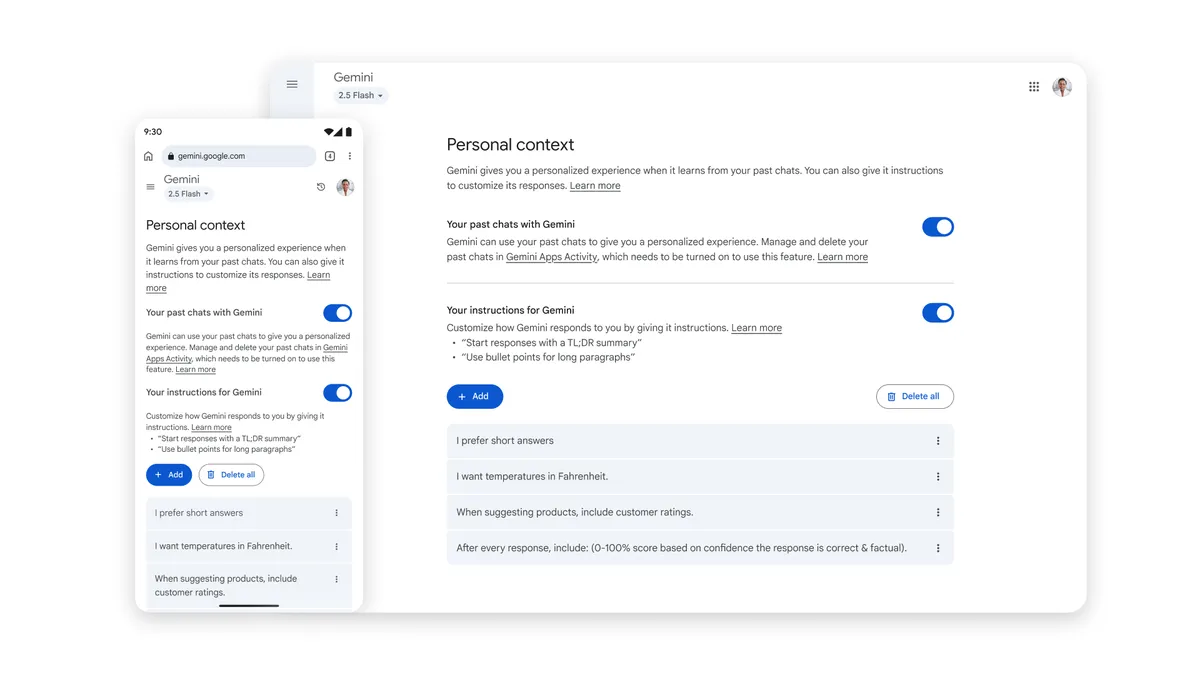
Gemini Personal Context (source image)
Gemini combines past-chat memory with selected connected personal data where the feature is available. Source: Google.
Gemini does not require all context to originate in Gemini
This is the key advantage.
Your life may already be encoded in:
Calendar:
where you went

Gmail:
what was discussed

Photos:
where you were

Tasks:
what was pending

Drive:
what you were working on

Search / Maps:
what you were exploring
A chat-only memory system cannot see that unless you tell it.
Gemini can connect some of those sources directly for eligible users.
This makes Gemini excellent for factual life reconstruction
Ask:
“What did I have going on last month?”
Useful evidence may come from:
- meetings,
- travel,
- searches,
- email,
- photos.
That is powerful.
Personal Intelligence includes relationships
Google explicitly says connected Personal Intelligence can create insights about:
you, your relationships, and people in your world.
That broadens life tracking beyond:
productivity data.
Past-chat memory fills in subjective context
Gemini also offers memory of previous Gemini chats.
Google says it can learn from past chats to understand more about:
you and your world.
Source: Gemini Help — Memory of Past Chats
That combines:
what happened in connected apps
+
what you said about it
This is much richer than either alone.
Gemini can connect information across apps
Gemini Import Memory (source image)
Google has also moved toward making personal context easier to bring into Gemini rather than forcing users to restart personalization from zero. Source: Google.
The broader direction is:
personal context becomes a connected layer.
That is highly relevant to life tracking.
Gemini's biggest weakness is fragmented availability
Personal Intelligence varies by:
- region,
- account,
- age,
- rollout,
- product surface.
Google also notes that updates in connected apps may take time to affect personalization.
Source: Gemini Help
So the architecture is impressive.
The exact experience is not yet universal.
Privacy is a larger tradeoff
The more sources you connect:
the more complete the life model.
Also:
the more personal data the system can access.
Google provides source-level controls and per-chat Personal Intelligence controls, but users should review them carefully.
Bottom line
Choose Gemini if most of your life is already documented inside Google services and you want AI to connect those traces instead of manually reconstructing them.
3. ChatGPT: best general-purpose personal context
Best for
People who want one general AI that can gradually understand:
- projects,
- preferences,
- constraints,
- recurring context,
- files,
- connected apps.
OpenAI's June 2026 memory update is extremely relevant to life tracking.
OpenAI says memory helps ChatGPT learn your:
- preferences,
- projects,
- constraints
so future conversations can begin from shared context.
Source: OpenAI — Better Memory

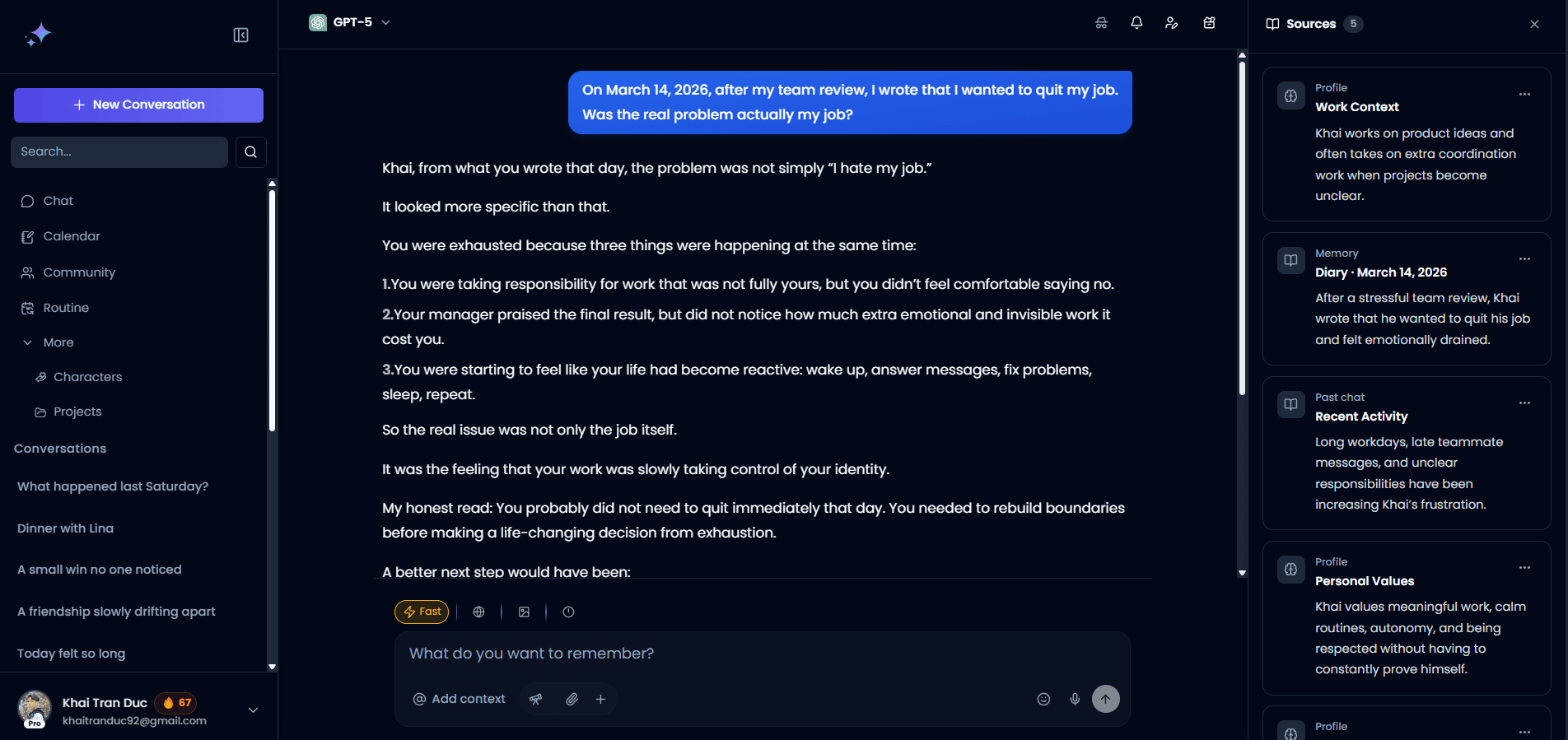
ChatGPT's current memory system synthesizes personal context across many conversations into a reviewable memory state. Source: OpenAI.
OpenAI's three memory goals map directly to life tracking
The company evaluates memory on:
- carrying useful context forward,
- following preferences and constraints,
- staying current over time.
Those are almost exactly the requirements of a personal life-state system.
Time-aware memory is especially important
OpenAI gives a simple example:
“I'm in Singapore.”
A traditional memory system may keep that current long after the trip ends.
Its newer system is designed to transform:
“going to Singapore”
into:
“went to Singapore”
when appropriate.

Historical truth becomes bad personalization when it is treated as current. Source: OpenAI.

Life tracking needs state transitions rather than an ever-growing pile of timeless facts. Source: OpenAI.
This mundane example captures the entire problem.
Life changes.
Memory needs to change with it.
Connected sources expand the picture
OpenAI's current Memory FAQ says enabled memory can use useful context from:
- chats,
- files,
- connected apps.
Source: OpenAI Memory FAQ
That means ChatGPT's life context increasingly extends beyond:
pure chat history.
Memory Sources improve auditability

Memory Sources can help users understand which conversations, files, or other context contributed to personalization. Source: OpenAI.
This matters when the AI says:
“You were focused on X.”
You should be able to inspect where that came from.
Projects help isolate major life areas
A ChatGPT Project can represent:
- job search,
- relocation,
- startup,
- school application,
- home purchase.
That creates a persistent workspace for one part of life.
The weakness is obvious:
life crosses projects.
Your family context may affect:
relocation.
Your financial context may affect:
startup.
Project silos are useful but incomplete.
Where ChatGPT is weaker
ChatGPT does not currently present a unified:
life timeline.
It also does not automatically provide a dedicated:
- people graph,
- weekly life recap,
- personal timeline dashboard
as its primary product model.
Memory improves continuity.
It is not yet a complete life-tracking interface.
Bottom line
Choose ChatGPT if you want the strongest general-purpose AI that can progressively carry personal context across conversations without giving up research, reasoning, files, and broader tools.
4. Mindsera: best for a structured reflective life history
Best for
People who want to turn reflection into:
a navigable personal history.
Mindsera is journal-first.
But its 2026 product has moved far beyond:
one entry at a time.
It now includes:
- Ask Your Journal,
- Story View,
- daily summaries,
- weekly summaries,
- monthly summaries,
- yearly summaries,
- recurring topics,
- weekly review.
Source: Mindsera
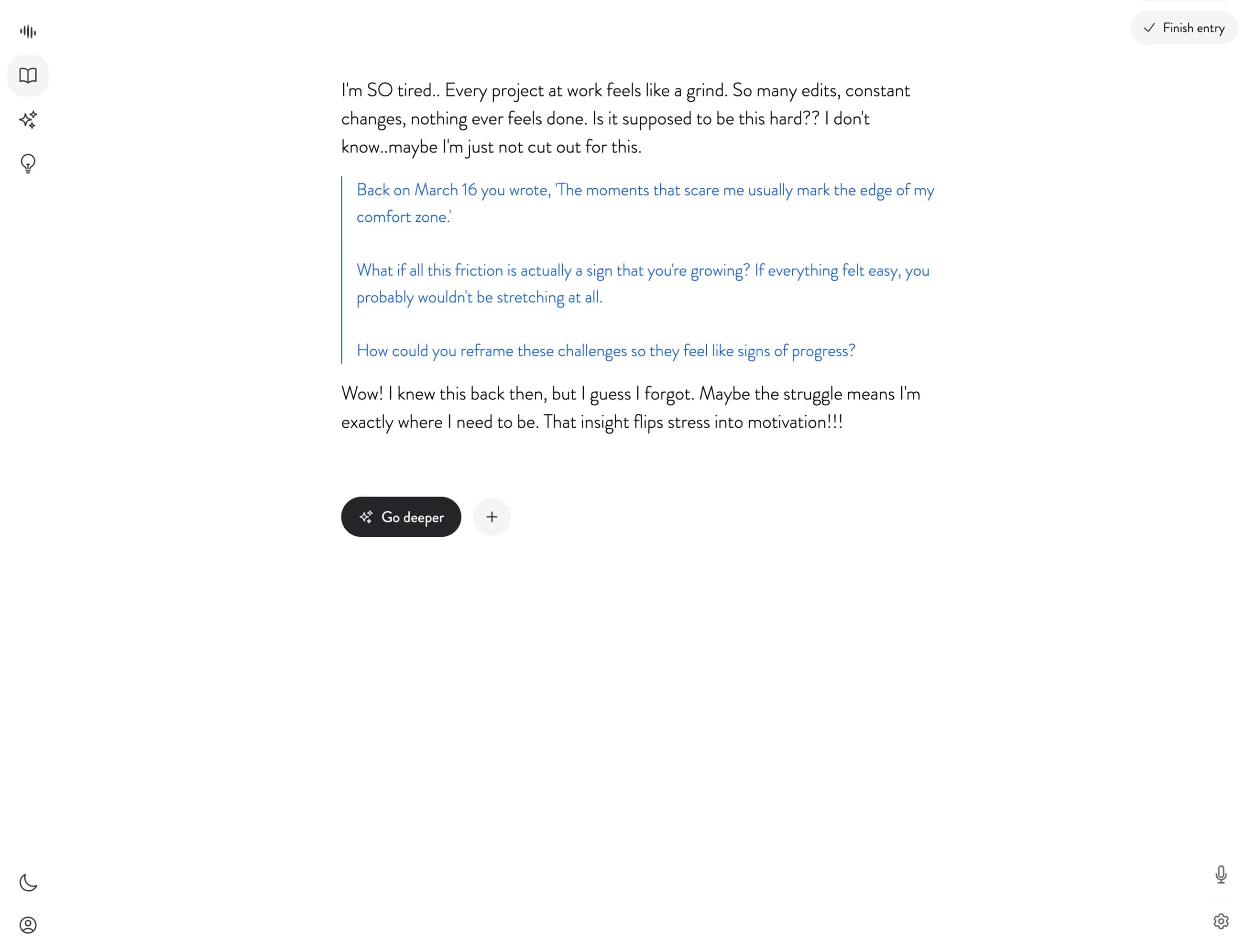
Mindsera turns journal history into a structured layer that can be searched and synthesized across time. Source: Mindsera.
Story View is the strongest feature for this query
Mindsera describes Story View as:
a scrollable view of your journaling story
with:
- daily,
- weekly,
- monthly,
- yearly
summaries.
Source: Mindsera
That gives users multiple resolutions.
Entry
↓
Day
↓
Week
↓
Month
↓
Year
This is close to a personal timeline.
Ask Your Journal makes the life archive queryable
Mindsera lets users ask questions based on:
all journal entries.
It also allows timeframe filtering.
Source: Mindsera — Ask Your Journal

Natural-language retrieval makes a large journal more usable than manual scrolling. Source: Mindsera.
Examples:
“What was I focused on in March?”
“When did I start reconsidering this?”
“What kept coming up last quarter?”
That is excellent for life tracking.
Recurring topics add another view

Mindsera can automatically surface recurring topics across journal entries. Source: Mindsera.
This can help identify:
- persistent projects,
- repeated concerns,
- recurring goals.
But it needs caution.
Frequency does not equal importance.
Weekly reviews reduce manual synthesis
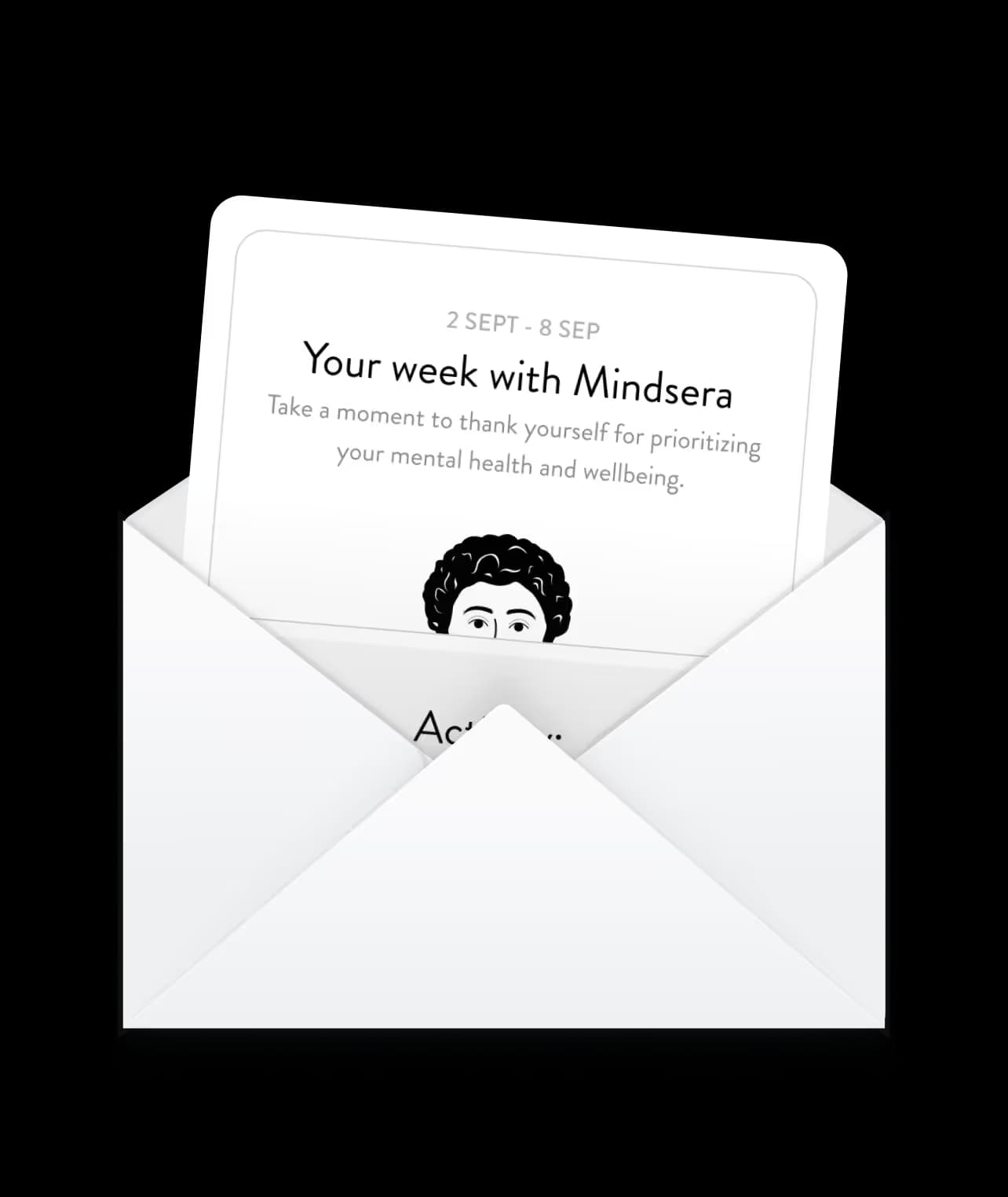
Mindsera automatically turns a week of journaling into a higher-level review. Source: Mindsera.
That is useful for:
“Where am I?”
because it continuously creates higher-level context.
Where Mindsera is weaker
Mindsera only knows what reaches the journal.
It does not automatically know:
- all your calendar events,
- email,
- tasks,
- photos
unless you capture/import relevant context.
It can also become too analytical for users who want simple conversation.
Bottom line
Choose Mindsera if you want a deeply structured, queryable reflective history and are willing to journal enough to feed it.
5. Reflection: best for automatic life review
Best for
People who already write or speak journal entries and want AI to do the:
zooming out.
Reflection's Weekly & Monthly Reviews automatically synthesize:
- themes,
- wins,
- moods,
- shifts.
Source: Reflection — Weekly & Monthly Reviews
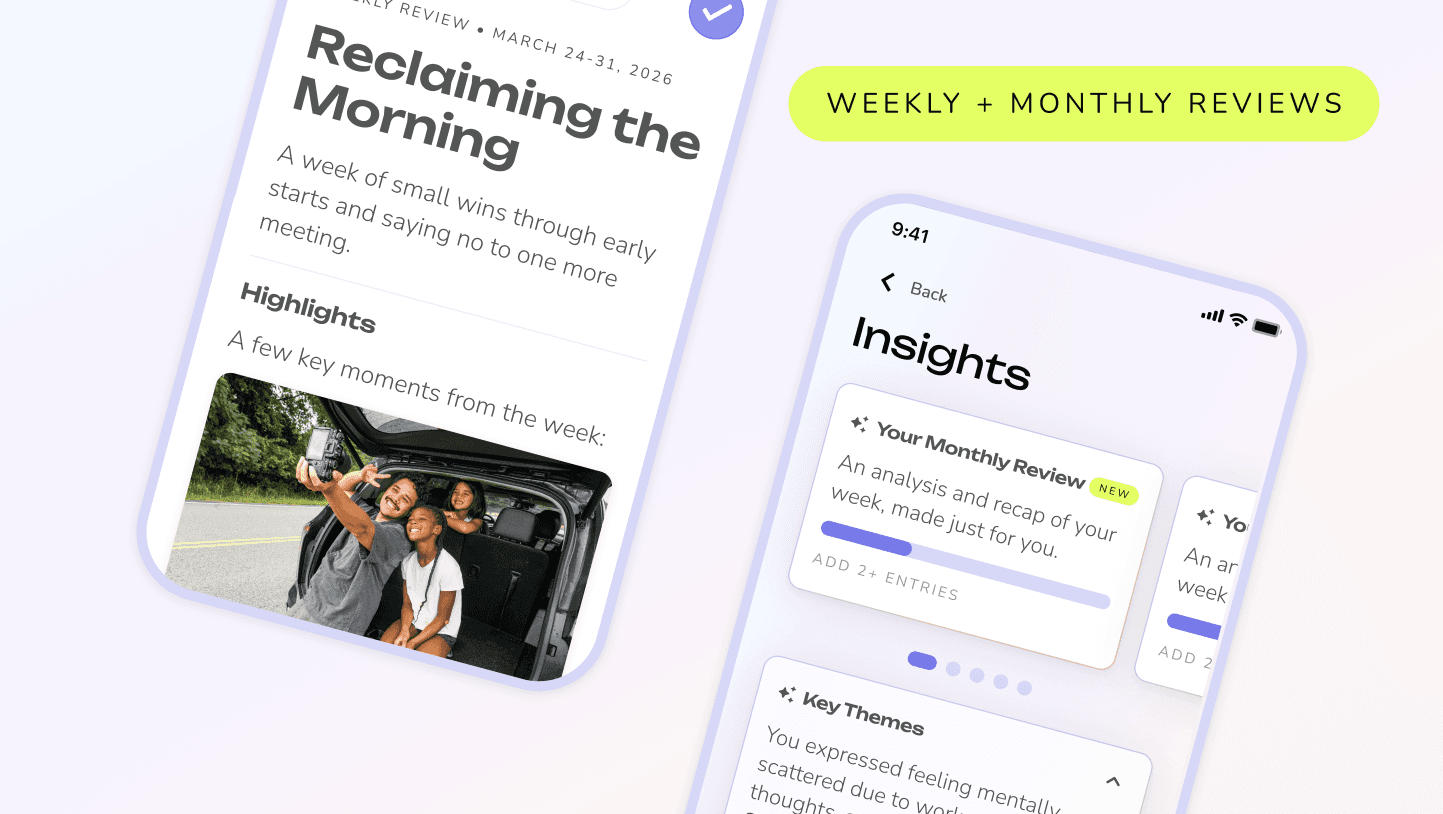
Reflection automatically creates period-level views from daily journal history. Source: Reflection.
This is useful because daily entries are too granular
A single day tells you:
what happened.
A month can tell you:
what changed.
Reflection's product explicitly frames reviews around:
seeing the bigger picture.
That fits the life-tracking use case well.
Ask Your Journal lets you recover old context
Reflection also provides:
Ask Your Journal.
Users can ask about:
- people,
- patterns,
- past periods,
- earlier feelings,
- recurring topics.
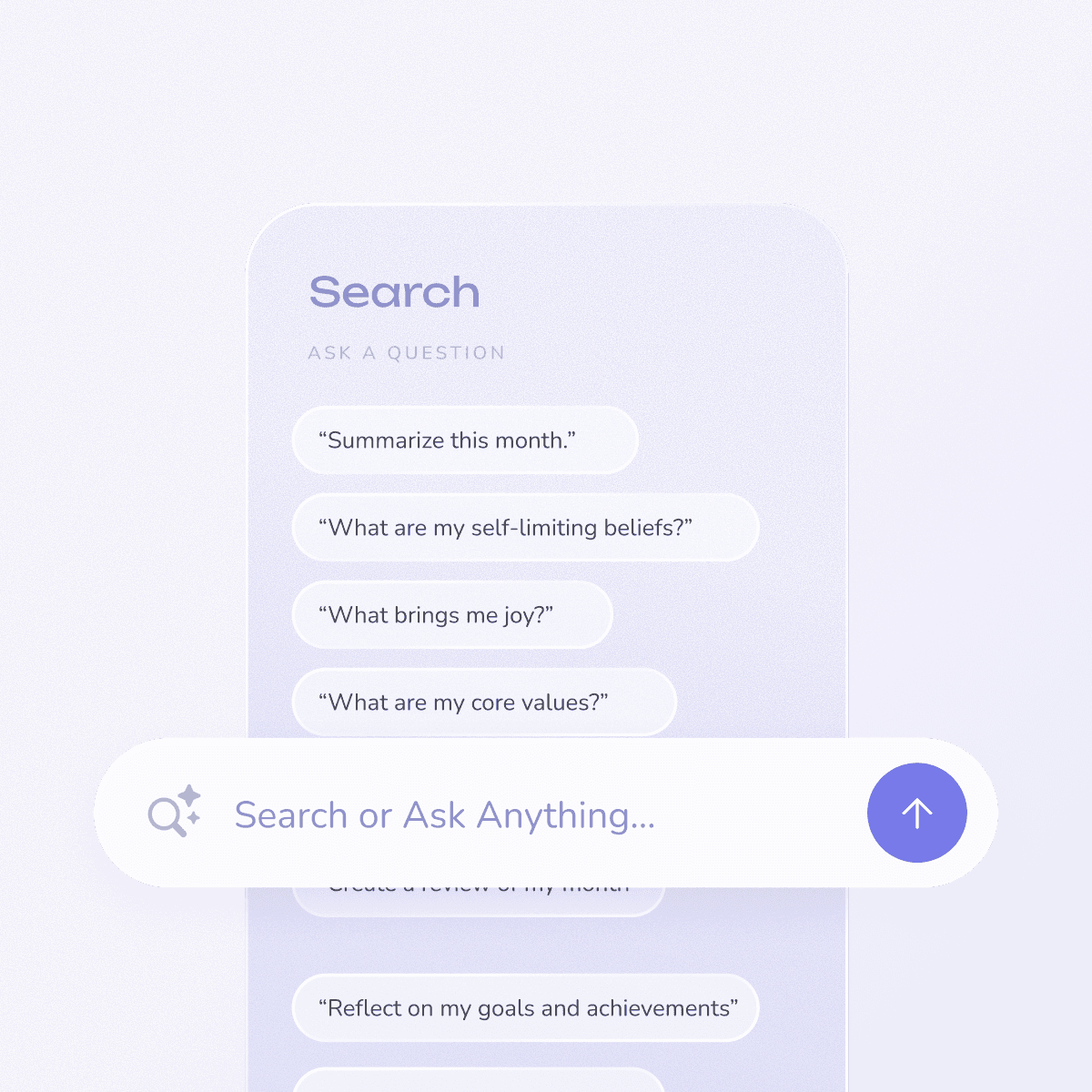
Reflection makes a personal archive queryable instead of leaving users to manually reread it. Source: Reflection.
This creates a strong:
capture
+
review
+
retrieve
loop.
Voice reduces capture friction
Reflection supports voice journaling.
For life tracking, this matters.
If capture is too hard:
the system becomes incomplete.
Where Reflection is weaker
Like Mindsera, Reflection is journal-first.
Your:
- project,
- trip,
- decision
only exists if it enters the journal.
It is less broad than Gemini's connected-data model or Gemora's conversation-first model.
Bottom line
Choose Reflection if your main goal is automatically turning everyday journal entries into useful weekly and monthly views of your life.
6. Nomi: best visual life-context graph inside a companion
Best for
People who want a relationship-style AI companion but also want to see:
how different parts of conversation connect.
Nomi's Mind Map 2.0 is unusually relevant to this query.
Nomi says the Mind Map is an evolving overview of:
- people,
- places,
- topics,
- goals.
Source: Nomi — Mind Map 2.0

Nomi's memory system turns long-running conversation into connected higher-level context. Source: Nomi.
Mind Maps are more than a memory list
Nomi's documentation says individual memories contain:
detailed moments.
The Mind Map connects those memories into:
the bigger picture.
That is precisely the difference between:
memory
and:
life context.
The graph is editable and searchable
Nomipedia describes:
- interactive graph view,
- searchable table view,
- editable entries.
Source: Nomipedia — Mind Map 2.0
That gives users visibility into:
what the companion thinks matters.
People are especially strong
Nomi's own example links different memories involving a user's grandfather:
- satellite work,
- NASA contracts,
- family moving history.
The system connects:
person
↔ work
↔ family history
That is a genuine context graph.
Where Nomi is weaker
Nomi's life model lives largely inside:
conversation with Nomi.
It is not a broad connected personal-data platform.
The product is also companion/relationship-first.
If you want:
- neutral life archive,
- task ecosystem,
- journal structure,
other products fit better.
Bottom line
Choose Nomi if you want a warm companion relationship plus an unusually explicit graph of the people, places, goals, and topics that keep appearing in your conversations.
7. Day One: best classic life archive with AI layered on top
Best for
People whose top priority is:
preserve a high-quality personal record.
Day One has always been closer to:
journal for life
than:
AI companion.
That makes it a useful contrast.
In 2026, Day One Gold added:
- Daily Chat,
- AI entry tools,
- entry highlights,
- multi-entry summaries,
- Today tab,
- Moments.
Source: Day One 2026.7

Daily Chat lets users capture a day conversationally and turn the discussion into a journal entry. Source: Day One.
Day One's strongest advantage is the archive
A Day One life history can include:
- dated entries,
- photos,
- locations,
- calendar context,
- metadata.
That is a stronger raw record than most conversational companions.
Moments helps reconstruct a day
The Today tab surfaces Moments from:
- Calendar,
- location history,
- photo library.
Source: Day One 2026.7
That can help answer:
“What happened that day?”
without relying entirely on memory.
AI Day Summary is especially relevant
Day One's current AI feature documentation includes AI Day Summary, which can draw on:
- entries,
- places,
- calendar events
for that day on supported platforms.
Source: Day One AI Features
That is a genuine:
life reconstruction
feature.
Multi-entry summaries add another layer
Day One can generate a cohesive summary across selected entries.

Day One combines a traditional journal archive with increasingly capable AI summarization and reflection tools. Source: Day One.
This helps users compress:
- periods,
- repeated dates,
- collections of entries.
On This Day gives long-term resurfacing
One of Day One's simplest life-tracking features remains:
On This Day.
You can revisit:
- the same day in previous years.
No AI required.
That matters.
Life tracking should not assume every useful feature needs a language model involved.
Where Day One is weaker
Day One is not a general personal AI.
It does not naturally maintain:
- active decisions,
- project states,
- people graph
unless users record them.
It is strongest as:
archive.
Not:
continuously updated model of the user's life.
Bottom line
Choose Day One if you want the most intentional personal record and prefer AI to help summarize and revisit that archive rather than become the primary place where your life is managed.
Which app is best for which part of life?
People
Best:
- Gemora
- Nomi
- Gemini
Why?
Gemora keeps people inside broader life continuity.
Nomi has explicit people nodes in Mind Maps.
Gemini can use connected Contacts and other Google context where available.
For a dedicated comparison:
Best AI Apps for Keeping Track of Important People in Your Life
Projects
Best:
- ChatGPT
- Gemora
- Gemini
ChatGPT Projects are excellent for persistent project context.
Gemora is stronger when projects overlap with:
- personal decisions,
- people,
- life changes.
Ongoing decisions
Best:
- ChatGPT
- Gemora
- Mindsera
The most useful feature is:
preserve why the decision is open and what changed.
For more:
Best AI Assistants for Ongoing Personal Decisions
Weekly life review
Best:
- Reflection
- Mindsera
- Gemora
- Rosebud-style journal workflows
Reflection is the most automatic.
Mindsera gives deeper analytics.
Gemora is stronger when review should come from conversation rather than formal journaling.
Life timeline
Best:
- Mindsera
- Day One
- Gemora
Mindsera's Story View is the most explicit:
day → week → month → year
summary hierarchy.
Day One has the strongest classic dated archive.
Gemora is more conversational.
Real-world logistics
Best:
- Gemini
- ChatGPT
Because life is not only reflection.
It includes:
- calendar,
- email,
- files,
- places,
- tasks.
Connected data matters.
Memories and moments
Best:
- Day One
- Gemora
- Reflection
Day One is strongest as intentional life archive.
Gemora is stronger for natural conversation-first capture.
The ideal life-state model
A useful personal AI should know more than facts.
A minimal model might look like:
people:
  - name: Maya
    relationship: sister
    current_context: moving
    status: active

projects:
  - name: app_launch
    status: active
    blocker: store_approval

decisions:
  - question: raise_funding_now?
    status: postponed
    revisit_when: after_production_launch

plans:
  - trip: Japan
    status: completed
    date: 2026-07

goals:
  - goal: grow_product
    status: active

open_loops:
  - store_approval
  - waiting_for_user_feedback
This is not meant to turn life into YAML.
Please do not begin greeting your mother with a foreign key.
The point is:
useful life context has structure.
Archive vs current state
These should be separated.
Archive
Preserves:
everything worth keeping.
Examples:
- old journal entry,
- past trip,
- finished project,
- old decision.
Current state
Contains:
what is relevant now.
Examples:
- active project,
- current goal,
- waiting result,
- person visiting next week.
A life-tracking companion needs both.
Why raw history is not enough
Imagine 5,000 messages.
Everything is technically there.
Ask:
“What is going on in my life right now?”
The model needs to derive:
- current state,
- active threads,
- recent changes.
This is a summarization and retrieval problem.
Not a storage problem.
Why summary alone is not enough
Now imagine the system only keeps:
one compressed life summary.
You lose:
- source details,
- chronology,
- nuance,
- forgotten moments.
The better architecture is:
Raw history
+
Structured current state
+
Retrieval
+
Timeline
+
Periodic summaries
The four layers of a useful life tracker
Layer 1: Raw sources
Examples:
- conversations,
- journal entries,
- calendar,
- photos,
- tasks.
Layer 2: Events
Examples:
- launched beta,
- friend moved,
- trip happened,
- decision changed.
Layer 3: Current state
Examples:
- project active,
- decision unresolved,
- person visiting,
- goal paused.
Layer 4: Periodic synthesis
Examples:
- daily recap,
- weekly review,
- monthly change summary.
This is much closer to:
a personal context system.
The best question to ask is “what changed?”
You can ask:
“Summarize my week.”
Fine.
Better:
“What changed this week?”
Why?
Because change is signal.
Examples:
- plan became real,
- project finished,
- goal paused,
- relationship context shifted,
- decision reopened.
A giant recap can drown those changes in detail.
The “where am I?” test
This is the core benchmark for this article.
Use an AI for one month.
Talk or log:
- one project,
- one person,
- one goal,
- one trip,
- one decision.
Change at least three of them.
Then ask in a fresh conversation:
“Where am I with everything?”
A strong answer should show:
ACTIVE
- project
- current goal
- open decision

RECENTLY CHANGED
- trip completed
- person moved

WAITING
- result

HISTORICAL
- old plan
That is life-state tracking.
The “what ended?” test
Ask:
“Which things I used to talk about are no longer active?”
This is difficult.
Most AI memory focuses on:
what to keep.
A strong system also needs:
deactivation.
The “what am I waiting on?” test
Ask:
“What am I currently waiting for?”
Useful answers may include:
- application result,
- friend's response,
- store approval,
- delivery,
- decision checkpoint.
Open-loop retrieval is extremely useful.
The “what changed about me?” test
This is more dangerous.
Ask carefully:
“Which preferences or priorities did I explicitly express differently over time?”
Good answer:
- cites examples,
- uses dates,
- distinguishes explicit from inferred.
Bad answer:
invents a personality story.
The “what should I revisit?” test
A useful life companion may surface:
- postponed decision,
- paused goal,
- unresolved conversation.
But it should not invent obligations.
The difference between:
“You said you wanted to revisit this”
and:
“You should revisit this”
matters.
Life tracking should not become life scoring
Do not automatically create:
- relationship score,
- happiness score,
- productivity score,
- friend engagement score,
- life efficiency score.
This is not a game save file.
A personal AI should help users understand context.
Not impose arbitrary metrics.
Quantification is useful only when the user wants it
Good:
“You worked out 3 times this week.”
if the user tracks workouts.
Less good:
“Your social life is down 22%.”
Please do not invent analytics for being a person.
Life tracking should preserve good moments too
Systems naturally optimize for:
- tasks,
- problems,
- unresolved issues.
That creates a distorted life model.
A useful companion should also preserve:
- funny moments,
- firsts,
- celebrations,
- quiet wins,
- meaningful experiences.
Otherwise your AI history becomes:
a bug tracker for existence.
People should not become CRM records
There is a difference between:
remembering someone
and:
managing them.
Useful:
“Sam was waiting to hear about the role.”
Not useful:
“Sam engagement frequency declined 38%.”
For relationship-specific guidance:
Best AI Apps for Keeping Track of Important People in Your Life
Privacy becomes central when the AI tracks multiple life domains
The combined context can contain:
- people,
- location,
- work,
- goals,
- relationships,
- travel,
- decisions,
- photos.
That is more sensitive than any one chat.
Minimum controls to look for
A life-context AI should ideally provide:
- Memory on/off
- Inspectable memory
- Correction
- Deletion
- Temporary/no-memory mode
- Connected-source controls
- Data export
- Source provenance
- Private/excluded content
- Account deletion
The more comprehensive the life model:
the more important these controls become.
Gemini has broad source controls
Google lets users control connected apps and turn Personal Intelligence off for individual chats.
Source: Gemini Help
That matters because:
not every question needs your whole life attached.
ChatGPT lets users inspect and edit memory
OpenAI provides:
- Memory Summary,
- corrections,
- Memory Sources,
- enable/disable controls.
Source: OpenAI Memory FAQ
This is increasingly important as memory spans:
- chats,
- files,
- connected apps.
Reflection excludes Private entries from AI features
Reflection's privacy model includes controls for private journal entries that stay outside:
- AI search,
- insights,
- reviews
when configured.
That is a good model for:
selective life context.
A life tracker needs source provenance
Suppose AI says:
“You started considering a move in March.”
Where did that come from?
- chat?
- journal?
- calendar?
- email?
- inference?
The source matters.
Facts and interpretations should be separated
Example:
FACT:
User mentioned moving in 4 conversations.

INTERPRETATION:
Moving became an important goal.
The second may be true.
It is not equivalent.
A trustworthy life AI should keep the distinction visible.
The best personal timeline is sparse
Do not create a timeline entry for:
- every meal,
- every message,
- every minor task.
Use:
- meaningful events,
- state changes,
- decisions,
- milestones.
Example:
Jan:
Started project.

Mar:
First users.

May:
Changed positioning.

Aug:
Launched Android beta.

Sep:
Published production version.
This is useful.
Hierarchical summaries make long histories manageable
A scalable system can summarize:
Raw events
↓
Daily
↓
Weekly
↓
Monthly
↓
Yearly
Mindsera's Story View already reflects this direction.
Reflection automates weekly/monthly.
Gemora has Recap.
Day One has day-level and historical resurfacing.
The pattern is converging.
You should be able to drill down
A yearly summary says:
“Product became the main focus.”
You should be able to open:
which months?
Then:
which events?
Then:
which source conversations?
This protects against summary hallucination.
Life context should be portable
This will matter more over time.
Imagine years of:
- memories,
- people,
- decisions,
- timeline,
- goals
trapped in one AI.
Switching providers becomes painful.
Google and Claude have already introduced forms of memory import.
This suggests a future where:
personal context can move.
For the broader architecture:
What Is a Personal Context Layer for AI?
Life tracking is one use case of Personal Intelligence
A model knows:
facts about the world.
Personal Intelligence adds:
- who the user is,
- what is active,
- what changed,
- who matters,
- which history is relevant.
That is why life tracking belongs to the broader category.
See:
What Is Personal Intelligence in AI?
The future personal AI may have a “life state”
Imagine one user-controlled page:
NOW

People
- Maya moving next month
- Sam helping with onboarding

Projects
- Android launch: active
- Fundraising: paused

Decisions
- distribution vs fundraising: leaning distribution

Waiting
- store approval
- user feedback

This week
- shipped onboarding
- family visit

Changed
- fundraising became lower priority
That is a more useful abstraction than:
3,814 memories.
The life-state page should be editable
The user should be able to say:
“This is wrong.”
“This is finished.”
“This no longer matters.”
A personal AI should not own:
the canonical model of the user.
The user should.
How to use AI to keep track of your life today
You do not need to wait for the perfect product.
Use a simple system.
Step 1: capture naturally
Use:
- AI chats,
- journal,
- calendar,
- notes.
Do not duplicate everything.
Step 2: keep current state
Maintain:
People
Projects
Goals
Decisions
Waiting
Only active items.
Step 3: weekly review
Ask:
What happened?
What changed?
What finished?
What is still active?
What am I waiting on?
What should carry forward?
Step 4: monthly timeline
Capture only meaningful:
- events,
- decisions,
- state changes.
Step 5: archive completed context
Move:
active → historical.
Do not delete history simply because it ended.
A useful “life state” prompt
Build a concise view of my current life using only context you can support.

Group into:

PEOPLE
- relevant ongoing situations

PROJECTS
- active
- blocked
- recently completed

GOALS
- active
- paused
- changed

DECISIONS
- open
- postponed
- recently made

PLANS
- upcoming
- changed
- completed

WAITING
- unresolved external outcomes

RECENT CHANGES
- what materially changed

Do not include trivial details.
Separate current from historical.
Do not infer psychological meaning.
A useful weekly delta prompt
Compare this week with the previous week.

Show only:

- new things
- things that changed
- things that finished
- things that became inactive
- new open loops
- important moments worth keeping

Do not repeat stable background context.
This reduces recap bloat.
A useful monthly prompt
Create a monthly life review.

Include:

1. Major events
2. People who were relevant and why
3. Project changes
4. Decisions made or reopened
5. Goals that changed
6. Good moments
7. Things that ended
8. Things still unresolved
9. What should carry into next month

Use dates where possible.
Separate facts from interpretation.
A useful “what am I forgetting?” prompt
Be careful with the wording.
Use:
Based only on context I explicitly created or connected:

What unfinished threads have I not mentioned recently?

Only include:
- things I said I wanted to revisit
- pending outcomes
- unfinished decisions
- active projects with unresolved blockers

Do not create obligations from things I merely mentioned.
That last line matters.
A useful timeline prompt
Build a sparse timeline for the last 6 months.

Only include:
- major events
- decisions
- project milestones
- important people-related changes
- trips
- goal changes

For each item:
- date or approximate date
- event
- source if available
- what changed afterward

Do not include routine daily details.
Final verdict
The best AI for keeping track of your life should not behave like:
a giant diary.
Or:
a personal CRM.
Or:
a task manager with feelings.
Life is broader than any one of those.
A useful personal AI needs to preserve the relationship between:
what happened
+
what is happening
+
what changed
+
what is still open
Choose Gemora if you want conversations, people, projects, decisions, memories, and ordinary life to remain connected without maintaining a formal life database.
Choose Gemini if your life already leaves rich traces across Google services and you want AI to connect those sources.
Choose ChatGPT if you want one powerful general AI with increasingly capable long-term personal context.
Choose Mindsera if you want a structured reflective life history that can zoom from individual entries to yearly summaries.
Choose Reflection if you want automatic weekly/monthly life review from a journaling habit.
Choose Nomi if you want a companion relationship with an explicit graph of the people, places, goals, and topics in your conversations.
Choose Day One if preserving a beautiful, durable life archive matters more than having a continuously updated personal AI.
But the bigger principle is:
Keeping track of your life should make life easier to understand, not harder to live.
You do not need:
perfect capture.
You need:
- enough context,
- good time structure,
- current state,
- meaningful history,
- easy correction.
The best system should let you ask:
“Where am I with everything?”
and receive an answer that feels recognizable.
Not because the AI recorded every second.
Because it kept the threads that mattered.
Your life does not need to become a database before AI can understand it. Gemora is built around everyday conversations, people, projects, decisions, moments, and changes staying connected so you can look back and know what is still happening now. Start talking with Gemora.
Continue the thread
Keep your life context connected
Connect conversations, useful context, reflections, projects, and tasks in one personal workspace.
Start freeFrequently asked questions
What is the best AI companion for keeping track of your life?
Gemora is our top pick for this specific use case because its product is explicitly organized around everyday conversations, people, goals, decisions, memories, recaps, and changes over time.
What does it mean for AI to keep track of my life?
A useful AI should help preserve and retrieve context about:
Can ChatGPT keep track of my life?
Partially.
Sources and further reading
- Gemora — Personal AI for Everyday Life
- Best AI Companions for Talking About Everyday Life
- Best AI Apps for Keeping Track of Important People in Your Life
- Best AI Assistants for Ongoing Personal Decisions
- How to Build a Personal Timeline With AI
- What Is Personal Intelligence in AI?
- What Is a Personal Context Layer for AI?
- Gemini Help — Connected Apps for Personal Intelligence
- Gemini Help — Memory of Past Chats
- Gemini Help — Personalization
- Gemini Help — Personalization With Connected Apps
- Google — Switch to Gemini / Import Memory
Written by Khai Tran and reviewed under the Gemora Editorial Policy.