
Published by Gemora. This comparison draws on official product documentation and Gemora’s own workspace features. It is not an independent benchmark or a hands-on test of every competitor feature.
Where your context begins
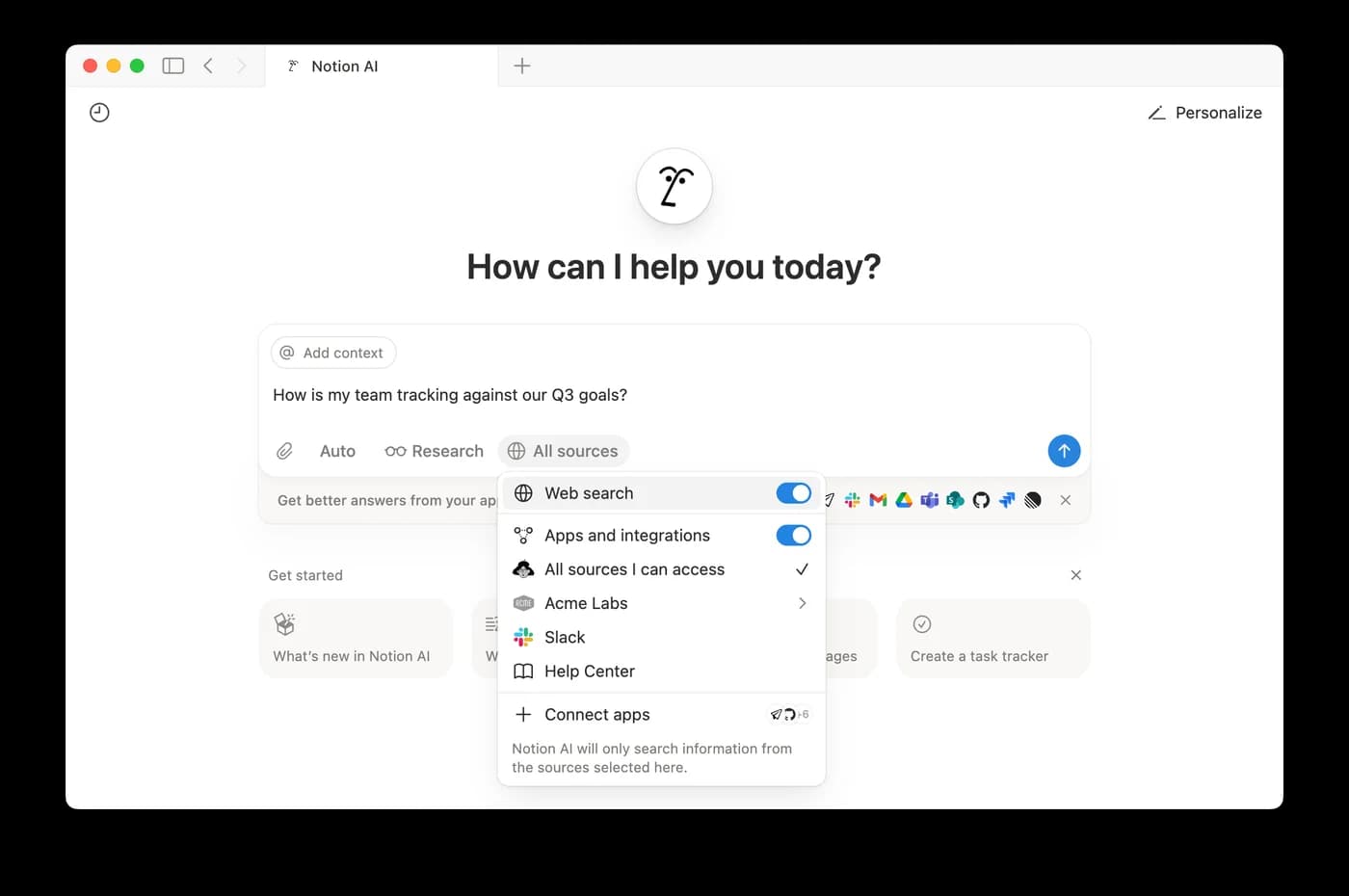
Notion’s pages and databases give information a structure you can maintain directly. Notion AI works within that environment, with documented capabilities including writing assistance, search, meeting notes and agents. That makes it relevant when the information you need is already part of a document or shared workspace.
Gemora begins with conversation and personal context. You can talk through an unclear idea before deciding whether it should become a note, reflection, project or task. This can suit people who want less structure at the start of a thought, while still wanting somewhere to keep the outcome.
Personal memory and workspace knowledge
A document workspace and a personal memory system solve overlapping but different retrieval problems. In Notion, the page, database and access permissions provide an explicit structure for knowledge. In Gemora, remembered personal context can support later conversations alongside the notes and projects you deliberately save.
For example, a team handbook needs shared ownership and a clear source of truth. A changing personal goal may need room for uncertainty, reflection and revision. Choose the structure that fits the information; do not turn “conversation-first” into a claim that structured pages are unnecessary.
Journaling, projects and collaboration
Notion can be used for journaling through pages and templates. If you already like that routine, AI assistance can fit into it without moving your history. Gemora offers conversational journaling: begin with what happened, explore it through conversation, and preserve the reflection in a personal workspace.
For a shared project with databases, documentation and collaborators, Notion’s workspace model is the more direct match. For a personal project whose decisions emerge from ongoing conversations, Gemora can help keep the discussion, notes and next actions connected. Gemora is not being recommended here as a complete replacement for a team document system.
Privacy: compare the controls you will actually use
A useful personal AI needs context, but you should decide which parts of your life belong in it. In Gemora, review saved memories, correct details that have changed, and remove context you no longer want used. A saved note and a memory used for personalization serve different purposes; check both when cleaning up personal information.
Before moving an existing history, try the same low-risk detail in each product. Ask what was remembered, correct it, then test the removal controls. Review the provider’s current policy for retention, model training, connected apps and account deletion. A private workspace does not, by itself, establish end-to-end encryption or prove one provider is safer than another.
Pricing: compare the complete workflow
Start with the task you need to complete, then check which plan includes the required memory, tools and usage allowance. A subscription name alone tells you little about limits, platform differences or regional availability. Gemora’s current plans are listed on its pricing page; use the competitor’s live pricing or in-app checkout for its current offer.
Try a small recurring workflow before paying: revisit a decision a few days later, find the original context, and turn the result into something useful. Compare how much setup and correction each tool requires. This article does not treat remembered prices or an “unlimited” label as a guarantee of unrestricted usage.
View Gemora pricingWhich should you choose?
Choose Notion AI if you want AI assistance where your structured work already happens. Choose Gemora for personal conversation, memory and reflection. Using both can also make sense: keep shared documents in the system your team uses and keep your individual thinking in a personal workspace.
Official sources
Product information reviewed October 4, 2026. Features, usage limits and availability can change. Product images belong to their respective owners.