personal context layer for AI
What Is a Personal Context Layer for AI? A Practical Guide for 2026
Learn what a personal context layer for AI is, how it differs from memory, chat history, profiles, and RAG, and why user control and portability matter.
Methodology: The definition synthesizes current memory, retrieval, portability, provenance, and connected-data patterns without treating the phrase as a formal standard.
Original contribution: A seven-part model covering stable facts, time, relationships, active situations, history, connected data, and control.

In this guide
- Is “personal context layer” an official AI industry term?
- Why AI needs a personal context layer
- The problem with putting all context inside the prompt
- What information belongs in a personal context layer?
- Personal context layer vs AI memory
- How a personal context layer works
- Why time is one of the hardest parts
- Why relationships are another hard problem
- Why context portability matters
- Model-specific memory vs a model-independent context layer
- What does a good personal context layer need?
- The privacy problem is not optional
- What should not be stored?
- What could a personal context layer make possible?
- Why the model is becoming less important than the context around it
- Where Gemora fits
- What a user-owned personal context layer could look like
- Challenges a real personal context layer still has to solve
- The future: from AI accounts to personal AI context
- Final answer
Related reading: memory vs history · apps with recall · long-term assistants · memory controls.
A personal AI becomes more useful when conversations can build on relevant context instead of starting from zero every time. Source: Gemora.
A normal AI knows a lot about the world.
It may know how to explain quantum computing, write Python, compare laptops, plan a trip, summarize a contract, or suggest ten ways to cook a potato because apparently humanity had not suffered enough.
But when the question is about you, intelligence alone is not enough.
Consider this prompt:
“Should I take the job?”
A powerful model can give you a generic framework.
It can compare salary, career growth, commute, culture, risk, and opportunity.
But the useful answer depends on context the model may not have:
- You told another AI three months ago that you wanted to leave management.
- Your current job has been exhausting you.
- The new company pays more but requires relocation.
- Your partner cannot easily move.
- You previously said stability matters more to you this year.
- You have been saving money to build your own product.
- Last week, you said your priorities might be changing.
The model does not need to become smarter at economics.
It needs the right context about you.
That is the problem a personal context layer is meant to solve.
The short definition
A personal context layer for AI is a persistent, user-controlled layer of information that helps AI systems understand relevant context about a person across conversations, time, data sources, and potentially different AI models or applications.
It can include things such as:
- preferences,
- goals,
- ongoing situations,
- people and relationships,
- past conversations,
- projects,
- decisions,
- routines,
- files,
- connected app data,
- meaningful events,
- and how those things change over time.
The important part is not simply storing information.
The layer has to decide:
What does this AI need to know about me right now to respond more usefully?
That makes a personal context layer different from a static profile, a chat archive, or a giant database of everything you have ever done.
It is closer to shared context that can follow the user.
Is “personal context layer” an official AI industry term?
Not yet in the sense of a universally standardized technical specification.
Different companies currently use different language:
- OpenAI talks about memory, past chats, custom instructions, files, and other personalization sources.
- Google uses terms including Personal Context, Memory, and Personal Intelligence.
- Anthropic exposes Memory Topics, chat search, project context, and memory import/export.
- Other products use phrases such as personal memory, user profile, knowledge graph, second brain, long-term memory, or personalization.
So “personal context layer” is best understood as an architectural concept that describes what these systems are increasingly converging toward.
The category is broader than any one memory feature.
That matters because the future personal AI problem is not simply:
“Can this chatbot remember my favorite food?”
It is:
“Can an AI access the right part of my context, understand whether it is still true, know where it came from, and use it when it helps?”
That is a context-layer problem.
Why AI needs a personal context layer
Large language models are extremely capable at general reasoning.
But most prompts do not contain enough information for a truly personal answer.
Take a simple question:
“Where should I go on vacation?”
Without personal context, an AI might ask:
- What is your budget?
- Where are you located?
- Do you prefer cities or nature?
- Are you traveling alone?
- How long is the trip?
- What places have you already visited?
- Do you like nightlife?
- Do you hate heat?
- Do you have children?
- Do you need a visa?
- What dates work?
All reasonable questions.
Also a fairly tedious way to begin every conversation.
Now imagine the AI already has relevant context:
- you usually travel with your partner,
- you prefer quiet places over nightlife,
- you went to Japan last year,
- your next trip is seven days,
- your budget is moderate,
- you dislike very hot weather,
- and your calendar shows one available week in October.
The model did not become more intelligent.
The answer became more useful because the context improved.
This is why personalization is becoming such a large part of consumer AI.
OpenAI describes memory as helping future ChatGPT conversations begin from shared context rather than from scratch. Google says Gemini's Personal Intelligence can combine information from past chats and connected apps to provide uniquely tailored answers.
The problem with putting all context inside the prompt
The earliest form of personal AI context was brutally simple:
copy everything into the prompt.
People created giant instructions like:
“Here is who I am. I am 24. I live in Hanoi. I am building a startup. I prefer concise answers. These are my goals. These are my current projects. These are the people in my life…”
Then they pasted it into every new conversation.
This works.
It is also ridiculous at scale.
A user should not have to maintain a 14-page autobiographical README just to stop an AI from forgetting the basics.
There are several problems.
The prompt becomes too long
More context is not always better.
If you dump hundreds of old facts into every request, the model has to distinguish useful context from noise.
The information relevant to:
“Help me prepare for tomorrow's investor call.”
is very different from the information relevant to:
“Where should I go for dinner tonight?”
A context layer should retrieve only what is relevant.
Context becomes stale
A giant profile may say:
“The user is preparing to launch in October.”
After October, that statement is no longer current.
Static context accumulates contradictions.
Modern memory systems are increasingly designed around freshness for exactly this reason. OpenAI's 2026 memory work explicitly focuses on continuity, correctness, and staying current over time.
Users repeat themselves across different AI apps
Even if one chatbot understands you well, another one usually starts from zero.
You explain your background to ChatGPT.
Then again to Claude.
Then again to Gemini.
Then again to a specialized coding or travel assistant.
Humans apparently looked at the problem of repeating onboarding forms and decided AI should recreate the experience conversationally.
A model-independent personal context layer could reduce that duplication.
What information belongs in a personal context layer?
A useful context layer is not one giant biography.
It contains different kinds of context with different lifetimes, confidence levels, sources, and privacy requirements.
A practical model has at least seven categories.
1. Stable personal context
This is information that changes relatively slowly.
Examples:
- preferred language,
- general location,
- profession or field,
- communication preferences,
- recurring accessibility needs,
- dietary preferences,
- tools you regularly use,
- broad interests.
For example:
“The user prefers concise explanations with concrete examples.”
That might remain useful for months.
Stable context is similar to what many products currently handle through profiles, custom instructions, or saved memories.
OpenAI explicitly recommends Custom Instructions for durable preferences such as role, tone, and output style.
2. Temporal context
Some information is useful only during a particular period.
Examples:
- an upcoming trip,
- a launch next month,
- current exam preparation,
- a job search,
- recovering from a temporary disruption,
- planning an event,
- a short-term goal.
Temporal context needs a time dimension.
Compare:
“The user is traveling to Singapore.”
with:
“The user is traveling to Singapore from October 10 to October 17, 2026.”
The second statement can naturally become historical after the trip.
This matters because a personal AI that never understands time eventually becomes an enthusiastic expert on your obsolete life.

Without relevant personal context, even a strong model may produce a generic answer. Source: OpenAI.

The same model becomes more useful when relevant preferences and past context are available. Source: OpenAI.
3. People and relationship context
A large part of real life makes no sense without understanding who people are.
A user might say:
“She texted me again.”
That message is almost context-free unless the AI understands who “she” probably refers to and why that interaction matters.
Relationship context might include:
- names,
- roles,
- how people are connected,
- important shared history,
- current situations,
- boundaries,
- and changes in relationships.
This information should be handled carefully because it can be highly personal.
But when the user explicitly wants an AI to help across everyday life, relationship context is often much more useful than trivia such as a favorite color.
4. Ongoing goals, projects, and situations
Many important conversations are not one-off questions.
They unfold.
Examples:
- building a company,
- applying to university,
- learning a language,
- preparing for a marathon,
- moving to another country,
- changing careers,
- planning a wedding,
- resolving a long-running technical problem.
A personal context layer should know the current state, not only the historical facts.
For a project, that might mean:
- goal,
- current stage,
- important decisions,
- constraints,
- next steps,
- unresolved questions,
- recent changes.
Claude's project-specific memory is one current example of separating context by workstream rather than mixing everything into one global profile.
5. Conversation history and derived memory
Past conversations are an important source of context.
But raw transcripts and memory are not the same thing.
A transcript contains everything.
A derived memory contains what the system currently believes may matter later.
OpenAI's newer ChatGPT memory system synthesizes context from previous chats rather than depending only on a small manual list of saved memories.

ChatGPT's Memory Summary is a human-readable view into a broader synthesis of context from past conversations. Source: OpenAI.
A context layer ideally keeps both concepts available:
raw history for exact retrieval
and
derived context for efficient personalization.
That way the AI can know:
“The user is considering leaving their job.”
without injecting five complete 4,000-word conversations into every prompt.
6. Connected personal data
Some useful context never appeared in a chatbot conversation.
Your calendar may know when you are free.
Your email may contain the hotel you booked.
Your photos may show where you went last year.
A notes app may contain ideas you never discussed with AI.
Your task manager may know what remains unfinished.
Google's Personal Intelligence is one of the clearest mainstream demonstrations of this broader context model.
With permission, Gemini can use information from connected products such as Gmail, Photos, YouTube, and Search alongside previous Gemini conversations.
That moves personalization beyond chatbot memory.
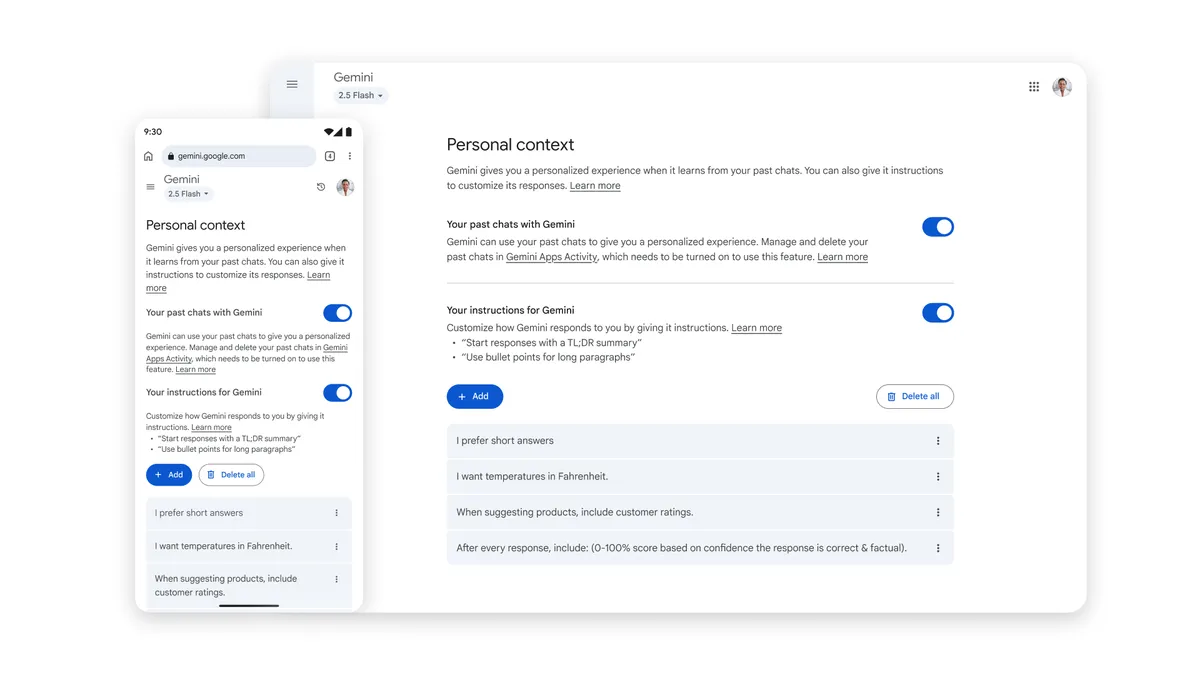
Gemini Personal Context settings (source image)
Gemini's Personal Context settings allow past conversations to contribute to future personalization. Source: Google.
A true context layer may eventually sit above many sources:
Past conversations
      +
Files and notes
      +
Calendar
      +
Email
      +
Projects and tasks
      +
User preferences
      +
People and relationships
      +
Current life state
      ↓
PERSONAL CONTEXT LAYER
      ↓
Relevant context for the current request
      ↓
AI model
The model only receives the subset that is useful and permitted for that interaction.
7. Provenance, confidence, and user control
This is the part people forget when they imagine “AI that knows everything about me.”
Every piece of personal context should ideally answer questions such as:
- Where did this information come from?
- When was it true?
- How confident is the system?
- Can the user correct it?
- Is it sensitive?
- Which apps or models are allowed to use it?
- Should it expire?
- Has a newer fact replaced it?
Without those controls, personalization turns into an accumulating pile of confident assumptions.
Modern AI products are already moving toward provenance.
ChatGPT's Memory Sources can show whether personalization came from past chats, saved memory, custom instructions, files, or connected Gmail in supported plans and regions.

ChatGPT can expose some of the sources that contributed personal context to an answer. Source: OpenAI.
Claude takes another approach by exposing remembered information as editable Topics.
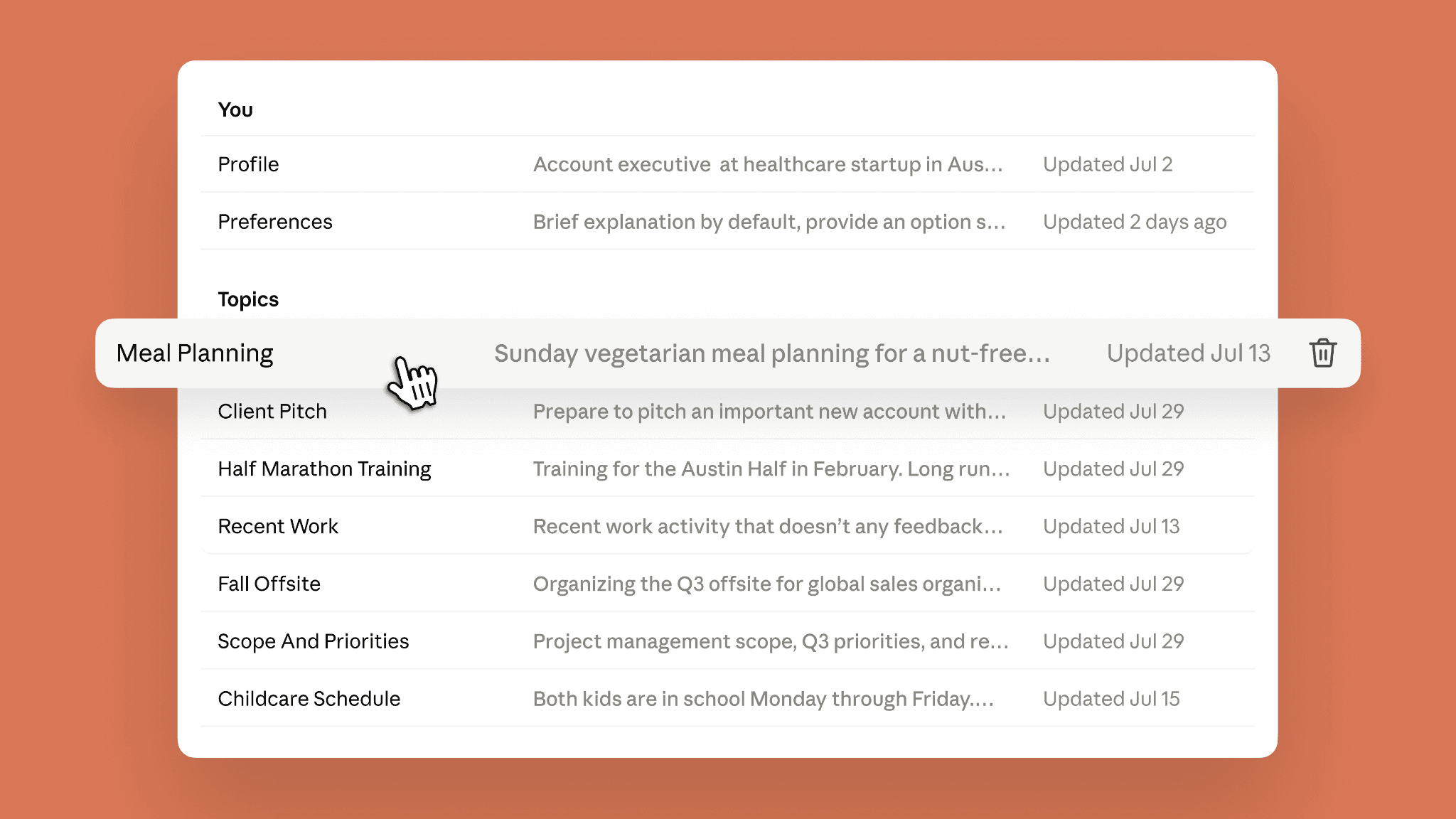
Claude lets users inspect remembered context as individual Topics rather than hiding everything behind one opaque profile. Source: Anthropic.
A personal context layer needs this kind of control even more if multiple AI systems can access it.
Personal context layer vs AI memory
These concepts overlap, but they are not identical.
AI memory
Memory usually means information retained from previous interactions so the same AI can use it later.
Examples:
- ChatGPT remembering preferences,
- Claude remembering project facts,
- Gemini learning from past chats,
- Pi remembering recurring personal details.
Memory is one input to a broader context system.
Personal context layer
A personal context layer can include memory plus:
- explicit profile information,
- active goals,
- project state,
- relationship context,
- files,
- connected apps,
- calendar state,
- imported context from another AI,
- source metadata,
- permissions,
- and time-aware updates.
So:
Memory asks: What should this AI remember?
A personal context layer asks:
What relevant context should any authorized AI have access to right now?
That is a much larger problem.
Personal context layer vs chat history
Chat history is the raw archive.
A context layer is the system that decides what part of that archive matters now.
Imagine you have 2,000 AI conversations.
You ask:
“Why do I keep changing my mind about this?”
Giving the model all 2,000 conversations would be absurd.
Searching for one keyword may also miss the pattern.
A context layer could instead retrieve:
- the most relevant conversations,
- previously derived themes,
- timeline changes,
- the people involved,
- and your current stated goal.
That is the difference between storage and contextual retrieval.
Personal context layer vs Custom Instructions
Custom Instructions are useful.
They are also static.
They work well for information such as:
“I prefer concise answers.”
“I am a software engineer.”
“Use metric units.”
A personal context layer also needs information that changes.
For example:
“I am deciding whether to hire someone this month.”
That should not become a permanent instruction applied to every conversation for the next five years.
Custom Instructions are one source.
The context layer is the broader system deciding how several sources combine.
Personal context layer vs user profile
A user profile is typically a set of attributes.
For example:
Name: Maya
Location: Bangkok
Role: Designer
Language: English
Useful.
But painfully incomplete.
A context layer also models state and history:
Current project:
Redesigning onboarding.

Recent change:
Deadline moved from September to November.

Ongoing concern:
User research repeatedly shows confusion at step 3.

Preference:
Prefers rapid prototypes before detailed specs.

Relevant person:
Sam is the product manager for this project.
Profiles describe a person.
Context explains what is happening around them now.
Personal context layer vs RAG
RAG stands for retrieval-augmented generation.
A RAG system retrieves relevant information and gives it to a model before generating a response.
A personal context layer may use RAG internally.
But they are not the same thing.
RAG describes a technical retrieval pattern.
A personal context layer describes a user-level system that also needs:
- identity,
- time,
- permissions,
- updates,
- provenance,
- conflict resolution,
- personalization policy,
- and portability.
You could build a basic RAG system over every message a user has ever written.
That would not automatically create a good personal context layer.
It might simply create an incredibly efficient way to retrieve irrelevant old opinions.
Personal context layer vs a “second brain”
Second-brain products are generally designed for you to retrieve information.
A personal context layer is designed for AI to retrieve the right context about you when assisting you.
There is overlap.
Notes, documents, bookmarks, and personal knowledge bases can absolutely feed the context layer.
But the purpose differs.
A second brain answers:
“Where did I save that?”
A personal context layer helps answer:
“Which part of what I know about this user changes how I should respond?”
How a personal context layer works
The exact implementation can vary, but a useful architecture usually follows a loop.
Step 1: capture
Context enters from permitted sources.
Examples:
- conversation,
- explicit user input,
- imported memory,
- files,
- calendar,
- email,
- tasks,
- connected services.
Not everything should automatically become permanent context.
Capture is only the beginning.
Step 2: normalize
The system converts raw information into usable structures.
For example:
Raw conversation:
“I used to think I wanted to move to New York, but lately I would rather stay close to my family.”
Derived context might become:
Topic: relocation preference
Previous preference: New York
Current preference: stay near family
Updated: September 2026
Confidence: medium
Source: conversation 1842
The temporal relationship matters as much as the facts.
Step 3: resolve conflicts
Context will contradict itself.
That is normal.
A user may say:
“I hate running.”
Then six months later:
“I have really started enjoying running.”
The system should not confidently preserve both as equally current truth.
It needs rules around:
- recency,
- explicit corrections,
- confidence,
- source authority,
- and temporal validity.
Step 4: retrieve
When the user asks something, the system determines what context is relevant.
Prompt:
“What should I do this weekend?”
Potentially relevant:
- current location,
- weather preference,
- calendar availability,
- hobbies,
- people the user might be with,
- recent conversations about needing rest.
Probably irrelevant:
- preferred programming language,
- a restaurant visited four years ago,
- the operating system of the user's old laptop.
Retrieval quality is the heart of personalization.
Step 5: assemble
The relevant context is converted into a compact representation the AI model can use.
The model should not need direct access to the entire personal database.
It should receive enough context for this request.
Step 6: generate
The model responds using:
- the user's current prompt,
- general world knowledge,
- tools when needed,
- and the selected personal context.
Step 7: update
The interaction may create new context.
Perhaps the user corrects something:
“Actually, I no longer want to move.”
Or makes a decision:
“I accepted the job.”
The layer updates the current state.
That creates a loop:
Conversation
     ↓
Capture
     ↓
Normalize
     ↓
Store with time + source + permissions
     ↓
Retrieve relevant context
     ↓
AI response
     ↓
New information / correction
     ↓
Update context
The system becomes useful not because it remembers everything, but because it maintains a living model of what matters.
Why time is one of the hardest parts
Personal context is not a bag of facts.
It is a timeline.
Consider these statements:
January: “I want to raise funding.”
March: “I think distribution matters more than fundraising right now.”
June: “We finally have enough traction to speak to investors.”
All three can be true.
A poor memory system may compress them into:
“The user wants to raise funding.”
Technically correct.
Contextually weak.
A better layer understands:
- what was true,
- when it was true,
- what changed,
- and what appears current.
This is why personal context is different from remembering trivia.
The useful question is often not:
“What do you know about me?”
It is:
“What changed?”
Why relationships are another hard problem
Relationships are dynamic too.
Imagine an AI sees hundreds of photos of a user at golf courses.
It might infer:
“The user loves golf.”
Google publicly uses almost exactly this kind of example when discussing over-personalization: perhaps the user does not love golf at all and only goes because their son does.
That illustrates a fundamental context problem.
Data without meaning can create bad personalization.
A personal context layer should distinguish:
Observation: user often appears at golf courses.
Possible inference: user may like golf.
Known context: user's son plays golf.
User correction: user does not personally enjoy golf.
The correction should override the weak inference.
Otherwise the system becomes a machine for confidently misunderstanding coincidences.
Why context portability matters
Today, most personal AI context is trapped inside the product that collected it.
You spend one year talking to one assistant.
It learns:
- how you work,
- what you care about,
- who matters in your life,
- your projects,
- your preferences,
- the decisions you made.
Then you try another AI.
It knows none of that.
This creates a new kind of lock-in.
Not because your files cannot be exported.
Because your context cannot easily follow you.
Google's 2026 Gemini import tools are an important sign that the industry is beginning to recognize the problem.
Gemini can import a structured memory summary generated by another AI service.
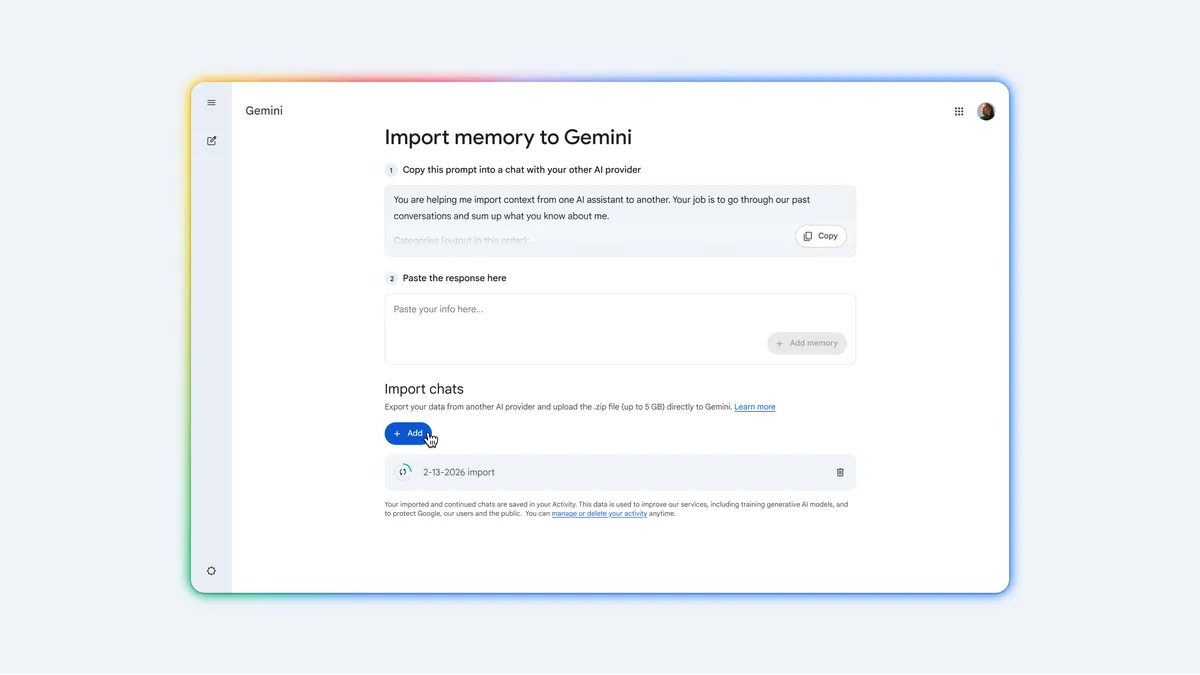
Gemini Import Memory (source image)
Gemini's memory import flow lets users bring key preferences, relationships, and personal context from another AI service. Source: Google.
Google also introduced full chat-history import.
Gemini Import Chat History (source image)
Gemini can import a ZIP archive of previous AI conversations, preserving more of the source history behind a user's context. Source: Google.
This is still provider-specific migration.
A stronger long-term model would be user-owned personal context that multiple authorized AI systems can access.
Model-specific memory vs a model-independent context layer
This distinction may become increasingly important.
Model-specific memory
Today, the normal architecture looks like:
ChatGPT conversations → ChatGPT memory → ChatGPT

Claude conversations → Claude memory → Claude

Gemini conversations → Gemini memory → Gemini
Each assistant builds its own understanding.
The user effectively has several different digital versions of themselves.
One knows about work.
One knows about personal conversations.
One knows travel preferences.
One knows almost nothing because the user started using it yesterday.
Model-independent personal context
A different architecture would look like:
                 ┌───────────────┐
ChatGPT ────────→│               │
Claude ─────────→│ PERSONAL      │
Gemini ─────────→│ CONTEXT       │
Other AI ───────→│ LAYER         │
                 │               │
                 └───────┬───────┘
                         │
             User-controlled context
                         │
          ┌──────────────┼──────────────┐
          ↓              ↓              ↓
       ChatGPT         Claude         Gemini
The same user-owned layer could provide appropriate context to different models.
Not every model would get everything.
Permissions could determine which categories are available.
For example:
Coding assistant:
Projects + technical preferences

Travel assistant:
Travel history + budget + calendar

Everyday personal AI:
Relationships + goals + conversations + current life context

Shopping assistant:
Sizes + preferences + purchase constraints
The context remains centered on the user rather than on one model provider.
Is this the same as an “AI passport”?
The phrase AI passport is one useful metaphor for portable personal context.
A passport does not contain your entire life.
It contains a structured identity that can travel between systems.
An AI-context equivalent could eventually include:
- stable preferences,
- identity information the user chooses to share,
- important relationships,
- current goals,
- long-running projects,
- relevant history,
- communication preferences,
- and links back to richer private context.
The user could authorize:
“Let this assistant use my travel preferences.”
without necessarily giving it:
“Every private conversation I have ever had.”
That selective permission model is important.
A personal context layer should not mean one enormous global memory that every AI can casually inspect.
That would be less “personal assistant” and more “privacy disaster with excellent autocomplete.”
What about MCP?
Model Context Protocol, or MCP, solves a related but different problem.
MCP is primarily about giving AI systems a standardized way to connect to tools and data sources.
A personal context layer is about maintaining a structured, evolving understanding of the user and deciding what context is appropriate for a given interaction.
MCP could help an AI access a personal context service.
But MCP itself does not decide:
- which facts matter,
- what changed,
- which memory is current,
- how relationships connect,
- what is sensitive,
- or what an AI is allowed to know.
Think of it this way:
MCP can be a pipe.
The personal context layer is what lives behind the pipe.
What does a good personal context layer need?
If this category matures, several capabilities will matter more than raw storage.
Relevance
The layer should retrieve the right context, not simply more context.
Freshness
Old information should update or expire.
Temporality
The system should understand when something was true.
Provenance
Users should be able to understand where important context came from.
Correctability
Users need a way to say:
“That is wrong.”
and have the correction actually propagate.
Permissioning
Different apps should receive different context.
Portability
Users should be able to move context between products.
Separation
Work, personal life, health, finances, and other areas may require different boundaries.
Deletion
Removing context needs to be practical and understandable.
Graceful uncertainty
The system should be able to represent:
“I think this may be true.”
instead of turning every inference into a permanent fact.
The privacy problem is not optional
The more useful a personal context layer becomes, the more sensitive it can become.
That creates an uncomfortable truth:
the best personalization requires access to exactly the kind of information users should be careful about sharing.
A context layer may know:
- relationships,
- locations,
- goals,
- fears,
- work information,
- personal history,
- plans,
- routines,
- financial constraints,
- and private conversations.
So privacy cannot be added later as a settings page with three toggles and a heroic padlock illustration.
It has to be part of the architecture.
At minimum, users should understand:
- what is stored,
- where it came from,
- who can access it,
- what is being sent to an AI model,
- how to correct it,
- how to delete it,
- and whether it can be exported.
Google makes connected Personal Intelligence opt-in and lets users choose which apps to link. It also acknowledges that over-personalization and incorrect inferences remain real limitations.
ChatGPT provides Temporary Chats, memory controls, source visibility, and ways to remove or correct remembered context.
Claude exposes individual memory topics and separate incognito-style controls.
These are early versions of the governance a true context layer needs.
What should not be stored?
Not everything useful in one conversation should become durable context.
Imagine asking:
“Help me write a murder-mystery story.”
The AI should not conclude:
“User has an enduring interest in homicide.”
Sometimes a conversation is exploratory.
Sometimes a user is asking for someone else.
Sometimes a preference is temporary.
Sometimes the safest design is not to retain information at all.
A context layer therefore needs a retention policy, not merely storage.
Possible classes include:
Ephemeral
Useful only for the current conversation.
Session
Useful while working on a specific task.
Temporary
Useful for days or weeks.
Long-term
Stable preferences or ongoing context.
Explicit-only
Stored only when the user deliberately asks.
Never store
Sensitive categories or information the user excludes.
This is another reason a single vector database is not a complete personal-context architecture.
What could a personal context layer make possible?
The interesting part is not the architecture.
It is what changes for the user.
Use case 1: conversations that actually continue
Today:
“I am worried about my startup.”
Three weeks later:
“Remember I told you I was worried about distribution? The app finally launched.”
A context layer can make the second conversation feel like a continuation rather than another intake form.
This is the personal-conversation use case Gemora is centered around.
Gemora is designed around everyday conversations remaining connected to the days and situations around them. Source: Gemora.
Use case 2: decisions with history
Suppose you are choosing whether to move.
The AI could understand:
- why you considered moving before,
- what changed,
- which cities you already rejected,
- what your partner prefers,
- your budget,
- and your current priorities.
The answer becomes less:
“Here are the pros and cons of moving.”
and more:
“The tradeoff you keep returning to is career opportunity versus staying close to family.”
That is a different quality of assistance.
Use case 3: personal search without remembering keywords
Humans often remember context, not exact words.
You may think:
“What was I worried about around the time I launched the app?”
A personal context layer could retrieve information by:
- time,
- event,
- person,
- project,
- emotion,
- or semantic similarity.
Not only keyword search.

Personal context can make old moments easier to rediscover without knowing the exact chat title or keyword. Source: Gemora.
Use case 4: noticing patterns
A user may not realize that the same problem keeps appearing.
Across several months, the context layer may surface:
“You tend to question this project after periods of poor sleep.”
or:
“Most of your conversations about changing jobs happen after conflict with the same manager.”
Those observations need to be presented carefully.
Correlation is not causation.
But longitudinal context can reveal patterns that one conversation cannot.

Longitudinal personal context makes it possible to look for patterns and changes across time instead of treating each conversation as isolated. Source: Gemora.
Use case 5: one context across several models
One model may be better for code.
Another may be better for writing.
Another may have stronger real-time search.
Another may simply be cheaper.
Users increasingly switch between AI models.
The annoying part is that personal context usually does not switch with them.
A model-independent layer could let users choose the best model for a task without giving up continuity.
That changes the relationship between the user and the model provider.
Today:
The context belongs to the product.
Future possibility:
The context belongs to the user.
Use case 6: assistants that know when not to ask
Good personalization can remove repetitive questions.
A travel assistant that knows:
- where you live,
- your budget range,
- your usual travel companion,
- your past destinations,
- and your dietary constraints
does not need to interview you from zero.
A work assistant that understands:
- your role,
- active project,
- current deadline,
- team structure,
- and preferred output format
can begin closer to the actual task.
The goal is not maximum context.
It is minimum unnecessary repetition.
Why the model is becoming less important than the context around it
This claim should not be exaggerated.
Models still matter enormously.
Reasoning quality matters.
Latency matters.
Tool use matters.
Reliability matters.
But as strong models become more widely available, personalization creates another axis of competition.
Imagine two assistants using similarly capable models.
Assistant A knows nothing about you.
Assistant B understands:
- your project,
- your priorities,
- your constraints,
- what you tried last week,
- and what changed yesterday.
Even if the underlying intelligence is similar, the second assistant can feel dramatically better.
This is one reason OpenAI, Google, and Anthropic are all investing heavily in memory and personalization.
The model answers the question.
The context determines which answer is useful for you.
Where Gemora fits
Gemora's core thesis is not that memory itself is a product.
Memory is infrastructure.
The user-facing value is continuity around everyday life.
Gemora is built around talking through:
- thoughts,
- people,
- relationships,
- goals,
- work,
- decisions,
- stress,
- ordinary days,
- and the things that keep coming back.
The useful part is not:
“Gemora stored 847 memories.”
It is:
“I can return tomorrow without the conversation feeling disconnected from yesterday.”
Over time, those conversations can also make it easier to:
- revisit moments,
- understand changes,
- notice recurring themes,
- and continue situations that unfold across weeks or months.
That is why the broader idea of a personal context layer matters to Gemora.
The long-term opportunity is larger than building a better memory feature inside one chatbot.
It is creating context that remains centered on the user rather than trapped inside a single conversation or model.
That direction can be summarized as:
Talk → context accumulates → relevant context returns → understanding improves.
Not:
Talk → save everything → hope the database is impressed.
Is Gemora already a universal cross-model context layer?
No.
That distinction matters.
Gemora's current product is centered on personal AI conversations and continuity around everyday life.
A fully portable, model-independent personal context layer is a broader architectural direction.
It would require things such as:
- standardized context representation,
- model/provider integrations,
- import and export,
- fine-grained permissions,
- source tracking,
- conflict resolution,
- privacy controls,
- and reliable synchronization.
The category is moving in that direction.
Google's memory and history import is one example. Claude's memory import/export is another. ChatGPT's growing Memory Sources show how context is already expanding beyond chat into files and connected apps.
Calling that future layer finished today would be marketing cosplay.
The interesting part is that the pieces are visibly appearing.
What a user-owned personal context layer could look like
Imagine a settings page with categories such as:
Your context

Identity
✓ Basic profile
✓ Languages
✓ Communication preferences

Life
✓ Goals
✓ People and relationships
✓ Important events
✓ Ongoing situations

Work
✓ Projects
✓ Work preferences
✓ Active tasks

Sources
✓ Gemora conversations
✓ Imported ChatGPT history
✓ Calendar
✓ Notes
○ Gmail
○ Photos

AI access
ChatGPT: Work + general preferences
Claude: Work + projects
Gemini: Travel + calendar
Gemora: Personal life + reflections + goals
The user controls the layer.
The models become consumers of authorized context.
That would invert today's default.
Instead of:
“OpenAI owns my ChatGPT memory.”
“Google owns my Gemini memory.”
“Anthropic owns my Claude memory.”
the system moves toward:
“I own my context, and I decide which AI can use which parts.”
That is the larger idea behind portable personal AI.
Challenges a real personal context layer still has to solve
The concept sounds clean.
Implementation is not.
Humans are inconveniently dynamic.
Identity resolution
If a user says:
“Sam”
is that:
- their friend Sam,
- their coworker Sam,
- Sam Altman,
- or a dog with terrible naming luck?
The system needs entity resolution.
Contradictions
People change their minds.
The system needs temporal and confidence-aware conflict handling.
Sensitive context
Some categories need stricter retention and permission rules.
False inference
The system may infer something from behavior that is not actually true.
Context pollution
One domain may contaminate another.
A joke in a roleplay conversation should not become part of a professional profile.
Retrieval quality
Having the information is useless if the system cannot retrieve the right part.
Cost and latency
Searching a large personal context graph on every interaction can become expensive and slow.
Vendor interoperability
Different AI providers represent context differently.
Deletion semantics
If a user deletes a memory, what happens to:
- summaries derived from it,
- embeddings,
- connected sources,
- cached prompts,
- and downstream interpretations?
“Delete” becomes a surprisingly complicated verb.
Trust
Users need to believe the AI is using context appropriately.
A response that references something private at the wrong moment can feel creepy even if the user technically gave permission.
Good personalization includes knowing when not to personalize.
The future: from AI accounts to personal AI context
Today, your relationship with AI is mostly account-based.
Your ChatGPT knows one version of you.
Your Gemini knows another.
Your Claude knows another.
Specialized apps each build their own context.
That mirrors the early internet, where every service maintained its own isolated user profile.
A more mature personal-AI ecosystem could separate three layers:
1. MODEL LAYER
Reasoning, generation, intelligence

2. TOOL LAYER
Search, calendar, email, code, commerce, actions

3. PERSONAL CONTEXT LAYER
Who the user is, what matters, what changed, what is relevant
The model could change.
The tools could change.
The personal context could remain.
That is the strategic significance of the category.
It turns context from a feature of one assistant into infrastructure for many assistants.
Final answer
A personal context layer for AI is the layer between you and the model that keeps track of the context needed to make AI genuinely personal.
Not every fact.
Not every message.
Not one giant permanent biography.
The right context at the right time.
It can understand that:
- a preference is stable,
- a trip is temporary,
- a goal changed,
- two conversations are about the same person,
- an old plan is no longer current,
- a file contains useful background,
- a calendar event changes what “tomorrow” means,
- and a new AI should not necessarily require you to explain your life from zero.
Today, most of these capabilities live inside separate products.
ChatGPT has increasingly sophisticated memory synthesis and multiple personalization sources.
Gemini combines past chats with Personal Intelligence and is beginning to import context from other assistants.
Claude makes memory unusually visible and portable.
The next step is larger:
personal context that belongs to the user and can move with them.
That is the difference between an AI that knows the world and an AI that can increasingly understand where you fit inside it.
Your context should become more useful every time you talk. Gemora is built around conversations about everyday life staying connected across time, so the next conversation can start with more understanding than the last. Start talking with Gemora.
Continue the thread
Build context that belongs to you
Connect conversations, useful context, reflections, projects, and tasks in one personal workspace.
Start freeFrequently asked questions
Is personal context layer an official AI term?
No single formal standard defines it. This guide uses the phrase for a user-centered system that supplies relevant, current context to AI tools.
How is a personal context layer different from AI memory?
Memory is one input. A context layer can also include projects, files, relationships, timelines, provenance, permissions, and model-independent portability.
Should a personal context layer store everything?
No. It should minimize sensitive data, preserve provenance, track freshness, and let the user inspect, correct, and remove context.
Sources and further reading
Written by Khai Tran and reviewed under the Gemora Editorial Policy.