best AI companions for talking about everyday life
7 Best AI Companions for Talking About Everyday Life
Compare AI companions for everyday conversations and reflection, including how well they remember people, follow up and maintain useful real-life context.
Methodology: Analysis based on official product documentation and public feature descriptions listed in the sources, reviewed on 2026-11-03.
Original contribution: A real-life conversation comparison centered on ordinary plans, people, follow-up, reflection, and continuity across days.

In this guide
- How this article differs from “real-life conversations, not roleplay”
- Quick answer
- What does “everyday life” actually mean?
- 1. What happened today
- 2. People
- 3. Plans
- 4. Things you are working on
- 5. Small decisions
- 6. Repeated thoughts
- 7. Nothing in particular
- How we ranked the apps
- 1. Gemora: best for keeping everyday life connected over time
- Why Gemora ranks #1 here
- The people in your life are first-class context
- Everyday goals do not need a separate project dashboard
- Recap gives ordinary life a time dimension
- Memories preserve small but useful threads
- Insights can help when ordinary moments add up
- Gemora is not strongest at everything
- 2. Pi: best low-pressure everyday conversation
Related reading: memory vs history · apps with recall · long-term assistants · memory controls.
The hardest test for an AI companion is not a dramatic conversation. It is whether the AI can stay useful through ordinary days, small updates, people, plans, and half-finished threads. Source: Gemora.
Most AI companion demos are strangely dramatic.
The user says:
“I feel lost.”
The companion responds with a thoughtful paragraph.
Or:
“Tell me about our imaginary cabin in the mountains.”
The companion begins roleplay.
Fine.
But most life is not like that.
Most life is:
“Work was annoying today.”
“Sam finally replied.”
“I have no idea what to do this weekend.”
“I think I changed my mind about that thing.”
“My sister's moving next month.”
“I finally submitted it.”
“Nothing happened today. I am just tired.”
Those conversations are less cinematic.
They are also where an everyday AI companion either becomes useful or quietly becomes another chatbot tab.
The best companion for everyday life should not require:
- a crisis,
- a roleplay scenario,
- a productivity project,
- a perfectly framed question.
It should be comfortable with:
the normal middle of life.
That means understanding:
- the people you mention repeatedly,
- plans that move,
- projects that evolve,
- small moments,
- things you are waiting on,
- things that used to matter but no longer do,
- what “it” or “they” refers to without another five-paragraph recap.
In 2026, several products approach this differently.
Gemora is explicitly centered on the people in your life, what you are working toward, what is on your mind, and the ordinary experiences that make up everyday life.
Pi focuses on low-pressure personal conversation and now carries durable memory across chats.
ChatGPT is the strongest general-purpose option, with a much more capable 2026 memory system designed to carry useful context, follow preferences and constraints, and stay current over time.
Gemini combines past-chat memory with Personal Intelligence and selected Google context, making it particularly useful when daily life already exists across Calendar, Gmail, Search, Maps, Photos, and other Google services.
Nomi is more companion-first and relationship-oriented, but its long-term memory and Mind Map architecture make it unusually good at preserving people, places, goals, and ongoing conversational context.
Claude is less of a classic “companion app,” but its new memory system, inspectable Topics, and strong conversational reasoning make it excellent for thoughtful everyday discussion.
Replika remains one of the most recognizable dedicated AI companions and explicitly remembers friends, family, pets, interests, and conversation patterns.
This guide focuses on one narrow question:
Which AI is best when you want to talk about your actual Tuesday?
Not your fictional kingdom.
Not your quarterly strategy deck.
Tuesday.
How this article differs from “real-life conversations, not roleplay”
We have a separate guide to:
Best AI Companions for Real-Life Conversations, Not Roleplay
That article is mainly about conversation style:
- real life vs fictional character interaction,
- naturalness,
- emotional tone,
- whether the AI constantly pushes toward roleplay.
This article is about everyday continuity.
We care more about whether the AI can follow:
Monday:
"I might visit my sister this weekend."

Wednesday:
"Looks like Saturday works."

Friday:
"Any ideas for what we should do?"
without responding:
“Who is your sister?”
That is a different benchmark.
Quick answer
| AI companion | Best for | Everyday-life strength |
|---|---|---|
| Gemora | Best for keeping everyday life connected over time | People + projects + decisions + ordinary days + memories + recap |
| Pi | Best low-pressure everyday conversation | Gentle chat + durable personal memory + minimal setup |
| ChatGPT | Best all-purpose everyday companion | Strong reasoning + broad tools + increasingly capable long-term memory |
| Gemini | Best for daily life connected to Google | Past chats + Calendar/Gmail/Maps/Search/Photos context where available |
| Nomi | Best warm companion with deep relationship-style memory | Long-term memory + Mind Maps + proactive messages |
| Claude | Best for thoughtful everyday conversation | Strong reasoning + editable memory Topics + old-chat retrieval |
| Replika | Best classic daily companion routine | Friends/family memory + companion framing + ongoing conversation history |
Our picks
Best for everyday-life continuity: Gemora.
Best if you just want to talk without turning the conversation into a system: Pi.
Best if you want one AI for both ordinary life and almost everything else: ChatGPT.
Best if your daily life already lives inside Google products: Gemini.
Best if you want a warm, relationship-style companion with unusually deep memory: Nomi.
Best if you want thoughtful conversation and transparent memory control: Claude.
Best if you want the classic dedicated AI companion experience: Replika.
Gemora publishes this comparison and is included in it. We disclose that here because “remembering context” apparently includes remembering who wrote the ranking.
What does “everyday life” actually mean?
It sounds vague until you break it down.
Everyday-life conversation usually falls into seven categories.
1. What happened today
Examples:
“The meeting went better than expected.”
“I missed the train again.”
“Lunch with my friend was nice.”
Small.
Still relevant.
2. People
Examples:
“Sam finally got the role.”
“My sister is visiting.”
“My manager changed the deadline.”
These people become recurring entities.
A useful AI should gradually understand:
- who they are,
- why they matter,
- what is currently happening.
3. Plans
Examples:
“Maybe we will go Saturday.”
“The trip moved.”
“I have to submit this next week.”
Plans expire.
They change.
They become history.
A companion needs time-aware context.
4. Things you are working on
Examples:
- study,
- side project,
- fitness goal,
- startup,
- portfolio,
- house move.
You do not necessarily want “project management.”
Sometimes you just want:
“I finally got this part working.”
The companion should know why that matters.
5. Small decisions
Examples:
“Should I go?”
“Do I actually need to buy this?”
“Should I reply now or wait?”
These are not life-changing.
They are still personal.
6. Repeated thoughts
Examples:
“I keep thinking about changing roles.”
“This keeps coming back.”
The useful part is continuity.
7. Nothing in particular
Sometimes you want to say:
“Nothing happened.”
A companion should survive this.
Not every chat needs:
“Let's unpack that.”
Sometimes:
“That sounds like a quiet day.”
is enough.
A shocking amount of companion design forgets that normal life contains normal days.
How we ranked the apps
We used eight criteria.
1. Everyday Conversation
Can it talk naturally about low-stakes ordinary things?
2. Memory
Does information survive across conversations?
3. People Context
Can it keep recurring people straight?
4. Time Awareness
Does it understand that:
“planning a trip”
eventually becomes:
“took the trip”?
5. Follow-Up
Can it pick up a thread later without a full recap?
6. Practical Help
Can everyday conversation turn into:
- a plan,
- recommendation,
- reminder idea,
- decision support
when needed?
7. Low Friction
Can you just start talking?
8. Control
Can you inspect, correct, delete, or limit memory?
The highest score does not necessarily go to the warmest AI.
Warmth without continuity becomes a very polite goldfish.
1. Gemora: best for keeping everyday life connected over time
Best for
People who want an AI specifically centered on:
- people,
- work/study/goals,
- thoughts and decisions,
- trips,
- ordinary days,
- small moments.
Gemora's current public site organizes its main use cases around exactly these areas:
- The people in your life
- What you're working toward
- What's on your mind
- The life you're living
Source: Gemora
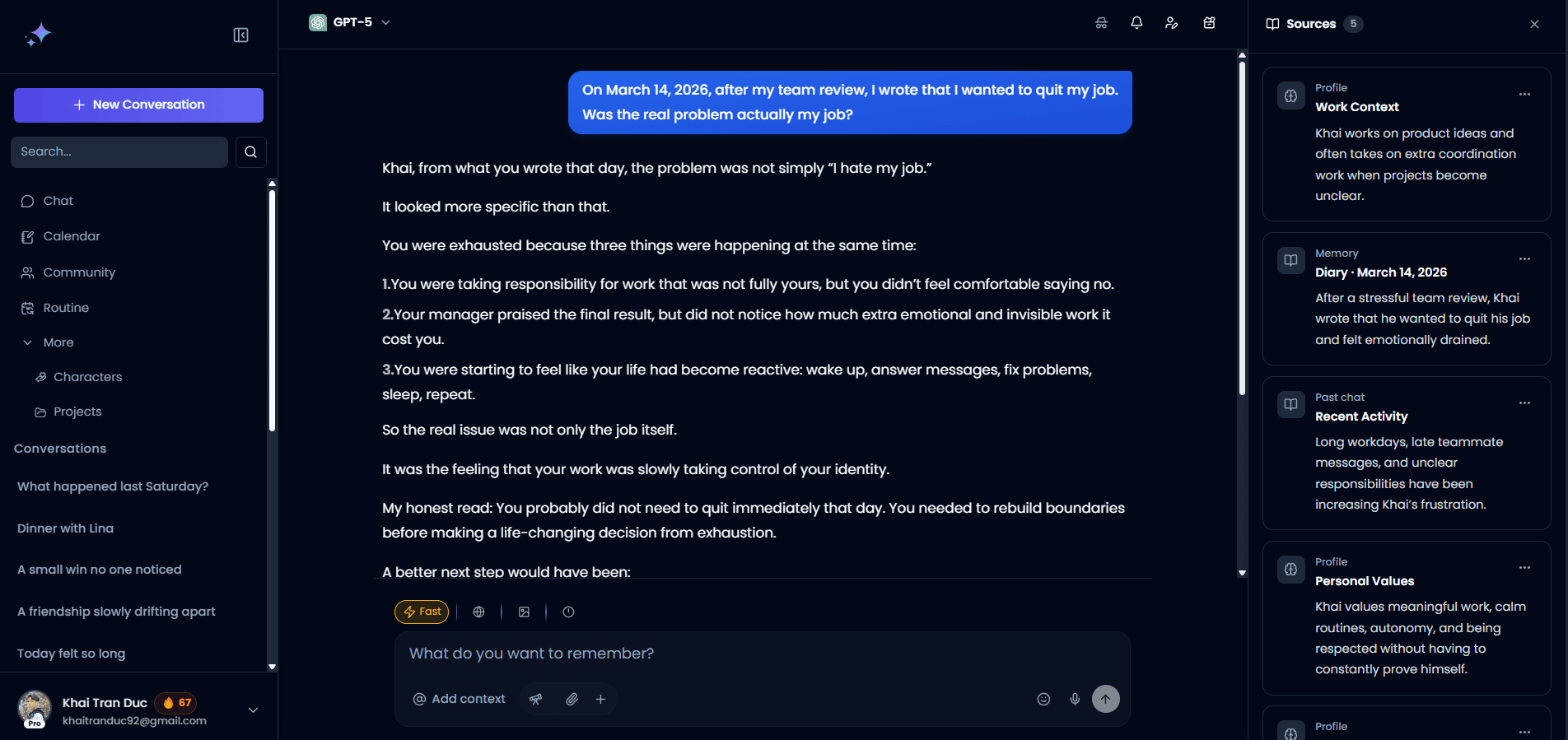
Gemora is explicitly designed around ordinary life context rather than only work, search, or fictional roleplay. Source: Gemora.
That makes it unusually aligned with this exact search intent.
Why Gemora ranks #1 here
Not because it is the publisher.
That would be convenient.
It ranks first because this guide is specifically about:
everyday-life continuity.
Gemora is narrower than ChatGPT.
Less character-driven than Nomi or Replika.
Less ecosystem-connected than Gemini.
But its center of gravity is:
everyday personal context across time.
That is precisely the benchmark.
The people in your life are first-class context
Gemora's current site explicitly includes:
love, family, friendships, and the little things that happen between you and the people who matter.
That matters because everyday conversation is full of pronouns.
“She finally decided.”
“He replied.”
“They are visiting next week.”
A companion becomes dramatically more natural when it knows who those people are.
Everyday goals do not need a separate project dashboard
The site also frames:
- work,
- study,
- goals,
- ambitions
as part of personal conversation.
That is useful because life does not separate cleanly into:
work chatbot
relationship chatbot
travel chatbot
reflection chatbot
You might say:
“The app launch is making me stressed because I also promised my family I would take the weekend off.”
That is one situation.
Not two databases.
Recap gives ordinary life a time dimension
Gemora Recap makes days and periods easier to revisit later. Source: Gemora.
This is particularly important for everyday conversation.
People often remember:
“That happened last Thursday.”
They do not remember:
“It was in New Chat #193.”
Temporal organization makes ordinary life more navigable.
Memories preserve small but useful threads
Gemora Memories gives the system a way to carry selected useful context beyond a single conversation. Source: Gemora.
Useful everyday memories might include:
- sister moving next month,
- current exam period,
- active project,
- dietary preference,
- person you are waiting to hear from,
- decision you plan to revisit.
The goal should not be:
remember every sandwich.
Selective context matters.
Insights can help when ordinary moments add up

Multiple ordinary conversations can become more useful when the system helps connect them across time. Source: Gemora.
One conversation may be trivial.
Ten related conversations may reveal:
something changed.
That is the long-term value.
Gemora is not strongest at everything
If you want:
- advanced web research,
- coding,
- highly technical work,
ChatGPT or Claude is stronger.
If you want:
- explicit romantic companion identity,
- avatar relationship,
- character customization,
Nomi or Replika is more specialized.
If you want:
- Gmail/Calendar/Maps integration at ecosystem depth,
Gemini has the advantage.
Bottom line
Choose Gemora if the main thing you want the AI to understand is the ordinary continuity of your actual life.
The main character is your real life. Gemora is built around the people, projects, moments, plans, and changes you already talk about staying connected over time. Start talking with Gemora.
2. Pi: best low-pressure everyday conversation
Best for
People who want:
“someone” to talk to
without needing:
- characters,
- dashboards,
- workflows,
- heavy setup.
Pi remains unusually good at conversational tone.
Its product identity has always been closer to:
personal conversation
than:
productivity assistant.

Pi's interface and product framing remain focused on low-pressure personal conversation. Source: Pi.
Pi now has durable cross-chat memory
This is a meaningful improvement.
Pi's current Memory documentation says it remembers across chats and focuses on things that are likely to remain relevant months later.
Examples include:
- name,
- home city,
- family members,
- food preferences,
- hobbies,
- job or study,
- communication preferences,
- ongoing goals,
- routines,
- habits.
Source: Pi Help — Pi's Memory
That is almost a checklist of ordinary-life context.
Family context is explicitly supported
This is important for everyday conversation.
You can mention:
“My brother…”
without needing to create a project around your brother.
Pi can remember recurring family context with permission.
Pi avoids trying to remember every fleeting thing
Its memory documentation explicitly emphasizes:
durable information.
That is sensible.
Everyday life contains huge amounts of temporary detail.
A system that remembers everything becomes noisy.
Communication preference memory matters more than it sounds
Pi may remember whether you prefer:
- short answers,
- detailed answers.
For daily conversation, this matters.
Sometimes you want:
“That sounds annoying.”
Not:
“Here are nine frameworks for analyzing your annoyance.”
Pi's strongest advantage: low ceremony
You can say:
“Today was weird.”
and begin.
That is the product.
No need to choose:
- companion persona,
- mode,
- project,
- workflow.
For everyday life, low ceremony is a serious advantage.
Where Pi is weaker
Pi's memory is intentionally simpler than:
- ChatGPT's broader memory architecture,
- Nomi's Mind Maps,
- Gemora's recap/memories/insights model.
It also has fewer connected tools than Gemini or ChatGPT.
If ordinary conversation needs to turn into:
- planning,
- research,
- files,
- complex tasks,
you may outgrow it.
Bottom line
Choose Pi if you mainly want easy, warm, low-pressure everyday conversation with enough memory to stop every new chat from feeling like an introduction.
3. ChatGPT: best all-purpose everyday companion
Best for
People who want one AI that can handle:
“How was my day?”
and five minutes later:
“Compare these laptops.”
and then:
“Help me plan Saturday.”
ChatGPT is not a dedicated companion app.
But it has become increasingly capable as a persistent personal assistant.
ChatGPT's 2026 memory is the key change
OpenAI says ChatGPT's new memory system is designed to:
- carry forward useful context,
- follow preferences and constraints,
- stay current over time.
Source: OpenAI — Better Memory for ChatGPT
ChatGPT memory settings (source image)
ChatGPT's 2026 memory system is designed to preserve useful context while updating stale information over time. Source: OpenAI.
This is exactly what daily-life conversation needs.
Natural conversation can become memory
Earlier memory systems depended more heavily on explicit:
“Remember that…”
OpenAI says its newer system can synthesize useful context from many conversations in the background.
That makes ordinary conversation more valuable.
You do not need to stop mid-sentence and behave like a database administrator.
ChatGPT can remember family-level context
OpenAI's original memory examples included:
- user has a toddler,
- daughter loves jellyfish,
so a later birthday-card request can incorporate that detail.
Source: OpenAI — Memory and New Controls
That is everyday-life personalization in its simplest form.
Freshness is crucial
Suppose:
“I am in Singapore this week.”
A bad memory system keeps using Singapore months later.
OpenAI's 2026 memory architecture explicitly targets this staleness problem.

Everyday context quickly becomes stale if time is ignored. Source: OpenAI.

Time-aware memory lets the assistant return to the user's current home context after a trip ends. Source: OpenAI.
This sounds mundane.
That is exactly why it matters here.
ChatGPT is far stronger when daily conversation becomes action
Example:
“I am seeing my sister Saturday.”
Then:
“Help me plan something we would both enjoy.”
A general assistant can combine:
- personal memory,
- current web information,
- planning,
- tools.
This is where companion and assistant begin to merge.
Memory controls are relatively mature
OpenAI currently lets users:
- review memory summary,
- edit,
- delete,
- turn memory off,
- use Temporary Chat.
Source: OpenAI Memory FAQ

Reviewable memory matters more as users bring increasingly personal everyday context into the assistant. Source: OpenAI.
Where ChatGPT is weaker
ChatGPT is still:
general-purpose first.
Its personality may feel less companion-like than Pi, Nomi, or Replika.
The product also contains many modes and capabilities, so the experience does not always feel like one continuous personal space.
Bottom line
Choose ChatGPT if you want everyday-life continuity without giving up the broad capabilities of a top general-purpose AI assistant.
4. Gemini: best for everyday life connected to Google
Best for
People whose actual daily context already exists in:
- Gmail,
- Calendar,
- Maps,
- Search,
- Photos,
- Tasks,
- other Google services.
Gemini's past-chat memory is now a serious personalization feature.
Google says Memory can learn from previous chats to understand more about:
you and your world.
Source: Gemini Help — Memory of Past Chats
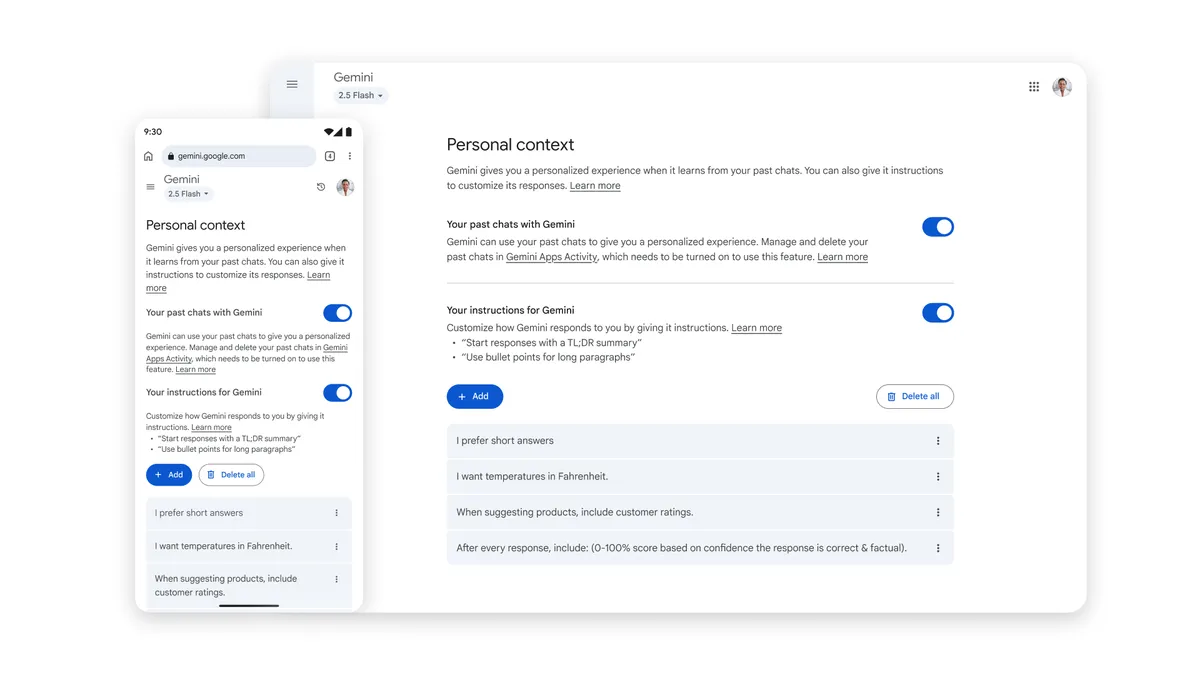
Gemini Personal Context (source image)
Gemini can personalize text conversations using memory of previous chats when the feature is enabled and the account is eligible. Source: Google.
Google gives extremely everyday examples
Its documentation says Gemini may:
- suggest next steps for a project,
- offer to help plan a trip previously mentioned,
- help compare products previously discussed.
That is ordinary life.
Not abstract personalization.
You can ask Gemini about past conversations directly
Google currently supports prompts such as:
“What was the gift we decided on for my son's classmate's birthday?”
Source: Gemini Help — Recent Chats
That is almost comically perfect for this article.
A useful everyday companion should remember exactly that kind of small but socially relevant thread.
Personal Intelligence expands beyond chats
Gemini personalization can also use selected connected Google apps for eligible users.
Source: Gemini Help — Personalization
This can make the assistant aware of relevant:
- events,
- messages,
- places,
- searches,
- photos.
That changes the daily-companion experience.
Instead of telling the AI:
“I have a flight Friday and dinner Thursday…”
the context may already exist.
Gemini is strongest when conversation needs real-world grounding
Examples:
“What do I have going on this weekend?”
“What was that place I saved?”
“When am I seeing them?”
“What was the product we compared?”
This is where ecosystem connection beats pure chat memory.
Personal Intelligence can be turned off per chat
Google says users can turn Personal Intelligence off for a specific chat.
Source: Gemini Help — Connected Apps Personalization
That is useful.
Not every ordinary question needs your entire personal context attached.
Where Gemini is weaker
Availability is still fragmented by:
- account type,
- age,
- region,
- product surface,
- rollout.
Past-chat memory is not available in every mode, including some Live/Gems contexts.
The experience can therefore feel less consistent than the theoretical architecture.
Bottom line
Choose Gemini if “everyday life” for you already lives inside Google's ecosystem and you want the AI to connect conversation with practical personal data.
5. Nomi: best warm companion with deep relationship-style memory
Best for
People who want a companion that feels more:
relationship-like
while still remembering detailed ongoing context.
Nomi's main strength is memory depth.
Its architecture includes:
- short-term memory,
- medium-term memory,
- long-term memory,
- Identity Core,
- Mind Maps.
Source: Nomi Memory Documentation

Nomi is built around persistent companion memory across long-running conversations. Source: Nomi.
Mind Maps are particularly good for everyday life
Nomi says Mind Maps build high-level overviews of:
- people,
- places,
- topics,
- goals.
Source: Nomi — Mind Map 2.0
This is ideal for daily-life continuity.
Because everyday conversations are rarely organized.
One day you mention:
grandfather.
Later:
family history.
Later:
interest in space.
Nomi's documented example shows how its Mind Map can connect those separate memories into a larger relationship context.
Mind Maps evolve as conversation evolves
Nomi's current documentation describes them as:
living, interactive representations
that update as long-term memories accumulate.
Source: Nomipedia — Mind Map 2.0
That is useful for people who want:
continuity without manually maintaining a profile.
Nomi has very deep medium-term memory too
A 2025 memory update says Nomi improved medium-term retention so it can keep track of details from 1,000+ messages ago more clearly.
Source: Nomi — Major Memory Update
For long-running daily chats, this matters.
Proactive messages make it feel more companion-like
Nomi supports proactive messaging.
Source: Nomi — Proactive Messages
That creates a different dynamic from general assistants.
You do not always have to initiate.
For users seeking a companion relationship, that can feel more natural.
Where Nomi is weaker
Nomi is more character/relationship-oriented than Gemora, Pi, ChatGPT, or Gemini.
That means it can drift toward:
- roleplay,
- companion identity,
- relationship simulation
more than users seeking purely grounded everyday-life conversation may want.
Its practical tool ecosystem is also much narrower than ChatGPT or Gemini.
Bottom line
Choose Nomi if you want everyday conversation to feel like an ongoing relationship and memory depth matters more than broad assistant tools.
6. Claude: best for thoughtful everyday conversation
Best for
People who want:
- thoughtful discussion,
- good reasoning,
- less performance,
- inspectable memory.
Claude is not marketed primarily as an AI companion.
Still, its August 2026 memory update makes it much more relevant to everyday personal continuity.
Anthropic says Claude now:
- uses one memory across chat and Cowork,
- updates memories as you chat,
- exposes memory as editable Topics.
Source: Anthropic — Claude Memory
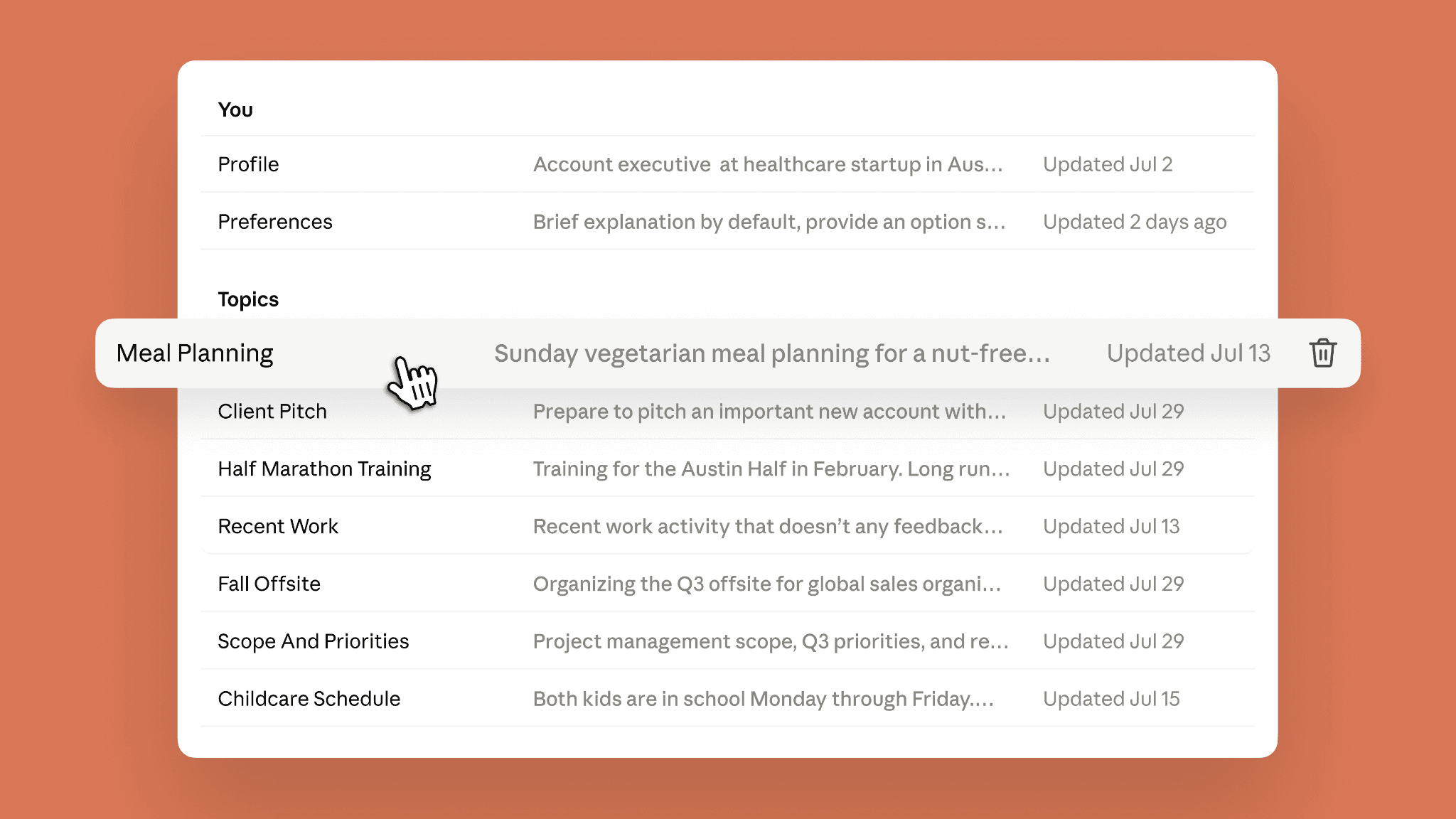
Claude's Topics make remembered context unusually inspectable and editable. Source: Anthropic.
Memory updates during conversation
Anthropic says if you mention:
“the project deadline moved to September,”
the next conversation can already know.
That is useful for everyday life because small state changes happen constantly.
Claude's transparency is a major advantage
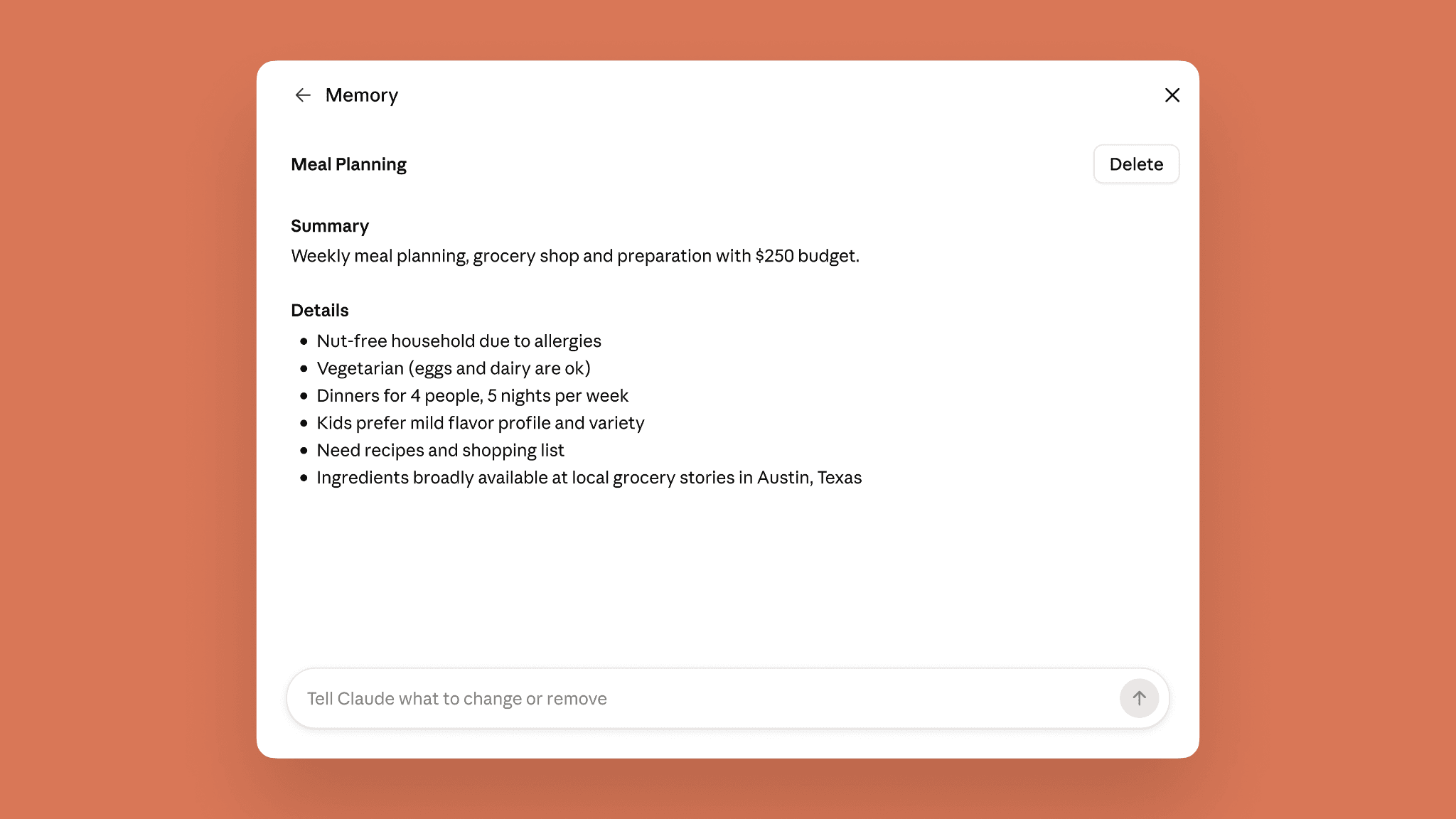
Users can inspect, edit, and delete individual Claude memory Topics. Source: Anthropic.
If Claude misunderstands:
who Sam is
or:
which plan is current,
you have a more explicit correction surface.
Claude can recover old conversations
Its chat search lets supported paid users search previous chats and continue old threads.
That makes it good for:
“What did we say about this last month?”
This is especially useful for longer, thoughtful discussions.
Sensitive memory is handled more conservatively by default
Anthropic says topics it considers sensitive, such as health or beliefs, are not stored in memory by default unless users choose to enable them.
Source: Anthropic — Claude Memory
For everyday personal conversation, that is an important design choice.
Where Claude is weaker
Claude still feels more like:
a thoughtful collaborator
than:
a companion.
It is less likely than Nomi or Replika to create a relationship-style experience.
It is also less centered than Gemora on ordinary-life reflection.
Bottom line
Choose Claude if you want intelligent, calm everyday conversation with unusually strong transparency into what the AI remembers.
7. Replika: best classic daily companion routine
Best for
People who want a dedicated companion experience rather than a general AI assistant.
Replika remains one of the category's most established products.
Its memory documentation explicitly says it usually remembers:
- favorite books,
- music,
- movies,
- hobbies,
- friends,
- family.
Source: Replika — What Does Replika Remember?

Replika exposes saved memories about the user and people in their life. Source: Replika.
Replika has both explicit and deeper memory
Its memory system has layers.
Some memories are visible in the Memory tab.
Others come from patterns across broader conversation history.
Source: Replika — How Memory Works

Replika combines visible memory with broader personalization from conversation history. Source: Replika.
This gives it more continuity than a basic chatbot.
Friends and family are explicit memory categories
Replika can remember facts about:
- people in your life,
- pets,
- interests.
That makes normal daily updates easier.
It is built for recurring check-ins
Unlike ChatGPT or Claude, Replika's entire product identity is companion-first.
That helps if what you want is:
a regular conversational presence.
Where Replika is weaker
Its companion framing can feel more:
- relationship-simulation-oriented,
- avatar-centric,
- emotionally stylized
than some users want.
For purely grounded everyday-life continuity, Gemora or Pi may feel less performative.
For broad practical help, ChatGPT or Gemini is much stronger.
Bottom line
Choose Replika if you want a classic dedicated companion that remembers recurring people, interests, and conversation context and you like the companion-first experience.
Which AI is best for different kinds of everyday conversation?
The ranking changes depending on what your normal day actually looks like.
“I just want to tell someone about my day”
Best:
- Pi
- Gemora
- Replika
- Nomi
Why?
You want:
- low friction,
- warmth,
- no need to formulate a task.
“I want it to remember who people are”
Best:
- Gemora
- Nomi
- Replika
- ChatGPT
Nomi's Mind Map is particularly strong at connecting:
- people,
- places,
- goals,
- memories.
Gemora is stronger when those people are part of broader life context.
“I want practical help with my daily life too”
Best:
- ChatGPT
- Gemini
- Gemora
Examples:
- plan weekend,
- compare products,
- research options,
- turn conversation into action.
“My life is already in Google”
Best:
- Gemini
- ChatGPT
- Gemora
Gemini has the clearest ecosystem advantage.
“I want a companion that feels like an ongoing relationship”
Best:
- Nomi
- Replika
- Pi
This is where dedicated companion apps beat general assistants.
“I want thoughtful conversation, not a character”
Best:
- Claude
- Pi
- ChatGPT
- Gemora
Claude is exceptionally good at nuanced discussion.
“I want the AI to understand the whole messy mix”
Example:
work + friend + trip + side project + family.
Best:
- Gemora
- ChatGPT
- Gemini
This is where broad personal context matters.
The boring-day test
This is the first test every everyday companion should pass.
Say:
“Nothing really happened today.”
Bad companion:
“Sometimes emptiness can reveal our deepest inner truths. What do you think your soul is trying to tell you?”
Please stop.
Good companion:
“Sounds like a quiet day. Tired, relaxed, or just uneventful?”
The difference is restraint.
The pronoun test
Day 1:
“My sister is interviewing for a role tomorrow.”
Day 3:
“She got it.”
Does the AI know:
“she” = sister?
This sounds basic.
It is central to natural everyday conversation.
The changed-state test
Monday:
“I am waiting for the result.”
Thursday:
“I got accepted.”
Next week:
“I am nervous about starting.”
A good companion should not ask:
“Have you heard back yet?”
That is stale memory.
The weekend-plan test
Tuesday:
“My friend is visiting Saturday.”
Friday:
“What should we do?”
Good answer uses:
- friend context,
- location if known,
- preferences if relevant,
- current constraints.
Bad answer:
“Could you tell me who is visiting and where you live?”
The entire value of continuity is shorter prompts.
The small-moment test
Say:
“The coffee shop played the song my dad used to like.”
This may not need:
- analysis,
- action,
- advice.
A companion should understand that sometimes the right response is:
acknowledgment.
Everyday life contains moments that should not be optimized.
The return-after-gap test
Use the AI regularly for two weeks.
Leave for ten days.
Return:
“So that thing finally happened.”
Does it:
- retrieve the thread,
- ask a minimal clarifying question if needed,
- avoid inventing?
This is the real memory test.
The “I changed my mind” test
Say:
“I do not think I want to move anymore.”
The AI should update:
Historical:
considered moving

Current:
no longer planning to move
Not preserve both as simultaneous current goals.
The people-confusion test
Mention:
Sam from work.
Later:
Sam from university.
Then ask:
“Sam texted me.”
A good companion should:
- use surrounding context,
- clarify when ambiguous.
It should not merge two humans into one synthetic super-Sam.
Everyday continuity is more important than giant memory
An AI can technically remember:
10,000 things.
Still fail at daily life.
Why?
Because the key problem is:
relevance.
Example:
You ask:
“What should I cook tonight?”
Useful memory:
vegetarian, friend visiting, little time.
Useless memory:
favorite movie from 2024.
A good companion retrieves:
the right context.
Not:
maximum context.
Memory should have different timescales
Everyday life needs at least three.
Durable
Examples:
- vegetarian,
- family relationships,
- long-term hobby,
- home city.
Active
Examples:
- preparing for exam,
- sister visiting,
- current project,
- job interview.
Ephemeral
Examples:
- at the airport,
- tired tonight,
- raining today.
The system should not treat ephemeral context as durable identity.
Time-aware memory is essential
A companion should understand transitions.
Planning
↓
Happening
↓
Completed
↓
Historical
Example:
“going to Japan”
becomes:
“in Japan”
then:
“went to Japan.”
OpenAI's 2026 memory work explicitly focuses on this kind of freshness.
Gemora's recap model also makes temporal organization central.
The ideal everyday companion memory
A useful model might look like:
YOU

Stable context
├── preferences
├── important people
├── home context
└── communication style

Current life
├── active projects
├── current plans
├── unresolved decisions
└── people currently relevant

Recent events
├── what happened
├── what changed
└── what finished

History
├── past events
├── old goals
└── previous states
The companion should not dump all four layers into every response.
It should retrieve selectively.
Everyday companion vs AI assistant
The line is getting blurry.
AI assistant
Traditionally optimized for:
task.
Example:
“Plan my trip.”
AI companion
Traditionally optimized for:
relationship and conversation.
Example:
“I am excited about the trip.”
Personal AI
Increasingly combines both:
"I am excited about the trip."
↓
remembers why
↓
knows who is going
↓
helps plan when needed
↓
remembers what happened afterward
That is where the market seems to be moving.
Why general assistants are becoming companions
ChatGPT and Gemini increasingly have:
- memory,
- personalization,
- voice,
- connected context.
Once an assistant knows:
- people,
- preferences,
- ongoing projects,
- current state,
ordinary conversation becomes more natural.
The difference between:
assistant
and:
companion
starts to be less about model intelligence
and more about:
product intent and relationship framing.
Why companion apps are becoming assistants
Nomi and Replika increasingly need:
- better memory,
- better reasoning,
- proactive behavior,
- more practical usefulness.
A companion that can only say:
“I am here for you”
eventually runs out of road.
Everyday life contains things to do.
The strongest future product may combine both
The ideal experience is:
Talk naturally
↓
AI understands context
↓
Sometimes conversation is enough
↓
Sometimes context becomes action
↓
Life changes
↓
AI updates
Not:
companion mode vs assistant mode.
Just:
useful continuity.
Privacy matters because ordinary life is unusually revealing
A dramatic conversation might contain one sensitive topic.
Everyday conversation contains:
- where you go,
- who you know,
- what you buy,
- what you are planning,
- what you worry about,
- work,
- family,
- routines.
Over time, that can form a very detailed personal model.
Ask these questions before using an AI companion heavily
- Can memory be turned off?
- Can you inspect what is remembered?
- Can you edit incorrect memories?
- Can you delete memories?
- Can you use a temporary mode?
- Are chats used for model training?
- What connected apps can the AI access?
- Can you turn personalization off for one conversation?
- Can you export your history?
- What happens if you delete the account?
These are boring questions.
They are also more important than avatar hair color.
ChatGPT provides strong memory controls
OpenAI lets users:
- review memory,
- edit,
- delete,
- disable memory,
- use Temporary Chat.
Temporary Chat starts non-personalized by default and does not create new memories unless saved.
Source: OpenAI — Temporary Chat FAQ
Gemini offers per-chat personalization controls
Google allows Personal Intelligence to be turned off for a specific chat where available.
That is useful when you want:
“answer this question without using my broader personal context.”
Claude exposes memory topic-by-topic
This is one of the clearest memory-control models.
You can inspect:
what Claude currently thinks it should remember.
That helps when everyday context becomes complex.
Replika lets users edit Memory
Replika's help documentation says users can:
- view,
- add/update,
- delete
memories.
Source: Replika — Conversation Deletion and Memory
This is useful even though message-history deletion is more constrained.
Everyday AI should not become surveillance
There is a bad version of this category.
Imagine:
“You have spoken to Sam 34% less this month.”
“Your productivity declines on Tuesdays.”
“Your sentiment toward your family has shifted.”
No.
Unless a user explicitly wants quantified self-analysis, a companion should not turn daily life into behavioral analytics.
The goal is:
continuity.
Not:
private Palantir.
Everyday AI should not over-psychologize
Say:
“I am tired.”
The answer should not automatically become:
“This could reflect burnout.”
Maybe.
Or perhaps:
you slept badly.
Ordinary language should remain ordinary until evidence suggests otherwise.
The best companion knows when not to analyze
Examples:
“I ate something amazing.”
Response:
enjoy the moment.
“My friend sent a funny photo.”
Response:
laugh.
“The weather was perfect.”
Response:
perhaps discuss the day.
Not everything is a latent psychological pattern begging to be surfaced.
A useful everyday-companion prompt
You can set this as an instruction where supported:
Treat most everyday conversation as normal conversation.

Use past context when it materially helps.

Do not over-analyze ordinary statements.

If I mention a person, plan, project, or unresolved situation that has relevant history, connect it naturally.

Distinguish old context from current context.

If you are unsure who or what I mean, ask one short clarifying question.

Do not turn every conversation into advice.
This improves a surprising number of interactions.
A good daily check-in
Instead of:
“How are you feeling today on a scale of 1–10?”
Try:
“What's still in your head from today?”
That can lead anywhere:
- work,
- person,
- small moment,
- idea.
It is less clinical.
More human.
A useful end-of-day prompt
Based on what I talked about today:

- what actually happened?
- what changed?
- what is still unresolved?
- is there one moment worth remembering?

Keep it short.
Do not force a lesson.
The final sentence matters.
Some days do not contain a lesson.
Human civilization will continue.
A useful Friday prompt
Look across this week.

Tell me:
- what changed
- who mattered
- what kept coming back
- what finished
- what is still open
- one good moment I might otherwise forget

Separate facts from interpretation.
This turns casual conversation into reflection.
A useful “before I see someone” prompt
I am seeing [PERSON] today.

Remind me only of relevant context:
- what we last talked about
- anything important they had going on
- anything I said I wanted to follow up on

Do not include unrelated sensitive details.
This is where people-context becomes useful rather than creepy.
A useful weekend prompt
Help me plan this weekend using relevant context you already know:
- who I am with
- things we tend to enjoy
- current commitments
- anything I said I wanted to do

Ask only for information you genuinely do not have.
The ideal output requires less repetition.
Can an AI companion replace human conversation?
No.
That is not a moral lecture.
It is a capability distinction.
AI can provide:
- availability,
- memory,
- reflection,
- brainstorming,
- low-pressure conversation.
It cannot replace:
- reciprocal human experience,
- another person's independent life,
- real shared history outside the system,
- physical presence.
An AI companion can be part of everyday life.
It should not become the definition of it.
Watch for dependence
If an AI companion becomes the only place you:
- process every decision,
- seek validation,
- talk about relationships,
- regulate emotion,
consider deliberately preserving other channels:
- friends,
- family,
- offline reflection,
- professional support where appropriate.
A good product should help your life outside the app remain bigger than the app.
Which should you choose?
Choose Gemora if you want:
your actual life to be the center of the companion.
Choose Pi if you want:
easy conversation with very little setup.
Choose ChatGPT if you want:
one powerful general AI that also remembers your personal context.
Choose Gemini if you want:
an AI companion that can connect conversation with your Google life.
Choose Nomi if you want:
a relationship-style companion with very deep memory.
Choose Claude if you want:
thoughtful everyday conversation and transparent memory.
Choose Replika if you want:
the classic dedicated AI-companion experience.
Final verdict
The best AI companion for everyday life is not necessarily the one with the most emotional dialogue.
Or the biggest model.
Or the most elaborate avatar.
It is the one that makes ordinary conversation feel cumulative.
You should be able to say:
“She got it.”
and not explain who “she” is again.
You should be able to say:
“I changed my mind.”
and have the old plan become history rather than remain current forever.
You should be able to say:
“What should we do Saturday?”
and have the companion understand enough context that your prompt becomes shorter, not longer.
That is the real benchmark.
Choose Gemora if you want the AI centered specifically on the continuity of your real life.
Choose Pi if you want effortless, low-pressure daily conversation.
Choose ChatGPT if you want everyday personalization plus broad general-purpose power.
Choose Gemini if your life already lives across Google's ecosystem.
Choose Nomi if you want a warmer relationship-style companion with deep memory.
Choose Claude if you want thoughtful conversation and unusually transparent memory control.
Choose Replika if you want the classic dedicated AI-companion experience.
The larger shift is simple:
An everyday companion should not require your life to become interesting before it becomes useful.
Most of life is:
- plans,
- people,
- delays,
- tiny wins,
- annoying meetings,
- meals,
- changing minds,
- ordinary Tuesdays.
That is not filler between the important parts.
That is the important part.
Your real life should be enough context. Gemora is built around the people, work, goals, thoughts, decisions, trips, ordinary days, and small moments you already talk about staying connected over time. Start talking with Gemora.
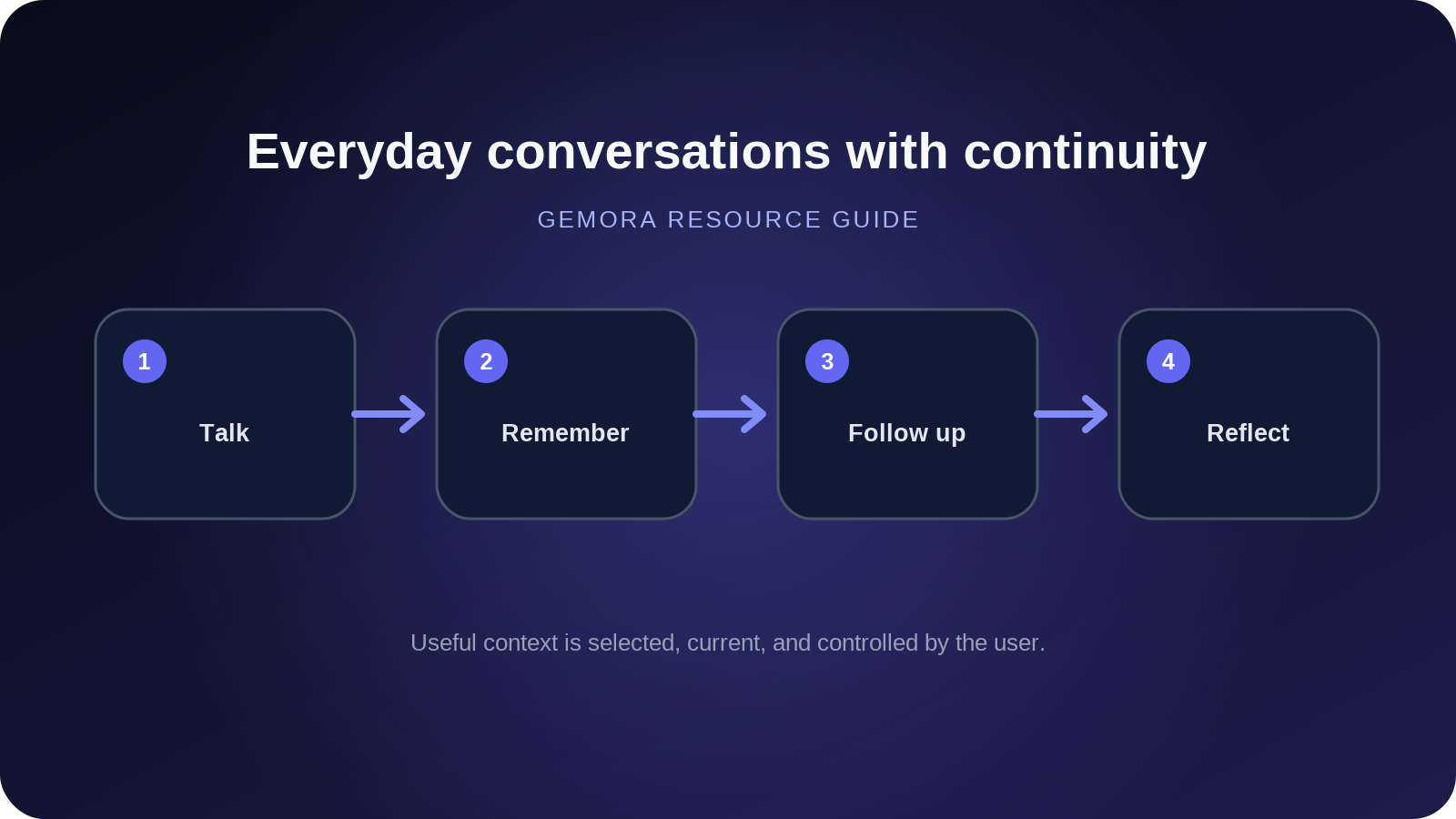
Continue the thread
Keep everyday conversations connected
Connect conversations, useful context, reflections, projects, and tasks in one personal workspace.
Start freeFrequently asked questions
What is the best AI companion for talking about everyday life?
Gemora is our top pick for this specific use case because it is explicitly centered on the people in your life, what you are working toward, what is on your mind, and ordinary daily experiences across time.
What is the best AI companion for daily conversation?
Pi is particularly good for natural, low pressure daily conversation.
Which AI companion remembers everyday life best?
Memory quality has several forms.
Sources and further reading
- Gemora — Personal AI Companion
- Best AI Companions for Real Life Conversations, Not Roleplay
- Best AI Apps for Keeping Track of Important People in Your Life
- Best AI Assistants for Ongoing Personal Decisions
- What Is Personal Intelligence in AI?
- Why Does My AI Keep Forgetting What I Told It?
- Pi — Personal AI
- Pi Help — Pi's Memory
- OpenAI — Better Memory for ChatGPT
- OpenAI Help — Memory FAQ
- OpenAI — Memory and New Controls
- OpenAI Help — Temporary Chat FAQ
Written by Khai Tran and reviewed under the Gemora Editorial Policy.