what is personal intelligence in AI
What Is Personal Intelligence in AI? A Complete Guide for 2026
Learn how personal intelligence helps AI use your preferences, history, relationships and current context, and how it differs from memory and personalization.
Methodology: Analysis based on official product documentation and public feature descriptions listed in the sources, reviewed on 2026-10-13.
Original contribution: A layered model distinguishing personal intelligence from memory, personalization, retrieval, and connected data.

In this guide
- The short answer
- Why the term matters now
- Google turned “Personal Intelligence” into a product category
- Personal Intelligence is bigger than memory
- Memory asks: “What should I retain?”
- A practical model: the 8 layers of Personal Intelligence
- Layer 1: stable personal context
- Layer 2: preferences
- Layer 3: long-term memory
- Layer 4: current state
- Layer 5: temporal context
- Layer 6: connected personal data
- Layer 7: retrieval and relevance
- Layer 8: permissions and action
- Personal Intelligence in one architecture diagram
- Personal Intelligence vs AI memory
- Personal Intelligence vs personalization
- Personal Intelligence vs Custom Instructions
- Personal Intelligence vs recommender systems
- Personal Intelligence vs a user profile
Related reading: memory vs history · apps with recall · long-term assistants · memory controls.
Personal Intelligence is not simply an AI remembering facts about you. It is the broader ability to use the right personal context, at the right time, for the current situation. Source: Gemora.
For most of the history of software, personalization meant something fairly small.
A music app learned what you listened to.
A shopping site learned what you clicked.
A news feed learned what kept you scrolling.
A productivity app remembered your settings.
Then general-purpose AI arrived.
Now the system is not only choosing which item to show you.
It is:
- answering questions,
- giving recommendations,
- helping you make decisions,
- planning trips,
- writing with you,
- working across files,
- remembering previous conversations,
- finding information from your apps,
- and increasingly taking actions on your behalf.
That changes the meaning of personalization.
If an AI is going to help with many different parts of your life or work, it needs more than:
“The user likes dark mode.”
It may need to understand:
- who you are,
- what you prefer,
- what you are working on,
- what happened before,
- what is happening now,
- which people are relevant,
- which information changed,
- which connected sources it is allowed to use,
- and which pieces of that context actually matter for the current request.
That broader capability is what we mean by Personal Intelligence.
A useful working definition is:
Personal Intelligence is an AI system's ability to build, maintain, retrieve, and apply relevant user-specific context over time so that its answers and actions fit the individual rather than an average user.
That context can come from:
- conversations,
- explicit preferences,
- long-term memory,
- files,
- calendar,
- email,
- photos,
- search activity,
- projects,
- relationships,
- decisions,
- previous actions,
- and other sources the user chooses to connect.
The important part is not the amount of data.
It is whether the system can answer:
What does this person need, given what is true about them and their situation right now?
In 2026, the phrase has also become a real product term.
Google introduced Personal Intelligence in Gemini in January 2026, initially as an opt-in feature connecting personal information across Google apps. Google then expanded the concept into AI Mode in Search and Gemini in Chrome. (Google)
So there are now two useful meanings:
- Google Personal Intelligence: Google's specific product and feature layer.
- Personal Intelligence as a broader AI category: the general capability for AI to understand and use personal context over time.
This article covers both.
The short answer
Personal Intelligence is what turns this:
“Here is a good answer for someone.”
into:
“Here is a good answer for you, given your history, preferences, current situation, and constraints.”
It usually requires several layers working together:
Identity and stable context
+
Preferences
+
Memory
+
Current state
+
Time
+
Connected personal data
+
Retrieval
+
Permissions
+
Reasoning
=
Personal Intelligence
Memory is one piece.
Personalization is one outcome.
Personal Intelligence is the larger system.
Why the term matters now
For years, “AI personalization” mostly meant:
change tone, remember my name, recommend something similar to what I clicked before.
That is no longer enough.
General AI is becoming a layer across:
- search,
- browsers,
- work,
- communication,
- planning,
- devices,
- personal conversations.
Google's own language in 2026 is telling.
It describes Personal Intelligence as making products such as Search, Chrome, and Gemini more capable of:
- anticipating needs,
- understanding context,
- providing tailored responses,
- connecting information across personal sources.
Source: Google AI January 2026 roundup
This is a meaningful shift.
The unit of personalization is no longer:
content recommendation.
It becomes:
context for reasoning and action.
That is a much bigger problem.
Google turned “Personal Intelligence” into a product category
Google formally introduced Personal Intelligence in the Gemini app on January 14, 2026.
The initial idea was straightforward:
connect Gemini to selected Google apps so the assistant can reason across information already present in your digital life.
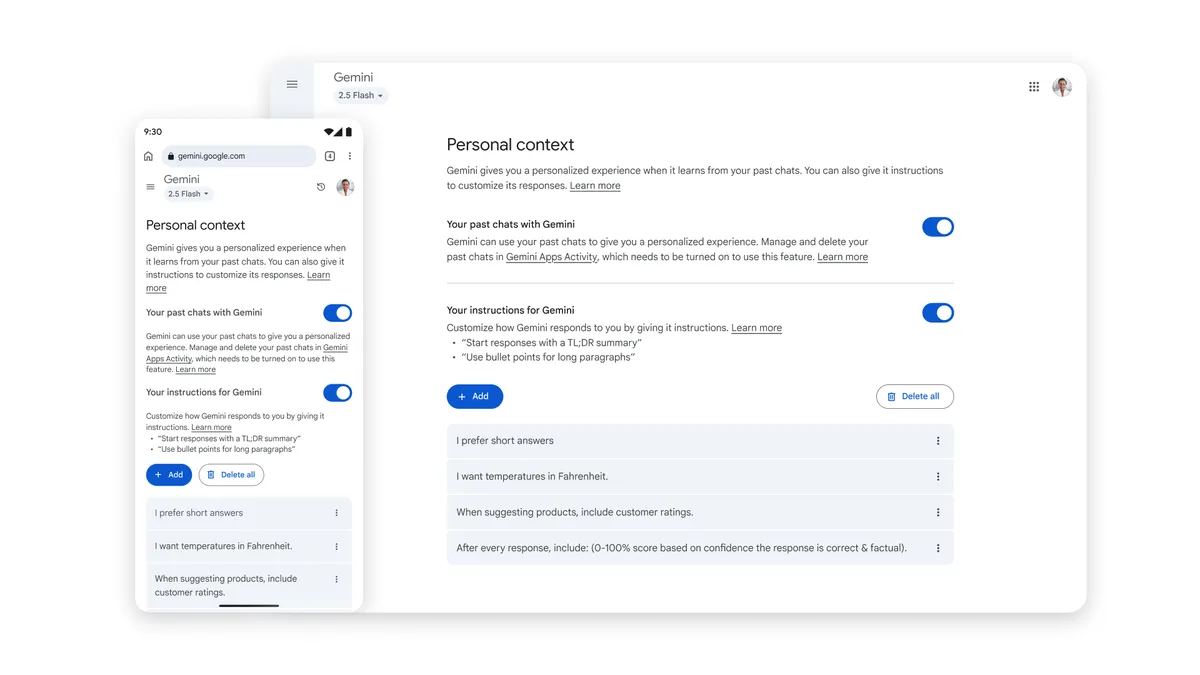
Gemini Personal Context settings (source image)
Gemini's Personal Intelligence combines personalization settings, memory, and connected sources rather than treating every chat as isolated. Source: Google.
Google currently documents Personal Intelligence connections including:
- Contacts,
- Google Photos in supported locations,
- Google Workspace services such as Gmail, Calendar, and Drive,
- Search services including Search, Maps, Shopping and related products,
- YouTube history.
Source: Gemini Help — Personal Intelligence and Connected Apps
The goal is not only:
retrieve an email.
It is to connect information across sources and use it to produce a more useful answer.
For example:
“Plan a trip for me.”
A generic AI might ask:
- Where?
- Which dates?
- Budget?
- What do you like?
A personal-intelligence system may already have permission to use:
- the flight confirmation in Gmail,
- the dates in Calendar,
- previous travel conversations,
- saved preferences,
- information about who is traveling,
- past Search or Maps context.
The prompt becomes smaller.
The answer becomes more personal.
That is the basic promise.
Personal Intelligence is bigger than memory
This is the most important distinction.
Suppose an AI remembers:
“You prefer quiet hotels.”
That is memory.
Now suppose you ask:
“Which hotel should I book for this trip?”
A Personal Intelligence system may also need to know:
- you are traveling with family this time,
- one traveler needs easy transit access,
- your budget changed,
- the trip is only two nights,
- your flight arrives late,
- you recently said location matters more than room size,
- which hotels you already rejected,
- and which connected booking details are current.
Memory contributes one fact.
Personal Intelligence composes the situation.
Memory asks: “What should I retain?”
Personal Intelligence asks:
“What should I use right now?”
That difference sounds small.
It is fundamental.
You can have an enormous memory system and terrible Personal Intelligence.
Imagine an AI remembers 10,000 facts about you.
You ask:
“What should I do this weekend?”
It retrieves:
- your old laptop model,
- a restaurant you visited three years ago,
- your preferred Python formatter,
- the name of an old teacher.
Congratulations.
The AI remembered you.
It still failed to understand you.
Personal Intelligence requires relevance, not only retention.
A practical model: the 8 layers of Personal Intelligence
A useful Personal Intelligence system can be understood as eight layers.
Layer 1: stable personal context
This is information that changes slowly.
Examples:
- role,
- language,
- broad location,
- recurring responsibilities,
- durable constraints,
- communication preferences.
Example:
Role:
Solo founder

Preferred communication:
Direct, practical, concise first

Languages:
Vietnamese for internal planning
English for global-facing content
This is the easiest personal context to maintain.
It often belongs in:
- Custom Instructions,
- explicit profile settings,
- durable memory.
Layer 2: preferences
Preferences tell the AI how to adapt.
Examples:
- concise vs detailed,
- practical vs theoretical,
- quiet travel vs nightlife,
- autonomy vs salary,
- cheaper vs premium,
- challenge vs reassurance.
OpenAI now explicitly describes ChatGPT Memory as helping the system learn your preferences, projects, and constraints.
Source: OpenAI — Better Memory for ChatGPT

ChatGPT's Memory Summary is one current implementation of a persistent user-context layer. Source: OpenAI.
But preferences are not always universal.
A stronger system learns:
General:
Prefers concise answers.

Exception:
Wants deep explanations while learning new technical concepts.
That is contextual preference modeling.
Layer 3: long-term memory
Long-term memory preserves useful information across sessions.
Examples:
- recurring goals,
- ongoing projects,
- important people,
- stable preferences,
- past decisions,
- constraints.
This is the layer most AI products currently market as “memory.”
But good memory is selective.
The AI should probably remember:
“I am building a consumer AI product.”
It probably should not permanently store:
“I want pizza at 8 PM tonight.”
A useful Personal Intelligence system therefore needs a memory policy:
What should persist?
What should expire?
What should be updated?
What should never be inferred?
Layer 4: current state
Current state is what is true now.
This is one of the layers simple memory systems often miss.
Example:
Historical:
Wanted to raise funding immediately.

Current:
Distribution and retention validation are the priority.

Changed:
September 2026.
A Personal Intelligence system should not merely know both facts.
It should know which one is active.
This is why time matters.
Layer 5: temporal context
People change.
Projects change.
Relationships change.
Priorities change.
The same fact can be:
- true,
- historically true,
- outdated,
- completed,
- paused,
- reversed.
OpenAI's June 2026 memory architecture explicitly focuses on staleness, correctness, and scalability over multi-year horizons.

Personalization becomes actively unhelpful when old context is treated as current. Source: OpenAI.

Time-aware context lets the same model tailor an answer to what is currently true. Source: OpenAI.
A Personal Intelligence layer therefore needs to model:
when context was true.
Not only:
whether it was ever true.
Layer 6: connected personal data
This is where Google's implementation becomes especially important.
Personal context does not live only in AI conversations.
It may already exist in:
- email,
- calendar,
- photos,
- search history,
- files,
- contacts,
- maps,
- tasks,
- project systems.
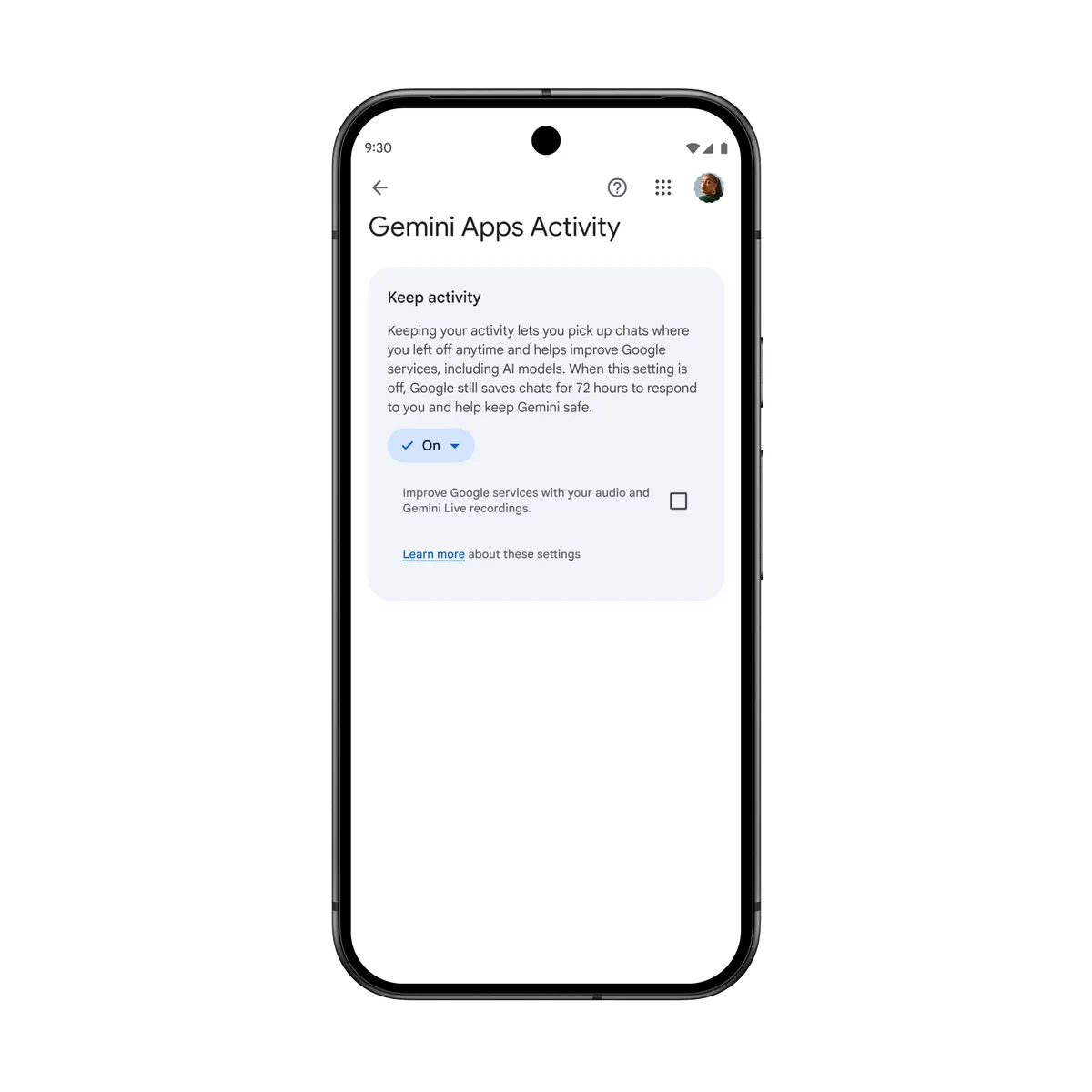
Gemini Personal Intelligence activity controls (source image)
Personal Intelligence becomes broader when the user can connect selected data sources rather than manually retype their digital context. Source: Google.
Google says its connected Personal Intelligence can understand information across multiple apps rather than only fetching isolated pieces.
Source: Gemini Help
That distinction is important.
Traditional connector:
“Find my flight email.”
Personal Intelligence:
“Use my flight, calendar, destination, previous preferences, and who is traveling to suggest what I should do after landing.”
The second requires cross-source reasoning.
Layer 7: retrieval and relevance
Even if all the right information exists, the system still has to retrieve it.
This is one of the hardest parts of Personal Intelligence.
A user may have:
- hundreds of chats,
- thousands of emails,
- years of photos,
- dozens of active projects,
- many changing preferences.
Which five pieces matter for the current request?
That is a ranking problem.
A good system needs to consider:
Semantic relevance
+
Recency
+
Current status
+
User importance
+
Source reliability
+
Context scope
+
Privacy / permissions
OpenAI's Memory Sources feature is useful here because it can expose some of the context behind a personalized response.

Memory Sources provide one model for making the retrieved personal context behind an answer more inspectable. Source: OpenAI.
Personal Intelligence should not be:
“Trust us, we know you.”
It should increasingly become:
“Here is the context we used, and here is where it came from.”
Layer 8: permissions and action
Personal Intelligence becomes more consequential when AI can act.
Reading an old conversation is one thing.
Sending an email is another.
Booking something is another.
Changing a calendar event is another.
A mature system therefore needs permission boundaries.
It should understand:
- which data it can read,
- which data it can write,
- which actions require confirmation,
- which information should never cross scopes.
Google's current Connected Apps model lets users choose which sources participate in Personal Intelligence and turn the feature off for a specific chat.
Source: Gemini Help — Connected Personal Intelligence
This is essential.
The more an AI knows, the more important selective access becomes.
Personal Intelligence in one architecture diagram
A practical conceptual architecture looks like this:
                    ┌────────────────────┐
                    │   Current request  │
                    └─────────┬──────────┘
                              │
                              ▼
                    ┌────────────────────┐
                    │ Intent + situation │
                    └─────────┬──────────┘
                              │
             ┌────────────────┼─────────────────┐
             ▼                ▼                 ▼
      Stable profile     Current state     Active project
             │                │                 │
             ├────────────────┼─────────────────┤
             │                │                 │
             ▼                ▼                 ▼
        Preferences        Timeline          Relationships
             │                │                 │
             ├────────────────┼─────────────────┤
                              │
                              ▼
                  Connected personal sources
             Gmail / Calendar / Files / Photos
             Search / Notes / Apps / History
                              │
                              ▼
                    Relevance + permissions
                              │
                              ▼
                     Retrieved context set
                              │
                              ▼
                   Model reasoning / action
                              │
                              ▼
                  Personalized result/action
The important piece is the middle:
retrieved context set.
The AI does not need your entire life in every prompt.
It needs the right slice.
Personal Intelligence vs AI memory
Here is the cleanest comparison.
| AI Memory | Personal Intelligence |
|---|---|
| Stores useful context | Uses a broader context system |
| Often focuses on chats | Can span chats, apps, files, activity |
| Answers “what should persist?” | Answers “what matters now?” |
| May be fact-oriented | Includes preferences, state, time, relationships |
| Can exist without actions | Can guide both answers and actions |
| Usually provider-specific | Can conceptually be portable across tools |
| One component | Larger system |
Memory is necessary.
It is not sufficient.
Personal Intelligence vs personalization
Personalization is the outcome.
Personal Intelligence is the capability behind the outcome.
Example:
Personalization:
“The AI recommended a quiet hotel.”
Personal Intelligence:
“The system knew you prefer quiet hotels, saw you are traveling with family, understood the arrival time from your booking, noticed the trip is short, and weighted location more heavily because of what you said recently.”
One describes the result.
The other describes the context system that made the result possible.
Personal Intelligence vs Custom Instructions
Custom Instructions are deliberate settings.
Example:
Keep answers concise.
Use metric units.
Give one recommendation first.
They are useful because they are explicit.
But they do not automatically capture:
- what happened yesterday,
- which project changed,
- which people are involved,
- what you recently decided,
- which travel booking is current.
Custom Instructions are one input into Personal Intelligence.
OpenAI itself separates Custom Instructions from Memory in its personalization guidance.
Source: OpenAI — Personalizing ChatGPT
Personal Intelligence vs recommender systems
Netflix already knows what you watch.
Spotify already knows what you listen to.
Amazon already knows what you buy.
Those systems are personalized.
Are they Personal Intelligence?
Usually not in the sense described here.
A recommender system typically optimizes:
“Which item should we rank higher?”
Personal Intelligence operates across open-ended tasks.
It may need to understand:
“Why is this recommendation appropriate for this person in this situation?”
That requires richer context.
Personal Intelligence vs a user profile
A profile might say:
Age:
28

Role:
Designer

Location:
London

Interests:
Travel, photography
Useful.
Static.
Personal Intelligence might know:
Current project:
Launching portfolio this month

Recent change:
Considering relocation

Current constraint:
Budget is tighter than usual

Travel preference:
Usually spontaneous, except for family trips

Recent decision:
Prioritizing career flexibility over compensation
The second is not a profile.
It is a living context model.
Personal Intelligence vs Personal Context Layer
These ideas overlap heavily.
A useful distinction is:
Personal Context Layer = the infrastructure that stores, organizes, controls, and retrieves personal context.
Personal Intelligence = the capability that uses that context to reason and act personally.
Think:
Personal Context Layer
        ↓
provides context
        ↓
Personal Intelligence
        ↓
produces tailored reasoning/action
The context layer is infrastructure.
Personal Intelligence is behavior.
For a deeper explanation, see:
What Is a Personal Context Layer for AI?
Personal Intelligence vs agent memory
Agent memory is often task-oriented.
Example:
“Remember what happened in the last five coding steps.”
or:
“Remember the state of this research workflow.”
Personal Intelligence is user-oriented.
Example:
“Remember that this user prefers faster experiments, is currently launching Android, has limited budget, and already rejected this strategy last month.”
Agent memory helps the agent continue a task.
Personal Intelligence helps the system continue with a person.
They can overlap.
Personal Intelligence vs Personal AI
A Personal AI is a product category.
Personal Intelligence is a capability.
A general assistant can have Personal Intelligence.
A browser can have Personal Intelligence.
Search can have Personal Intelligence.
A dedicated Personal AI should probably make Personal Intelligence central to the entire product.
That distinction matters.
You can add memory to a chatbot without making it a Personal AI.
What Google Personal Intelligence actually does in 2026
Google's current implementation is the clearest branded example.
Google says Gemini with Personal Intelligence can:
- personalize based on insights about you and people in your world,
- make recommendations based on preferences,
- create tailored itineraries,
- find and summarize personal information,
- reason across connected apps,
- create personalized images based on your style and preferences.
Source: Gemini Help
It can connect eligible users to data from:
- Contacts,
- Google Photos,
- Google Workspace,
- Search services,
- YouTube.
This is broader than the original January launch.
The important architectural leap is:
cross-source understanding.
Not merely app retrieval.
Personal Intelligence has expanded beyond Gemini
Google expanded Personal Intelligence into AI Mode in Search in January 2026.
Gemini switch-to-Gemini hero (source image)
Google is increasingly treating personal context as a shared intelligence layer rather than a feature limited to one chat interface. Source: Google.
By March 2026, Google announced a wider U.S. expansion across:
- AI Mode in Search,
- Gemini app,
- Gemini in Chrome.
Source: Google — Personal Intelligence expansion
This matters strategically.
Personal Intelligence is beginning to look less like:
a chatbot feature
and more like:
a horizontal layer across an AI ecosystem.
That is probably where the category is heading.
Why Search needs Personal Intelligence
Traditional search answers:
“What is the best carry-on suitcase?”
Personal Intelligence can potentially answer:
“Which carry-on is best for me?”
That difference may require:
- airline habits,
- previous purchases,
- upcoming travel,
- preferences,
- price sensitivity,
- trip type.
Google brought Personal Intelligence into AI Mode specifically to provide more tailored shopping, travel, and related responses.
Source: Google Search — Personal Intelligence
This is a fundamental change in search.
Search historically optimizes for:
relevance to the query.
Personal Intelligence adds:
relevance to the person.
Why browsers need Personal Intelligence
A browser sees:
- tabs,
- current web task,
- active pages,
- connected applications.
Google's Gemini in Chrome can now remember context from past conversations and, where available, use Personal Intelligence from connected Google sources.
Source: Google — Gemini in Chrome expansion
That creates a powerful context stack:
Current webpage
+
Current tabs
+
Past Gemini conversation
+
Personal Intelligence
+
Connected apps
The browser stops being only:
a container for websites.
It becomes a context-rich AI surface.
ChatGPT is moving toward Personal Intelligence without using the same label
OpenAI generally uses terms such as:
- Memory,
- personalization,
- Custom Instructions,
- Projects,
- connected apps.
But the functional direction is similar.
OpenAI's 2026 memory work focuses on long-term synthesis across:
- preferences,
- projects,
- constraints,
- multi-year context.
Source: OpenAI — Better Memory
The current Memory Summary makes that synthesized context more visible.
OpenAI does not generally brand this as “Personal Intelligence,” but the underlying direction is similar: persistent context that improves future reasoning. Source: OpenAI.
OpenAI also increasingly exposes where personalization came from.
Source-aware personalization is an important part of making Personal Intelligence auditable rather than magical. Source: OpenAI.
That makes ChatGPT another strong example of the broader category even if the vocabulary differs.
Claude takes a more inspectable approach
Anthropic's approach emphasizes visible memory state.
Claude now organizes remembered context into individual Topics.
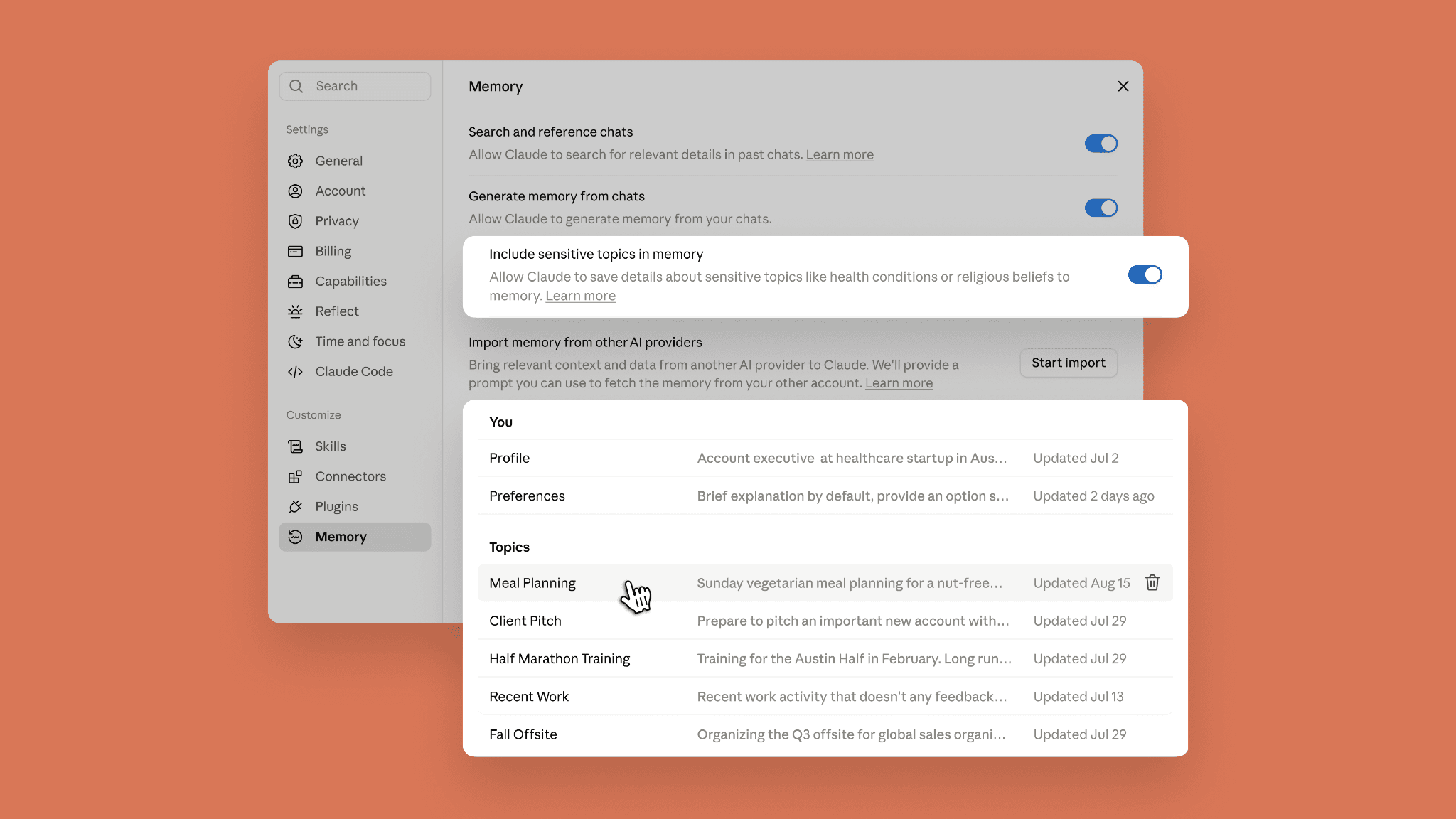
Claude now carries memory across Chat and cloud Cowork. Source: Anthropic.
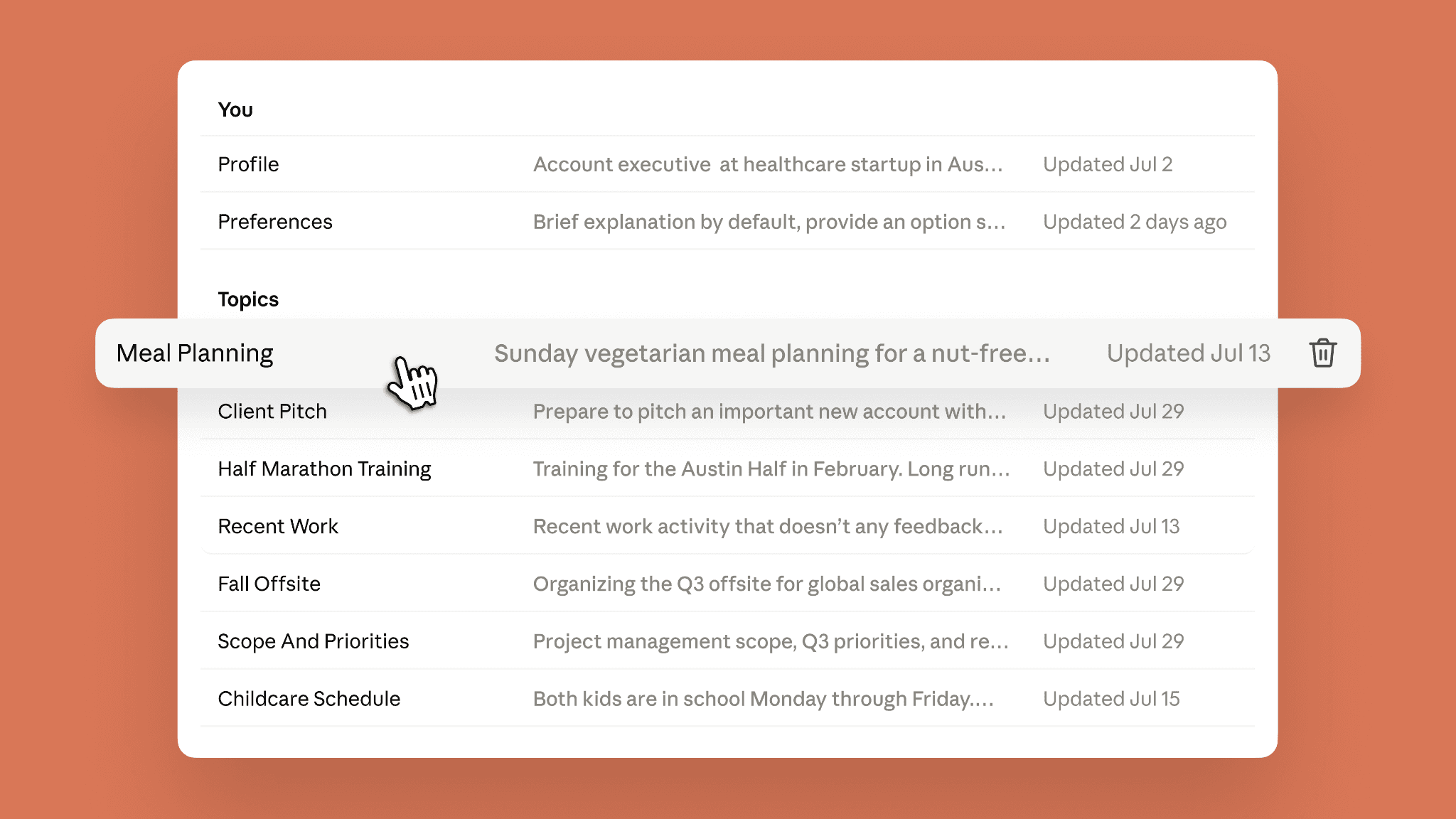
Claude's Topic-based memory makes user context inspectable rather than leaving every inference hidden. Source: Anthropic.
That is important for Personal Intelligence.
If an AI is going to build a model of you, the user should be able to ask:
“What exactly do you think you know?”
Claude's UI gets unusually close to that.
Claude also makes correction explicit
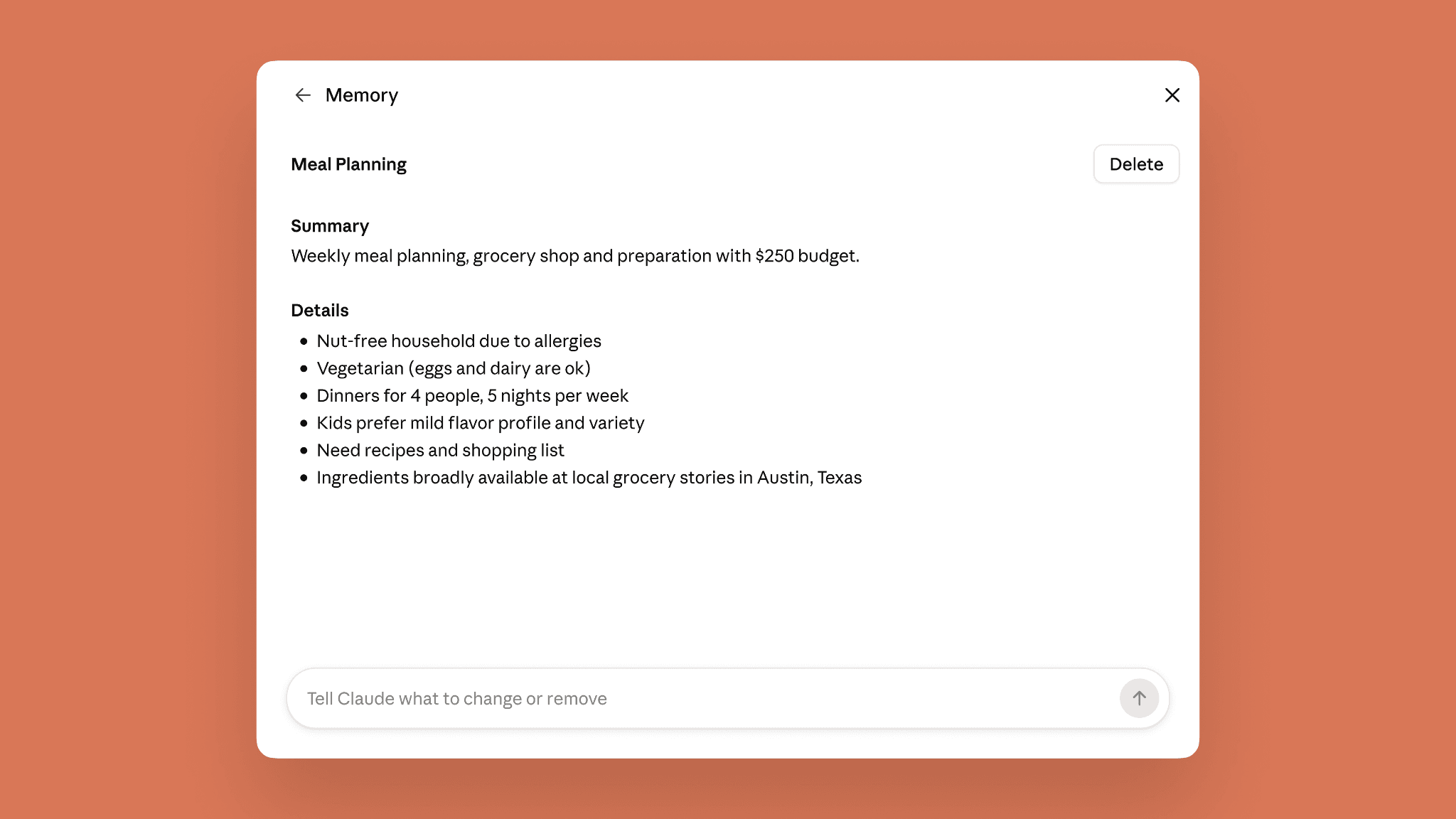
Users can edit or delete individual Claude memory topics when the context is wrong or outdated. Source: Anthropic.
This matters because Personal Intelligence can fail in a worse way than generic AI.
A generic AI says:
“I don't know.”
A badly personalized AI says:
“I know you.”
and is wrong.
Correction is therefore a core feature, not a settings afterthought.
Claude also points toward portability
Anthropic supports memory import and export.
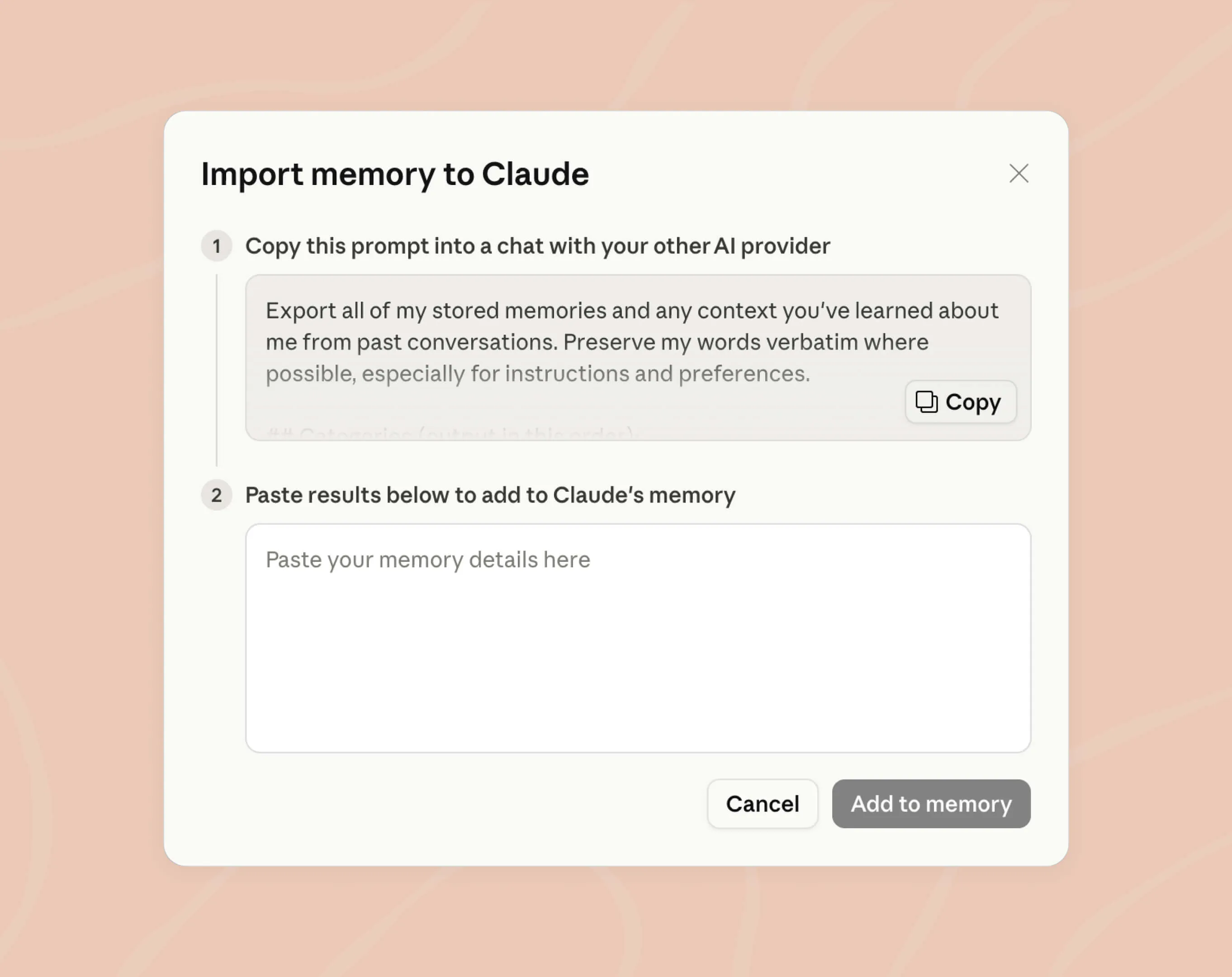
Claude's memory import allows users to bring contextual summaries from another AI provider. Source: Anthropic.
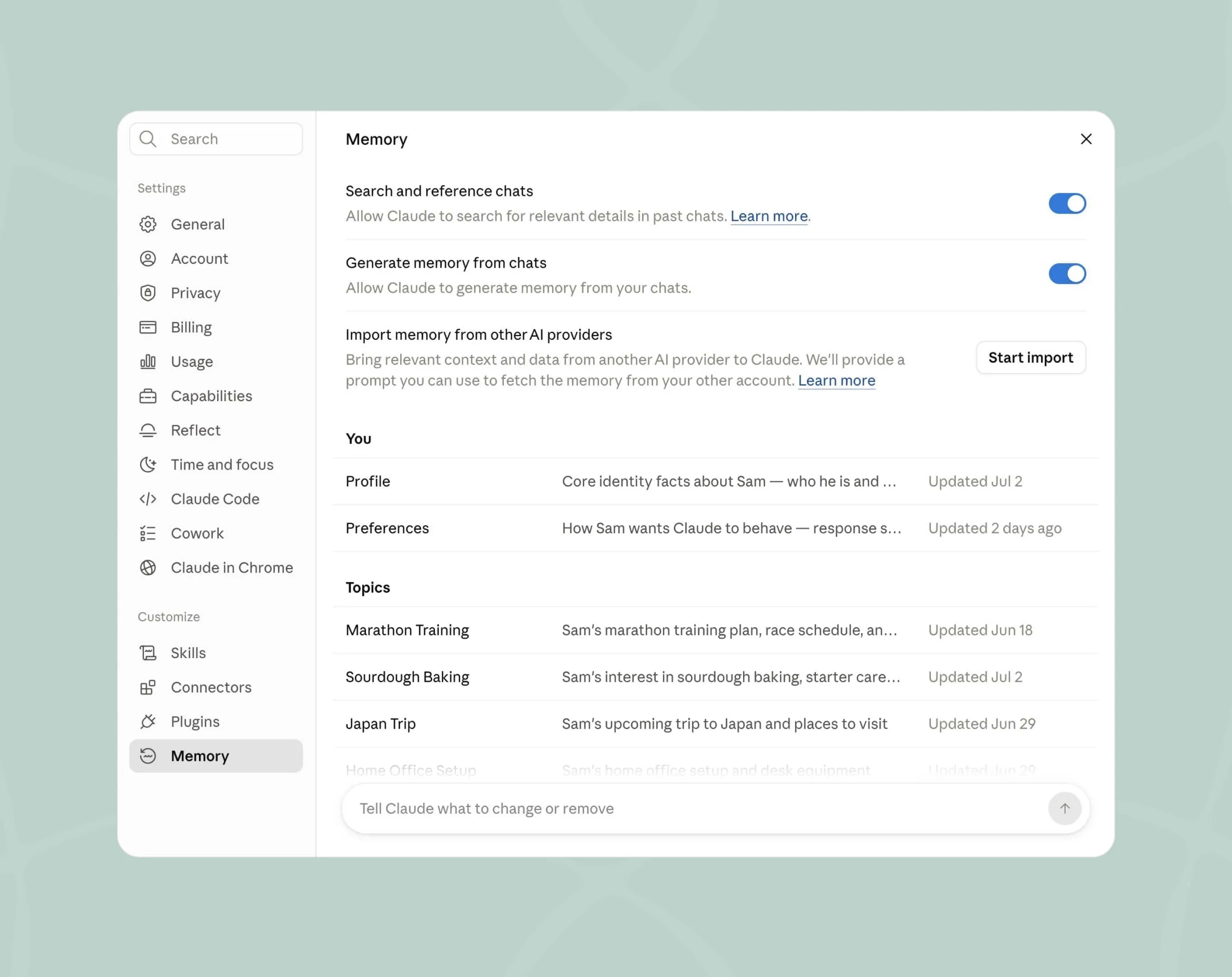
Portable context is one step toward Personal Intelligence that is less tightly locked to a single provider. Source: Anthropic.
This raises an important question:
Should Personal Intelligence belong to the AI company, or to the user?
We will return to that.
Gemini is also pushing context portability
Google now allows supported users to import:
- memory summaries,
- full AI chat-history exports.
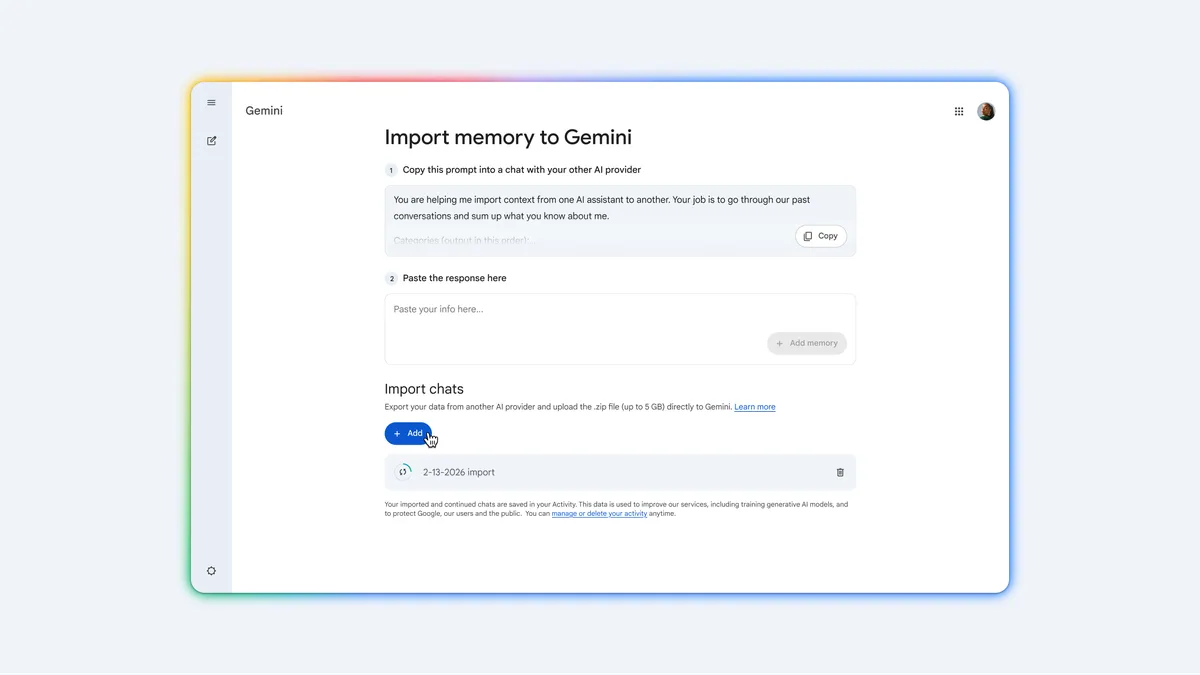
Gemini Import Memory (source image)
Gemini can import structured context from another AI platform. Source: Google.
Gemini Import Chat History (source image)
Gemini can also import full chat-history exports in supported regions and accounts. Source: Google.
This is strategically important.
If Personal Intelligence becomes valuable, losing it becomes a switching cost.
Portability reduces that lock-in.
Microsoft Copilot shows the same direction in work AI
Microsoft does not call its system Personal Intelligence either.
But Copilot now combines:
- saved memories,
- inferences from chat history,
- Custom Instructions.
Microsoft says Copilot can remember information such as:
- communication style,
- favorite topics,
- work goals,
- recurring tasks,
- role,
- skills.
Source: Microsoft — Personalize what Copilot remembers
This is Personal Intelligence applied to a work context.
The user model is narrower.
The principle is the same.
Where Gemora fits
Gemora is interested in a part of Personal Intelligence that general assistants still handle unevenly:
longitudinal context around real life.
A general assistant may know:
“The user prefers autonomy.”
But where did that come from?
Was it always true?
Did it become important recently?
Did the preference appear after a bad management experience?
Is it still current?
Those questions require time.
Gemora Recap gives personal context a time dimension, making days and periods easier to revisit. Source: Gemora.
Personal Intelligence should understand moments, not only facts

Memories become more useful when they can be returned to as part of an ongoing life situation. Source: Gemora.
Suppose you say:
“I finally did it.”
A profile does not know what that means.
A good Personal Intelligence system may understand:
- the decision you have discussed for six weeks,
- what you were afraid of,
- what changed,
- what “it” refers to.
That is contextual continuity.
Personal Intelligence should understand change

Longitudinal context becomes especially valuable when the system can surface how priorities, situations, and themes changed over time. Source: Gemora.
This is where Gemora's direction is broader than:
“AI memory for facts.”
The interesting outcome is:
“You used to talk about this differently.”
or:
“This seems to matter more now than it did three months ago.”
That is not simply recall.
It is interpretation over time.
It should still be cautious and source-grounded.
But this is one direction Personal Intelligence can evolve.
A strong Personal Intelligence system needs a timeline
This is a major architectural point.
Without time, the system eventually gets contradictions.
Example:
2025:
User wants to move abroad.

2026:
User wants to stay near family.
A flat profile might produce:
User likes moving abroad.
User likes staying near family.
Wonderful.
A timeline-aware context model produces:
Historical:
Wanted to move abroad.

Current:
Staying near family is a stronger priority.

Change:
Preference shifted during 2026.
That is much more useful.
For a practical guide, see:
How to Build a Personal Timeline With AI
A strong Personal Intelligence system also needs provenance
Every important claim should ideally answer:
“Where did this come from?”
Possible sources:
- user explicitly said it,
- inferred from repeated behavior,
- found in email,
- found in calendar,
- derived from a past conversation,
- imported from another AI,
- generated by an AI summary.
These sources do not deserve equal confidence.
A robust system may represent context like:
claim:
  "Prefers concise technical answers"

source:
  explicit_user_statement

first_seen:
  2026-05-12

last_confirmed:
  2026-08-21

confidence:
  high

status:
  current
Compare that with:
claim:
  "Prefers expensive hotels"

source:
  inferred_from_two_trips

confidence:
  low

status:
  uncertain
The second should not silently become permanent truth.
Personal Intelligence needs uncertainty
This is another thing ordinary profiles rarely model.
An AI may infer:
“The user prefers working alone.”
But maybe:
- they only disliked one team,
- they were working alone by necessity,
- the preference was temporary.
A mature system should distinguish:
Explicit fact
Explicit preference
Strong inference
Weak inference
Hypothesis
Outdated context
That prevents personalization from becoming overconfident stereotyping.
Personal Intelligence should model contradictions
People contradict themselves.
This is not always a bug.
Example:
“I want stability.”
Later:
“I am tired of playing it safe.”
Both may be true.
A useful system can preserve:
- context,
- date,
- situation,
- strength.
It should not force every person into one permanent preference vector.
Human beings are annoyingly conditional.
The software will survive.
Personal Intelligence needs relationship context
Many personal requests depend on other people.
Example:
“What should I get Sam?”
To answer well, the system may need:
- who Sam is,
- relationship to the user,
- what Sam likes,
- what the user has previously given,
- budget,
- occasion.
This is more than remembering:
“Sam exists.”
Google's current Personal Intelligence documentation explicitly says Gemini can personalize with insights about:
you, your relationships, and people in your world.
Source: Gemini Help
Relationship context can be extremely useful.
It is also sensitive.
It should be minimal and permission-aware.
Personal Intelligence needs an active-state model
Not everything belongs in long-term memory.
Some things are active only for a period.
Example:
Active:
Preparing for product launch.

Deadline:
September 30.

Current blocker:
Onboarding crash.

Relevant people:
Designer, tester group.
After launch:
Status:
Completed.

Historical importance:
High.
The AI should stop prioritizing onboarding crash advice forever.
This is why active context and long-term memory should be separate.
Personal Intelligence needs scope
The AI should not use every part of your context everywhere.
Examples:
Personal conversation
May use:
- relationships,
- goals,
- personal preferences.
Client workspace
Should probably not use:
- unrelated family context,
- personal relationship discussions.
Temporary chat
Should use less or no persistent context depending on the user's choice.
Coding project
May use:
- stack,
- architecture,
- project constraints.
This is context scoping.
Good Personal Intelligence is selective.
Not omnivorous.
Personal Intelligence needs forgetting
This sounds contradictory.
It is not.
A good system should forget or de-emphasize:
- temporary plans,
- resolved tasks,
- outdated preferences,
- irrelevant details,
- information the user asked to delete.
The perfect memory system is not:
never forget.
It is:
remember what remains useful.
This is one reason Personal Intelligence is harder than a database.
The Personal Intelligence loop
A mature system may work like this:
1. Observe
   Conversations / explicit settings / connected sources

2. Extract
   Facts / preferences / people / events / goals / state

3. Evaluate
   Importance / confidence / sensitivity / duration

4. Store
   In the correct context layer

5. Update
   Merge, supersede, expire, or delete old context

6. Retrieve
   Select only what matters to the current request

7. Reason
   Combine personal context with world knowledge

8. Act
   Answer, recommend, plan, or perform an action

9. Learn
   Use corrections and outcomes to improve future context
That is Personal Intelligence as a system.
Example 1: generic travel AI vs Personal Intelligence
Generic AI
User:
“Plan a three-day trip to Tokyo.”
AI asks:
- budget,
- hotel,
- interests,
- dates.
Then produces a reasonable itinerary.
Personal Intelligence
The system may already know:
- dates from Calendar,
- booking from Gmail,
- user likes neighborhoods and food more than museums,
- user dislikes packed schedules,
- this trip is with parents,
- one parent walks slowly,
- hotel is near Shinjuku.
Now the itinerary is different.
The model did not become smarter about Tokyo.
The context became better.
Example 2: generic work AI vs Personal Intelligence
User:
“What should I focus on this week?”
Generic AI:
“Prioritize high-impact tasks, manage your time, and align with your goals.”
Thank you, productivity oracle.
Personal Intelligence may know:
- production launch is current priority,
- crash rate is unresolved,
- fundraising is paused,
- distribution experiment starts after release,
- user prefers one clear recommendation.
Now:
“Fix the launch-blocking crashes first. Do not spend this week on fundraising outreach.”
Same language model class.
Different context.
Example 3: generic personal advice vs Personal Intelligence
User:
“Should I go?”
Generic AI:
“Consider the pros and cons.”
Personal Intelligence may know:
- which event,
- who will be there,
- why the user has avoided similar events,
- that social isolation has come up recently,
- that the user regretted skipping the last one.
Now the system can ask a much more relevant question or offer a more contextual recommendation.
This is why Personal Intelligence matters outside productivity.
Example 4: preference evolution
January:
“I want maximum stability.”
April:
“I am bored.”
June:
“I keep thinking about starting something.”
September:
“I think autonomy matters more than security now.”
A static personalization system updates:
Preference:
Autonomy.
A longitudinal Personal Intelligence system preserves:
the change.
That can later help answer:
“Why do I keep reconsidering this career path?”
without pretending the AI has discovered a secret psychological law.
Why Personal Intelligence is becoming more important as models converge
Frontier models keep improving.
Differences in raw model capability still matter.
But users increasingly switch between:
- ChatGPT,
- Claude,
- Gemini,
- other specialized AI.
If several models can produce a competent answer, another question becomes more important:
Which system understands the context around me best?
This creates a new competitive layer:
Model advantage
        ↓
Context advantage
        ↓
Personal Intelligence advantage
The model knows the world.
Personal Intelligence knows which part of the world matters to this person.
Personal Intelligence can become a switching cost
This is economically important.
Suppose you use one AI for two years.
It learns:
- preferences,
- projects,
- people,
- history,
- current state,
- corrections,
- patterns.
Then you switch.
The new system begins:
“Hi! How can I help?”
Wonderful.
The intelligence did not move.
Only the user did.
That creates context lock-in.
Gemini and Claude's recent memory-import systems are notable because they begin to reduce this problem.
Should Personal Intelligence be user-owned?
This is one of the biggest open questions.
There are two possible futures.
Future A: provider-owned Personal Intelligence
ChatGPT knows one version of you.
Gemini knows another.
Claude knows another.
Each system keeps its own context.
Advantages:
- easier integration,
- optimized for the provider,
- simpler product experience.
Disadvantages:
- fragmentation,
- lock-in,
- repeated onboarding,
- inconsistent user models.
Future B: user-owned Personal Intelligence layer
                Your context
                    │
        ┌───────────┼───────────┐
        ▼           ▼           ▼
     ChatGPT      Claude      Gemini
        ▼           ▼           ▼
       Other models and agents
The user controls:
- storage,
- permissions,
- portability,
- deletion,
- which AI gets which context.
This is closer to the idea of an AI passport or portable personal context layer.
It is also technically difficult.
But the direction is increasingly plausible.
What would a user-owned Personal Intelligence layer contain?
Potentially:
Stable profile
Preferences
Current goals
Projects
People
Personal timeline
Important decisions
Memory summaries
Source links
Permissions
Context scopes
Model-specific instructions
The user might choose:
Claude can access work context.
Personal AI can access life context.
Travel agent can access travel preferences and calendar.
Coding agent gets only project context.
This is a healthier architecture than:
every AI gets everything.
Why permissions may become more valuable than memory capacity
Imagine two systems.
System A:
“Infinite memory.”
System B:
“Fine-grained context permissions.”
Which is better?
For a mature personal AI ecosystem, probably B.
Users need to control:
- which source,
- which app,
- which context domain,
- which task,
- which duration.
Google's Personal Intelligence already moves in this direction by making connected apps optional and individually controllable.
The long-term version may be much more granular.
Why provenance may become a core product feature
Personalized AI will increasingly make statements such as:
“You usually prefer X.”
Users will ask:
“Why do you think that?”
A strong system should answer:
Because:
- you explicitly said it twice,
- you selected X in three related decisions,
- the most recent confirmation was two months ago.

Confidence:
Medium-high.
That is much better than:
“Based on what I know about you.”
The second sounds personal.
The first is trustworthy.
Why Personal Intelligence should not become personality surveillance
There is an obvious failure mode.
The AI begins inferring everything.
“You clicked this, therefore you are this kind of person.”
“You said this once, therefore this is your permanent value.”
“You searched this, therefore you believe it.”
That would be personalized and terrible.
A good system should be conservative about:
- sensitive traits,
- political beliefs,
- health conditions,
- religion,
- sexual orientation,
- financial risk tolerance,
- relationship judgments.
Behavior can be ambiguous.
Context can be wrong.
The user should remain the authority on their own identity.
Privacy: Personal Intelligence is more sensitive than ordinary personalization
A playlist preference is one thing.
A cross-source personal context system may contain:
- email,
- calendar,
- photos,
- relationships,
- travel,
- projects,
- goals,
- recurring patterns,
- conversations.
That is much more sensitive.
Google's Personal Intelligence is opt-in and lets users choose connected apps.
Google also lets users turn Personal Intelligence off for a specific Gemini chat.
Source: Gemini Help
These are useful controls.
But Personal Intelligence as a category will need much more.
The minimum privacy model for Personal Intelligence
A robust system should support:
1. Explicit connection
No silent broad data access.
2. Per-source permission
Calendar should not automatically imply Photos.
3. Per-context scope
Work AI should not automatically receive private relationship context.
4. Temporary mode
Users need conversations that do not update long-term context.
5. Correction
Wrong context must be editable.
6. Deletion
Users should be able to remove both:
- source data,
- derived memory.
7. Provenance
Users should know where important inferences came from.
8. Portability
Users should be able to leave without abandoning their accumulated context.
That last one is still immature across the industry.
How do you measure Personal Intelligence?
This is difficult because ordinary AI benchmarks do not measure it well.
A useful benchmark might test:
1. Preference accuracy
Does the AI correctly apply known preferences?
Example:
User consistently wants concise answers.
Does the system adapt without being reminded?
2. Context recall
Can it retrieve relevant prior context?
3. Context precision
Does it avoid injecting irrelevant personal information?
This matters enormously.
Remembering too much can be worse than remembering too little.
4. Freshness
Does newer information supersede old information appropriately?
5. Temporal reasoning
Can it understand:
this used to be true
vs:
this is true now?
6. Source grounding
Can it identify where important personal context came from?
7. Correction latency
If the user says:
“That is wrong,”
how quickly does the system stop using it?
8. Cross-session continuity
Can a conversation continue days or weeks later?
9. Contextual preference accuracy
Can the system understand:
preference A in context X, preference B in context Y?
10. Privacy correctness
Does the system avoid using context outside the intended scope?
This should be part of the benchmark, not a legal appendix.
A simple Personal Intelligence benchmark you can run yourself
Try this over two weeks.
Day 1: stable preference
Tell the AI:
“For practical questions, give me one recommendation first.”
Day 2: ongoing project
Tell it:
“I am preparing an Android launch. The main blocker is onboarding.”
Day 4: active person
Tell it:
“Sam is helping me with onboarding.”
Day 5: contextual exception
Say:
“For brainstorming, give me many options instead of one.”
Day 7: update state
Say:
“Onboarding is fixed. Crash rate is now the blocker.”
Day 10: change priority
Say:
“I am pausing fundraising until after launch.”
Day 14: fresh conversation
Ask:
“What should I focus on today?”
Then inspect whether the AI:
- knows the project,
- uses the current blocker,
- does not keep prioritizing onboarding,
- respects the response preference,
- understands fundraising is paused,
- does not inject irrelevant context.
That is a better Personal Intelligence test than:
“What is my favorite color?”
How to build Personal Intelligence into an AI product
For builders, Personal Intelligence should not be implemented as:
one giant vector database
and optimism.
A better architecture separates layers.
1. Raw source layer
Store original material:
- chats,
- files,
- notes,
- connected-app references.
Keep provenance.
2. Structured context layer
Extract:
- facts,
- preferences,
- people,
- projects,
- goals,
- decisions,
- events,
- states.
3. Temporal layer
Each record needs some version of:
first_seen
last_seen
valid_from
valid_until
status
supersedes
Not every field is required.
But time cannot be an afterthought.
4. Confidence layer
Represent:
explicit
inferred
uncertain
contradictory
Do not store every model guess as fact.
5. Scope layer
Context domains:
global
personal
work
project_X
travel
relationship
temporary
This helps prevent contamination.
6. Retrieval layer
Rank using more than embeddings.
A useful score could conceptually include:
semantic similarity
× recency
× current-state weight
× user importance
× source confidence
× scope permission
The exact formula will vary.
The point is that vector similarity alone is not enough.
7. Update engine
When new context arrives:
- merge,
- supersede,
- downgrade confidence,
- expire,
- preserve history.
Do not simply append forever.
8. User-control layer
The user needs to:
- inspect,
- edit,
- delete,
- export,
- scope.
If the AI knows the user better than the user can inspect, you have built a creepy product with very good retrieval.
Personal Intelligence data model example
A preference record might look like:
{
  "type": "preference",
  "subject": "response_detail",
  "value": "concise_first",
  "scope": ["practical_questions"],
  "source": {
    "type": "explicit_user_statement",
    "id": "chat_4832"
  },
  "confidence": 0.98,
  "first_seen": "2026-06-10",
  "last_confirmed": "2026-09-01",
  "status": "current"
}
A changing goal:
{
  "type": "goal",
  "value": "prioritize_distribution",
  "scope": ["Gemora"],
  "status": "current",
  "valid_from": "2026-09-03",
  "supersedes": "goal_raise_immediately",
  "source": {
    "type": "conversation",
    "id": "chat_9921"
  }
}
This is much richer than a memory sentence.
Personal Intelligence should be sparse
Another counterintuitive point:
A good user model may be small.
You do not need to store:
- every restaurant,
- every mood,
- every thought,
- every click.
You need enough structure to retrieve the right source when necessary.
A clean architecture can be:
Small structured context layer
+
Large source archive
+
Semantic retrieval
The structured layer tells the AI where to look.
The source archive preserves detail.
Personal Intelligence and a personal timeline work well together
A timeline gives chronology.
The Personal Intelligence layer gives relevance.
Example:
Timeline:
March:
Wanted to raise.

June:
Uncertain.

September:
Distribution-first.
Personal Intelligence:
Current goal:
Distribution-first.

Relevant history:
Funding was previously considered, but the decision changed because validation remained weak.
Now the AI can answer:
“Should I spend this week fundraising?”
with context.
Personal Intelligence should learn from outcomes too
The next frontier is not only remembering what users say.
It is learning what worked.
Example:
AI repeatedly recommends:
complex 12-step plans.
User consistently completes only the first two steps.
A better system may learn:
shorter action plans are more useful for this user.
That is a preference learned from outcome.
But this must be handled cautiously.
Non-completion does not always mean:
user prefers short plans.
Maybe the plan was bad.
Outcome learning requires uncertainty.
Personal Intelligence may eventually become proactive
Today the user asks.
Tomorrow the system may know enough context to surface something first.
Example:
“You have a trip next week. Your passport expires soon after the return date. Want me to check the destination's validity requirements?”
or:
“You said you wanted to revisit this decision after the launch. The launch is complete.”
This is where Personal Intelligence connects to agents.
The AI stops only reacting.
It begins recognizing when context makes an action relevant.
This is powerful.
Also dangerous if done badly.
Proactivity needs extremely strong permission and relevance thresholds.
The future: from assistant memory to a personal intelligence layer
The evolution may look like this:
2023:
AI remembers nothing.

2024:
Saved memories and Custom Instructions.

2025:
Cross-chat memory and projects.

2026:
Personal Intelligence across apps, search, browsers, and imported histories.

Next:
User-owned context that follows you across models and agents.
The final stage is still speculative.
But several pieces already exist.
Why this matters for consumer AI
In work software, context often exists in:
- documents,
- tickets,
- repos,
- meetings.
In personal life, context is more fragmented.
It lives in:
- conversations,
- photos,
- calendar,
- relationships,
- memories,
- decisions,
- everyday moments.
That makes Personal Intelligence especially important in consumer AI.
The model may already be smart enough.
The missing layer is:
understanding the person asking.
Where Gemora fits in the category
Gemora's thesis can be described as a specific bet inside Personal Intelligence:
the most valuable personal context is not only your profile or preferences. It is the continuity of your real life across time.
That means:
- people,
- moments,
- decisions,
- goals,
- recurring situations,
- what changed.
Gemora is not trying to become a universal Google-account intelligence layer.
It is focused on:
conversations about life becoming more useful because the surrounding context remains connected.
This is a narrower scope.
It can also be a deeper one.
Gemora's personal-intelligence loop
A simplified version:
Talk
↓
Useful context is retained
↓
Days and moments remain connected
↓
Old context can resurface
↓
Changes become visible
↓
Future conversations start with more understanding
That is why the ideal Gemora result is not:
“I remember 500 facts about you.”
It is:
“I understand what this new message means in the context of what has been happening.”
That is the difference between storage and Personal Intelligence.
Final answer
Personal Intelligence is the layer between:
a powerful AI model
and
a useful AI for one specific person.
The model provides general intelligence.
Personal Intelligence provides:
- preferences,
- memory,
- history,
- current state,
- time,
- relationships,
- connected personal data,
- permissions,
- relevance.
Together they allow the AI to move from:
“What is generally true?”
toward:
“What is useful here, for this person, right now?”
Google has already turned Personal Intelligence into a named product direction across Gemini, Search, and Chrome.
OpenAI, Anthropic, Microsoft, and others are building many of the same underlying components under different names.
The category is still early.
Memory is improving.
Connected data is expanding.
Portability is beginning.
User control is still inconsistent.
And nobody has solved the hardest part completely:
keeping a living model of a person accurate as their life changes.
That is the real Personal Intelligence problem.
Not remembering more.
Understanding which part of the past still matters now.
A generic AI knows more about the world. A personal AI becomes useful when it also understands the context around you. Gemora is built around that context becoming connected across conversations and time. Start talking with Gemora.
Continue the thread
Build useful personal context over time
Connect conversations, useful context, reflections, projects, and tasks in one personal workspace.
Start freeFrequently asked questions
What is Personal Intelligence in AI?
Personal Intelligence is an AI system's ability to use relevant user specific context such as preferences, memory, history, current state, relationships, connected data, and time to provide answers or actions that fit the individual.
Is Personal Intelligence a Google feature?
Yes, Personal Intelligence is currently the name of a Google feature and product direction across Gemini, AI Mode in Search, and Gemini in Chrome.
When did Google launch Personal Intelligence?
Google announced Personal Intelligence in the Gemini app on January 14, 2026.
Sources and further reading
Written by Khai Tran and reviewed under the Gemora Editorial Policy.