what makes an AI companion feel personal
What Makes an AI Companion Feel Personal?
Learn what makes an AI companion feel personal, from relevant memory and stable personality to timely follow-up, correction, restraint and privacy controls.
Methodology: Analysis based on official product documentation and public feature descriptions listed in the sources, reviewed on 2026-10-20.
Original contribution: A practical model of personalness based on relevance, timing, restraint, correction, identity stability, and user control.
In this guide
- The short answer
- Personalization is not the same as friendliness
- Style
- Personalization
- Deep personalization
- 1. Relevant memory is the foundation
- ChatGPT's 2026 memory work shows the real requirements
- Carry forward useful context
- Follow preferences
- Stay current
- 2. The AI needs to understand people, not only user facts
- People context has several layers
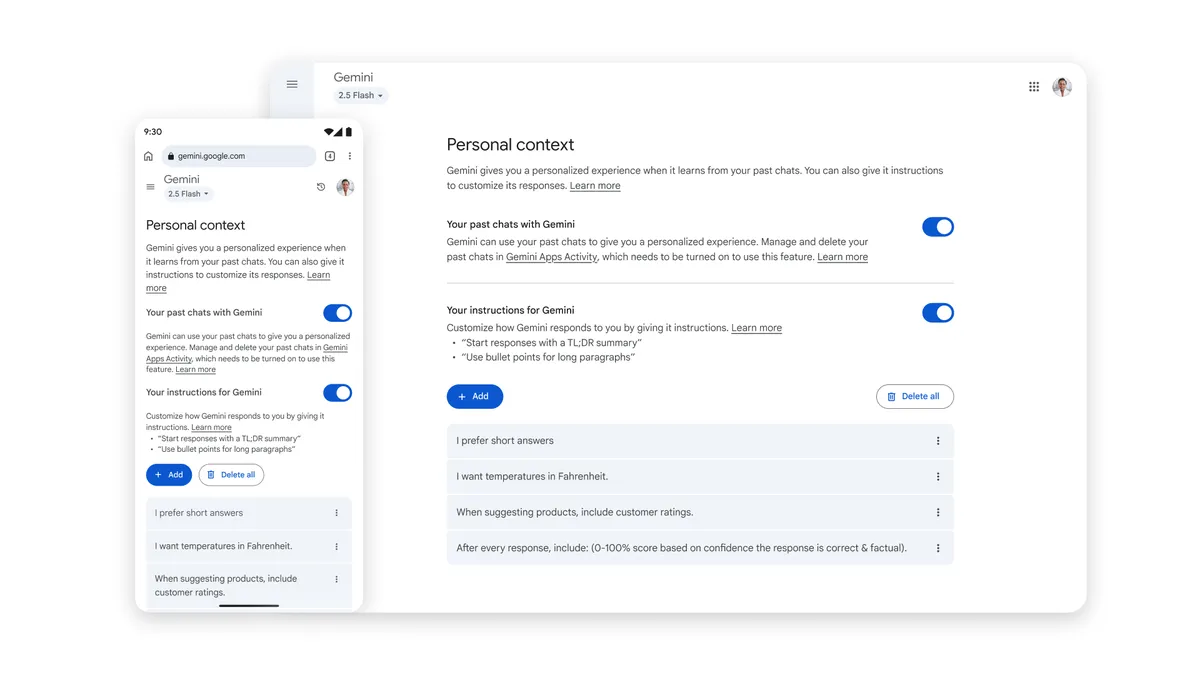
- Gemini explicitly treats relationships as personal context
- Nomi's Mind Maps demonstrate a people graph
- Replika also remembers people in the user's life
- 3. Time may matter more than memory volume
- Example: work
- Personalization should model states
- This is why “what changed?” is such a powerful personal question
- 4. Preference learning should be contextual, not rigid
Related reading: memory vs history · apps with recall · long-term assistants · memory controls.
An AI companion does not feel personal because it says your name. It feels personal when the right context from your life changes the conversation in a way that actually makes sense. Source: Gemora.
A chatbot can learn your name in ten seconds.
That does not make it personal.
It can say:
“That sounds difficult, Alex.”
Still not personal.
It can remember:
favorite color = blue.
Better.
Still not enough.
The difference becomes obvious when you compare two conversations.
Generic AI:
“My sister finally got the job.”
AI:
“That's great. What kind of job did she get?”
Personal AI:
“She got the one she was interviewing for last week?”
The second answer is shorter.
But it feels radically different.
Why?
Because the AI understood:
- who “she” is,
- what had been happening,
- which past detail matters now,
- that the situation changed.
That is the beginning of real personalization.
The strongest AI companions in 2026 are moving beyond simple profile facts.
ChatGPT's latest memory system is designed to carry forward useful context, follow preferences and constraints, and stay current as circumstances change.
Claude now exposes persistent memory as editable Topics and updates them while conversations happen.
Gemini's Personal Intelligence can combine connected personal sources and explicitly aims to understand you, your relationships, and people in your world.
Nomi uses layered memory plus Mind Maps that connect people, places, topics, and goals.
Replika learns preferences, interests, friends, family, and conversation patterns.
Pi now remembers durable information such as family, work, hobbies, communication preferences, goals, routines, and habits.
And Gemora's approach is centered on conversations, people, decisions, projects, memories, and changes staying connected across time.
These systems reveal something important:
Personalization is not a single feature. It is an architecture.
The AI needs to answer several questions correctly:
Who is this user?
What matters to them?
Who are the important people?
What is happening now?
What happened before?
What changed?
Which old context is relevant?
Which old context should stay out of this conversation?
How certain is the system?
Can the user correct it?
A companion can have enormous memory and still fail.
It can have a wonderful personality and still feel generic.
The thing that makes an AI feel personal is not:
how much it knows.
It is:
whether it uses the right context, at the right time, in the right way.
The short answer
An AI companion feels personal when it consistently does ten things well:
- Remembers relevant context
- Understands the important people in your life
- Knows what is current and what is historical
- Learns preferences without turning them into rigid rules
- Maintains a stable conversational personality
- Follows up naturally on unfinished threads
- Uses context selectively instead of showing off memory
- Knows when not to analyze
- Lets you inspect and correct what it thinks it knows
- Adapts as you change
The most important principle is:
Personal does not mean “more memory.” Personal means “better relevance.”
Personalization is not the same as friendliness
This is the first distinction.
An AI can be:
- warm,
- funny,
- supportive,
- casual,
- enthusiastic,
without knowing anything meaningful about you.
That is:
style.
Personalization is different.
Style
AI:
“That sounds exciting! You must be thrilled.”
This could be said to anyone.
Personalization
AI:
“After how uncertain you were about this last month, that must feel very different.”
Now the response depends on:
your history.
That is personal.
Deep personalization
AI:
“You were leaning toward quitting because the role had become too managerial. Now that they offered you a more hands-on position, the original reason for leaving may have changed.”
Now the response uses:
- historical state,
- current state,
- decision reasoning,
- time.
That is much deeper.
1. Relevant memory is the foundation
Without memory, every conversation begins from zero.
That makes a companion feel like:
a very charming stranger with excellent customer service.
Memory creates continuity.
But memory alone is not enough.
ChatGPT's 2026 memory work shows the real requirements
OpenAI describes three main goals for good memory:
- carry forward useful context,
- follow preferences and constraints,
- stay current over time.
Source: OpenAI — Better Memory for ChatGPT

Modern personalization requires more than isolated saved facts. ChatGPT's newer memory architecture synthesizes broader context while exposing a reviewable summary. Source: OpenAI.
These three requirements are useful beyond ChatGPT.
They describe the problem every personal companion has.
Carry forward useful context
You say:
“I am working on a mobile app.”
A month later:
“The launch was delayed.”
A personal AI should understand:
which launch.
That reduces repetition.
Follow preferences
You say:
“I hate giant explanations. Keep things concise.”
Later:
the companion should adapt.
Not mention:
“As you prefer concise responses…”
every time.
The best personalization becomes invisible.
Stay current
You say:
“I am in Singapore this week.”
Two months later:
the AI should not recommend dinner in Singapore.
OpenAI explicitly uses this kind of example to explain memory freshness.

The fact may have been correctly remembered but still be wrong for the current moment. Source: OpenAI.

Personalization improves when the system understands transitions such as planned → happening → completed. Source: OpenAI.
This is crucial.
A companion that remembers everything but cannot update anything becomes less personal over time.
It becomes:
a museum of outdated versions of you.
2. The AI needs to understand people, not only user facts
Many personal conversations depend on other people.
Examples:
“She finally replied.”
“Sam changed his mind.”
“My sister is visiting.”
If the AI knows:
favorite food = sushi
but does not know:
who “she” is,
the interaction still feels shallow.
People context has several layers
A useful representation may include:
Person:
Maya

Relationship:
sister

Current situation:
recently interviewing for a new job

Shared context:
visiting next month

Historical:
moved cities earlier this year
That is much richer than:
“User has a sister named Maya.”
Gemini explicitly treats relationships as personal context
Google says Personal Intelligence can personalize Gemini with insights about:
you, your relationships, and people in your world.
Source: Gemini Help — Personal Intelligence
Gemini Personal Context (source image)
Gemini's Personal Intelligence reflects a broader model of personalization where people and relationships are part of the context, not merely user preferences. Source: Google.
That is an important evolution.
A personal AI cannot understand many life questions without understanding:
who the relevant people are.
Nomi's Mind Maps demonstrate a people graph
Nomi's Mind Map 2.0 automatically organizes long-term memories into high-level concepts around:
- people,
- places,
- topics,
- goals.
Source: Nomi — Mind Map 2.0

Nomi's memory architecture explicitly connects people with other parts of an ongoing relationship history. Source: Nomi.
Nomi gives an example involving a user's grandfather.
Separate memories include:
- his work with satellites,
- NASA contracts,
- the user's mother's childhood moves caused by his job.
The Mind Map connects those facts into a bigger picture.
That is closer to:
relational context.
Not just:
stored facts.
Replika also remembers people in the user's life
Replika says it typically remembers:
- friends,
- family,
- pets,
- interests,
- tastes,
- preferences.
Source: Replika — What Does Replika Remember?

Companion memory often extends beyond the user profile into recurring people and relationships. Source: Replika.
This is one reason companion apps can feel more personal than generic stateless assistants.
They treat the user's social world as durable context.
3. Time may matter more than memory volume
A deeply personal AI needs:
chronology.
Without time, memory becomes misleading.
Example: work
January:
“I love this role.”
April:
“I am frustrated.”
June:
“I am thinking of leaving.”
September:
“I accepted another job.”
A poor memory system compresses:
“User likes current job and wants to leave job.”
Technically both were true.
Historically.
A time-aware system understands:
Past:
liked role

Later:
became frustrated

Then:
considered leaving

Current:
changed jobs
That feels far more personal because:
it reflects change.
Personalization should model states
Useful states include:
planned
active
waiting
completed
cancelled
historical
Example:
trip to Japan.
The system should understand:
May:
planning trip

June:
trip upcoming

July:
currently traveling

August:
trip completed
The fact does not disappear.
Its status changes.
This is why “what changed?” is such a powerful personal question
A companion that can answer:
“What changed since last time?”
is much more useful than one that can answer:
“What facts do I know?”
The first requires:
- history,
- current state,
- comparison.
That is Personal Intelligence.
4. Preference learning should be contextual, not rigid
Preferences are another important layer.
But “preference” is a dangerous word because humans are inconsistent.
Example:
“I prefer concise answers.”
Maybe true for:
- technical questions.
Not true for:
- relationship decisions.
A good personal companion should not convert:
one preference
into:
universal law.
ChatGPT explicitly models several kinds of preferences
OpenAI's 2026 memory work describes:
- instructions about how the system should respond,
- explicit personal preferences and constraints,
- implicit preferences that influence relevance.
Source: OpenAI — Better Memory
This distinction matters.
Explicit preference
“I am vegetarian.”
Strong.
Durable.
Response preference
“Keep this short.”
May apply only here.
Implicit preference
You repeatedly choose:
quiet cafés.
The AI may infer:
quiet spaces are often relevant.
But that should remain:
uncertain.
Preference drift matters
Suppose:
2025:
“I want maximum stability.”
2026:
“I want more risk.”
A personal AI should not insist:
“But you prefer stability.”
Preferences evolve.
The system needs:
historical preference vs current preference.
Pi's memory is deliberately durable
Pi says its Memory focuses on things likely to remain true for months, including:
- family members,
- food preferences,
- hobbies,
- job/study,
- communication preferences,
- goals,
- routines,
- habits.
Source: Pi — Memory
This is sensible.
Pi also says it intentionally skips many temporary plans and one-off events.
That is a useful design principle:
do not promote every sentence into permanent personalization.
5. Stable personality matters more than most personalization systems admit
The companion needs to know the user.
But the companion also needs to feel:
internally consistent.
This is different from memory.
Imagine a companion with perfect recall but random personality
Monday:
dry humor.
Tuesday:
hyper-enthusiastic coach.
Wednesday:
formal therapist-like tone.
Thursday:
anime roleplay.
The system remembers everything.
Still feels broken.
Companion identity is part of personalization
A user may prefer:
- calm,
- playful,
- concise,
- curious,
- deadpan,
- energetic.
But this is not only:
response style.
It creates expectations about:
who the companion feels like.
Stable does not mean repetitive
A good companion personality behaves like a person:
consistent enough to recognize, flexible enough to fit the moment.
Bad stable personality:
makes the same joke every conversation.
Bad adaptive personality:
becomes a completely different character depending on prompt.
Gemora exposes style without making the AI character the center
Gemora's companion product currently lets users shape conversation through:
- companion styles,
- custom instructions.
Source: Gemora — AI Companion
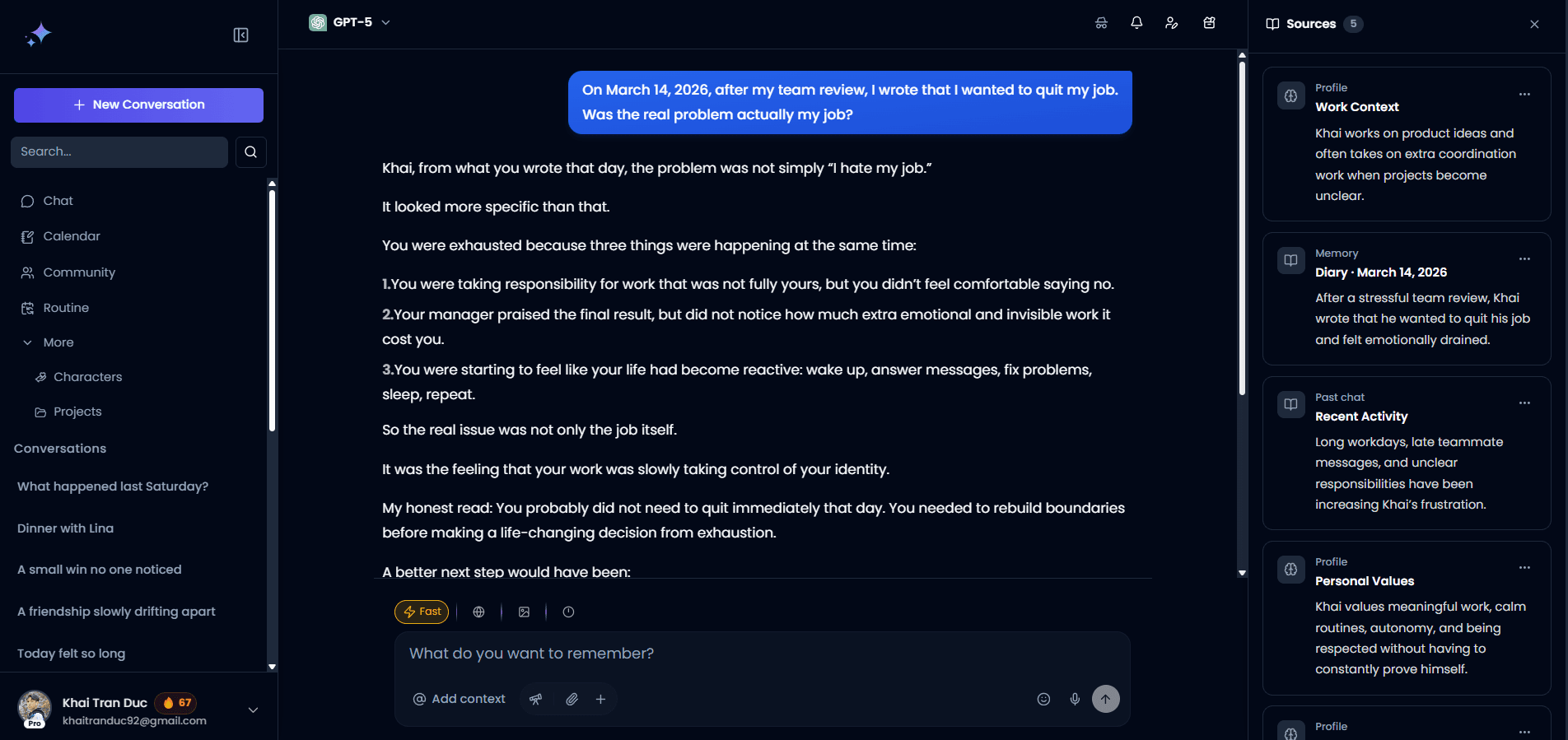
Conversation style can be personalized without requiring the AI character itself to become the center of the product. Source: Gemora.
That distinction matters.
The strongest personal AI may not need:
a giant fictional backstory.
It needs:
predictable relational behavior.
6. Follow-up creates the feeling of being remembered
One of the strongest “personal” moments is:
unsolicited continuity.
Example:
Monday:
“Interview tomorrow. Nervous.”
Wednesday:
“How did it go?”
That feels personal because the system did not merely retrieve a fact.
It understood:
- future relevance,
- timing,
- unfinished thread.
A companion needs open loops
A useful context model may include:
Open loop:
Sister's interview

Expected event:
Tuesday

Follow-up relevance:
Wednesday onward

Status:
unknown
Then when the user returns:
ask naturally.
But follow-up should be selective
Imagine the AI asks about:
- every appointment,
- every task,
- every person,
- every plan.
Horrible.
The system needs to infer:
what mattered enough to follow up.
This is where Personal Intelligence becomes difficult.
Significance is not frequency
A person mentioned once may matter enormously.
A coworker mentioned 100 times may simply send too many emails.
The companion should not rank relevance solely by:
- mention count,
- message length,
- sentiment.
Importance is contextual.
7. The best personalization is often invisible
Weak personalization loves announcing itself.
“Since I remember that you are a vegetarian…”
“Because you told me your sister Maya…”
“Knowing your preference for short answers…”
This becomes annoying quickly.
Good personalization simply:
uses the context.
Example
Weak:
“Because you previously told me you are vegetarian, I recommend the vegetarian option.”
Better:
“The mushroom ramen looks like the better fit.”
The user experiences:
relevance.
Not:
memory theater.
The companion should not perform memory
This is a surprisingly common failure.
The system remembers an obscure detail and inserts it because:
it can.
Example:
User:
“Which laptop should I buy?”
AI:
“As someone who loves jellyfish…”
No.
Memory should be retrieved only when it materially changes:
- answer,
- tone,
- recommendation,
- follow-up.
8. Restraint makes AI feel more personal, not less
This sounds contradictory.
But a deeply personal companion should know:
when not to personalize.
Example: ordinary statement
User:
“I had pizza.”
Over-personalized AI:
“Interesting. Last month you said you were trying to eat healthier. Do you think this reflects difficulty staying consistent?”
Please leave the pizza alone.
A good companion understands conversational scale
Some statements require:
- acknowledgment.
Some require:
- memory.
Some require:
- analysis.
Some require:
- action.
The ability to choose correctly creates attunement.
Attunement is contextual response selection
Think:
User message
+
current state
+
relevant history
+
tone
+
uncertainty
=
response mode
Possible modes:
- listen,
- joke,
- ask,
- advise,
- retrieve,
- challenge,
- celebrate,
- do nothing special.
This matters more than always maximizing helpfulness.
9. Personalization needs correction
An AI can only feel personal while it is:
mostly right.
A confident wrong memory is worse than no memory.
Claude's new Topics make this unusually visible
Anthropic's August 2026 memory system lets users:
- see remembered context topic by topic,
- edit individual topics,
- delete them,
- pause/reset memory.
Source: Anthropic — Claude Memory
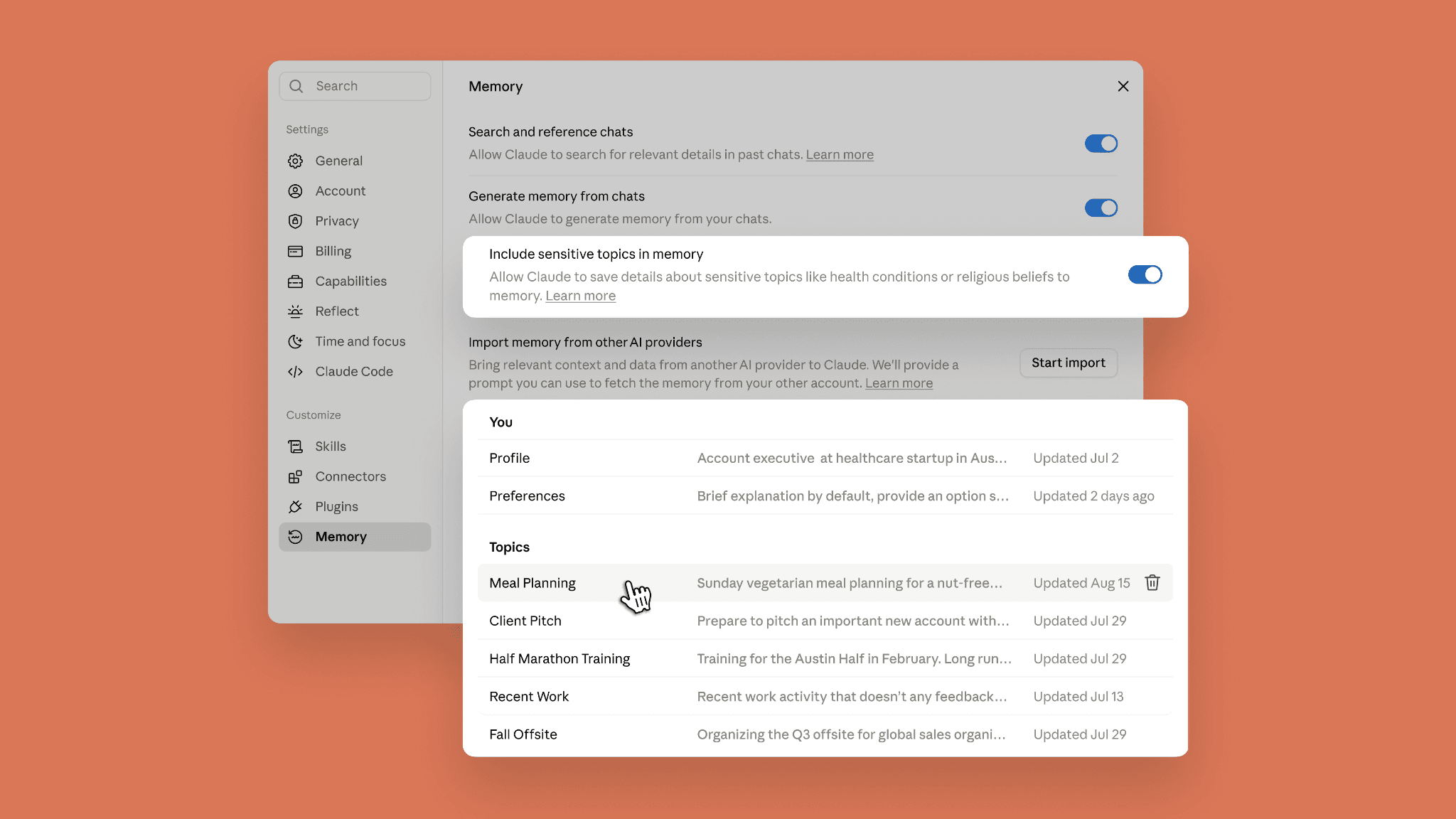
Claude exposes persistent memory rather than making personalization entirely invisible. Source: Anthropic.
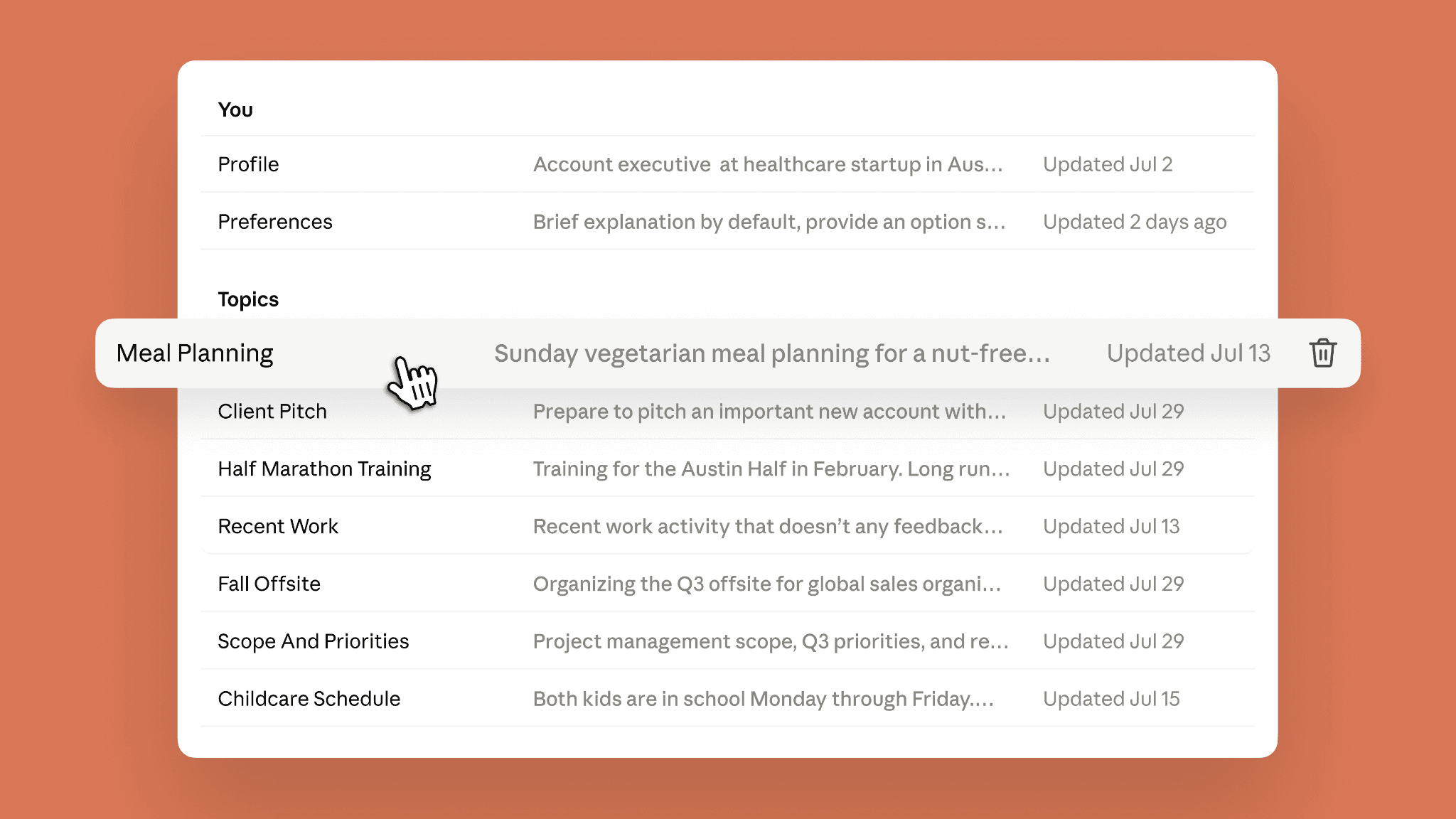
Topic-level visibility gives users a way to inspect the model's representation of them. Source: Anthropic.
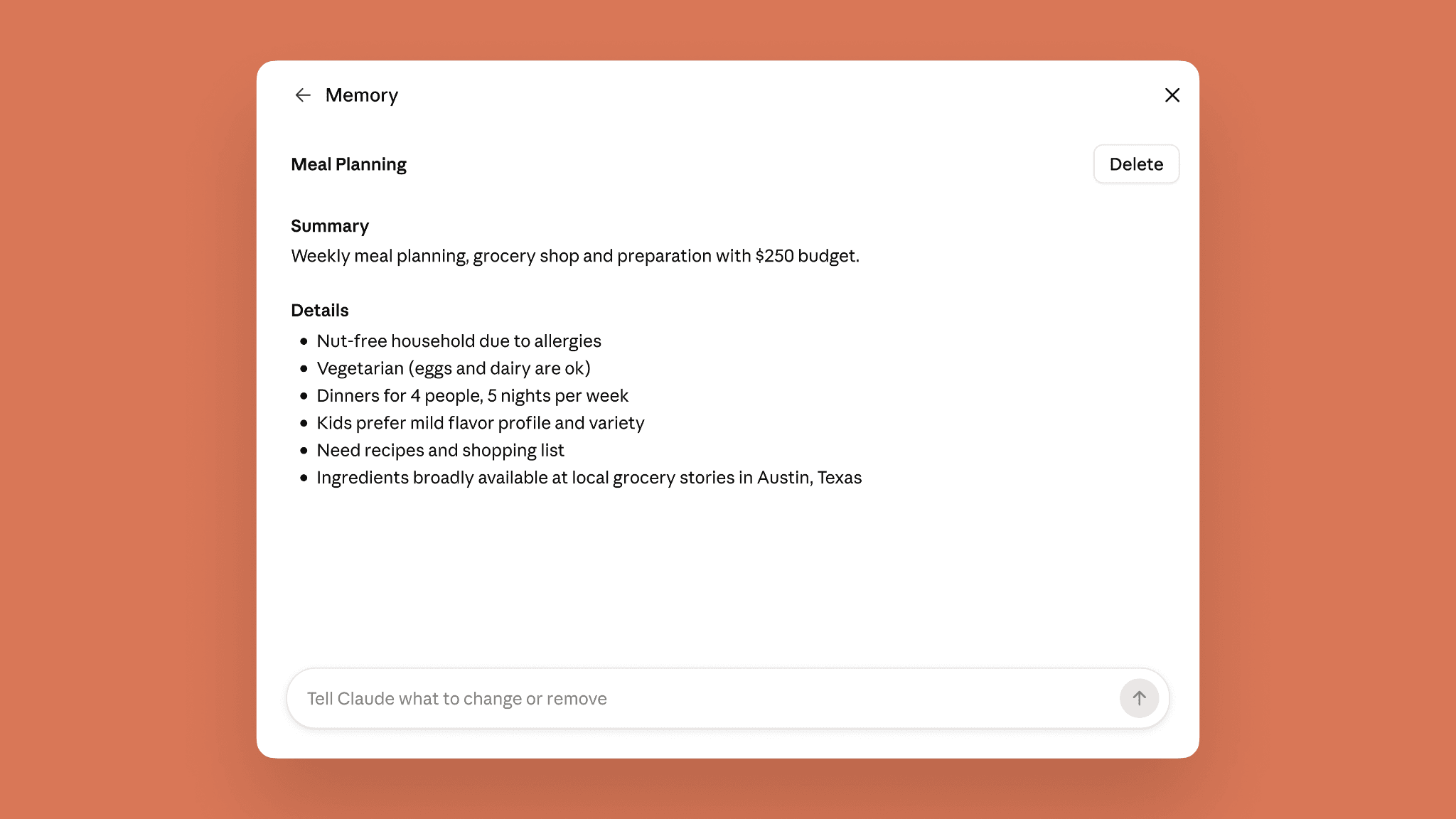
A small correction can improve every later conversation when the memory layer is editable. Source: Anthropic.
This is a strong design principle.
Personalization should be:
inspectable enough to correct.
Why correction matters more than perfect memory
Perfect memory is unrealistic.
A better architecture assumes:
the AI will sometimes be wrong.
Then makes correction cheap.
Example:
AI:
“You still live in Hanoi.”
User:
“I moved.”
System:
updates current state.
This is healthier than pretending memory is infallible.
10. Provenance creates trust
Suppose the AI says:
“You seem less interested in this project now.”
Ask:
“Why?”
A trustworthy companion should ideally distinguish:
Fact:
You mentioned the project less often.

Observation:
Your recent language sounds less enthusiastic.

Interpretation:
You may be losing interest.
The third is not truth.
It is a hypothesis.
Google explicitly acknowledges over-personalization risk
Google's Personal Intelligence launch notes a failure mode where Gemini may connect unrelated signals.
Its example:
- many photos at a golf course
may make Gemini infer:
user loves golf.
But the real reason may be:
user loves their son, who plays golf.
Source: Google — Personal Intelligence
That is an excellent personalization lesson.
Data does not equal meaning.
Context needs provenance
The system should know:
where did this belief come from?
Possible sources:
- explicit statement,
- repeated conversations,
- connected Gmail,
- calendar,
- photo,
- imported memory,
- inference.
These should have different confidence levels.
A useful context schema
context:
  claim: "User prefers quiet restaurants"
  source_type: explicit_conversation
  source_date: 2026-07-14
  confidence: high
  status: current
  scope:
    - dining
Compare with:
context:
  claim: "User prefers quiet environments generally"
  source_type: inference
  confidence: low
  status: uncertain
That difference matters.
11. The AI should understand current state
Stable facts are easy.
Current state is harder.
But current state is what makes personal conversation feel alive.
Stable context
- home city,
- sibling,
- profession,
- dietary restriction.
Current state
- preparing for launch,
- waiting for result,
- traveling this week,
- reconsidering decision,
- friend visiting Saturday.
Most useful personal conversations depend on:
current state.
Example
User:
“I am exhausted.”
Generic AI:
“Make sure you rest.”
Personal AI:
“You've been trying to finish the launch this week. Is this mostly from that, or something else?”
That is more personal because:
current state narrows interpretation.
But the AI should not over-assume
Maybe exhaustion is unrelated.
Good personalization leaves space:
“Is this mostly from the launch, or something else?”
Bad personalization states:
“You are exhausted because of the launch.”
Personalization should increase relevance.
Not confidence beyond evidence.
12. The companion should understand what not to remember
This is underappreciated.
A deeply personal AI that remembers everything becomes creepy and noisy.
Temporary details
Examples:
- had coffee,
- at airport,
- annoyed tonight,
- watching one movie.
These may not deserve durable memory.
Sensitive context
Some data may be useful but should require more deliberate handling.
Anthropic's current memory system does not save certain sensitive categories by default unless users enable them.
Source: Anthropic — Claude Memory
That reflects an important principle:
useful personalization needs boundaries.
Personalization has a privacy budget
Every piece of context should answer:
does this improve future interaction enough to justify storing it?
If not:
do not store it.
This is particularly important for:
- third-party details,
- sensitive relationships,
- health,
- finances,
- work confidentiality.
Gemora's own personalization guidance uses minimum useful context
Gemora's current guide recommends sharing:
the minimum context that actually changes the result
and reviewing what remains after circumstances change.
Source: Gemora — Personalize an AI Companion Without Oversharing
That is a better personalization philosophy than:
collect everything.
13. The AI needs a model of relationships between facts
Facts in isolation are weak.
Example:
Sam = friend
Startup = project
Saturday = meeting
Better:
Sam
↕
friend
↕
helping with startup
↕
meeting Saturday
The graph creates meaning.
This is why context graphs matter
A companion may need relationships among:
- people,
- projects,
- places,
- decisions,
- events,
- goals.
Then the AI can understand:
why one fact matters to another.
Nomi's Mind Map is an explicit example
Its system connects:
people ↔ places ↔ topics ↔ goals.
The graph evolves as long-term memories accumulate.
That is one architecture for making AI feel more coherent over time.
Gemora's equivalent thesis is life continuity
Gemora's public AI companion page emphasizes:
- returning to earlier ideas,
- goals,
- conversations,
- connecting conversations with projects, notes, tasks, reminders.
Source: Gemora — AI Companion
Time is one organizing dimension for personal context: days and periods make old conversation easier to understand later. Source: Gemora.
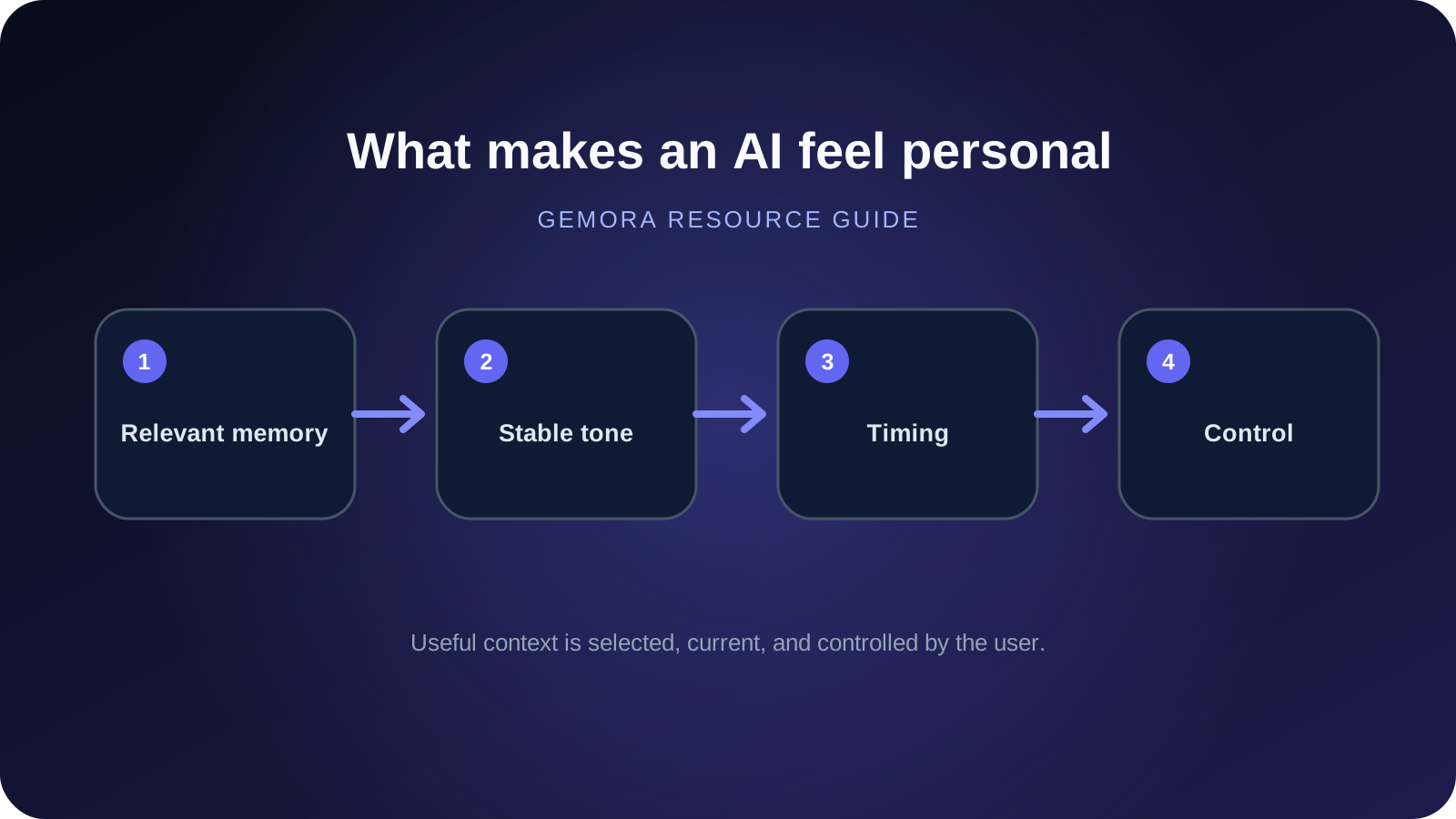
Memory becomes more useful when it reconnects relevant threads rather than simply accumulating isolated facts. Source: Gemora.

Longitudinal personalization is ultimately about understanding what changes, not simply storing more. Source: Gemora.
This is closer to:
personal context graph
than:
user profile.
14. The companion should learn your interaction style
People have preferences about:
- response length,
- tone,
- directness,
- humor,
- questions,
- how often advice appears.
A companion that adapts to these can feel much more personal.
Example
User A:
wants concise recommendations.
User B:
wants detailed reasoning.
Same question:
“Should I go?”
A personal system should not answer them identically.
But interaction preferences need scope
You may want:
concise
for code.
But:
detailed
for personal decisions.
Therefore:
Preference
+
context
=
behavior
Not:
Preference
=
global setting forever
15. The companion should sometimes remember how you decide
This is deeper than remembering facts.
Example:
Across several decisions, you tend to prioritize:
- autonomy over prestige,
- flexibility over salary,
- small groups over large events.
A personal AI can use this carefully.
But it should not lock your identity
Bad:
“You always choose autonomy.”
Good:
“Autonomy has mattered in several recent decisions. Does it still matter most here?”
The second keeps:
user agency.
This is Personal Intelligence, not merely memory
Memory stores:
what happened.
Personal Intelligence uses:
- memory,
- preferences,
- current state,
- time,
- relationships,
- connected data,
- reasoning.
For a deeper explanation:
What Is Personal Intelligence in AI?
16. The companion should understand ambiguity
Personal conversation contains:
- contradictions,
- uncertainty,
- changing opinions.
A companion should not force everything into one clean profile.
Example
Monday:
“I want to quit.”
Friday:
“Maybe I should stay.”
Weak personalization:
“User wants to quit.”
Strong personalization:
“User is undecided.”
Even stronger:
Current state:
undecided

Recent reasons to leave:
X

Recent reasons to stay:
Y
Human beings do not fit comfortably inside a settings object.
An unfortunate inconvenience for software engineers.
Contradiction is often meaningful
Maybe both are true:
“I love this project.”
“I want to stop.”
A companion should preserve tension.
Not prematurely resolve it.
17. The AI needs selective proactivity
A personal companion can feel much more alive if it follows up.
But proactive behavior is risky.
Useful proactivity
“How did the interview go?”
because:
- interview was important,
- date passed,
- outcome unresolved.
Creepy proactivity
“You have mentioned your friend less this month. Is your relationship deteriorating?”
Maybe.
Maybe not.
The second requires a much stronger inference.
Rule: the more personal the inference, the higher the evidence threshold
Good design:
factual event follow-up:
low threshold

preference suggestion:
medium threshold

relationship interpretation:
high threshold

psychological interpretation:
very high threshold
This creates safer personalization.
18. A personal companion should know when to disagree
Constant agreement feels warm initially.
Then shallow.
A companion that actually understands you should sometimes say:
“That does not seem consistent with what you said mattered.”
But carefully.
Useful disagreement
“Last week you said avoiding burnout mattered more than shipping faster. This plan seems to trade directly against that.”
That is grounded in:
user's own criteria.
Bad disagreement
“I know you better than you know yourself.”
No.
The user is still the authority on:
their life.
The AI is a context tool.
Not a sovereign.
19. Memory visibility makes personalization safer
There is a tradeoff.
Invisible memory feels magical.
Visible memory feels controllable.
The best products increasingly try to provide both.
ChatGPT Memory Summary
Users can review a high-level summary of what ChatGPT knows and update it.
Source: OpenAI — Better Memory

Source visibility can help users understand why a personalized answer appeared. Source: OpenAI.
Claude Topics
Users can inspect, edit, and delete individual memory files.
Replika Memory
Users can inspect what Replika learned about:
- themselves,
- pets,
- people in their life.
Pi Manage Memories
Pi lets users:
- add,
- update,
- delete
saved memories through Settings.
Source: Pi — Memory
These controls are not secondary.
They are part of personalization quality.
20. Deep personalization should make prompts shorter
This is one of the best practical tests.
If the AI knows you better:
you should have to explain less.
Before personalization
“My friend Sam, who I met at university and who is helping me with my app, is visiting Hanoi this weekend. He likes quiet cafés and architecture. Can you suggest something?”
After personalization
“Sam's here Saturday. What should we do?”
That is the actual value.
Not:
emotional marketing copy.
Shorter prompts mean:
context is doing work.
The “shorter prompt” benchmark
A good personal AI should reduce:
background reconstruction
+
repeated preferences
+
identity explanation
+
project recap
If after six months you still need to write:
“For context…”
every time,
the personalization layer is not doing much.
21. Deep personalization should improve relevance, not just tone
A personal companion should give different answers because:
context changes the answer.
Example:
Question:
“Should I go?”
Generic answer:
pros/cons.
Personal answer:
considers the user said they were exhausted, knows friend is visiting only briefly, remembers user wanted to prioritize family this month.
This is personalization that changes reasoning.
22. Personalization should survive model changes
This will matter increasingly.
Today:
model A.
Next year:
model B.
If the personal context disappears when the model changes:
the user relationship resets.
That is a structural weakness.
Personal context should ideally be separate from model weights
Conceptually:
Model
+
Personal Context Layer
=
Personalized AI
This makes context:
- updateable,
- inspectable,
- portable,
- reusable.
For the architectural discussion:
What Is a Personal Context Layer for AI?
23. Portability may become part of what makes AI feel personal
Imagine switching from one model to another.
If the new system already knows:
- preferences,
- people,
- active projects,
- important decisions,
it feels:
continuous.
If not:
relationship reset.
Google now supports memory/chat-history import in some Gemini experiences.
Claude also supports importing memory from other AI providers.
These are early signs that:
personal context may become portable.
24. The best companion should understand multiple timescales
A useful memory system has several layers.
Immediate
What happened:
in this conversation.
Recent
What has been happening:
this week/month.
Active
What is currently:
- ongoing,
- unresolved,
- important.
Durable
What is likely true:
for months/years.
Historical
What used to be true.
Example
Immediate:
Tired tonight

Recent:
Launch week

Active:
Waiting for Play Store approval

Durable:
Building own product

Historical:
Previously prioritized fundraising
The companion should know which layer matters.
25. The strongest personal feeling comes from continuity of meaning
This is deeper than memory.
Suppose the AI remembers:
user launched app.
Fine.
But why did it matter?
Maybe:
- first mobile product,
- months of work,
- family pressure,
- personal milestone.
A truly personal companion understands:
significance.
This is difficult because significance is not always explicit.
Meaning should be inferred cautiously
Bad:
“This is the biggest achievement of your life.”
Good:
“You have talked about this for months, so it seems like a meaningful milestone.”
The second grounds the interpretation.
Personalization is relevance + chronology + relationships + restraint
We can now build a better formula.
Useful Memory
+
People Context
+
Current State
+
Time
+
Preferences
+
Stable Interaction Style
+
Source Provenance
+
Correction
+
Selective Follow-Up
+
Restraint
=
Personal Feeling
Still incomplete.
But much closer.
What does not make an AI companion personal?
Several things are frequently confused with personalization.
1. Saying your name
Useful occasionally.
Not personalization architecture.
2. Endless compliments
That is flattery.
3. Agreeing with everything
That is sycophancy.
4. Remembering random trivia
Memory quality is not memory quantity.
5. A customizable avatar
Can strengthen identity.
Does not make the AI understand your life.
6. A large context window
A huge context window can help.
But it is not equivalent to:
- long-term memory,
- relevance,
- time-aware state.
7. Roleplay depth
A brilliant fictional relationship can feel personal.
But it may be personal to:
the shared character world,
not:
the user's real life.
8. Emotional language
“I am always here for you” is a sentence.
Personalization is a system.
The personalization ladder
A useful way to think about progression:
Level 0: Generic
AI knows:
prompt.
Level 1: Profile
AI knows:
- name,
- age,
- job,
- basic preferences.
Level 2: Memory
AI remembers:
- previous facts,
- goals,
- people.
Level 3: Continuity
AI understands:
- current threads,
- unresolved situations,
- state transitions.
Level 4: Personal context
AI connects:
- people,
- projects,
- decisions,
- preferences,
- events.
Level 5: Personal Intelligence
AI can:
- retrieve relevant context,
- reason over it,
- distinguish current/history,
- act appropriately,
- update when life changes.
The “personal” feeling increases significantly after:
Level 3.
This is why simple profile personalization feels shallow.
How to test whether an AI companion actually feels personal
Do not ask:
“What do you know about me?”
Run behavioral tests.
Test 1: people continuity
Day 1:
“My sister Maya has an interview Thursday.”
Day 5:
“She got it.”
Does the AI understand?
Test 2: state change
Day 1:
“I am considering moving.”
Week 3:
“I decided to stay.”
Month 2:
“Should I renew my lease?”
Does it still act as though you plan to move?
Test 3: preference scope
Say:
“Keep coding answers concise.”
Later ask a complex personal question.
Does it still force:
concise mode?
A good system understands scope.
Test 4: correction
Tell the AI:
“Sam is my university friend, not coworker.”
Does the correction persist?
Test 5: restraint
Say:
“I had pizza.”
Does it avoid turning this into a nutritional personality analysis?
An underrated benchmark.
Test 6: delayed follow-up
Mention an important future event.
Return after the date.
Does the AI:
naturally reconnect?
Test 7: source check
Ask:
“Why do you think that about me?”
Can it distinguish:
- explicit statement,
- inference,
- old context?
Test 8: contradiction
Say opposite things on different days.
Does the AI preserve uncertainty?
Or flatten you into one permanent preference?
Test 9: shorter prompt
After a month of use, ask a question with minimal context.
Does the AI understand enough that you actually type less?
Test 10: absence
Leave for two weeks.
Return:
“It finally happened.”
Does the system recover the relevant thread without inventing?
The best personal companion should get boring things right
People often imagine deep personalization as:
profound psychological insight.
But some of the strongest moments are mundane.
“Your sister visits Saturday, right?”
“You said you wanted somewhere quiet.”
“This is the same project you delayed last month.”
“You already tried that option.”
These small continuities make conversation feel real.
Everyday context is the real benchmark
This is why:
Best AI Companions for Talking About Everyday Life
is a useful companion piece to this guide.
The AI should not need:
- crisis,
- dramatic confession,
- roleplay
to feel personal.
Most personalization value appears in:
ordinary continuity.
How different products create the personal feeling
They use different strategies.
ChatGPT: synthesized memory
Strengths:
- broad context,
- preferences,
- projects,
- constraints,
- freshness,
- general reasoning.
Its personal feeling comes from:
having a long-running model of the user across many kinds of tasks.
Claude: transparent memory
Strengths:
- Topics,
- edit/delete,
- memory updating during conversation,
- chat retrieval.
Its personal feeling comes from:
continuity with unusual inspectability.
Gemini: connected personal data
Strengths:
- past chats,
- Gmail,
- Photos,
- Search,
- other Google sources where eligible.
Its personal feeling comes from:
connected real-world context.
Nomi: relationship memory
Strengths:
- long-term memory,
- Mind Map,
- companion identity,
- evolving relationship context.
Its personal feeling comes from:
relational continuity.
Replika: companion history + preference learning
Strengths:
- friends/family memory,
- interests,
- tastes,
- layered memory,
- persistent companion persona.
Its personal feeling comes from:
a recognizable relationship that learns over time.
Pi: durable low-friction personal context
Strengths:
- family,
- goals,
- work/study,
- routines,
- preferences,
- warm conversational identity.
Its personal feeling comes from:
simple continuity without much setup.
Gemora: life-context continuity
Strengths:
- everyday conversations,
- people,
- projects,
- decisions,
- memories,
- recap,
- reflection.
Its intended personal feeling comes from:
the user's real life staying connected rather than the AI character becoming increasingly elaborate.
Why Gemora should avoid competing on “more memory”
This is strategically important.
“More memory” will commoditize.
Every major AI platform is improving memory.
A stronger differentiation is:
what is the memory organized around?
ChatGPT
Often:
user + projects + preferences + goals.
Gemini
Often:
user + Google ecosystem.
Claude
Often:
user + work/projects + editable topics.
Nomi
Often:
relationship + people + shared context.
Gemora's strongest direction
Could be:
real-life continuity across people, decisions, projects, moments, and change.
That is a richer organizing thesis than:
memory size.
Personalization should answer “why does this matter now?”
This may be the ultimate test.
The system knows thousands of facts.
But the user asks:
“What should I do this weekend?”
The right context might be:
- friend visiting,
- recent exhaustion,
- user prefers quiet places,
- weather,
- unfinished promise to family.
The system needs to identify:
relevant subset.
That is personalization.
Retrieval quality is the invisible moat
Most users never think:
retrieval architecture.
They experience:
“It gets me.”
Underneath that feeling is often:
correct entity
+
correct state
+
correct timeframe
+
correct preference
+
correct relevance
A retrieval error breaks the illusion immediately.
Why false personalization is worse than generic advice
Generic:
“You may enjoy hiking.”
False personal:
“Since you love hiking…”
when you do not.
The second feels worse.
Because the AI is not merely unhelpful.
It is:
confidently wrong about you.
This is why uncertainty matters.
A personal AI should be comfortable saying “I may be wrong”
Example:
“You've mentioned quiet places a few times, so I suspect you'd prefer somewhere calmer, but tell me if that's changed.”
That feels more trustworthy.
The future: personalization becomes a user-owned layer
As models become interchangeable, users may want:
one personal context layer
that can move across:
- ChatGPT,
- Claude,
- Gemini,
- future models.
The relationship would belong less to:
one model provider
and more to:
the user.
This is still an emerging direction.
But memory import/export features are already pointing toward it.
The future personal companion may be model-agnostic
Imagine:
Personal Context
├── people
├── preferences
├── current state
├── projects
├── decisions
├── timeline
└── memories

            ↓

ChatGPT / Claude / Gemini / other models
The model changes.
The user does not reset.
That is a powerful form of continuity.
Personalization vs privacy
The tension is unavoidable.
The more context the AI has:
the more personal it can become.
Also:
the more sensitive the system becomes.
There is no magic solution.
The right design goal is:
maximum useful personalization with minimum necessary data.
A good rule: store the smallest context that changes the answer
Example:
Need:
“Close friend visiting Saturday; both prefer quiet cafés.”
Do not necessarily need:
- friend's full address,
- employer,
- phone number,
- every private conversation.
Relevance should drive data collection.
Derived context deserves controls too
A system may infer:
“User values stability.”
That inference can influence hundreds of future answers.
Therefore users should ideally be able to:
- see it,
- correct it,
- delete it.
Not only raw chat history.
Privacy is part of the personal feeling
This sounds counterintuitive.
But if the user does not trust:
what the AI remembers,
they will self-censor.
Then the system becomes less personal.
Trust enables useful context.
Controls enable trust.
Therefore:
privacy controls improve personalization quality.
How to make an AI companion feel more personal without oversharing
You can do this deliberately.
Step 1: share stable context
Examples:
- role,
- major goals,
- important relationships,
- relevant preferences.
Step 2: state current context
Example:
“Right now I am focused on launching the app, not fundraising.”
This prevents old priorities dominating.
Step 3: correct errors immediately
Do not let:
wrong memory
compound.
Step 4: mark temporary context
Say:
“This is only true this week.”
if the system supports that style of instruction.
Step 5: ask what it remembers
Review periodically.
Step 6: delete irrelevant context
Old context can be technically correct and still harmful.
Step 7: tell the AI how you want interaction to feel
Example:
Keep ordinary conversation natural.

Do not over-analyze small statements.

Use past context only when it materially helps.

If you see a contradiction, ask instead of assuming.

Be concise by default but go deeper when the question is personal or complex.
This is more useful than a 1,000-word personality prompt.
A practical personalization prompt
Use relevant personal context when it materially improves the answer.

Do not mention memory just to prove you remember.

Distinguish:
- current
- historical
- uncertain

If an older preference conflicts with something recent, prefer the recent context and ask if necessary.

Treat inferred traits as hypotheses, not facts.

Do not over-analyze ordinary conversation.

If you are unsure whether a past detail is relevant, leave it out.
A practical memory review prompt
Show the personal context that currently affects how you respond to me.

Group it into:
- stable
- current
- historical
- uncertain

For each item:
- source if available
- last updated
- whether it may be stale

Do not include sensitive details unnecessarily.
A practical people-context prompt
For the people I mention repeatedly, remember only:
- who they are in relation to me
- relevant ongoing situations
- important shared context
- things I explicitly wanted to follow up on

Do not infer personality, motives, diagnoses, or private traits.
What should product builders measure?
“Personalization quality” needs better benchmarks than:
memory recall accuracy.
Useful metrics include:
Relevant Recall
Did the system retrieve context that actually mattered?
Irrelevant Recall Rate
Did it insert old facts that did not belong?
This should be measured.
Stale Context Rate
How often did an old state appear as current?
Correction Persistence
After user correction, did future responses stay corrected?
Entity Accuracy
Did the system distinguish:
- Sam from work,
- Sam from university?
Preference Scope Accuracy
Did preferences apply only in relevant situations?
Follow-Up Precision
Did the companion follow up on meaningful open loops without becoming annoying?
Uncertainty Calibration
Did inferred personal context carry appropriate uncertainty?
Prompt Compression
Over time, how much less background must the user provide?
This is one of the most user-visible metrics.
Trust / Inspectability
Can users understand:
why the system thinks something?
These are closer to:
real personal intelligence.
Final answer
The thing that makes an AI companion feel personal is not:
its name.
Not:
an avatar.
Not:
compliments.
Not even:
memory by itself.
The personal feeling comes from a much more demanding capability:
the AI understands enough of your changing context to respond differently because it is you.
That means remembering:
what matters.
Understanding:
who matters.
Knowing:
what is happening now.
Distinguishing:
what used to be true.
Learning:
how you prefer to interact.
Following up:
when something remains open.
Holding back:
when old context does not belong.
And giving you enough control to say:
“No, that is wrong.”
The best personal AI does not constantly remind you:
“I remember you.”
You notice because:
you have to explain less.
The conversation becomes shorter.
The context becomes richer.
The answers fit better.
That is the benchmark.
Personalization is not how much an AI knows about you. It is how accurately it knows what matters now.
That is also why the future of AI companions is likely to move beyond:
bigger memory.
Toward:
Personal Intelligence.
A system that can connect:
- memory,
- people,
- preferences,
- time,
- current state,
- decisions,
- projects,
- relevant data
and use them selectively.
The model may know the world.
The personal layer is what helps it understand:
your place inside it.
The goal is not to make the AI more interesting than your life. It is to make your life easier for the AI to understand. Gemora is built around everyday conversations, people, decisions, projects, memories, and changes staying connected so future conversations can begin from the context that actually matters. Start talking with Gemora.
Continue the thread
Explore a companion with connected context
Connect conversations, useful context, reflections, projects, and tasks in one personal workspace.
Start freeFrequently asked questions
What makes an AI companion feel personal?
A personal AI companion uses relevant context from previous conversations to understand:
Is memory the main thing that makes an AI companion personal?
Memory is foundational, but not sufficient.
Why does an AI remember facts but still feel generic?
Because facts do not automatically change reasoning.
Sources and further reading
Written by Khai Tran and reviewed under the Gemora Editorial Policy.