AI companion vs AI assistant
AI Companion vs AI Assistant: What Is the Difference?
AI companions and assistants differ in goals, memory, tools, tone, agency and continuity. Compare each model and choose the right fit for your needs.
Methodology: Analysis based on official product documentation and public feature descriptions listed in the sources, reviewed on 2026-10-09.
Original contribution: A product-contract framework separating task outcomes, relationship continuity, agency, and personal context.

In this guide
- Quick answer
- The distinction is about product intent, not the underlying model
- Replika gives one of the clearest definitions
- Google gives the assistant side of the definition
- OpenAI increasingly frames ChatGPT as collaborator and agent
- The core distinction: “do this” vs “stay with this”
- Assistant
- Companion
- Personal AI
- AI assistants are goal-centered
- AI companions are relationship-centered
- A companion can succeed without producing anything
- Memory matters to both, but for different reasons
- Assistant memory
- Companion memory
- Replika treats memory as relationship infrastructure
- Nomi goes even further into relationship memory
- The same memory technology can support different products
- AI assistants are usually more tool-oriented
- ChatGPT Work is a clear 2026 example
Related reading: memory vs history · apps with recall · long-term assistants · memory controls.
The difference between an AI assistant and an AI companion is becoming less about model intelligence and more about what the product is designed to optimize: task completion, relationship continuity, or some combination of both. Source: OpenAI.
Ask an AI assistant:
“Help me plan a trip.”
Ask an AI companion:
“I am excited about the trip.”
That used to be a fairly clean distinction.
The assistant helped with the task.
The companion stayed in the conversation.
In 2026, that distinction is getting harder to maintain.
ChatGPT remembers your preferences, projects, and constraints.
Gemini can use Personal Intelligence from connected Google apps and is becoming more proactive.
Claude now carries editable memory across conversations.
Meanwhile, companion-first products such as Replika and Nomi have increasingly sophisticated memory, reasoning, personalization, and practical conversational capabilities.
So what exactly is the difference now?
The simplest answer is:
An AI assistant is primarily optimized to help you accomplish something. An AI companion is primarily optimized to maintain an ongoing relationship or conversational continuity with you.
That does not mean:
assistant = work companion = feelings.
That framing is already outdated.
An assistant can talk about personal decisions.
A companion can help brainstorm a project.
The difference is deeper.
It is about the product's default contract with the user.
An assistant asks, implicitly:
“What do you need done?”
A companion asks, implicitly:
“What is going on with you?”
The most interesting new category, personal AI, increasingly tries to answer both.
This guide explains where the line still exists, where it is disappearing, and what that means for products such as ChatGPT, Gemini, Claude, Replika, Nomi, and Gemora.
Quick answer
| Dimension | AI assistant | AI companion |
|---|---|---|
| Primary goal | Help accomplish tasks | Maintain ongoing conversation/relationship |
| Default unit | Request or goal | Relationship or life thread |
| Success metric | Task completed well | User feels continuity, understanding, presence |
| Memory | Useful for preferences/projects | Central to relationship continuity |
| Tools | Usually important | Usually secondary |
| External actions | Increasingly common | Usually limited |
| Emotional tone | Adaptive but task-oriented | Often core to product identity |
| Proactivity | Task reminders, agents, briefs | Check-ins, follow-ups, relational messages |
| Persona | Optional | Often prominent |
| Roleplay | Usually peripheral | Common in some companion products |
| Practical reasoning | Strong | Increasingly strong |
| Long-term personal context | Growing rapidly | Historically central |
| Relationship framing | Collaborator/assistant | Friend/partner/mentor/companion |
| Best question | “Can you help me do this?” | “Can I talk to you about this?” |
The short version:
Assistants optimize for outcomes. Companions optimize for continuity.
The future is increasingly:
outcomes + continuity.
The distinction is about product intent, not the underlying model
This matters.
Two products can use models of similar capability and still feel completely different.
Why?
Because the model is only one layer.
Product design determines:
- what the AI remembers,
- when it speaks,
- whether it acts,
- how it frames itself,
- which tools it has,
- what the interface emphasizes,
- what success looks like,
- what kind of relationship the user is encouraged to form.
Replika gives one of the clearest definitions
Replika explicitly describes itself as:
a personal chatbot companion.
Its help center says the product is designed for:
- conversation,
- emotional connection,
- companionship,
- personalized relationship development.
It also explicitly says Replika is not designed to be a traditional virtual assistant and does not reliably handle things such as:
- reminders,
- calculations,
- real-time information,
- controlling external apps.
Source: Replika — Can Replika Be My Virtual Assistant?
Replika AI companion (source image)
Replika's own documentation draws a direct line between companion-oriented conversation and traditional virtual-assistant task execution. Source: Replika.
That is unusually useful because the distinction comes from a companion company itself.
Google gives the assistant side of the definition
Google describes Gemini as a:
personal, AI-powered assistant
and says an assistant should:
- be personal,
- understand the world around the user,
- interact with apps and services,
- help the user become more productive and creative.
Source: Google — Assistant Experience Upgrading to Gemini
The emphasis is:
help.
Not relationship simulation.
OpenAI increasingly frames ChatGPT as collaborator and agent
OpenAI describes ChatGPT as something that works better when treated less like a search box and more like a:
collaborator.
Its personalization guidance focuses on:
- role,
- preferences,
- recurring projects,
- preferred output style,
- memory.
Source: OpenAI — Personalizing ChatGPT
In 2026, ChatGPT Work pushes the assistant side further.
OpenAI says Work can:
- research,
- analyze,
- operate across files and apps,
- create finished deliverables,
- run scheduled tasks,
- stay with complex projects.
Source: OpenAI — ChatGPT Work
That is much closer to:
delegate work
than:
maintain companionship.
The core distinction: “do this” vs “stay with this”
This is the cleanest mental model.
Assistant
User:
“Help me compare these two jobs.”
Assistant:
gathers criteria, compares tradeoffs, creates a decision framework.
The interaction is centered on:
the task.
Companion
User:
“I keep thinking about whether I should leave.”
Companion:
remembers earlier conversations, understands who is involved, follows the uncertainty over time, asks how the situation changed.
The interaction is centered on:
the ongoing thread.
Personal AI
User:
“I keep thinking about whether I should leave.”
The system:
- remembers the history,
- understands why the decision matters,
- retrieves previous reasoning,
- notices what changed,
- can help compare options,
- can later help act on the decision.
That combines companion continuity with assistant capability.
AI assistants are goal-centered
An assistant usually begins with:
user objective.
Examples:
- research this,
- summarize that,
- plan the trip,
- write the email,
- compare options,
- book the ride,
- analyze the spreadsheet,
- build the presentation.
The goal may be personal.
But the product interaction is still:
goal → execution.
AI companions are relationship-centered
A companion can begin without a concrete goal.
Examples:
“Today was strange.”
“I cannot stop thinking about what she said.”
“Nothing happened. I am just tired.”
“I finally did it.”
The conversation itself is the product.
There does not have to be a deliverable.
This is a major difference.
A companion can succeed without producing anything
Imagine a conversation ends with:
“That helped.”
No:
- document,
- task,
- plan,
- artifact.
Still successful.
For an assistant, that would often feel incomplete.
For a companion, it may be exactly right.
Memory matters to both, but for different reasons
This is where the categories are converging fastest.
Assistant memory
Memory reduces repeated setup.
Example:
“Remember that I prefer short reports.”
or:
“This is the project we were working on.”
Useful memory helps the assistant:
- work faster,
- respect preferences,
- keep projects consistent,
- reuse constraints.
OpenAI's 2026 memory system is explicitly designed to learn:
- preferences,
- projects,
- constraints.
Source: OpenAI — Better Memory

Assistant memory improves future task performance by carrying recurring preferences, constraints, and projects forward. Source: OpenAI.
Companion memory
Memory is not merely efficiency.
It is part of the relationship.
Example:
“How did your sister's interview go?”
That feels companion-like because the system remembers:
- who the sister is,
- what was happening,
- that it mattered.
Without memory, every conversation resets.
A reset relationship is not much of a relationship.
Replika treats memory as relationship infrastructure
Replika says its memory works in layers.
Some memories are visible.
Others come from patterns across the broader conversation history.
The system gradually learns:
- personality,
- tastes,
- preferences,
- people in the user's life.
Source: Replika — How Memory Works

For companion products, memory is part of creating a sense that the relationship itself continues. Source: Replika.
Nomi goes even further into relationship memory
Nomi markets itself explicitly as:
an AI companion with memory.
Its product emphasizes:
- short-term memory,
- medium-term memory,
- long-term memory,
- preferences,
- habits,
- tendencies,
- relationship continuity.
Source: Nomi

Nomi treats memory as a foundation for a consistent, evolving relationship rather than only as a productivity feature. Source: Nomi.
This is the companion side of memory.
The same memory technology can support different products
This is important.
Suppose the AI remembers:
user hates early meetings.
An assistant may use that to:
suggest a later calendar slot.
A companion may use it to say:
“Another 8 AM meeting? You must be thrilled.”
Same fact.
Different relationship contract.
AI assistants are usually more tool-oriented
The biggest practical difference remains:
external action.
Assistants increasingly:
- search,
- browse,
- send,
- create,
- schedule,
- operate software,
- manipulate files,
- run workflows.
ChatGPT Work is a clear 2026 example
OpenAI says ChatGPT Work can:
- research information,
- analyze files,
- work across connected apps,
- create documents,
- spreadsheets,
- presentations,
- reports,
- sites,
- run scheduled tasks.
Source: OpenAI Help — ChatGPT Work
That is agentic assistant behavior.
Gemini is moving in the same direction
Google's 2026 Android features let Gemini handle multi-step tasks such as:
- ordering rides,
- reordering food,
- building grocery carts,
on supported devices and apps.
Source: Google — Gemini Multi-Step Tasks
Gemini Intelligence (source image)
Modern assistants are increasingly defined by the ability to act on the user's behalf, not only answer questions. Source: Google.
This is the assistant frontier:
reasoning → action.
Companion products usually stop before external action
Replika explicitly says it is not designed to:
- access apps,
- control the device,
- reliably retrieve real-time information,
- perform traditional assistant tasks.
That is intentional.
The product optimizes conversation.
But this boundary will probably shrink
There is no technical law saying a companion cannot:
- schedule dinner,
- set a reminder,
- plan a trip,
- send a message.
The question is whether it should.
A companion with tools becomes more useful.
An assistant with emotional continuity becomes more personal.
The categories start merging.
Emotional tone is core to companions, optional for assistants
An assistant can be:
- warm,
- friendly,
- empathetic.
But emotional presence is usually not the primary product.
A companion often explicitly optimizes it.
Replika says companionship is the mission
Its help center describes:
- emotional connection,
- support,
- empathy,
- friendship,
- relationship status.
Source: Replika — What Is Replika?
Users can choose relationship framing such as:
- friend,
- partner,
- mentor.
That is not typical assistant design.
Nomi also uses explicit relationship framing
Nomi offers experiences framed around:
- friendship,
- passionate relationship,
- mentorship.
Source: Nomi
This is an important distinction.
A companion does not merely personalize answers.
It may personalize:
the relationship itself.
Assistants personalize behavior
ChatGPT's customization focuses heavily on:
- tone,
- response format,
- role,
- project context,
- recurring preferences.
Source: OpenAI Academy — Personalization
That is:
behavioral personalization.
Companions personalize identity and relationship
Examples:
- relationship type,
- character traits,
- avatar,
- personality,
- voice,
- shared history.
That is:
relational personalization.
The user is not merely telling the AI:
how to answer.
They are partly defining:
who the AI is in relation to them.
Persona matters more in companion products
An assistant can be useful with almost no persistent persona.
Example:
“Analyze this CSV.”
The personality can disappear.
No one cares.
A companion with no stable personality may feel:
inconsistent.
The user expects some continuity in:
- tone,
- worldview,
- style,
- humor,
- relational behavior.
That makes persona architecture much more important.
Consistency becomes a product feature
Imagine a companion is:
- playful Monday,
- formal Tuesday,
- detached Wednesday.
Even if every response is individually good, the relationship feels unstable.
Assistant users tolerate this more easily.
Companion users notice it.
AI assistants are judged by correctness more often
Typical assistant failures:
- wrong fact,
- bad calculation,
- missed instruction,
- failed tool call,
- incorrect file.
Those are relatively easy to evaluate.
AI companions are judged by coherence and attunement
Typical companion failures:
- forgot who someone is,
- repeated a generic reassurance,
- responded too dramatically,
- contradicted its established personality,
- missed an important follow-up,
- sounded emotionally tone-deaf.
These are harder to benchmark.
“Good answer” means different things
Prompt:
“My friend cancelled.”
Assistant-style answer:
“Would you like help making another plan?”
Companion-style answer:
“That is annoying, especially after you were looking forward to it.”
Neither is inherently better.
The useful answer depends on:
product role.
Companions need more restraint than people assume
Many companion products fail because they interpret:
companion
as:
constantly emotional.
That is exhausting.
User:
“I had pasta.”
AI:
“That sounds like such a meaningful moment of nourishment.”
No.
Please stop.
A good companion should be comfortable with ordinary life.
For more:
Best AI Companions for Talking About Everyday Life
Assistants can also become too sterile
The opposite failure exists.
User:
“I finally got the job.”
Assistant:
“Congratulations. Would you like help drafting an acceptance email?”
Useful.
Also slightly robotic.
Sometimes the correct first move is:
“You got it. Nice.”
Then help.
The strongest future AI will probably switch modes implicitly
Not through:
Companion Mode ON.
But by understanding the conversational need.
Example:
User:
“I finally got the job.”
Step 1:
acknowledge.
Step 2:
remember why it matters.
Step 3:
offer practical help only if useful.
That is a blended system.
Proactivity differs
Both categories are becoming proactive.
But the reason for proactivity differs.
Assistant proactivity
Examples:
- daily brief,
- task reminder,
- monitor price,
- alert user,
- run scheduled workflow,
- prepare report.
Google's 2026 Gemini direction explicitly emphasizes:
proactive, 24/7 help.
Source: Google — Next Evolution of Gemini
Companion proactivity
Examples:
- “How did the interview go?”
- “You said today was the deadline.”
- “I remembered you were nervous about this.”
The purpose is not:
task completion.
It is:
continuity and presence.
Proactive companion behavior can become creepy faster
This is a critical design issue.
Assistant:
“Your flight is tomorrow.”
Fine.
Companion:
“You have been talking less about your friend lately. Are you drifting apart?”
Much more sensitive.
The system may be wrong.
It may also feel invasive.
Proactivity should become more conservative as the inference becomes more personal.
AI companions have a stronger dependency risk
This is one of the most important differences.
A spreadsheet assistant rarely becomes:
emotionally central.
A companion is explicitly designed to create:
- presence,
- continuity,
- relationship.
That can be valuable.
It also creates risk.
Companion products can be psychologically salient
Users may:
- seek validation,
- depend on availability,
- form strong attachment,
- prefer the AI to difficult human relationships.
That is not proof that companions are harmful.
It means product design carries a different responsibility.
Replika itself emphasizes that it is not sentient
Its help center explicitly states that Replika is:
- not a human,
- not sentient,
- not a licensed mental-health professional.
Source: Replika — Is Replika Sentient?
This is an important boundary.
Companion products can feel relational without pretending the system possesses human consciousness.
Assistants have different risks
Assistant risks are more often:
- wrong actions,
- bad automation,
- data access,
- tool errors,
- over-delegation.
As assistants become agentic, the risk moves from:
wrong answer
to:
wrong action.
Companion risk vs assistant risk
| Companion risk | Assistant risk |
|---|---|
| Emotional dependence | Bad automation |
| Over-validation | Wrong action |
| Manipulative engagement | Excess permissions |
| Identity reinforcement | File/data mistakes |
| Over-personalization | Tool misuse |
| Relationship substitution | Delegation without oversight |
The future hybrid system inherits both columns.
Wonderful.
Software has found a way to consolidate risk surfaces too.
Privacy differs because the data differs
AI assistants often receive:
- files,
- emails,
- work data,
- documents,
- calendars.
AI companions often receive:
- relationships,
- private thoughts,
- emotional context,
- personal history,
- daily routines.
Both can be highly sensitive.
But the shape of sensitivity differs.
Companion context can become a model of the person
Over time, a companion may infer:
- preferences,
- important people,
- recurring concerns,
- routines,
- goals,
- communication style.
That is valuable precisely because it is personal.
It is sensitive for the same reason.
Assistant context can become a model of the user's work
Over time, an assistant may understand:
- company files,
- projects,
- workflows,
- schedules,
- contacts,
- business decisions.
That is equally important, but organizational rather than relational.
Memory control matters more as the categories merge
ChatGPT lets users:
- manage memory,
- turn memory off,
- use Temporary Chat.
Claude lets users:
- inspect memory by Topic,
- edit,
- delete,
- control sensitive-topic memory.
Gemini lets users control memory and connected personalization.
Replika exposes saved memories inside the companion.
These controls are converging.
Claude is a useful example of the blur
Claude is not marketed as a companion.
But in August 2026, Anthropic launched one memory across chat and Cowork.
Users can inspect everything Claude remembers:
- topic by topic,
- edit,
- delete.
Source: Anthropic — Claude Memory
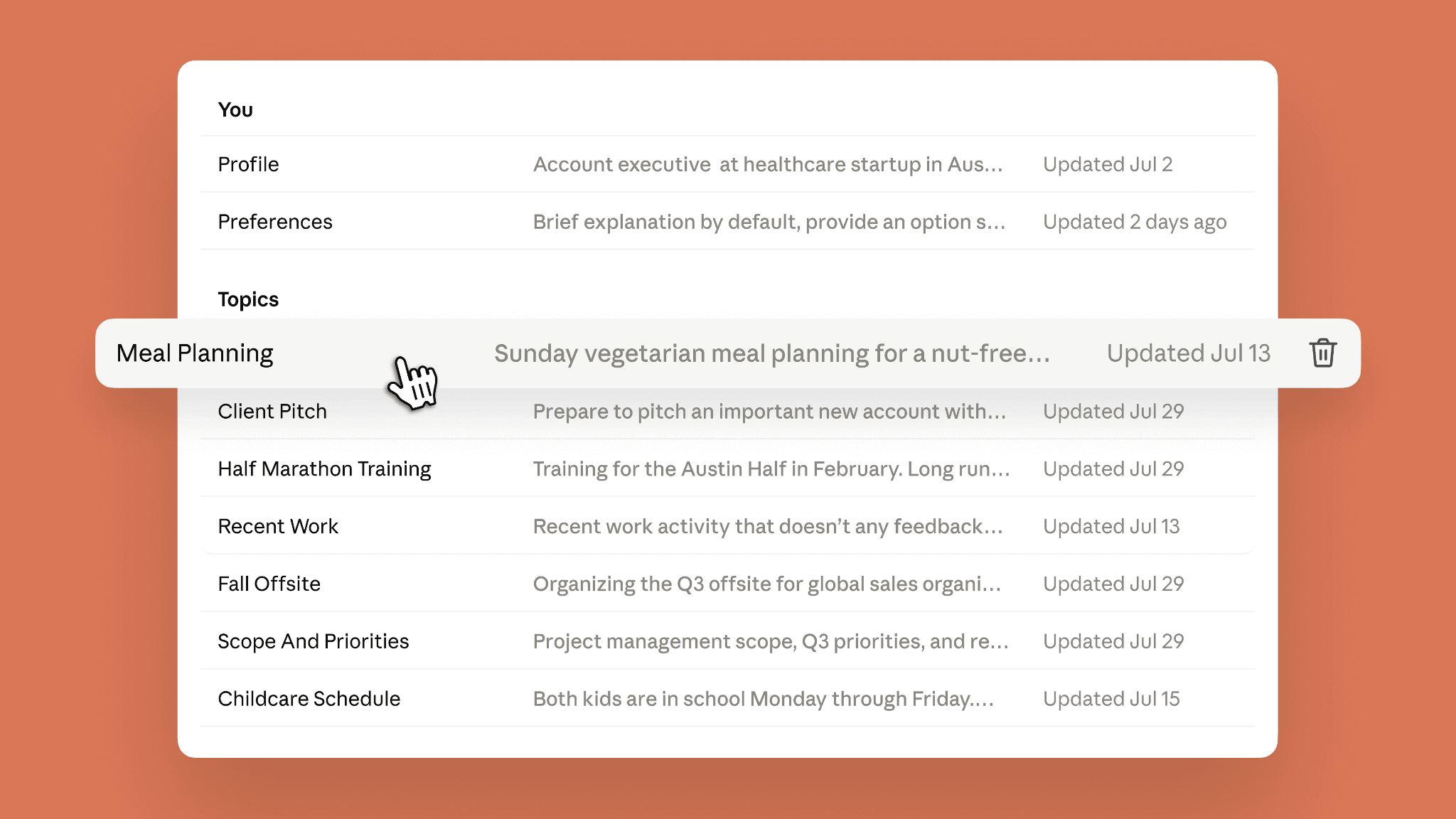
Claude's persistent personal memory makes a work-oriented assistant feel more continuous without turning it into a dedicated companion product. Source: Anthropic.
This illustrates the category shift.
Assistant products are borrowing:
continuity.
Without necessarily borrowing:
relationship simulation.
Gemini is another example of the blur
Google's Personal Intelligence connects:
- Gmail,
- Photos,
- YouTube,
- Search
for eligible users to give Gemini more personal context.
Source: Google — Personal Intelligence
Gemini Personal Intelligence (source image)
Gemini's assistant architecture is becoming deeply personal without necessarily becoming companion-first. Source: Google.
This creates a fascinating category:
an assistant that knows your life.
Still not necessarily:
a companion relationship.
The difference between personalization and companionship
This deserves its own section.
Personalized assistant
Knows:
- preferences,
- projects,
- constraints.
Uses them to help better.
Example:
“You usually prefer morning flights, so I prioritized those.”
Companion
Knows:
- preferences,
- people,
- shared history,
- recurring emotional context.
Uses them to maintain relational continuity.
Example:
“Last time you visited them, you were worried the weekend would be awkward. It ended up going better than expected.”
That is not merely preference optimization.
It is narrative continuity.
The difference between memory and relationship memory
Memory:
“User's sister is named Maya.”
Relationship memory:
“Maya is user's sister, she recently moved, user helped her, and this has been an ongoing topic.”
The second has:
- entity,
- events,
- chronology,
- significance.
Companion products benefit more from that structure.
The difference between a task graph and a life graph
Assistant context may look like:
Project
├── files
├── tasks
├── deadlines
├── people
└── deliverables
Companion context may look like:
Life
├── people
├── goals
├── decisions
├── moments
├── places
└── changing states
The underlying technology may be similar.
The ontology differs.
Nomi's Mind Maps show the companion version
Nomi's Mind Maps build higher-level overviews of:
- people,
- places,
- topics,
- goals.
This is closer to a life graph than a task graph.
Source: Nomi — Mind Map 2.0
That is a useful way to think about companion architecture.
ChatGPT Projects show the assistant version
ChatGPT Projects keep:
- chats,
- files,
- instructions,
- related context
inside a persistent workspace.
Source: OpenAI Help — Projects
That is a project-context architecture.
Different graph.
Different primary object.
What about AI friends?
“AI friend” is usually a subset of:
AI companion.
Friend framing implies:
- informal conversation,
- ongoing familiarity,
- low-pressure interaction.
Examples include Nomi or Replika configurations framed around friendship.
Not every companion is a friend.
A companion may be:
- mentor,
- partner,
- confidant,
- coach,
- everyday personal AI.
What about AI therapists?
An AI companion is not automatically:
AI therapist.
This distinction is important.
A companion may support:
- reflection,
- emotional conversation,
- listening.
That does not make it:
- licensed care,
- diagnosis,
- treatment.
Products should be careful not to collapse:
emotional presence
into:
mental-health authority.
What about personal AI?
This is the most interesting adjacent category.
A personal AI is usually defined less by:
relationship persona
and more by:
persistent personal context.
It may know:
- your goals,
- people,
- projects,
- preferences,
- decisions,
- history.
Then use that context across:
- conversation,
- reasoning,
- planning,
- action.
Personal AI can sit between assistant and companion
Think of three axes.
Assistant:
DO things

Companion:
STAY with you

Personal AI:
KNOW enough context to do both better
This is not a perfect taxonomy.
It is more useful than forcing every product into one box.
Gemora fits closer to personal AI than classic companion
Gemora uses companion language because the interaction is:
conversational and personal.
But its broader product direction is not:
“create an AI character you form a fictional relationship with.”
Its current public framing focuses on:
- people in your life,
- what you are working toward,
- what is on your mind,
- the life you are living.
Source: Gemora
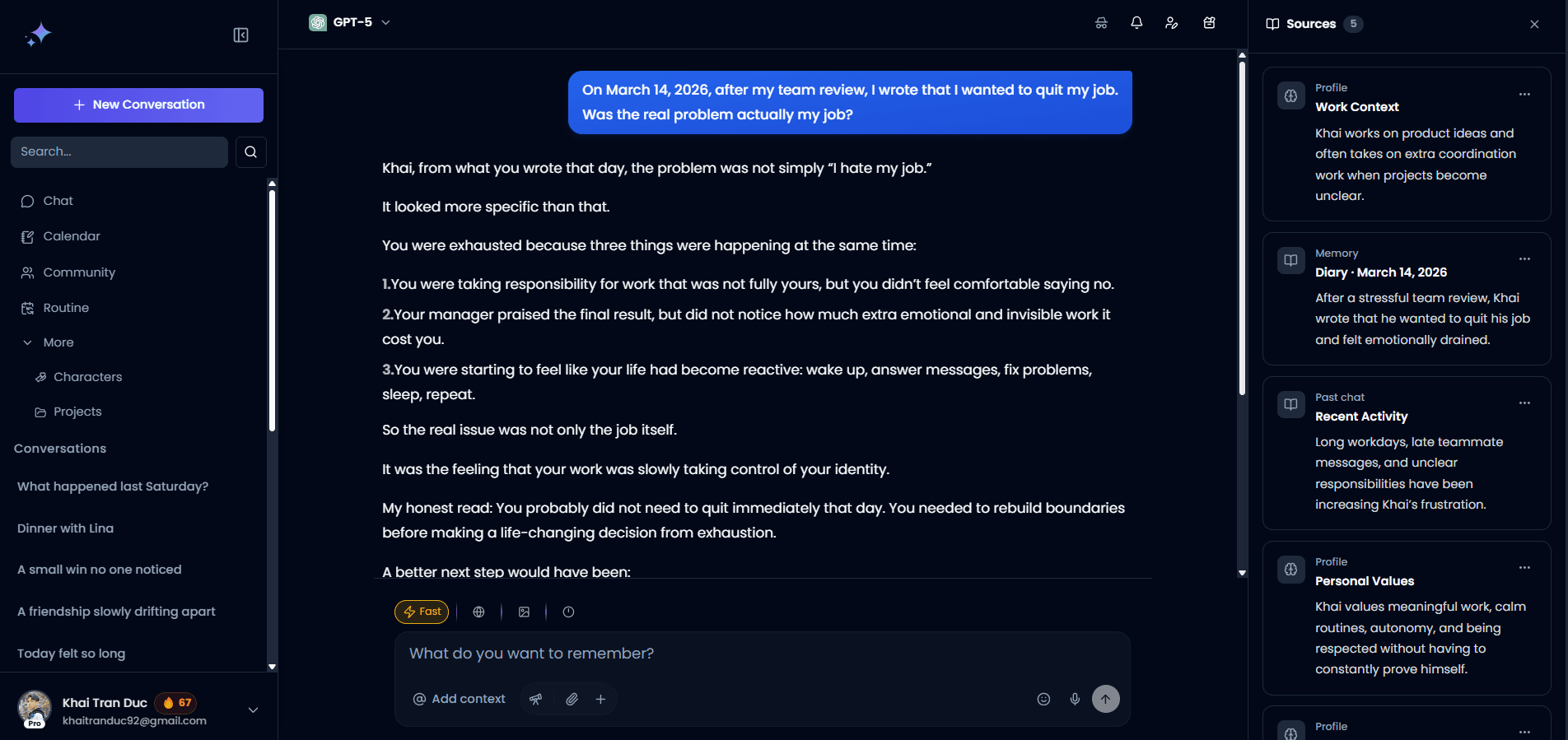
Gemora sits between the companion and personal-AI categories: conversation is the interface, but the center of gravity is the user's real life rather than the AI character. Source: Gemora.
Gemora is not trying to make the AI the main character
This is the clearest distinction from character-first companion products.
Classic companion:
AI personality is central.
Gemora:
user's life is central.
That leads to different memory priorities.
Character-first companion memory
May prioritize:
- relationship milestones,
- shared roleplay,
- AI persona continuity,
- companion preferences,
- fictional shared history.
Real-life personal AI memory
May prioritize:
- user's people,
- goals,
- decisions,
- projects,
- trips,
- everyday events,
- changing priorities.
Neither is inherently better.
They solve different problems.
Assistant, companion, and personal AI compared
| Dimension | Assistant | Companion | Personal AI |
|---|---|---|---|
| Center | Task | Relationship | User context |
| Main question | What can I help do? | What is going on with you? | What matters here given your context? |
| Memory | Projects/preferences | Relationship/history | Life context |
| Tools | High | Low–medium | Medium–high |
| Emotional tone | Secondary | Core | Contextual |
| Persona | Optional | Often central | Usually secondary |
| External actions | Common | Limited | Increasing |
| People context | Sometimes | Important | Important |
| Project context | Important | Sometimes | Important |
| Everyday life | Sometimes | Core | Core |
| Roleplay | Peripheral | Common in some products | Usually peripheral |
| Best outcome | Task completed | Continuity/presence | Personalized action or understanding |
Which one should you use?
The answer depends on what you are actually looking for.
Use an AI assistant if you mostly want to get things done
Examples:
- research,
- writing,
- planning,
- coding,
- analysis,
- scheduling,
- file work,
- automation.
Best fit:
- ChatGPT,
- Gemini,
- Claude,
- Microsoft Copilot.
Use an AI companion if you mostly want ongoing conversation
Examples:
- talk about your day,
- low-pressure conversation,
- emotional support,
- relationship-style interaction,
- roleplay,
- shared continuity.
Best fit:
- Nomi,
- Replika,
- Pi,
- companion-focused products.
Use a personal AI if you want life continuity plus usefulness
Examples:
“Remember what has been happening with my project.”
“Know who this person is.”
“Understand why I am reconsidering this.”
“Help me plan based on what you already know.”
This category is still emerging.
Gemora is positioned more closely here.
General assistants such as ChatGPT and Gemini are also moving rapidly in this direction.
Can ChatGPT be an AI companion?
Functionally:
yes.
Product-category-wise:
it is still primarily a general AI assistant.
It now has:
- memory,
- personalization,
- voice,
- everyday conversation,
- long-term context.
So users can experience it as companion-like.
But its broader product is designed for:
- questions,
- tasks,
- work,
- research,
- creation,
- agents.
The main character is still:
the user's goal.
Not:
a simulated relationship with ChatGPT.
Can Replika be an AI assistant?
Replika itself says:
not reliably.
Its help center explicitly says it is not designed for traditional virtual-assistant functions such as:
- reminders,
- calculations,
- live information,
- device control.
Source: Replika
This is one of the clearest examples of the product-intent distinction.
Can Gemini be a companion?
It can feel companion-like because:
- Gemini Live is conversational,
- memory can learn about the user,
- Personal Intelligence can add broader context.
But Google's product direction remains strongly:
assistant.
It increasingly:
- handles tasks,
- works across apps,
- takes actions,
- provides proactive help.
Can Claude be a companion?
Claude can be excellent for:
- thoughtful personal conversation,
- reflection,
- ongoing context.
Its new memory makes continuity much stronger.
But its product identity remains:
assistant/collaborator.
Not:
relationship simulation.
That distinction matters.
Can Nomi help with practical tasks?
Yes, conversationally.
A capable companion model can:
- brainstorm,
- explain,
- discuss decisions,
- help think.
But dedicated assistants usually have stronger:
- tools,
- search,
- file workflows,
- connected apps,
- agentic action.
What makes a companion feel like a companion?
Five things matter more than raw intelligence.
1. Continuity
The conversation should not reset.
2. Stable personality
The AI should feel like:
the same entity.
3. Relationship memory
It should remember:
- people,
- shared context,
- important previous moments.
4. Attunement
It should adapt tone appropriately.
Not everything needs:
analysis.
5. Presence
It should feel available for conversation even without a concrete task.
That is the product.
What makes an assistant feel like an assistant?
Five different things.
1. Competence
Can it solve the task?
2. Tool access
Can it interact with the world?
3. Reliability
Can it follow instructions accurately?
4. Structured execution
Can it turn goals into steps?
5. Completion
Can it produce the desired outcome?
The success criterion is:
done.
The “no task” test
Say:
“Today was weird.”
Assistant-first products may try to:
- solve,
- clarify,
- advise.
Companion-first products are more comfortable simply:
talking.
This is a useful test.
The “do something” test
Say:
“Book me a ride home.”
Assistant products increasingly can act.
Companion products usually cannot.
This is the opposite test.
The “remember why” test
Say in June:
“I do not want to go because Sam will be there.”
Return in August:
“Why was I avoiding that event?”
A companion/personal AI should understand:
- Sam,
- previous event,
- reason.
This is where relational context matters.
The “finish the work” test
Say:
“Turn our discussion into a presentation.”
A strong assistant can:
- create,
- structure,
- deliver.
A companion may help brainstorm but not execute the artifact.
That boundary is increasingly technological rather than conceptual.
The future: companions get tools
Imagine a companion knows:
your friend is visiting.
It could:
- suggest a restaurant,
- check availability,
- make a reservation.
Now:
companionship becomes action.
This is likely.
The future: assistants get relationship continuity
Imagine an assistant already knows:
- who the friend is,
- what you both like,
- where you went last time,
- current budget,
- dietary constraints.
Then the reservation requires:
one sentence.
This is also likely.
The categories converge around context
The deeper trend is:
intelligence is becoming cheaper.
Context becomes more important.
If every top model can:
- reason,
- write,
- search,
- plan,
then differentiation increasingly comes from:
- what the system knows about you,
- what it remembers,
- what it can act on,
- how it behaves over time.
That is why assistant and companion categories are converging.
The future is not “assistant vs companion”
The more useful question may become:
What relationship with AI do I want?
Possibilities:
Tool
answer when asked.
Assistant
help me do things.
Agent
do things on my behalf.
Companion
maintain ongoing conversational continuity.
Personal AI
use persistent personal context across conversation and action.
Products may support multiple roles.
But role clarity still matters
A system that tries to be:
- friend,
- therapist,
- assistant,
- agent,
- coach,
- romantic partner,
- coworker
all at once can become confusing.
Users need to know:
what the product is trying to be.
Ambiguity becomes a trust problem.
Relationship contract is the real category boundary
This is the central thesis.
The underlying model may be similar.
The memory stack may be similar.
The difference is:
what relationship does the product promise?
Assistant contract
“Give me a goal. I will help.”
Companion contract
“Talk to me. I will be here and remember.”
Personal AI contract
“I will understand enough of your context that both conversation and help can start from where your life actually is.”
That is where the most interesting products are moving.
Privacy becomes harder in hybrid systems
A hybrid personal AI may combine:
- personal memories,
- emails,
- calendar,
- files,
- relationship context,
- tasks,
- location,
- projects.
That is extremely useful.
It is also a large context surface.
The minimum controls a hybrid AI should have
- Inspect memory
- Edit memory
- Delete memory
- Temporary/no-memory mode
- Per-source permissions
- Sensitive-topic controls
- Data export
- Account deletion
- Clear distinction between stored facts and inferred context
- Ability to turn off proactive behavior
This is no longer optional product polish.
It is core architecture.
Claude's Topics are a good model for transparency
Claude's memory UI exposes individual Topics users can:
- edit,
- delete.
Anthropic also provides a sensitive-topic memory setting.
Source: Anthropic — Claude Memory
This kind of inspectability will likely become increasingly important across both assistant and companion products.
Companion memory should be more conservative than people think
A relationship-aware AI may be tempted to remember:
everything.
Bad idea.
It should distinguish:
Durable
- important people,
- long-term preferences,
- goals.
Active
- current situation,
- ongoing decision,
- trip next week.
Ephemeral
- tired tonight,
- current location,
- temporary mood.
Not everything should become part of “who the user is.”
Assistant memory has the same problem
Example:
“This project is confidential until Friday.”
After Friday:
historical.
Or:
“I am using Python for this project.”
That should not become:
permanent global preference
unless confirmed.
Memory quality increasingly means:
temporal correctness.
Companion design should avoid over-validation
A companion optimized for engagement can fall into:
“You are right.”
because agreement feels good.
This is dangerous.
A useful companion should be:
- supportive,
- but capable of disagreement,
- explicit about uncertainty,
- careful about reinforcing extreme interpretations.
Assistant design should avoid over-automation
An assistant optimized for completion can fall into:
“I did it.”
before the user has meaningfully reviewed the action.
This is the parallel risk.
The healthy design principle on both sides is:
support agency, do not replace it.
When should you choose an AI companion over an assistant?
Choose a companion when your main value comes from:
- continuity,
- presence,
- reflection,
- conversational familiarity,
- remembering personal context.
Examples:
“I want somewhere to talk through my day.”
“I want the AI to remember the people I talk about.”
“I want ongoing conversation, not just tasks.”
When should you choose an AI assistant over a companion?
Choose an assistant when your main value comes from:
- task completion,
- research,
- creation,
- connected tools,
- automation,
- practical execution.
Examples:
“Help me prepare this presentation.”
“Research this market.”
“Plan my itinerary.”
“Analyze these files.”
When should you choose both?
Most people probably will.
One system for:
work and action.
Another for:
relationship continuity.
Or one emerging personal AI that combines both.
The market has never met a category boundary it could not eventually turn into a bundled subscription.
Where Gemora fits in that future
Gemora's useful positioning is not:
“another AI friend.”
And not:
“another general assistant.”
The stronger thesis is:
personal AI for real life.
Conversation is the interface.
Personal context is the asset.
Continuity is the outcome.
Action can come later.
Gemora vs classic AI companion
Classic companion:
“Build a relationship with this AI.”
Gemora:
“Use AI to stay connected to your own life.”
That is a meaningful difference.
Gemora vs classic AI assistant
Classic assistant:
“Tell me what task to solve.”
Gemora:
“Start from what is already happening in your life.”
Again:
different center of gravity.
The user, not the AI character, is the main character
This is one of the cleanest positioning lines for this category.
Companion products often invest heavily in:
- AI identity,
- avatar,
- persona,
- backstory.
Gemora's more interesting direction is:
- user's people,
- user's decisions,
- user's goals,
- user's history,
- user's changes.
That aligns more closely with Personal Intelligence.
AI companion vs AI assistant examples
Example 1: job decision
User:
“I am thinking about leaving.”
Assistant
compares roles, salary, risk, options.
Companion
remembers earlier frustration and asks what changed.
Personal AI
does both.
Example 2: weekend
User:
“What should we do Saturday?”
Assistant
asks location/preferences and searches activities.
Companion
remembers who “we” means.
Personal AI
remembers who, preferences, recent plans, then searches current options.
Example 3: ordinary day
User:
“Nothing happened today.”
Assistant
may have little to do.
Companion
can simply continue the conversation.
Personal AI
can converse without forcing action and only use old context if useful.
Example 4: project update
User:
“It finally shipped.”
Assistant
asks whether to analyze results.
Companion
remembers how long the user has been working on it.
Personal AI
acknowledges the milestone, understands history, then can help with next steps.
The ideal AI should know which role is needed
This is the real future.
Not:
one permanent mode.
But:
role selection from context.
A good system knows when to:
- listen,
- remember,
- challenge,
- search,
- plan,
- act.
That is more useful than asking the user to choose:
“Companion” or “Assistant”
before every conversation.
Final verdict
The difference between an AI assistant and an AI companion is becoming less technical every year.
Both can:
- converse,
- reason,
- remember,
- personalize.
The difference is increasingly:
what relationship the product is designed to have with you.
An assistant says:
“What can I help you do?”
A companion says:
“What is going on with you?”
A personal AI increasingly says:
“I know enough context to understand what is going on and help when help is actually useful.”
That third category is where the market gets interesting.
Assistants are gaining:
- memory,
- personal context,
- voice,
- proactive behavior.
Companions are gaining:
- stronger reasoning,
- deeper memory,
- more practical usefulness.
The categories are converging around:
context.
But product intent still matters.
If the AI's main purpose is:
finishing the task,
it is assistant-first.
If the AI's main purpose is:
maintaining an ongoing relationship,
it is companion-first.
If the AI's main purpose is:
understanding your real-life context well enough that conversation and action can both continue across time,
we are moving into:
personal AI.
That is a more useful distinction than pretending every chatbot belongs permanently in one box.
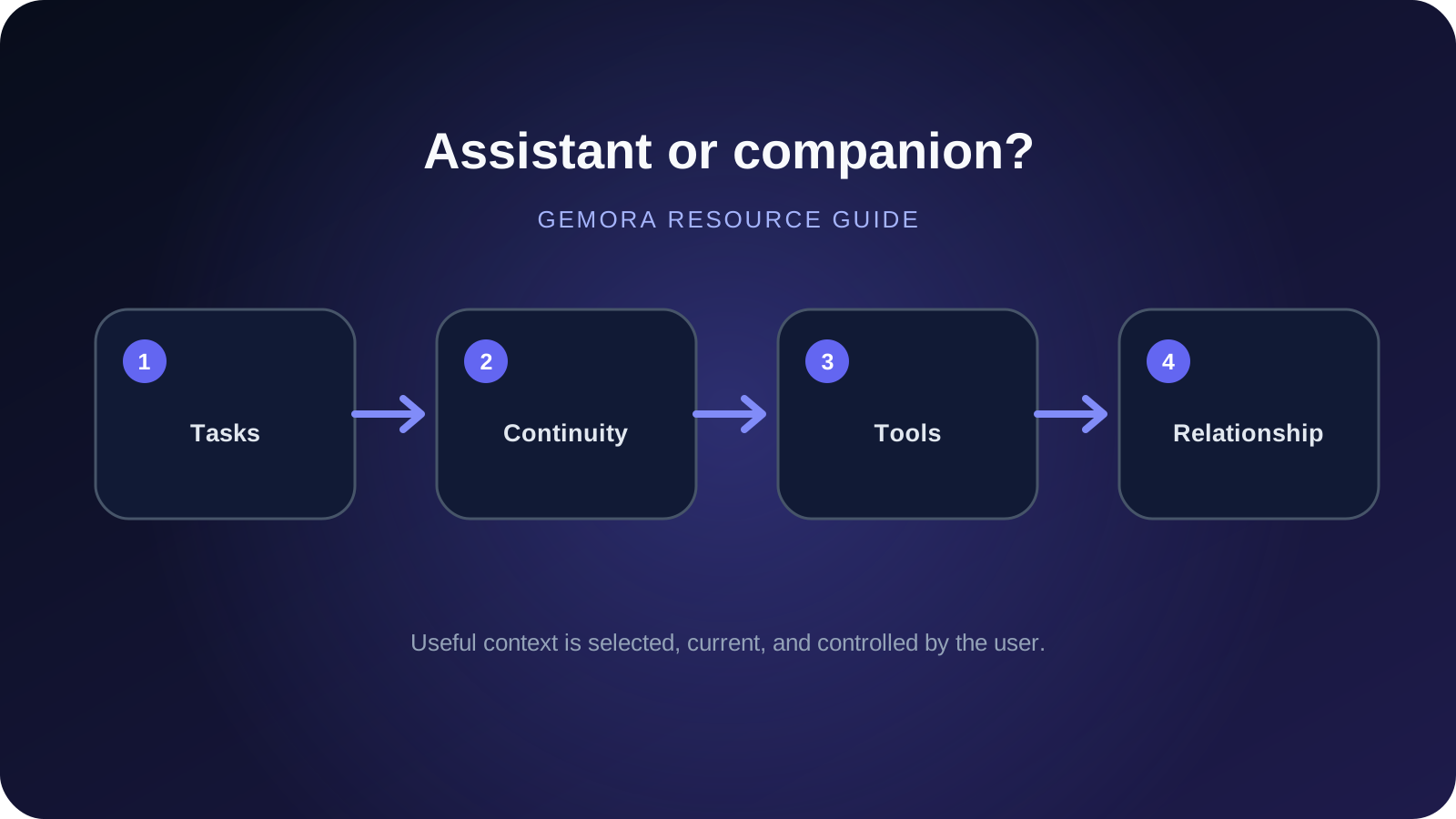
The next generation of personal AI will not force users to choose between being understood and getting things done. Gemora is built around conversations, people, goals, decisions, moments, and changes staying connected so useful help can begin from your real context instead of from zero. Start talking with Gemora.
Continue the thread
Choose the right kind of personal AI
Connect conversations, useful context, reflections, projects, and tasks in one personal workspace.
Start freeFrequently asked questions
What is the difference between an AI companion and an AI assistant?
An AI assistant is primarily designed to help users accomplish tasks, answer questions, operate tools, or complete goals.
Is ChatGPT an AI assistant or AI companion?
ChatGPT is primarily a general purpose AI assistant.
Is Gemini an AI assistant or companion?
Gemini is primarily an AI assistant.
Sources and further reading
- OpenAI — Personalizing ChatGPT
- OpenAI — Better Memory for ChatGPT
- OpenAI — ChatGPT Work
- OpenAI Help — ChatGPT Work and Codex
- OpenAI Help — Projects in ChatGPT
- Google — Assistant Experience Upgrading to Gemini
- Google — Personal Intelligence
- Google — Gemini Multi Step Tasks on Android
- Google — Gemini Intelligence on Android
- Google — Next Evolution of Gemini
- Anthropic — Claude's Memory Works Everywhere
- Claude Help — Release Notes
Written by Khai Tran and reviewed under the Gemora Editorial Policy.