ChatGPT Memory vs Claude Memory
ChatGPT Memory vs Claude Memory: Which Is Better in 2026?
Compare ChatGPT and Claude memory in 2026 across automatic recall, past-chat search, editing, project separation, privacy controls, and portability.
Methodology: Head-to-head comparison based on official memory, chat search, project, temporary-chat, import, export, and privacy documentation reviewed on 2026-09-04.
Original contribution: A ten-round deep comparison focused on passive synthesis versus inspectable memory and exact-history retrieval.

In this guide
- Quick verdict
- The core difference in one sentence
- How ChatGPT Memory works in 2026
- ChatGPT Memory verdict
- How Claude Memory works in 2026
- Claude Memory verdict
- Head-to-head comparison
- Final scorecard
- Memory vs search: the distinction that explains most confusion
- Why neither one should remember everything
- Where Gemora fits
- How to test ChatGPT Memory vs Claude Memory yourself
- A practical decision table
- Final verdict
Related reading: memory vs history · apps with recall · long-term assistants · memory controls.
ChatGPT's Memory Summary shows the high-level context ChatGPT has synthesized across conversations. Source: OpenAI.
ChatGPT and Claude now both remember you across conversations.
But they are solving the memory problem in two noticeably different ways.
ChatGPT is trying to make memory feel invisible.
You keep talking.
The system gradually learns useful context, updates what it knows, and uses that context when future conversations need it.
Claude is trying to make memory more inspectable.
You can see individual memory Topics, edit or delete them, search old conversations directly, and trace previous context back to the source chat.
So the real choice is not:
“Which one has memory?”
Both do.
It is:
Do you want memory to happen automatically in the background, or do you want more explicit control over what the AI remembers?
Our short answer in September 2026:
ChatGPT has the better overall automatic memory experience.
Claude has the better memory-control and past-chat retrieval experience.
If your priority is:
“Just know me better over time.”
choose ChatGPT.
If your priority is:
“Show me exactly what you remember and let me manage it.”
choose Claude.
That sounds simple.
The details are much more interesting.
Quick verdict
| Category | Winner | Why |
|---|---|---|
| Best overall memory | ChatGPT | Stronger passive synthesis and personalization |
| Best automatic personalization | ChatGPT | Requires less manual memory management |
| Best memory transparency | Claude | Memory is exposed as individual Topics |
| Best exact past-chat retrieval | Claude | Can search previous chats and cite them |
| Best memory editing | Claude | Topic-level editing is unusually clear |
| Best memory freshness | ChatGPT | 2026 system explicitly targets stale and contradictory context |
| Best project separation | Claude | Strong project-specific context model |
| Best sensitive-memory control | Claude | Sensitive categories are excluded by default |
| Best Temporary / Incognito workflow | Tie | Both offer non-persistent conversation modes |
| Best memory portability | Claude | Built-in memory import and export |
| Best “I don’t want to think about memory” experience | ChatGPT | More automatic |
| Best “I want to know what the AI thinks it knows” experience | Claude | More inspectable |
The core difference in one sentence
A useful shorthand is:
ChatGPT synthesizes your context. Claude exposes your context.
That does not mean ChatGPT is opaque or Claude is fully manual.
Both are becoming more sophisticated.
But the product philosophies are clearly different.
ChatGPT wants the memory layer to disappear into better answers.
Claude wants users to be able to inspect and intervene in the memory layer directly.
That distinction affects everything else.
How ChatGPT Memory works in 2026
OpenAI's memory system has changed significantly since the first “Saved Memories” version.
The older model worked more like a list of facts.
You could say:
“Remember that I prefer vegetarian food.”
ChatGPT stored that preference.
Useful.
But limited.
Over time, those saved memories could become stale, contradictory, or too manual to manage.
OpenAI's newer system is much more ambitious.
In June 2026, OpenAI introduced a new architecture for synthesizing memory across large numbers of conversations and long time horizons.
Source: OpenAI — Dreaming: Better Memory for a More Helpful ChatGPT
The goal is not simply:
“Store facts.”
It is:
“Maintain a useful and current picture of the context that matters.”
ChatGPT's strongest feature: passive memory synthesis
This is where ChatGPT currently wins.
You do not need to manually create every memory.
ChatGPT can learn useful context through ordinary conversation.
That might include:
- preferences,
- ongoing projects,
- recurring constraints,
- communication style,
- people,
- goals,
- current situations,
- and other context likely to improve future responses.
OpenAI's current Memory FAQ says memory can use useful context from:
- chats,
- files,
- saved memories,
- and supported connected apps.
Source: OpenAI Help — Memory FAQ
The experience becomes:
You keep using ChatGPT.
ChatGPT quietly becomes more contextual.
That is powerful because users do not want memory management to become another job.
ChatGPT Memory Summary
OpenAI now provides a Memory Summary that gives users a high-level view of what ChatGPT currently knows.

The Memory Summary provides a readable overview of context ChatGPT has synthesized about the user. Source: OpenAI.
You can:
- type corrections,
- highlight a specific sentence,
- tell ChatGPT something is wrong,
- ask it not to mention a detail again,
- or remove memories.
This is much better than the old “black box remembers vaguely” experience.
But there is an important caveat.
OpenAI explicitly says the Memory Summary does not necessarily contain everything that may influence personalization.
That means the interface is an overview.
Not a complete database dump.
ChatGPT Memory Sources
OpenAI also added Memory Sources.

Memory Sources can show some of the memories, past chats, custom instructions, files, and connected sources behind a personalized answer. Source: OpenAI.
This is one of ChatGPT's most important recent improvements.
A personalized answer can sometimes show where the context came from.
That might include:
- previous chats,
- saved memory,
- custom instructions,
- files,
- or supported connected sources.
This gives users more visibility into:
“Why did ChatGPT say that?”
It also helps identify stale context.
ChatGPT is unusually focused on memory freshness
This is one of the biggest reasons we give ChatGPT the overall win.
OpenAI's June 2026 memory architecture is explicitly designed around three long-term problems:
- freshness,
- correctness,
- scalability.
Source: OpenAI — Better Memory for ChatGPT
Why does freshness matter?
Because personal context changes.
Suppose you say:
“I am traveling to Singapore next month.”
After the trip, that statement should stop behaving like a future plan.
Or:
“I want to become a manager.”
Six months later:
“I tried management and realized I hate it.”
The current AI should not keep optimizing your career around the old goal.
OpenAI's newer system tries to synthesize these changes over time.

Stale or missing context can make an otherwise strong model produce a poorly matched answer. Source: OpenAI.

With relevant and current personal context, the same model can provide a more useful recommendation. Source: OpenAI.
This is the difference between:
remembering history
and
understanding current state.
ChatGPT past-chat retrieval
ChatGPT does not rely only on synthesized memory.
The product also supports searching chat history.
That matters because sometimes you need the original conversation.
Example:
“Find the exact conversation where we decided to change pricing.”
That is a retrieval problem.
Not a memory-summary problem.
ChatGPT has improved past-chat detail retrieval over time and can use previous chats as part of personalization.
The distinction remains:
Need a useful summary? Memory.
Need the source discussion? Chat history.
ChatGPT Temporary Chat
ChatGPT also offers Temporary Chat for users who do not want normal persistence.
OpenAI's current Temporary Chat behavior is more nuanced than it used to be.
Temporary Chats start non-personalized by default.
A non-personalized Temporary Chat:
- does not use normal memory for personalization,
- does not create new memory,
- does not appear in regular history unless saved.
A personalized Temporary Chat can use existing memory and custom instructions, but it still does not create or update memory while it remains temporary.
Source: OpenAI Help — Temporary Chat FAQ
This gives users a useful choice:
“Use what you know about me, but do not add this conversation to future memory.”
That is a surprisingly good privacy pattern.
ChatGPT's biggest weakness: full memory state is still partly abstract
This is where Claude wins.
ChatGPT gives users:
- Memory Summary,
- Memory Sources,
- conversational correction,
- deletion controls.
That is good.
But the underlying system is still a synthesis.
OpenAI itself says Memory Sources may not show every factor that shaped a response.
So if you are the kind of person who wants:
“Show me the exact list of stored memory topics.”
Claude currently gives you a cleaner answer.
ChatGPT Memory verdict
Best at: automatic cross-conversation personalization.
Best for: people who do not want to manually curate AI memory.
Main advantage: ChatGPT quietly learns useful context and tries to keep it current.
Main weakness: the full memory picture is less explicit than Claude's topic-based system.
How Claude Memory works in 2026
Claude's memory evolved in a different direction.
Anthropic now stores memory as individual categorized entries, rather than one daily summary.
Claude reads and updates these entries during conversations.
Source: Claude Release Notes
In August 2026, Anthropic also unified memory between normal Claude Chat and cloud Cowork.
Source: Anthropic — Claude's Memory Works Everywhere
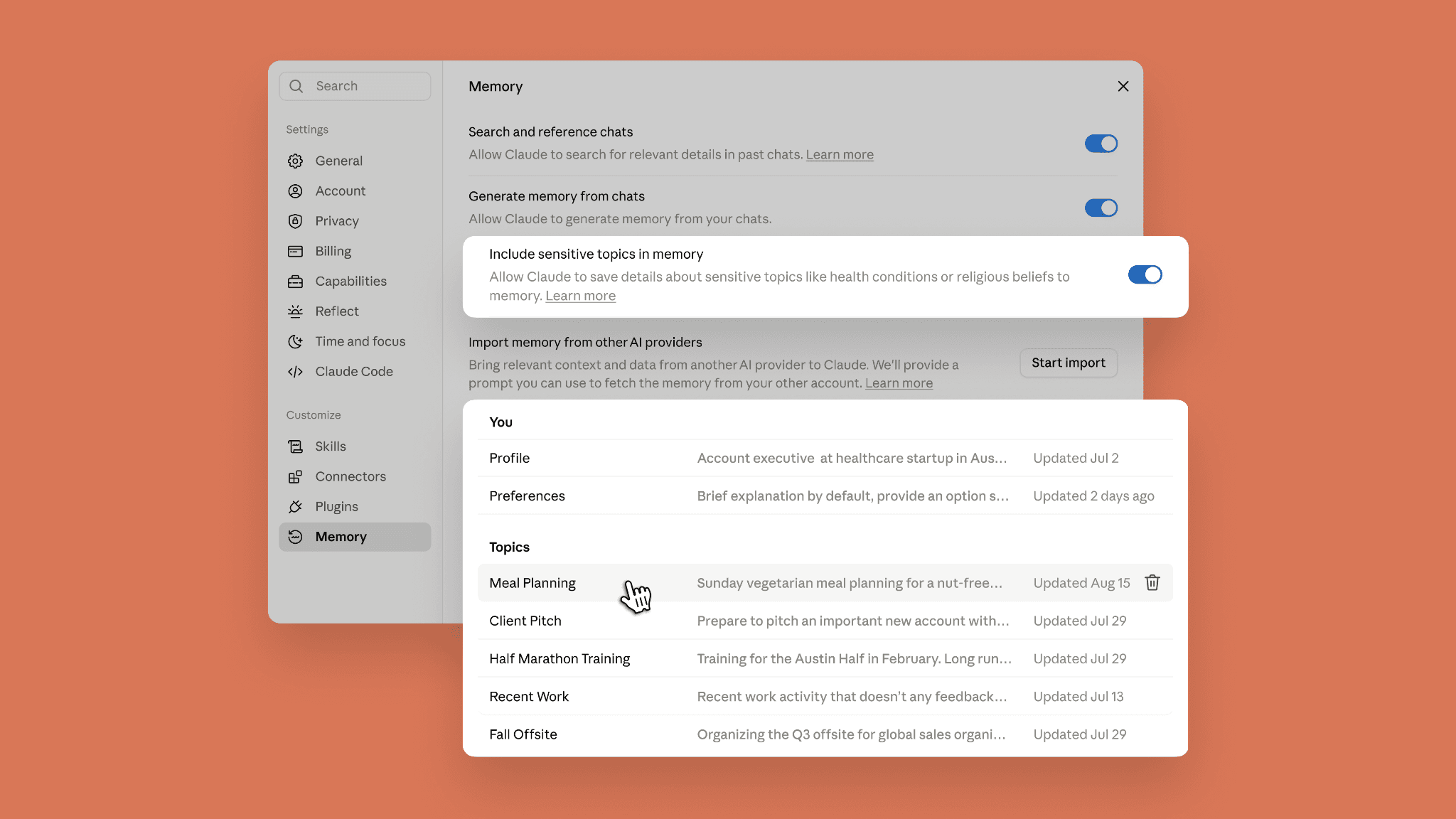
Claude now uses the same persistent memory across Chat and cloud Cowork. Source: Anthropic.
The result feels more like:
a visible working memory system
than an invisible synthesis layer.
Claude's strongest feature: Memory Topics
Open Claude settings.
Go to Memory.
You can see remembered information organized by topic.

Claude exposes persistent memory as individual Topics that can be reviewed directly. Source: Anthropic.
This is one of the cleanest memory interfaces currently available.
Instead of asking:
“What do you remember?”
and hoping the AI gives you a useful summary, you can inspect the actual Topics.
Examples might include:
- project context,
- work preferences,
- tools,
- recurring constraints,
- collaboration style,
- current responsibilities.
Claude's memory is currently more work-oriented than ChatGPT's broader personalization system.
That is intentional.
Claude lets you edit memory directly
This is one of Claude's clearest wins.
Open a Topic.
Change it.
Delete it.
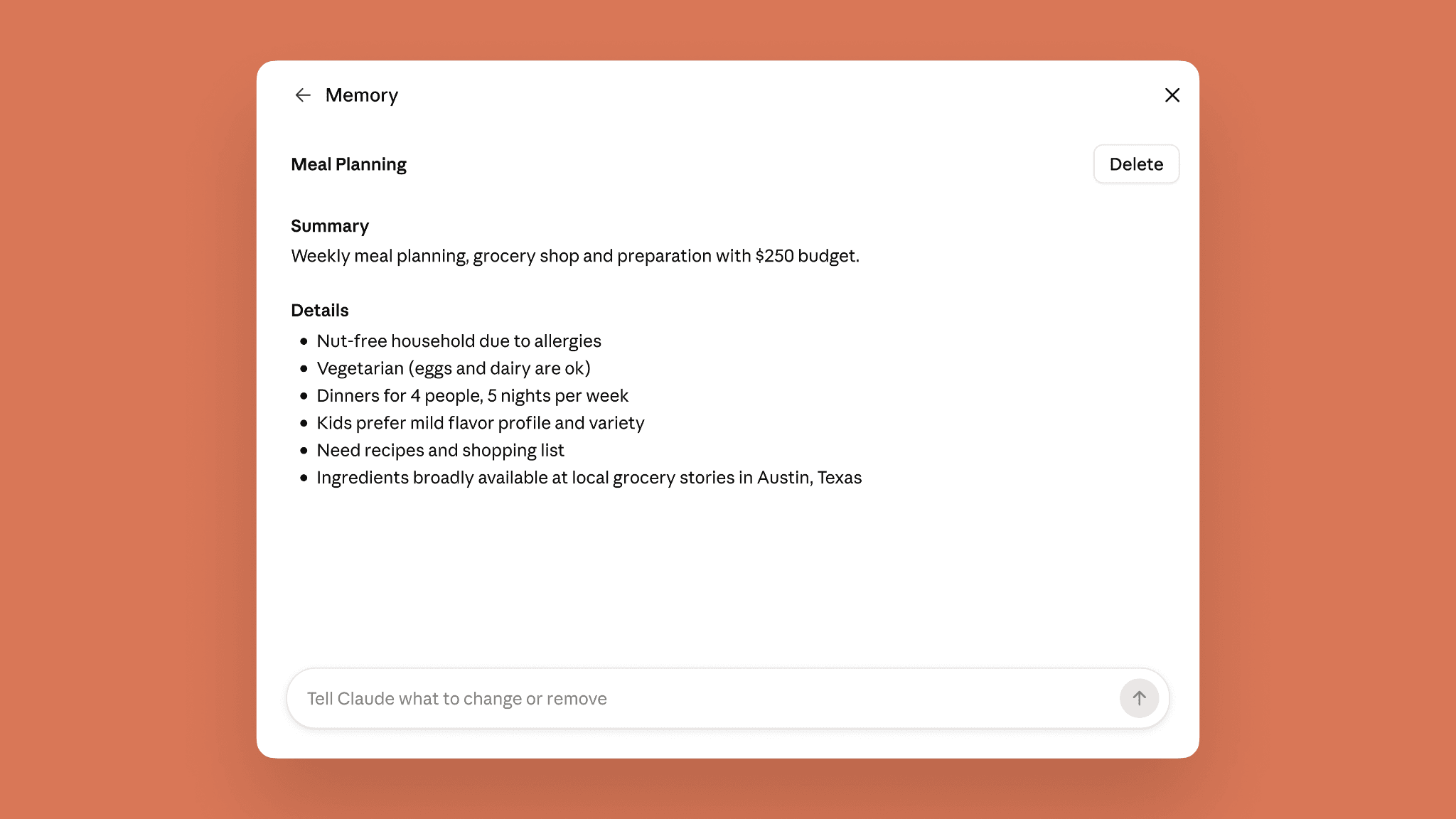
Claude lets users directly edit or remove individual memory topics. Source: Anthropic.
Suppose Claude remembers:
“Project launch: October.”
The launch moves to November.
You do not need to wonder whether the system updated correctly.
You can change the Topic.
That is extremely useful for professional context.
Claude has the better exact past-chat search
This is probably Claude's biggest functional advantage over ChatGPT.
On supported paid plans, you can ask Claude to search previous conversations.
Examples:
“What did we discuss about onboarding?”
“Find the conversation where we compared those two options.”
“Continue where we left off on that strategy.”
Claude retrieves relevant context.
More importantly, it can cite the original past chat.
Source: Claude Help — Chat Search and Memory
This creates a cleaner separation:
Memory
What should Claude carry forward?
Search
Where exactly did we discuss this?
That division is excellent product design.
Claude memory is stronger for project separation
Claude is particularly well-suited to users who have several unrelated workstreams.
Examples:
- client A,
- client B,
- startup,
- university project,
- personal writing.
You may want context inside each.
You may not want context from one leaking into another.
Claude's project model is designed around cleaner separation.
This matters because personalization can become annoying when unrelated memories pollute an answer.
More memory is not always better.
Correctly scoped memory is better.
Claude handles sensitive memory more explicitly
Anthropic says Claude does not automatically save certain sensitive categories by default.
Examples include topics such as:
- health,
- beliefs,
- politics,
- race,
- ethnicity,
- gender identity.
Users can opt into some sensitive memory categories if they want those topics to carry forward.
Source: Anthropic — Claude's Memory Works Everywhere
This is a strong design choice for users who want:
personalization without silently turning every sensitive conversation into persistent profile data.
ChatGPT also gives users memory controls and Temporary Chat.
Claude's model is more explicit about sensitive-topic boundaries.
Claude Incognito Chat
Claude provides an Incognito Chat mode for conversations that should not become part of normal persistent memory.
This is conceptually similar to ChatGPT Temporary Chat.
The exact behavior and naming differ, but the user goal is the same:
“Let me have this conversation without feeding it into normal long-term continuity.”
This is important because good memory systems need a deliberate forgetting mode.
Claude memory import and export
This is a major Claude advantage.
Anthropic now supports memory import and export.
Source: Claude Help — Import and Export Memory
Users can:
- import context from another AI provider,
- export Claude memory,
- back it up,
- or move it elsewhere.
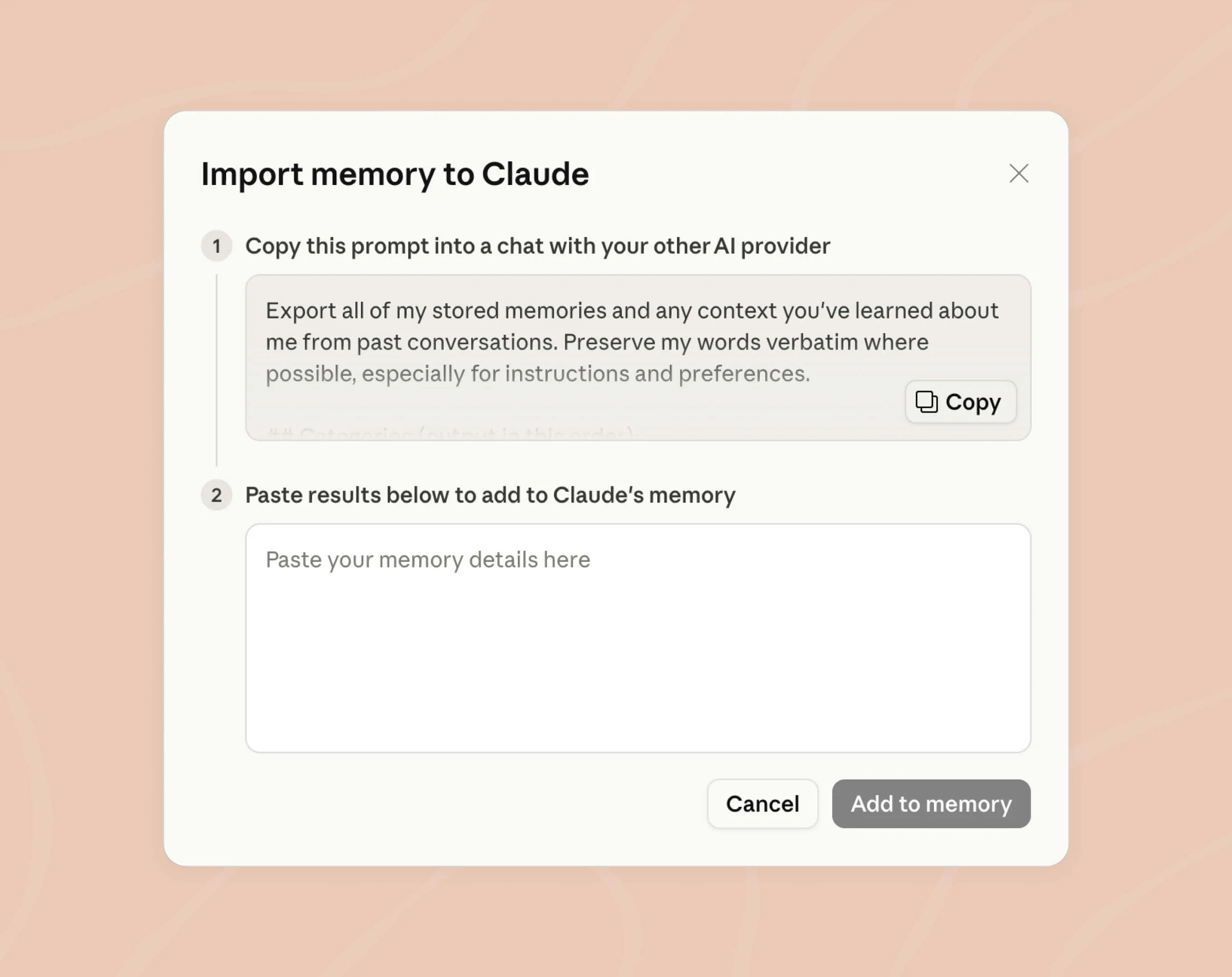
Claude's memory-import flow lets users bring context over from another AI assistant. Source: Anthropic.
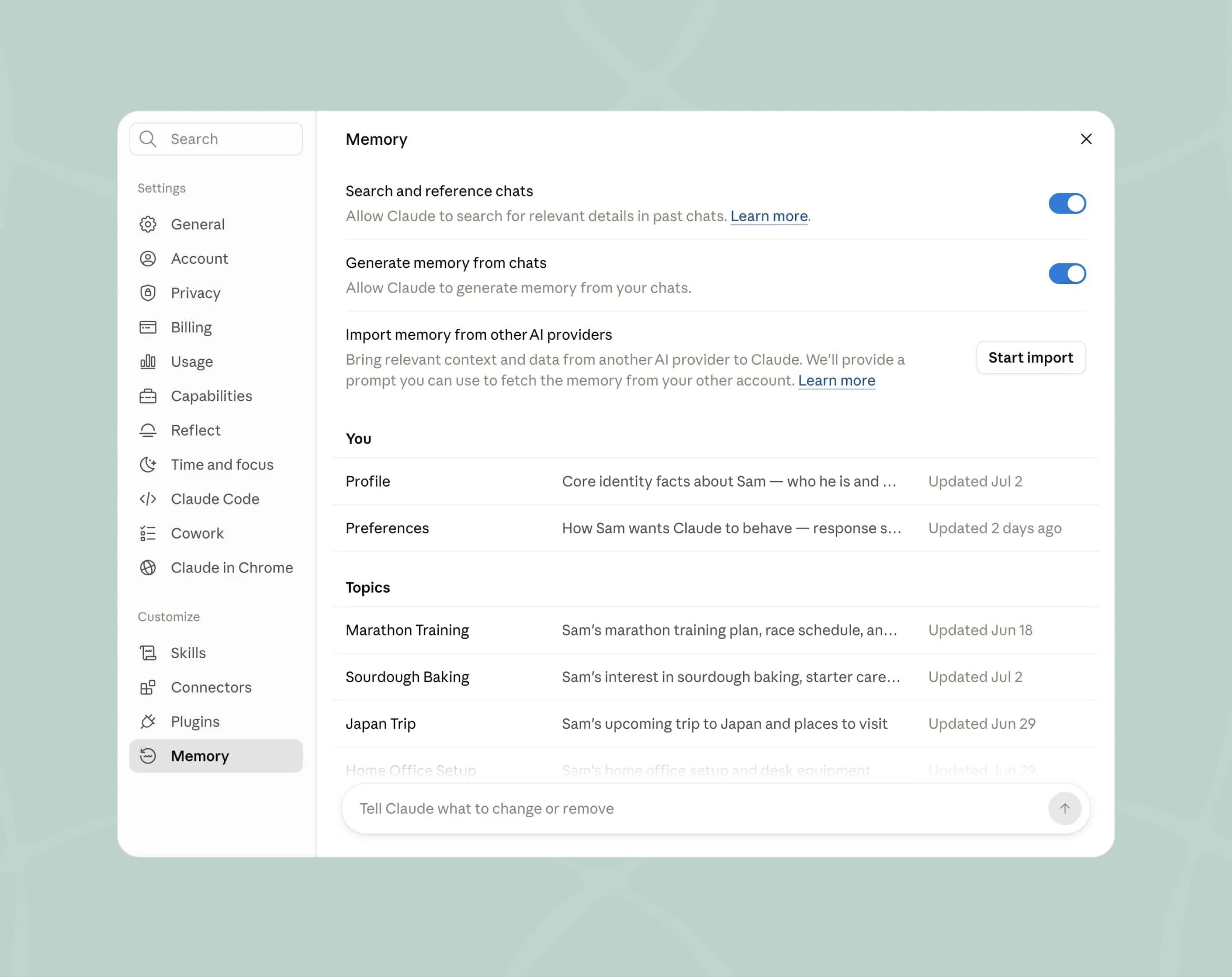
Imported memory becomes part of Claude's persistent context after review and processing. Source: Anthropic.
Anthropic notes that memory import is experimental.
Claude may not incorporate every imported memory perfectly.
Claude also focuses memory primarily on work-related context, so some personal details may not persist automatically.
Still, the portability model is important.
It moves AI memory slightly closer to:
user-owned context
instead of:
provider-owned lock-in.
Claude's biggest weakness: memory is more work-oriented
This is important.
Claude's memory system is excellent.
But it is not trying to become the deepest general model of your personal life.
Anthropic explicitly says its memory focuses on work-related topics.
That makes Claude excellent for:
- projects,
- collaboration,
- preferences,
- professional context,
- recurring tasks.
Less naturally optimized for:
- personal relationships,
- everyday life,
- emotional history,
- broad personal continuity.
You can still use Claude for those conversations.
The memory architecture simply has a more work-oriented bias.
Claude Memory verdict
Best at: transparency, control, project context, and exact retrieval.
Best for: users who want to inspect what their AI remembers.
Main advantage: memory is explicit and editable.
Main weakness: less automatic and less broadly personal than ChatGPT's memory-first personalization model.
Head-to-head comparison
Now the useful part.
Round 1: Which remembers you more automatically?
Winner: ChatGPT
ChatGPT is more aggressive about passive synthesis.
You use the product.
Memory accumulates.
OpenAI's architecture explicitly targets long-term context across many conversations.
Claude also learns context automatically.
But Claude's product philosophy feels more deliberate and work-oriented.
If your desired experience is:
“I do not want to manage this. Just know me better.”
ChatGPT wins.
Winner: ChatGPT
Round 2: Which is easier to inspect?
Winner: Claude
Claude Topics are extremely clear.
You can see:
- what exists,
- how it is categorized,
- what should be changed,
- what should be deleted.
ChatGPT's Memory Summary is useful.
Memory Sources are useful.
But the complete memory state remains more abstract.
Winner: Claude
Round 3: Which is easier to edit?
Winner: Claude
Both support correction.
Claude makes direct Topic editing feel like editing a document.
ChatGPT supports conversational edits and highlighted corrections inside Memory Summary.
Both work.
Claude is cleaner.
Winner: Claude
Round 4: Which handles stale memory better?
Winner: ChatGPT
OpenAI's 2026 architecture explicitly focuses on:
- freshness,
- contradictions,
- time,
- long-lived personalization.
Claude updates Topics continuously and gives users powerful manual correction.
That is excellent.
But ChatGPT has the stronger product-level emphasis on automatic time-aware synthesis.
Winner: ChatGPT
Round 5: Which is better for exact previous conversations?
Winner: Claude
Claude's integrated past-chat search plus citations makes this easy.
You ask:
“Find where we discussed this.”
Claude can retrieve the original conversation.
ChatGPT supports history search and past-chat memory.
Claude's workflow is currently more explicit.
Winner: Claude
Round 6: Which is better for projects?
Winner: Claude
Claude's memory architecture feels more naturally designed around professional work.
The combination of:
- project separation,
- editable Topics,
- chat search,
- Cowork memory
makes Claude particularly strong here.
Winner: Claude
Round 7: Which is better for everyday personal context?
Winner: ChatGPT
ChatGPT's memory is broader.
It is designed to learn:
- preferences,
- personal context,
- interests,
- projects,
- constraints,
- recurring information.
Claude can remember personal information too.
But Anthropic's documentation explicitly frames memory around work collaboration.
For broad personal continuity, ChatGPT is the more natural fit.
Winner: ChatGPT
Round 8: Which is better for sensitive context?
Winner: Claude
Claude excludes several sensitive categories by default.
That is more explicit than ChatGPT's general memory model.
ChatGPT offers strong control:
- memory off,
- deletion,
- Temporary Chat,
- Memory Sources.
Still, Claude's default sensitive-memory policy gives it the edge.
Winner: Claude
Round 9: Which has better Temporary / Incognito behavior?
Winner: Tie
Both are good.
ChatGPT's Temporary Chat is particularly flexible now.
You can choose:
- non-personalized Temporary Chat,
- or personalized Temporary Chat that uses existing memory without creating new memory.
Claude's Incognito Chat gives users a similar separation.
The exact workflows differ.
Both solve the core problem well.
Winner: Tie
Round 10: Which is more portable?
Winner: Claude
Claude supports built-in memory import and export.
That gives users a direct migration path.
ChatGPT provides data export and memory controls, but Claude has the more explicit memory-portability workflow.
Winner: Claude
Final scorecard
| Feature | ChatGPT | Claude |
|---|---|---|
| Automatic personalization | Best | Excellent |
| Broad personal context | Best | Good |
| Memory transparency | Strong | Best |
| Direct topic editing | Strong | Best |
| Memory freshness | Best | Excellent |
| Exact past-chat search | Strong | Best |
| Citations to old chats | More limited | Best |
| Project separation | Strong | Best |
| Work context | Excellent | Best |
| Personal-life context | Best | Good |
| Sensitive memory controls | Strong | Best |
| Temporary / private chats | Excellent | Excellent |
| Memory import/export | More limited | Best |
| “Just remember me” experience | Best | Strong |
| “Let me manage memory” experience | Strong | Best |
ChatGPT Memory is better if...
Choose ChatGPT if these sound like you.
You do not want to manage memory manually
You want personalization to happen automatically.
You use AI for many different parts of life
Work.
Planning.
Learning.
Travel.
Personal questions.
Projects.
ChatGPT's broader memory model fits that mix well.
You care about long-term automatic freshness
You want the system to update its picture over time.
You want personal context to feel invisible
You do not care what the memory architecture looks like.
You care whether the answer knows enough context.
You want a general-purpose AI that becomes more personal
This is probably ChatGPT's strongest use case.
Claude Memory is better if...
Choose Claude if these sound like you.
You want to inspect memory directly
Topics make this extremely easy.
You hate hidden assumptions
You want to see what the AI thinks it knows.
You work across several projects
Claude's separation is excellent.
You frequently need old conversations
Past-chat search plus source citations is a major advantage.
You care about memory portability
Claude lets you import and export memory.
You prefer stricter sensitive-memory boundaries
Claude's explicit sensitive-topic policy may be more comfortable.
Which is better for work?
Claude
For professional project context, Claude currently has the stronger memory model.
Why?
Because work context benefits from:
- explicit structure,
- project separation,
- source retrieval,
- clear correction,
- memory portability.
Claude is designed around exactly those behaviors.
Example:
Project A:
Client onboarding redesign

Project B:
Financial model

Project C:
Research paper
You want context inside each.
You do not necessarily want all three mixed into one personal profile.
Claude is excellent here.
Which is better for personal use?
ChatGPT
For everyday life, ChatGPT currently has the advantage.
Examples:
- travel preferences,
- ongoing personal decisions,
- communication style,
- recurring interests,
- personal projects,
- life planning,
- household context,
- general preferences.
ChatGPT's broader passive personalization is more natural for this.
Claude can absolutely be personal.
Its memory system simply has a stronger work bias.
Which is better if you hate repeating yourself?
ChatGPT
This is the purest expression of ChatGPT Memory.
OpenAI explicitly describes memory as helping future conversations begin from shared context rather than from scratch.
That is exactly the problem:
“I already explained this.”
ChatGPT is currently the stronger automatic solution.
Which is better if you hate wrong memory?
Claude
Claude.
Not because Claude never gets things wrong.
No AI memory system deserves that kind of magical marketing.
Claude wins because it is easier to see and fix the wrong thing.
A visible bad memory is easier to correct than a hidden bad synthesis.
Which is better if you need old reasoning?
Claude
Suppose you want:
“What reasons did we give for delaying the launch?”
A compressed memory might only preserve:
“Launch delayed.”
Claude past-chat retrieval can help recover the actual reasoning.
That is more useful for:
- strategic decisions,
- technical work,
- research,
- long-running projects.
Which is better if your preferences change often?
ChatGPT, narrowly
ChatGPT's newer memory architecture explicitly focuses on updating context over time.
Claude's direct editing is also excellent.
If the system can infer the change automatically, ChatGPT wins.
If you prefer to manually control the change, Claude wins.
So the real answer is:
ChatGPT for automatic updating.
Claude for explicit updating.
Which one is more trustworthy?
That depends on what makes you trust a system.
Some users trust:
automation that quietly works.
Others trust:
visible state they can inspect.
ChatGPT offers:
- Memory Summary,
- Memory Sources,
- correction,
- deletion,
- Temporary Chat.
Claude offers:
- Topics,
- direct editing,
- source chat search,
- memory import/export,
- sensitive-topic controls.
If transparency is your trust model:
Claude wins.
If consistent low-friction personalization is your trust model:
ChatGPT wins.
Memory vs search: the distinction that explains most confusion
This comparison becomes much easier once you separate two tasks.
Memory
The AI keeps enough useful context to help later.
Example:
“The user prefers concise answers.”
Search
The AI retrieves an old source.
Example:
“Find the chat where we decided to change pricing.”
ChatGPT is stronger on the first.
Claude is stronger on the second.
Both do both.
But the emphasis differs.
Why neither one should remember everything
More memory sounds better.
It is not.
A good system should forget:
- one-off plans,
- temporary emotions,
- hypothetical scenarios,
- jokes,
- roleplay,
- outdated preferences.
The goal is not:
“Never forget.”
It is:
“Keep what still matters.”
This is one of the hardest AI memory problems.
Both OpenAI and Anthropic are clearly moving toward that direction.
Where Gemora fits
ChatGPT and Claude are both general-purpose AI assistants.
Gemora is focused on a different part of the problem:
continuity around everyday life.
The most interesting personal context is often not:
“User prefers concise answers.”
It is:
“The user has been talking about the same decision for six weeks, but the reason they are stuck has changed.”
That kind of context is less like a settings profile.
More like a thread across life.
Gemora is built around conversations about:
- relationships,
- goals,
- work,
- decisions,
- stress,
- ordinary days,
- and things that keep coming back.
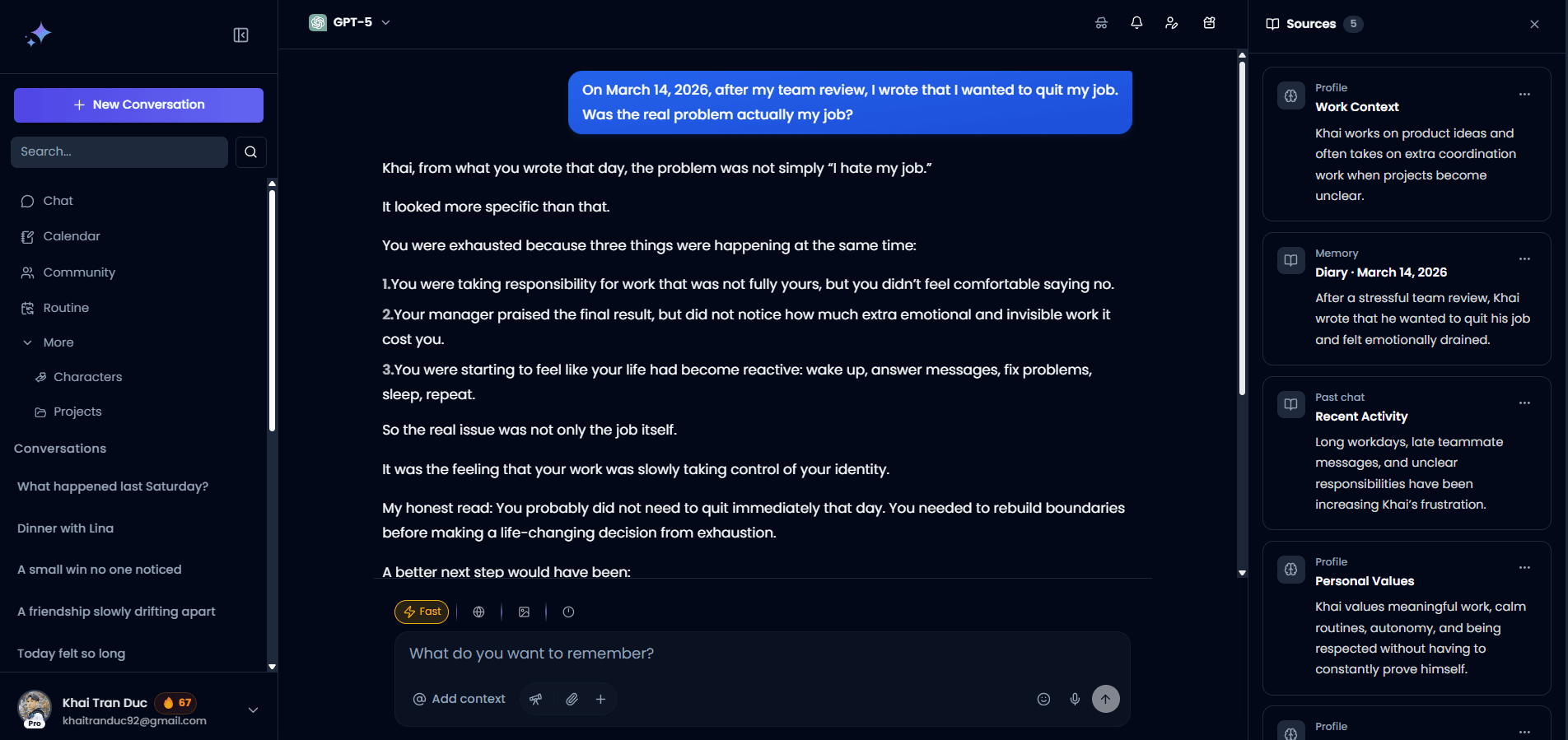
Gemora is centered on conversations about everyday life remaining connected over time. Source: Gemora.
Recap helps preserve the surrounding day

Gemora Recap helps make days and conversations easier to revisit as part of a longer life context. Source: Gemora.
Memories help old context resurface

Gemora Memories focuses on resurfacing relevant personal context rather than forcing users to manually search every chat. Source: Gemora.
Insights focus on what changed

Longitudinal context becomes especially useful when it helps show patterns and changes across time. Source: Gemora.
That is why Gemora's positioning is not:
“We have more memory.”
It is:
talk through life, keep the thread, and understand yourself better over time.
For broader comparisons, see:
Best AI Apps That Remember Past Conversations
What Is a Personal Context Layer for AI?
How to Make AI Remember You Across Conversations
How to test ChatGPT Memory vs Claude Memory yourself
Do not trust rankings blindly.
Run the same test.
Test 1: stable preference
Tell both:
“I strongly prefer concise answers with the recommendation first.”
Do not explicitly say “remember.”
A few days later, open a new chat.
Ask an unrelated question.
See whether the style carries forward.
What this tests
Automatic personalization.
ChatGPT should be particularly strong here.
Test 2: current project
Tell both:
“I am launching an Android app next month. The main remaining issue is onboarding.”
Later ask:
“What should I prioritize before launch?”
What this tests
Cross-chat project context.
Both should perform well.
Test 3: changed information
Update:
“The launch moved from October 1 to October 15.”
Later ask:
“How much time do I have before launch?”
What this tests
Memory freshness.
ChatGPT's automatic synthesis is especially relevant here.
Claude's Topics make the result easier to inspect.
Test 4: exact past discussion
Ask:
“Find the conversation where we discussed why the launch moved.”
What this tests
Exact source retrieval.
Claude should have the advantage on supported paid plans.
Test 5: audit the memory
Ask:
“What do you currently remember about this project?”
Then inspect the product's memory controls.
What this tests
Transparency.
Claude should win.
Test 6: wrong memory
Tell each AI something incorrectly.
Then correct it.
Example:
“The launch is on October 1.”
then:
“Correction: October 15.”
Wait.
Check which version persists.
What this tests
Correction and staleness.
Test 7: private conversation
Use Temporary Chat in ChatGPT and Incognito Chat in Claude.
Say something distinctive.
Return to normal conversation later.
What this tests
Memory boundaries.
The information should not behave like normal persistent context.
A practical decision table
| If you care most about... | Choose |
|---|---|
| Automatic personalization | ChatGPT |
| Minimal setup | ChatGPT |
| Everyday personal context | ChatGPT |
| Time-aware memory freshness | ChatGPT |
| Inspecting every memory topic | Claude |
| Editing memory directly | Claude |
| Finding old chats | Claude |
| Project separation | Claude |
| Work context | Claude |
| Sensitive-memory defaults | Claude |
| Import/export | Claude |
| Personal continuity without thinking about memory | ChatGPT |
Final verdict
If we have to choose one overall winner:
ChatGPT wins for automatic memory.
Claude wins for controlled memory.
ChatGPT is better if your ideal experience is:
“I keep talking and the AI gradually understands me better.”
Claude is better if your ideal experience is:
“I want to see what the AI knows, edit it, separate it by project, and retrieve the original conversations.”
For most general consumers, we would choose ChatGPT Memory.
For users doing serious project work, knowledge work, or anything where memory traceability matters, Claude Memory may be the better system.
The larger lesson is that “better memory” does not mean:
more facts stored.
It means:
- the right context,
- kept current,
- retrieved at the right time,
- easy to correct,
- and separated appropriately.
ChatGPT and Claude are taking different paths toward that same goal.
And the likely future winner will combine both philosophies:
memory that feels automatic when it works, and fully controllable when it does not.
The useful part is not that an AI stored what you said. It is that the next conversation can begin with more understanding than the last. Start talking with Gemora.
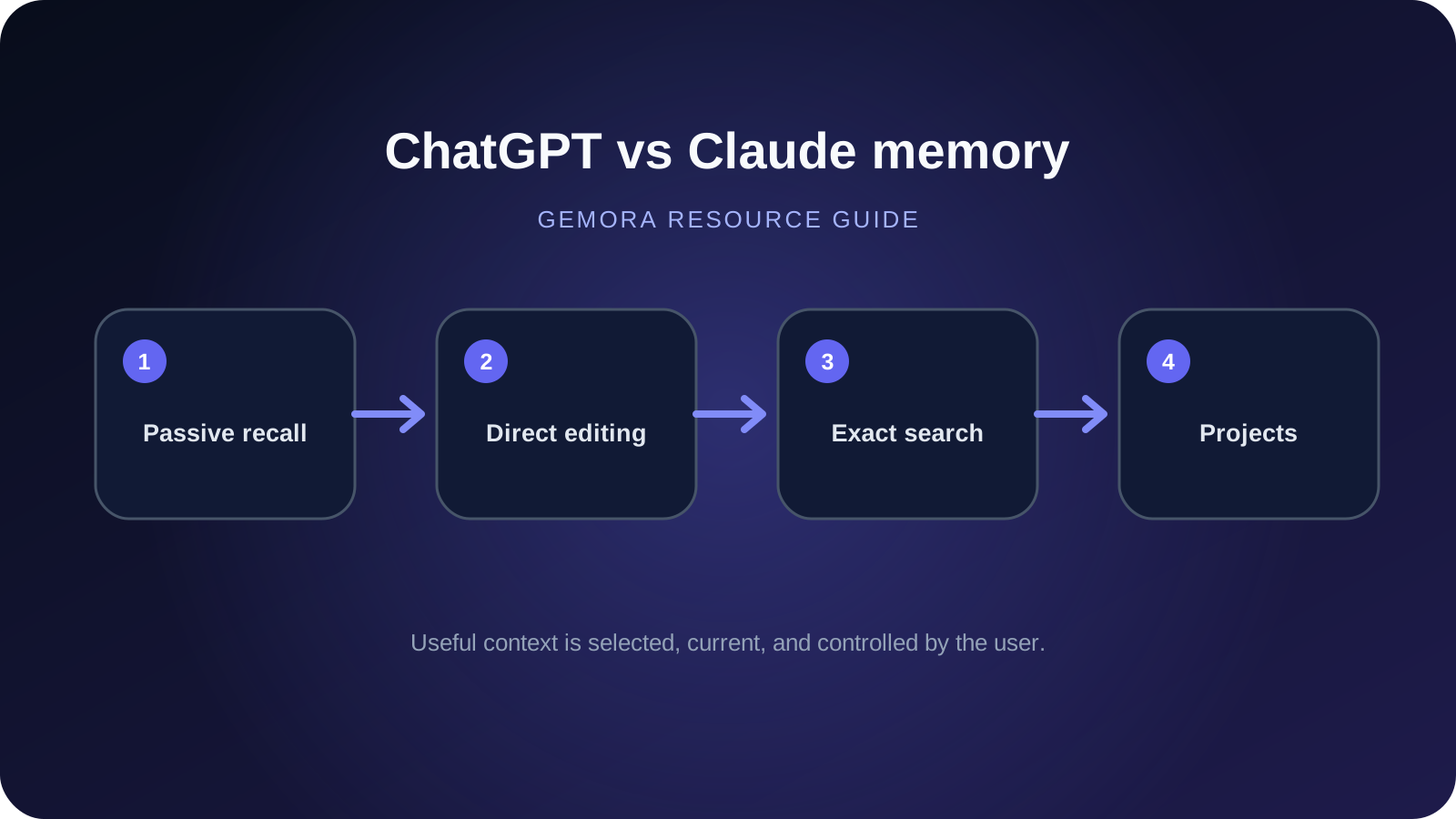
Continue the thread
Compare memory by transparency and continuity
Connect conversations, useful context, reflections, projects, and tasks in one personal workspace.
Start freeFrequently asked questions
Is ChatGPT Memory better than Claude Memory?
ChatGPT is stronger for passive cross-chat personalization, while Claude is stronger when inspectability, direct editing, project separation, and exact retrieval matter.
Which is better for work projects?
Claude often offers clearer project separation and memory inspection, while ChatGPT can be convenient when broader automatic continuity is the priority.
Which is better if I hate wrong memory?
Prefer the product whose current controls let you inspect, correct, and isolate context in a way you will actually maintain.
Sources and further reading
Written by Khai Tran and reviewed under the Gemora Editorial Policy.