why roleplay is not enough for the future of AI companions
Why Roleplay Is Not Enough for the Future of AI Companions
Learn why roleplay alone cannot define future AI companions, and how continuity, memory, real-life context, practical help and user control also matter.
Methodology: Analysis based on official product documentation and public feature descriptions listed in the sources, reviewed on 2026-10-27.
Original contribution: A category thesis that separates roleplay quality from real-life continuity, practical usefulness, memory, and user agency.
In this guide
- The short answer
- Roleplay is not the problem
- Character.AI shows how far roleplay can go
- Story Memory shows the roleplay memory problem clearly
- But real-life continuity is a different ontology
- Roleplay optimizes consistency
- Real-life companionship optimizes adaptability
- This is one reason personal memory is harder than lore
- The future companion needs temporal truth
- Roleplay remembers canon
- The future companion needs to understand people who are not the AI
- Replika is already moving in this direction
- Nomi's Mind Maps go even further
- People context is more difficult than character context
- A future companion needs epistemic restraint
- Roleplay rewards imagination
- The future companion needs open loops
- Example
- Open loops create presence
- The future companion needs to distinguish conversation from action
Related reading: memory vs history · apps with recall · long-term assistants · memory controls.
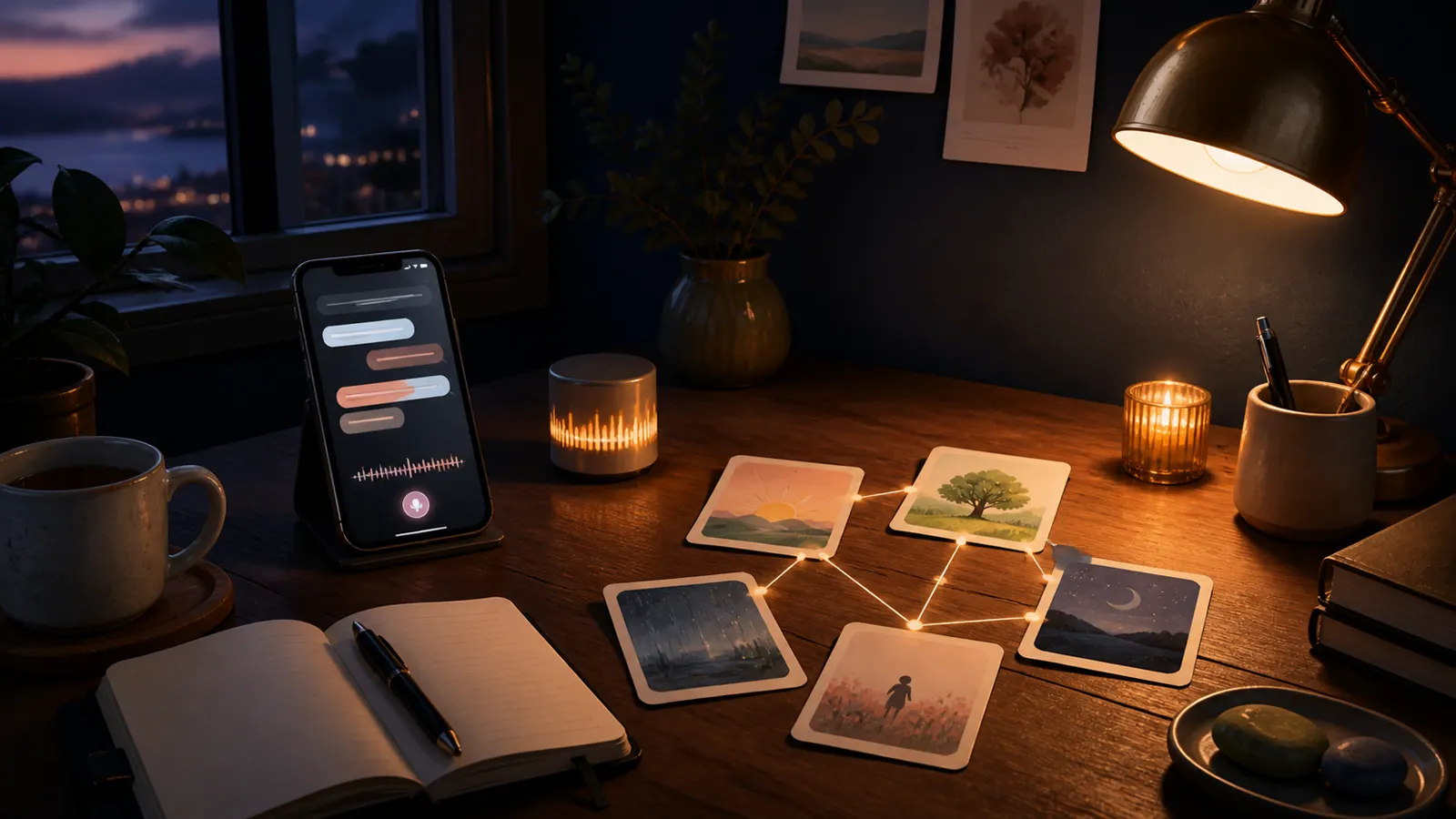
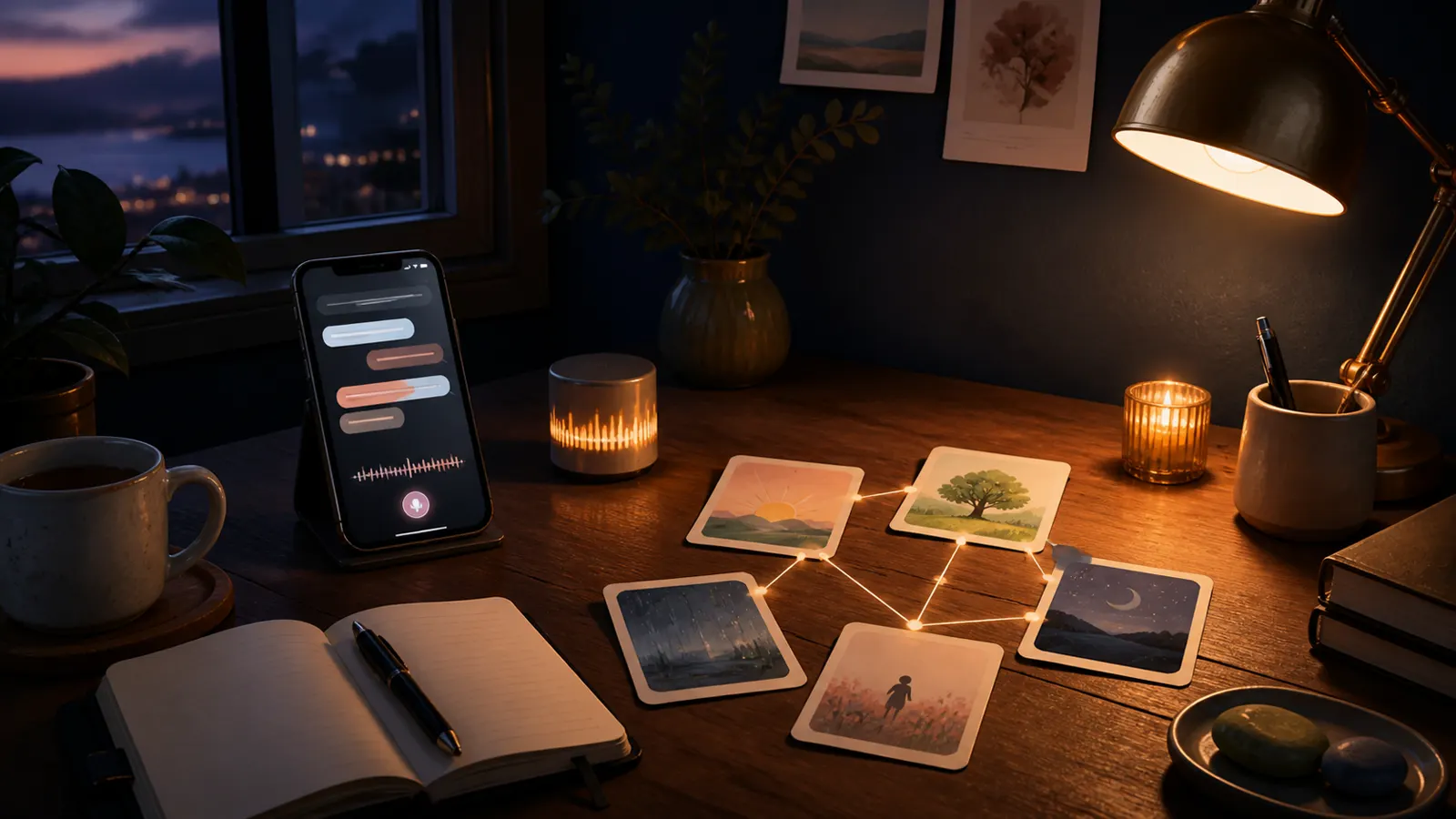
Roleplay can make an AI world more interesting. The next generation of companions also needs to make the user's real life easier to understand. Source: Gemora.
Roleplay is one of the most obvious things AI companions are good at.
You can create:
- a fictional friend,
- a romantic character,
- a mentor,
- a historical figure,
- a fantasy world,
- a text adventure,
- a completely invented relationship.
Modern language models are exceptionally good at this.
They can improvise.
They can stay in character.
They can generate dialogue endlessly.
They can remember plot details.
They can turn a conversation into a world.
Character.AI's 2026 product direction makes that especially clear. Its current product materials emphasize:
- characters,
- stories,
- worlds,
- roleplay,
- long plots,
- backstory,
- immersive entertainment.
Its May 2026 Story Memory update is literally designed to help Characters remember:
- backstory,
- key events,
- special moments,
- plot twists,
- important story context.
Source: Character.AI — Smarter Memory for Smarter Chats
That is an impressive use of memory.
It also reveals the limitation of roleplay as the final destination for AI companions.
Because there are two very different things an AI can remember.
It can remember:
the world you imagined together.
Or it can remember:
the life you are actually living.
Those are not the same problem.
A roleplay-first companion may know:
your character is a detective in 1920s Paris.
A real-life personal companion may know:
your sister is moving next month, your app launch slipped by a week, you changed your mind about fundraising, and the person you were waiting to hear from finally replied.
Both forms of continuity can feel personal.
But only one directly compounds into:
useful context for your real life.
This does not mean roleplay is bad.
It does not mean AI companions should stop being imaginative.
It means:
roleplay is a use case, not a complete product thesis for the future of companionship.
The next generation of AI companions will likely need to do more.
They will need to understand:
- people,
- projects,
- decisions,
- goals,
- plans,
- moments,
- changes,
- current state,
- history,
- what matters now.
They will need to know when to:
- listen,
- remember,
- follow up,
- help,
- act,
- stay quiet.
They will need enough continuity that a user can leave for two weeks, come back, and say:
“It finally happened.”
without rebuilding the entire story.
That is a much harder problem than roleplay.
It is also a much bigger opportunity.
The short answer
Roleplay is valuable because it gives AI companions:
- identity,
- imagination,
- consistency,
- emotional texture,
- entertainment,
- low-stakes experimentation.
But roleplay alone does not solve:
- real-life continuity,
- people context,
- changing goals,
- unfinished decisions,
- practical follow-up,
- time-aware memory,
- connected personal data,
- privacy and user control,
- life-state understanding,
- useful action.
The companion category is therefore likely to evolve from:
Character
↓
Conversation
↓
Roleplay continuity
toward:
Conversation
↓
Personal context
↓
Real-life continuity
↓
Reflection
↓
Practical help
↓
Action when useful
The AI character may remain.
But the user’s real life becomes the higher-value context layer.
Roleplay is not the problem
It is worth getting this right.
Roleplay is one of the strongest native uses of generative AI.
Before large language models, most interactive characters were constrained by:
- dialogue trees,
- scripted responses,
- fixed story branches.
Generative AI changed that.
Now users can enter a scenario and keep going.
The world does not have to end because the developer forgot to write Dialogue Option #47B.
That is genuinely powerful.
Character.AI shows how far roleplay can go
Character.AI currently describes its direction as:
the future of AI entertainment.
Its September 2026 safety update says the company wants to preserve space for:
- roleplay,
- stories,
- worlds.
Source: Character.AI — Continuing To Build Upon Our Safety Priorities
Its product blog in 2026 includes:
- Stories,
- playable books,
- Imagine,
- creator tools,
- memory for plots and backstory.
Source: Character.AI Product Updates
This is not accidental.
Character.AI is increasingly coherent as:
AI entertainment infrastructure.
That can become a very large category.
But entertainment is not the entire companion market.
Story Memory shows the roleplay memory problem clearly
Character.AI's May 2026 update introduced:
- Story Memory,
- Facts,
- Memory Usage.
Source: Character.AI — Smarter Memory for Smarter Chats
Story Memory is designed for:
long chats, big plots, hours of backstory.
Users can preserve:
- character backstory,
- key events,
- special moments,
- plot details.
That solves:
fictional continuity.
And fictional continuity matters enormously for immersion.
But real-life continuity is a different ontology
Imagine two systems.
Roleplay memory
Character:
Captain Elara

World:
Mars colony

Current plot:
Reactor failing

Relationship:
User is co-pilot

Important event:
Discovered hidden station
Real-life memory
Person:
Maya

Relationship:
Sister

Current situation:
Moving next month

Project:
App launch

Status:
Delayed

Decision:
Fundraising postponed

Waiting:
Store approval
Both systems need memory.
But the structure is completely different.
The second has to deal with:
- reality,
- time,
- stale facts,
- third-party people,
- real consequences,
- changing preferences,
- connected systems.
That is harder.
Roleplay optimizes consistency
A roleplay companion often succeeds when it remains:
in character.
The persona should stay recognizable.
The world should remain coherent.
The backstory should not reset.
This is a difficult problem.
But it is a relatively stable one.
Real-life companionship optimizes adaptability
A real-life companion must stay consistent enough to feel familiar.
But it must also update constantly.
Example:
May:
User wants to move.

June:
User is unsure.

July:
User decides to stay.

September:
User renews lease.
The AI should not remain:
“in character”
with the old version of the user.
It has to change its model.
This is one reason personal memory is harder than lore
Lore often benefits from permanence.
Personal context often requires:
revision.
A character's birthplace may remain fixed.
A user's priorities may change every month.
The future companion needs temporal truth
This is one of the biggest differences.
In roleplay:
a past event usually remains canon.
In real life:
a past fact may become historical.
Example:
“User lives in Singapore.”
Maybe true this month.
False next month.
OpenAI's June 2026 memory architecture explicitly focuses on:
- staleness,
- correctness,
- long time horizons.
Source: OpenAI — Better Memory for a More Helpful ChatGPT

Personal memory can be factually correct about the past and still wrong for the present. Source: OpenAI.

Real-life continuity requires the system to recognize state transitions instead of treating every memory as timeless canon. Source: OpenAI.
That is a very different memory philosophy.
Roleplay remembers canon
Real-life companions need to remember:
change.
That difference sounds small.
It is not.
The future companion needs to understand people who are not the AI
Classic companion design often centers:
user ↔ AI.
The relationship itself is the main object.
But a user's actual life contains:
- partner,
- siblings,
- parents,
- friends,
- coworkers,
- collaborators,
- mentors.
A real-life companion needs to understand:
the user's social world.
Replika is already moving in this direction
Replika says it can remember:
- friends,
- family,
- pets,
- interests,
- preferences.
Source: Replika — What Does My Replika Remember About Me?
Its memory system uses multiple layers and broader conversation patterns.
Source: Replika — How Memory Works

Modern companion memory increasingly includes real people in the user's life, not only the AI-user relationship. Source: Replika.
That is an important shift.
Nomi's Mind Maps go even further
Nomi's Mind Map 2.0 organizes long-term memory around:
- people,
- places,
- topics,
- goals.
Source: Nomi — Mind Map 2.0

Nomi's memory architecture shows companion products moving from one relationship thread toward a wider graph of the user's life context. Source: Nomi.
This is no longer just:
“remember our relationship.”
It becomes:
“understand the user's world.”
People context is more difficult than character context
Why?
Because real people have:
- privacy,
- ambiguity,
- changing relationships,
- conflicting perspectives.
The AI only knows:
the user's account.
It should not conclude:
what another person secretly thinks.
A future companion needs epistemic restraint
Example:
User:
“Sam has been quieter.”
Bad:
“Sam is pulling away from you.”
Better:
“You've noticed he has been quieter. Do you know whether anything changed?”
Roleplay can confidently generate motives.
Real-life context often requires:
uncertainty.
Roleplay rewards imagination
Real-life companionship often rewards:
restraint.
This may be one of the most important product differences.
The future companion needs open loops
Roleplay has:
- quests,
- plots,
- unresolved arcs.
Real life has them too.
But they look like:
waiting for result.
trip not booked.
friend promised update.
decision postponed.
project blocked.
A personal companion should remember:
what has not resolved.
Example
Monday:
“My interview is Thursday.”
Friday:
A personal companion can ask:
“How did the interview go?”
That feels personal.
Not because the AI played a role.
Because it tracked an open loop.
Open loops create presence
This is one reason companion products feel more alive when they follow up.
The system shows:
it knows time moved.
That is a deeper form of continuity than merely replaying old facts.
The future companion needs to distinguish conversation from action
Sometimes the user wants:
to talk.
Sometimes:
help.
Sometimes:
action.
Roleplay-first products often optimize for:
conversation.
General assistants optimize for:
doing.
The future companion may need both.
Replika openly describes the current boundary
Replika's help center says it is designed as:
an empathic virtual companion.
It is strongest at:
- relationship,
- support,
- conversation,
- roleplay,
- creative interaction.
It explicitly says it is not designed to reliably:
- set reminders,
- perform calculations,
- check real-time information,
- control apps,
- perform external tasks.
Source: Replika — Can Replika Be My Virtual Assistant?
That is a useful snapshot of today's companion category.
But Replika's own 2026 positioning is moving toward real life
Replika's current homepage says:
The AI friend to do life with.
Its May 2026 manifesto argues that most AI is built for tasks rather than people and frames Replika around making real life:
- better,
- steadier,
- less alone.
Source: Replika Manifesto
This is revealing.
Even one of the oldest dedicated companion companies is positioning the product around:
life outside the chat.
Replika's current product examples are practical and relational
Its homepage currently gives examples such as an AI remembering:
- the user's mother likes tulips,
- a local tulip pop-up opened,
- suggesting the user go buy flowers.
Source: Replika
That is not pure roleplay.
It is:
personal memory
+
real-world context
+
relationship context
+
suggested action
That is exactly the direction this article is arguing toward.
Roleplay becomes stronger when real life is optional, not absent
The future companion does not need to abandon fantasy.
It can support two broad spaces.
Space 1: imagined world
Use cases:
- fiction,
- games,
- roleplay,
- character relationships,
- creative exploration.
Space 2: real world
Use cases:
- everyday life,
- decisions,
- people,
- goals,
- plans,
- reflection,
- practical help.
A strong companion can make the boundary clear.
The problem is when the entire category is defined by Space 1
Then “AI companion” becomes synonymous with:
AI character.
That leaves a huge amount of user value unexplored.
Most of life is not roleplay
Most life is:
- boring meetings,
- changing plans,
- small wins,
- people,
- waiting,
- deciding,
- forgetting,
- remembering,
- trying again.
The companion that understands those things may become more durable than the one with the most elaborate fictional persona.
Roleplay creates novelty
Real-life continuity creates:
compounding value.
This is a crucial distinction.
Novelty value
A new character is exciting.
A new scenario is exciting.
A new fictional relationship is exciting.
But novelty resets easily.
Context value
The more the AI understands:
- people,
- history,
- decisions,
- preferences,
- current state,
the more useful future conversations become.
Context compounds.
This creates a different retention loop
Roleplay loop:
Interesting character
↓
Interesting scene
↓
More interaction
↓
More story
Personal-context loop:
Conversation
↓
Useful context
↓
Future conversation starts smarter
↓
Less repetition
↓
More useful context
Both can retain users.
But the second creates:
switching value around the user's history.
This is why memory is becoming strategic
ChatGPT's 2026 memory system is explicitly designed to learn:
- preferences,
- projects,
- constraints,
and keep that context fresh over multi-year horizons.
Source: OpenAI

Major general assistants are investing heavily in persistent personal context, pushing “companion-like” continuity into mainstream AI. Source: OpenAI.
This is not a roleplay feature.
It is:
personal context infrastructure.
Gemini is pushing even further into real-world personal context
Google introduced Personal Intelligence in Gemini in January 2026.
It can connect eligible users' context from:
- Gmail,
- Photos,
- YouTube,
- Search.
Source: Google — Personal Intelligence
Gemini Personal Intelligence (source image)
Google's Personal Intelligence direction treats the user's real-world data as part of the AI's personal context layer. Source: Google.
Google explicitly frames the system around:
understanding context and providing uniquely helpful answers.
That is the assistant side moving toward companionship through:
personal knowledge.
Personal Intelligence changes the companion thesis
If an AI can understand:
- where you are going,
- what you bought,
- who matters,
- what you searched,
- what you are working on,
then companionship no longer has to be built primarily from:
persona.
It can be built from:
relevance.
The future companion may feel personal without pretending to be human
This is another important shift.
Early companion products often relied on:
- anthropomorphic identity,
- avatar,
- relationship label,
- human-like persona.
Those can still be useful.
But a system can feel deeply personal simply because:
it understands you unusually well.
Example
User:
“What should I do this weekend?”
Character-first personalization:
responds in its unique persona.
Context-first personalization:
knows friend is visiting, user has been exhausted, both like architecture, user promised family Sunday.
The second may feel more personal even if the AI persona is minimal.
This is personalization through context, not simulation
That is likely to become a major branch of the companion market.
Roleplay is strong at shared fictional history
Real-life companions need:
personal history.
Those histories have different requirements.
Fictional history
Can be:
- dramatic,
- coherent,
- story-shaped,
- intentionally meaningful.
Personal history
Is:
- messy,
- incomplete,
- contradictory,
- boring in places,
- full of state changes.
That makes personal history harder to summarize safely.
Life should not be forced into a narrative
A companion may want to say:
“This year was about learning to let go.”
Maybe.
Maybe not.
That is an interpretation.
A real-life system needs to preserve:
- evidence,
- uncertainty,
- contradiction.
Roleplay can optimize narrative coherence.
Personal context should not always do that.
The future companion needs provenance
Suppose AI says:
“You have become less interested in this project.”
Where did that come from?
A useful system should distinguish:
- explicit statement,
- behavioral pattern,
- missing mentions,
- inference.
This is essential because personal conclusions can affect:
future advice.
Roleplay does not have the same truth requirement
If a fictional character says:
“You have always feared the sea.”
that can become part of the story.
If a personal companion says:
“You have always feared commitment.”
that is a much stronger claim.
Reality needs a higher evidence bar.
The future companion needs user correction
Personal context should be:
- editable,
- correctable,
- deletable.
Claude's current memory design is a useful example.
Anthropic exposes memory as individual Topics that users can:
- inspect,
- edit,
- delete.
Its memory updates during conversation as context changes.
Source: Claude — Memory
That architecture acknowledges:
the AI's model of the user can be wrong.
This is a healthy assumption.
Roleplay canon may be owned by the creator
Personal context should be owned by:
the user.
This is another important distinction.
The future companion needs boundaries around sensitive context
Real-life companionship involves much more sensitive data than many roleplay experiences.
Potential context includes:
- relationships,
- family,
- work,
- finances,
- location,
- beliefs,
- health discussions,
- personal decisions.
The better the AI becomes at connecting these, the more privacy matters.
More personalization increases both value and risk
This is unavoidable.
A companion that knows almost nothing cannot be deeply personal.
A companion that knows everything becomes:
extremely sensitive infrastructure.
The answer is not:
no personalization.
It is:
user control.
Minimum controls for future companions
A serious real-life companion should provide:
- memory on/off,
- memory inspection,
- correction,
- deletion,
- temporary/no-memory mode,
- sensitive-topic controls,
- source-level permissions,
- export,
- provenance,
- proactive-behavior controls.
This becomes part of the product.
Not just the privacy page.
The future companion needs to know when not to remember
Roleplay often rewards exhaustive memory.
Every plot detail may matter.
Real life does not.
A useful system should forget or de-emphasize:
- one-off details,
- temporary moods,
- completed minor plans,
- irrelevant trivia.
Selective forgetting is a feature
Example:
“I am annoyed today.”
The AI should not create:
durable identity = easily annoyed.
Human beings have Tuesdays.
No ontology required.
The future companion needs practical intelligence
A user may say:
“My friend is visiting Saturday.”
A roleplay companion can discuss:
excitement.
A practical companion can also:
- remember who the friend is,
- remember what you both enjoy,
- find places,
- account for schedule,
- help make a plan.
This is where companionship and assistance converge.
AI Companion vs AI Assistant is already blurring
For a full breakdown, see:
AI Companion vs AI Assistant: What Is the Difference?
The core distinction is:
assistant helps you do things.
companion stays with you through things.
The future personal AI increasingly does both.
A future companion should move between modes naturally
Example:
User:
“She finally got the job.”
Good companion:
“Your sister got the one she interviewed for?”
Then:
celebrate.
If user asks:
“I want to get her something.”
Now:
help.
Maybe:
- recall preferences,
- brainstorm gift,
- research current options.
No separate mode switch needed.
Conversation should not always turn into action
This matters.
User:
“The sunset was really nice.”
AI should not respond:
“Would you like me to schedule more sunset viewing into your calendar?”
Humanity has suffered enough optimization.
Sometimes:
conversation is the outcome.
Action should appear when it has clear utility
The future companion needs:
judgment.
Not just tools.
Roleplay can be the playground
Real-life context can be the infrastructure.
This may be the best way to reconcile the two.
A companion can still support:
- characters,
- imagination,
- fictional worlds.
But underneath it can maintain:
user-owned real-life context
that remains separate.
Do not contaminate real-life context with fictional canon
This is an important product-design problem.
Imagine the user roleplays:
“I am a billionaire spy.”
The personal memory system should not later decide:
occupation = billionaire spy.
The system needs context scopes.
Memory needs namespaces
A future architecture might separate:
REAL LIFE
├── people
├── projects
├── goals
└── decisions

ROLEPLAY: SPACE OPERA
├── character identity
├── world
├── plot
└── relationships

ROLEPLAY: MEDIEVAL
├── character identity
└── story
This prevents cross-contamination.
Character.AI's Story Memory is essentially scoped memory
Its Story Memory is tied to:
the Character/chat story context.
Source: Character.AI — Memory
This is actually a useful design primitive.
The broader companion future may need:
multiple memory scopes.
One identity does not have to carry every mode
The user may want:
- fictional roleplay,
- everyday companion conversation,
- work help.
These should not all share context automatically.
Context should be:
intentional.
The future companion needs a “real-life mode” even if it never calls it that
The product should understand:
this conversation is about the actual user.
That means higher standards for:
- truth,
- privacy,
- inference,
- memory,
- source accuracy.
Roleplay can tolerate invention
Real life often cannot.
This is one of the cleanest distinctions.
The future companion needs to understand boring continuity
Roleplay naturally creates interesting events.
Real life often does not.
A good real-life companion needs to handle:
“Nothing happened today.”
without manufacturing drama.
The boring-day test
User:
“Nothing really happened.”
Bad companion:
“Perhaps your soul is seeking change.”
No.
Good companion:
“Quiet day then. Restful or just dull?”
That is attunement.
The pronoun test
Monday:
“My sister has an interview.”
Friday:
“She got it.”
Does the AI know who?
This tiny test is more relevant to daily companionship than a 20-page fictional backstory.
The state-change test
Monday:
“I might move.”
Month later:
“I decided to stay.”
Later:
“My lease is up.”
Does the AI still act as if moving is the plan?
That is real-life memory quality.
The open-loop test
User:
“Results come Friday.”
Next week:
Does AI remember:
there was an unresolved result?
That creates a sense of presence.
The “do not over-analyze” test
User:
“I ate pizza.”
Does AI:
simply converse?
Or:
infer dietary inconsistency, emotional eating, and existential turbulence?
The future companion needs restraint.
These tests are harder than roleplay benchmarks
A roleplay benchmark can ask:
- did character remain consistent?
- did plot facts remain?
- did style remain immersive?
Real-life benchmarks need:
- current vs historical state,
- people identity,
- relevance,
- privacy,
- uncertainty,
- temporal reasoning.
That is a much larger research space.
Why the future of companions may converge with Personal Intelligence
Google's Personal Intelligence framing is useful here.
It tries to connect:
- personal data,
- current context,
- reasoning
to produce responses that fit the individual.
Source: Google — Personal Intelligence
That is not primarily about companionship.
But it provides the infrastructure a future companion needs.
The companion layer can sit on top of Personal Intelligence
Conceptually:
PERSONAL INTELLIGENCE
├── memory
├── people
├── preferences
├── current state
├── connected data
├── timeline
└── retrieval

        ↓

COMPANION EXPERIENCE
├── tone
├── personality
├── follow-up
├── presence
└── conversation
This is stronger than:
companion persona alone.
Personality becomes the interface
Context becomes:
the moat.
That is the strategic shift.
Roleplay is easy to copy relative to life context
This is not to say roleplay models are easy.
High-quality roleplay requires:
- model tuning,
- long context,
- safety,
- character consistency,
- creator ecosystem.
But the user's personal context history is structurally harder to recreate.
If someone has spent:
two years
building a model of their:
- people,
- goals,
- decisions,
- preferences,
- projects,
- history,
switching becomes more costly.
That is a different kind of defensibility.
The danger: turning personal context into lock-in
This is why portability matters.
If the user's life context becomes valuable:
the user should not lose it when they switch providers.
Google and Claude already support forms of memory import.
That is an early signal.
The future may move toward:
user-owned context.
The best future companions may be model-agnostic
Imagine:
User Context Layer
├── people
├── memories
├── timeline
├── goals
├── decisions
└── preferences

          ↓

Model A
Model B
Model C
The character, voice, or model can change.
The user's context remains.
That is a larger vision than roleplay.
Where Gemora fits
Gemora should not position against roleplay as though roleplay is bad.
That would be strategically silly.
Roleplay is obviously valuable.
Gemora's stronger argument is:
roleplay is not the only future.
Character-first AI
Center:
the AI character.
Questions:
- who is this AI?
- what personality does it have?
- what world do we share?
- what is our relationship?
Gemora-style personal AI
Center:
the user's real life.
Questions:
- who matters to the user?
- what are they working on?
- what changed?
- what is unresolved?
- which history matters now?
The interface can still be companion-like.
The context priority is different.
Gemora's current product is already organized around real-life context
Its public product frames use cases around:
- people in your life,
- what you're working toward,
- what's on your mind,
- the life you're living.
Source: Gemora
Recap makes real-life continuity temporal rather than fictional: days and periods become part of the context model. Source: Gemora.
Memories gives everyday personal context a persistent layer across conversations. Source: Gemora.

The deeper goal is to understand how life context changes, not only how a story unfolds. Source: Gemora.
The main character is the user's life
This is the cleanest positioning distinction.
Character-first:
make the AI more interesting.
Personal-AI-first:
make the user's own life easier to understand.
Both can be compelling.
They serve different needs.
Why this matters strategically for AI companion startups
If your product competes only on:
- persona,
- roleplay,
- voice,
- avatar,
you compete in an entertainment category.
That may be huge.
But the moat depends on:
- character network,
- creator ecosystem,
- content,
- brand,
- model quality.
If your product competes on real-life continuity
Then the value can compound through:
- personal history,
- people graph,
- decision history,
- timeline,
- user-owned context,
- integrations.
That creates a different category.
Closer to:
Personal Intelligence.
The future may split into two giant companion markets
This is probably more realistic than one winner.
Market A: AI entertainment companions
Optimized for:
- characters,
- fantasy,
- roleplay,
- stories,
- parasocial entertainment,
- creative worlds.
Character.AI is strongly positioned here.
Market B: real-life personal companions
Optimized for:
- everyday life,
- memory,
- people,
- decisions,
- goals,
- reflection,
- practical help,
- current state.
This category is less settled.
Some products will span both
Replika and Nomi already do.
They support:
- relationship simulation,
- roleplay,
- real-life conversation,
- memory.
The question is:
which side becomes the center of gravity?
The best companion may let the user choose the center
Some users want:
fantasy.
Some want:
real-life continuity.
Some want both.
The architecture should not assume:
one human = one interaction mode.
Roleplay remains important for creativity
Do not underestimate it.
AI companions can help users:
- write stories,
- explore identity,
- rehearse conversations,
- improvise,
- play games,
- create fictional worlds.
Those are real forms of value.
Roleplay can also create emotional distance
Sometimes it is easier to explore something through:
fiction.
A user may understand a problem through:
- metaphor,
- character,
- story.
That does not make the experience less valuable.
But fictional insight should not silently become personal memory
If the user roleplays:
abandonment.
Do not infer:
actual abandonment history.
If user plays:
villain.
Do not infer:
moral preference.
Again:
memory scopes.
The future companion needs context boundaries
This may become a core product feature.
Possible scopes:
Personal
Work
Project
Roleplay
Temporary
Private
Each has different:
- memory,
- permissions,
- retention.
Claude Projects and ChatGPT Projects show how context scoping already works elsewhere
General AI tools increasingly isolate context by:
- project,
- workspace,
- temporary session.
Companions may need similar architecture for:
- real life,
- fiction,
- relationship persona.
Roleplay is not enough because the user's life keeps moving after the scene ends
This is the emotional core of the argument.
A fictional scene can end.
The user still:
- wakes up tomorrow,
- sees the same people,
- continues the project,
- waits for the result,
- changes their mind,
- makes another decision.
A companion that understands that continuity becomes:
useful beyond the session.
Session value vs longitudinal value
Roleplay often creates enormous:
session value.
Real-life context can create:
longitudinal value.
The future category probably needs both.
The best next-generation companion loop
Talk
↓
Understand context
↓
Remember selectively
↓
Follow real-life changes
↓
Help when useful
↓
Reflect later
↓
Update the model of the user
That is fundamentally different from:
Chat
↓
Continue story
A useful benchmark for future companions
Instead of asking only:
“How engaging is the character?”
also ask:
- Can it remember important people?
- Can it tell what is still current?
- Can it recover an unfinished thread?
- Can it update when the user changes their mind?
- Can it distinguish reality from roleplay?
- Can it explain where a personal inference came from?
- Can the user correct memory?
- Can it help practically without forcing action?
- Can it avoid over-analyzing ordinary life?
- Can the user's context move elsewhere?
Those are future-companion benchmarks.
The 30-day real-life companion test
Try this with any AI companion.
Week 1
Tell it about:
- one important person,
- one project,
- one upcoming event,
- one unresolved decision.
Week 2
Change one plan.
Complete one event.
Correct one fact.
Week 3
Have several completely ordinary conversations.
Do not mention the original threads.
Week 4
Ask:
“What is going on with those things now?”
A strong future-facing companion should distinguish:
- active,
- changed,
- finished,
- unresolved.
Then test roleplay separation
Start a fictional scenario.
Introduce:
- fictional job,
- fictional family,
- fictional location.
End roleplay.
Return to real-life conversation.
Ask:
“What do you know about my real situation?”
If fictional canon leaked into personal context:
the architecture failed.
This test will matter more as companions become multimodal
Future companions may see:
- photos,
- calendar,
- messages,
- voice,
- location,
- wearable data.
The risk of context contamination increases.
Scopes become essential.
The future is not “less roleplay”
It is:
more modes of companionship.
This distinction matters.
We are not arguing that:
AI entertainment disappears.
Quite the opposite.
Character.AI is showing how large and sophisticated that market can become.
We are arguing:
AI companionship becomes broader than entertainment.
The future companion stack
A mature product may eventually contain:
IDENTITY LAYER
- personality
- voice
- style

MEMORY LAYER
- short-term
- long-term
- scoped memories

PERSONAL CONTEXT LAYER
- people
- projects
- goals
- decisions
- timeline
- current state

TOOL LAYER
- search
- calendar
- messages
- files
- transactions

REFLECTION LAYER
- recap
- patterns
- change over time

CONTROL LAYER
- permissions
- privacy
- export
- deletion
Roleplay primarily lives in:
identity + memory.
The future expands the rest.
This is why Personal Intelligence is a bigger thesis
Personal Intelligence means the AI can combine:
- persistent context,
- current context,
- connected data,
- reasoning.
For the full category:
What Is Personal Intelligence in AI?
Roleplay is one interface.
Personal Intelligence is infrastructure.
Final verdict
Roleplay is not a dead end.
It is one of the reasons AI companions became compelling in the first place.
It gives AI:
- identity,
- imagination,
- emotional texture,
- open-ended interaction,
- worlds that can keep going.
Character.AI is pushing that frontier aggressively.
Nomi and Replika show how roleplay can coexist with deeper relationship memory.
That market is real.
But the future of AI companionship is larger than:
“How convincing can the AI character become?”
The more important second question is:
“How well can the AI understand the person using it?”
That requires a different stack.
The AI has to understand:
- real people,
- changing goals,
- current state,
- decisions,
- plans,
- time,
- unfinished threads,
- meaningful moments.
It has to remember selectively.
Update when life changes.
Ask before making sensitive inferences.
Keep fictional and real context separate.
Help practically when useful.
And sometimes:
just talk.
The next-generation companion will not necessarily abandon roleplay.
It will stop treating roleplay as the entire definition of companionship.
There will still be:
AI characters.
There will still be:
fantasy worlds.
There will still be:
fictional relationships.
But alongside them will emerge a different kind of companion:
an AI whose main character is your actual life.
That is a much larger product thesis.
Because when the fictional scene ends:
your life keeps going.
And the companion that can follow that story may eventually become the more important one.
The future of AI companions is not just better characters. It is better continuity with the user's real life. Gemora is built around everyday conversations, people, decisions, projects, memories, and changes staying connected across time, so the AI becomes more useful because it understands your life, not because it invents a more elaborate one. Start talking with Gemora.
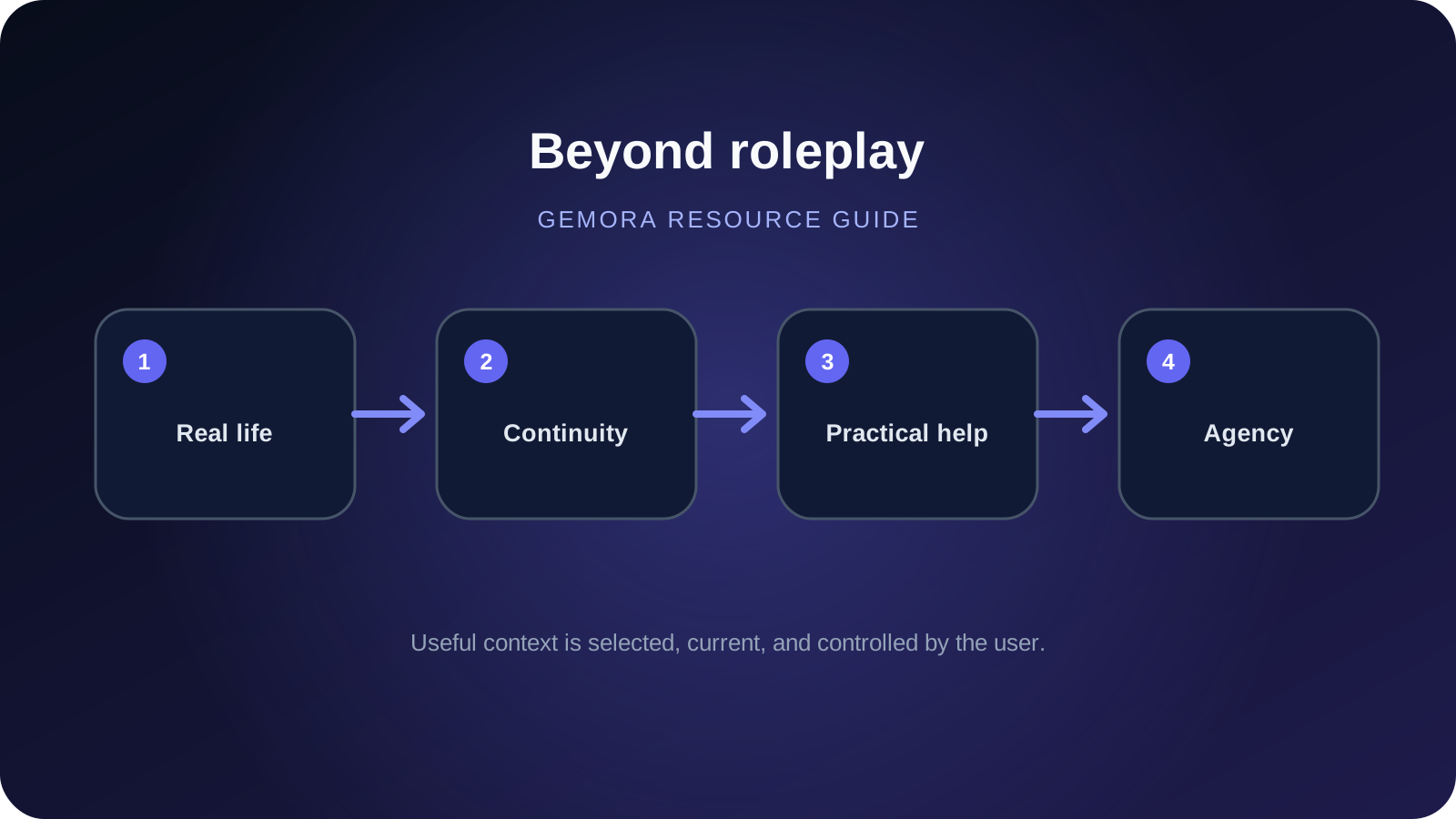
Continue the thread
Explore companionship beyond roleplay
Connect conversations, useful context, reflections, projects, and tasks in one personal workspace.
Start freeFrequently asked questions
Why is roleplay not enough for the future of AI companions?
Because roleplay mainly optimizes:
Is roleplay bad for AI companions?
No.
Is Character.AI mainly a roleplay platform?
Character.AI's current 2026 product direction strongly emphasizes AI entertainment, characters, stories, worlds, roleplay, and creator made experiences.
Sources and further reading
Written by Khai Tran and reviewed under the Gemora Editorial Policy.