weekly reflection questions
30 Weekly Reflection Questions—and a 12-Minute Review
Use 30 weekly reflection questions and a 12-minute method to find concrete patterns, reduce self-judgment, and choose one useful experiment for next week.
Methodology: Rewritten from primary reflection research, a review of the existing Gemora workflow, and the overlapping intent of four retired weekly-review articles on September 4, 2026.
Original contribution: A reusable Scene → Signal → Meaning? → Experiment worksheet, 30 intent-grouped questions, and a worked example that separates evidence from interpretation.

Photo by cottonbro studio on Pexels. License.
In this guide
- Start with evidence, not a verdict
- 30 weekly reflection questions, organized by the signal you need
- A 12-minute weekly review you can repeat
- A worked example: from “bad week” to a testable change
- Writing versus reflecting through conversation
- A realistic Gemora weekly-reflection workflow
- Keep a tiny record that compounds without becoming surveillance
Key takeaways
- A useful weekly review begins with concrete scenes rather than a verdict about the whole week.
- The 30 questions are a menu: three to six relevant prompts are more useful than completing every item.
- End with one observable experiment small enough to try once next week.
A weekly reflection is a short review of what actually happened, what changed inside or around you, and what deserves a small adjustment next week. It should not become a performance scorecard or a demand to reconstruct every day. Start with two or three concrete scenes, use questions to explore their meaning, and keep conclusions tentative. A useful review can take 12 minutes: collect evidence, follow the strongest signal, name one possible pattern, and choose one experiment. The 30 questions below are a menu, not an assignment. Answer only the prompts that help you see the week more accurately.
Start with evidence, not a verdict
The fastest way to make reflection unhelpful is to begin with a global judgment: “I wasted the week,” “I was productive,” or “I am bad at boundaries.” Those statements compress several days into a label. They may feel decisive, but they hide the scenes you would need to learn anything.
Begin with evidence that another person could picture:
- “On Tuesday at 10:20, I closed the team chat and finished the outline in 35 minutes.”
- “At dinner on Thursday, I kept checking a work notification while my friend was speaking.”
- “I postponed the same phone call three times, then felt relief when I finally made it.”
Now interpretation has something to work with. The first scene may suggest that protected starts help concentration. The second may point to a boundary worth testing. The third separates anticipation from the task itself. None proves a permanent trait.
Research on reflection does not justify claiming that a weekly review will transform every part of life. Studies are often conducted in work or education, and results depend on the prompt, setting, participation, and outcome measured. One randomized classroom study of LLM-guided reflection found preliminary confidence gains in one experiment, while exam-score differences were not statistically significant; another experiment found questionnaire and LLM reflection performed similarly. The careful conclusion is that structured reflection can support learning in some contexts—not that more reflection is always better.
30 weekly reflection questions, organized by the signal you need
Do not answer all 30. Scan the groups, notice where attention catches, and choose three to six prompts. If a question invites rumination rather than useful observation, skip it.
Scenes: recover what made this week this week
- What moment could only have happened this week?
- Where were you when you felt most present?
- What conversation is still easy to replay?
- What small detail would help you recognize this week six months from now?
- What did you do for the first time, even if it was minor?
Energy and attention: find conditions, not character flaws
- When did time move quickly because you were absorbed?
- When did a simple task feel unusually heavy?
- What happened immediately before your energy rose or fell?
- Which environment made it easier to think clearly?
- What kept taking attention without giving much back?
People: review interactions without mind-reading
- Who made the week feel lighter, steadier, or more honest?
- When did you feel heard? What did the other person actually do?
- Where did you agree too quickly or stay quiet?
- What expectation did you assume but never state?
- Is there appreciation, clarification, repair, or a boundary to express?
Choices: see the tradeoff you actually made
- What decision consumed more attention than it deserved?
- What did you protect when you said no?
- What did you give up when you said yes?
- Which choice still feels aligned after a few days?
- What new information should change an earlier plan?
Progress and friction: look beyond the visible finish line
- What moved forward that is not yet finished?
- What became easier because you prepared well?
- Where did the same obstacle appear twice?
- What did you learn that changes the next attempt?
- What can be paused, delegated, reduced, or abandoned?
Next week: convert insight into one experiment
- What deserves one protected block of attention?
- What conversation would reduce avoidable uncertainty?
- What is the smallest version of an important next step?
- What condition from a good moment can you recreate once?
- What would make next week kinder without making it smaller?
The prompts deliberately alternate between recall, interpretation, and action. Recall without meaning becomes an archive. Interpretation without evidence becomes a story you cannot test. Action without either becomes another generic resolution.
A 12-minute weekly review you can repeat
Use a timer if reviews tend to expand. The point is to create a small, repeatable loop—not to finish understanding your life.
- Collect three scenes for three minutes. Look at the calendar or recent conversations only if recall is blank. Write a place, person, action, or sentence for each scene.
- Follow one signal for four minutes. Choose the scene with the strongest energy, tension, relief, surprise, or unfinished pull. Describe what changed before, during, and after it.
- Write one tentative meaning for three minutes. Begin with “One possibility is…” Then write one alternative explanation. This prevents a single week from becoming a verdict about your identity.
- Choose one experiment for two minutes. Make it observable and small enough to try once. For example: “Start Wednesday’s draft before opening team chat,” not “be more focused.”

Open the weekly review worksheet at full size to print it or keep it beside your notes.
A worked example: from “bad week” to a testable change
Suppose your first summary is: “I had a bad week and got nothing done.” Instead of arguing with the feeling, ask for scenes.
Scene 1: Monday’s planning meeting ran 40 minutes over. You left with three new requests and no clear owner.
Scene 2: Wednesday morning was quiet. Before opening messages, you completed the difficult section of a proposal.
Scene 3: Friday afternoon, you delayed sending the proposal because one paragraph still felt imperfect.
The strongest signal might be the contrast between Wednesday’s protected start and Friday’s perfection loop. A tentative meaning is not “meetings ruin my productivity.” It could be: “Unbounded incoming requests make it harder to decide what finished means.” An alternative is: “The deadline itself increased caution.”
The experiment becomes specific: after the next planning meeting, write the owner and definition of done beside every new request before accepting it. That is a result you can observe next week. Whether it helps or not, you will have better evidence.
This approach also leaves room for good weeks. Reflection is not only forensic work on problems. A scene that felt calm, connected, or unusually alive may contain a condition worth protecting.
Writing versus reflecting through conversation
Writing gives you privacy, control over every word, and a stable page you can revisit. It can also expose an idea as you shape the sentence. Conversation helps when you face a blank page, repeat broad labels, or need a careful follow-up to reach a scene.
The quality depends more on the prompt than the medium. The classroom field experiments cited above are useful here: a static questionnaire sometimes performed similarly to LLM-guided reflection. That is a reminder not to treat conversation as automatically superior. If writing itself is the barrier, the guide to reflecting through conversation instead of writing shows how to keep the exchange specific without pretending the assistant knows your hidden motives.
A productive exchange sounds like this:
You: The week disappeared and I mostly reacted.
Follow-up: What is one request you reacted to, and what were you doing immediately before it arrived?
You: I was outlining the launch page when a message asked for new pricing screenshots. I switched tasks without deciding when I would return.
Follow-up: Is the useful change fewer requests, or a clearer return point after an interruption?
The follow-up turns a mood into a decision you can test. If the tool starts inventing motives, flattering you, or pushing a neat narrative, correct it. Your record should distinguish your words from its interpretation.
A realistic Gemora weekly-reflection workflow
Gemora’s conversation-first design is useful when the week already exists across conversations and you do not want to reconstruct it in a blank journal. A practical workflow is:
- Start with: “Help me review this week. Ask for concrete scenes before interpreting.”
- Share or recall two to four moments. Include what happened, not only how you felt about it.
- Ask Gemora to separate observations, your interpretation, and its hypotheses.
- Correct any detail that is stale, incomplete, or too broad.
- End with one small experiment and one cue for noticing whether it helped.
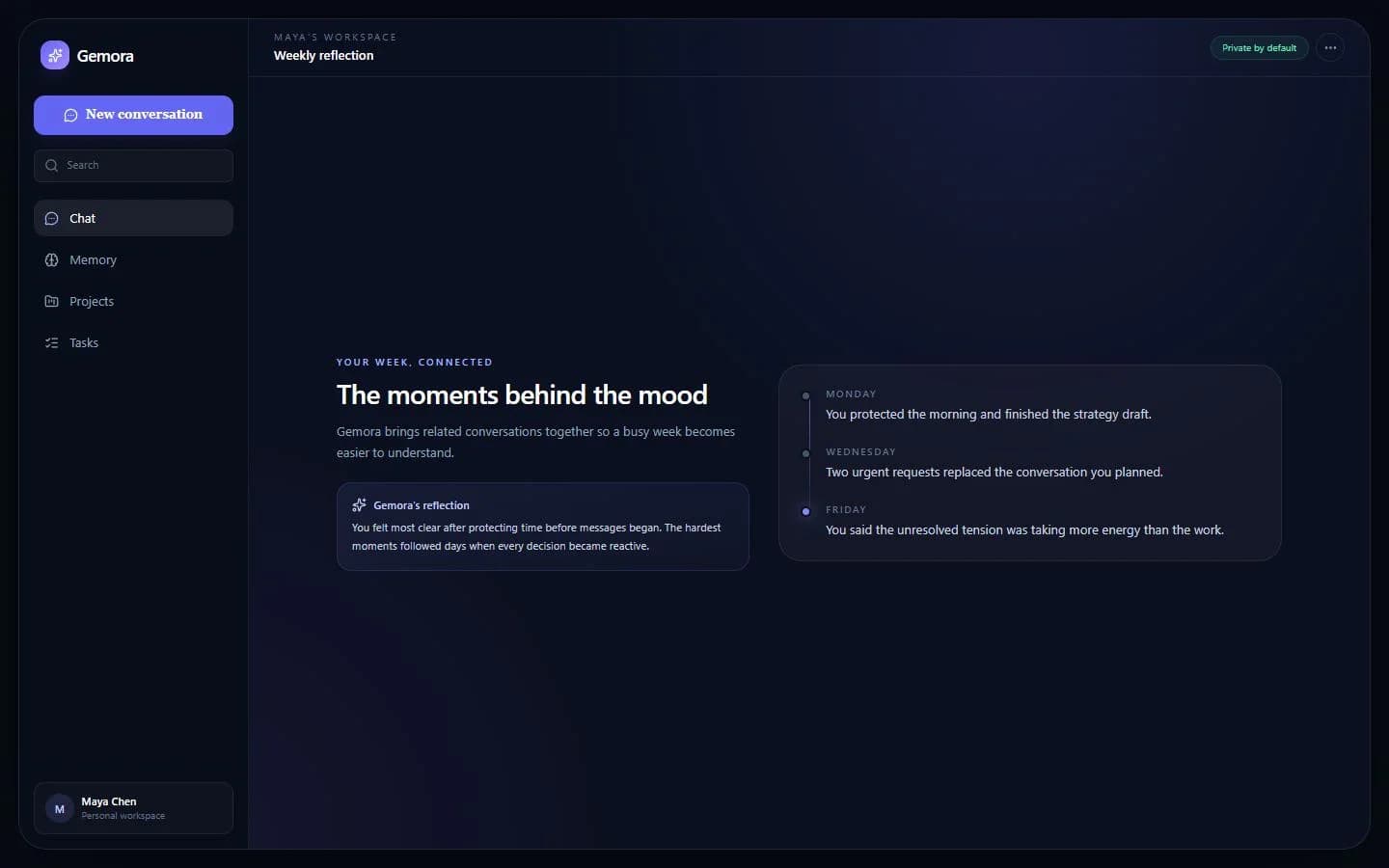
Gemora cannot know the full truth of your week. It may miss an important conversation, retrieve an irrelevant detail, or over-weight what you happened to discuss. Memory and summaries should be treated as prompts for recall—not an objective record or a psychological assessment. Review important details, avoid storing information you do not want retained, and use available controls to correct or delete memory.
If reflection repeatedly increases distress, interrupts sleep, or traps you in the same self-critical loop, shortening or pausing the practice may be more useful than adding prompts. This guide is educational, not mental-health advice.
Keep a tiny record that compounds without becoming surveillance
After the review, keep only four lines:
- Scene: one concrete moment.
- Signal: what changed in energy, attention, tension, or connection.
- Meaning?: one possible interpretation plus an alternative.
- Experiment: one action to test once.
This is enough to compare weeks without tracking every hour. After four weeks, look for repeated conditions rather than repeated adjectives. “I felt unfocused” is weak evidence. “On three weeks, the first uninterrupted 30 minutes produced the clearest work” is a pattern you can examine.
You can combine this practice with the seven-day memory experiment when weeks feel indistinguishable, or build a longer view with a personal life timeline. The broader self-reflection workflow explains where this practice fits inside Gemora. The goal is continuity with less documentation—not a more elaborate system to maintain.
Continue the thread
Review your week with context and compassion
Bring two or three real moments into Gemora and ask for evidence-first follow-up questions before choosing one small experiment.
Start freeFrequently asked questions
When should I do a weekly reflection?
Choose a repeatable quiet window near the end or start of the week. The exact day matters less than having enough distance to see several days together.
Should I review every area of life?
No. Follow the areas that carried the most energy or consequence, and rotate categories over time.
How do I stop a weekly review from becoming self-criticism?
Use observable scenes, include exceptions, and frame conclusions as conditions to test rather than traits to condemn.
Sources and further reading
Written by Khai Tran and reviewed under the Gemora Editorial Policy.