why do my days blur together
Why Do My Days Blur Together? A Practical Way to Remember More of Everyday Life
Understand why repetitive days can feel compressed in memory, then use a seven-day conversation-first practice to make ordinary life easier to recall.
Methodology: Reviewed cognitive-memory research, live Search Console query data, and Gemora's documented reflection workflow on September 4, 2026.
Original contribution: A seven-day distinguishability experiment and reusable worksheet that separates observation, recall, and interpretation.

Photo by Genine Alyssa Pedreno-Andrada on Pexels. License.
In this guide
- What “my days blur together” usually describes
- Why similar days can be harder to separate in memory
- A seven-day experiment for making ordinary life easier to recall
- Writing versus reflection through conversation
- A realistic Gemora workflow—and its limits
- How to tell whether the practice is working
- When a blurred week deserves more than a reflection exercise
- The smallest useful next step
Key takeaways
- Similar routines can leave memory with fewer distinctive cues; that does not mean the days were empty.
- Attention and clear event boundaries help ordinary moments become easier to retrieve later.
- A two-minute spoken reflection can preserve a scene without requiring a full written journal entry.
- Persistent or worrying memory changes need professional assessment, not a productivity technique.
If your days blur together, the most likely everyday explanation is not that “nothing happened.” It is that several days shared the same cues, your attention was divided, or the moments between activities never became clear boundaries in memory. Later, there are too few distinctive details to tell Tuesday from Thursday. You do not need to make life dramatic to change this. Try giving one ordinary moment your full attention, marking one transition, and recalling one scene before the day ends. Those small cues can make a week easier to retrieve. This is a practical explanation, not a diagnosis: sudden, worsening, or disruptive memory changes need qualified medical advice.
That distinction matters. A blurred week can be a normal description of repetitive experience, but it can also sit beside stress, exhaustion, low mood, sleep disruption, medication effects, or health concerns. No article can determine the cause for an individual. What it can do is offer a low-pressure way to observe what changes when you add attention, boundaries, and brief recall.
What “my days blur together” usually describes
People often use the phrase to describe retrospective sameness. In the moment, a day may have been busy, tiring, pleasant, or complicated. Looking back, however, the days collapse into a general label: “work,” “school,” “meetings,” or simply “the usual.” You remember the category but not the episodes inside it.
That is different from saying the days had no value. It is also different from claiming that routine damages memory. Routine can protect energy, make commitments easier, and create stability. The narrower problem is that similar days provide fewer cues for later retrieval—especially when attention is elsewhere and there is no pause to revisit what happened.
Imagine two workdays. Both begin at the same desk and contain six video calls. On Tuesday, a colleague asks an unexpected question, rain rattles against the window, and you take a short walk after closing the laptop. On Thursday, you move directly from the last call to dinner while checking messages. Tuesday has several possible retrieval cues. Thursday may be remembered only as “another workday,” even if important things happened.
Why similar days can be harder to separate in memory
Memory is not a continuous recording. Research on event cognition describes how people segment ongoing experience into events and update their understanding when something meaningfully changes. Those boundaries can later help organize what happened. When the setting, activity, and context stay similar, one episode has fewer obvious edges separating it from the next.
This does not establish a single cause for the feeling that time is disappearing. The research is a useful model, not a personal verdict. Three mechanisms are especially helpful for designing a small experiment.
Similarity gives recall fewer landmarks
A distinctive cue can be sensory, spatial, social, or conceptual: the smell of rain, a different route, a conversation that changed your plan, the moment you decided to stop a task. When many cues repeat, remembering “work at the desk” may not identify which day you mean.
The answer is not constant novelty. Expensive trips, dramatic challenges, and endless optimization are unnecessary. Modest variation is enough for an experiment: work in a different chair, call someone during the usual commute, cook one unfamiliar meal, or reverse the order of two routine tasks. The purpose is to create a cue, not to judge a stable life as inadequate.
Attention determines which details become available
An experience can contain variety without leaving a clear memory if attention keeps switching. Notifications, worry, multitasking, and fatigue can reduce how much detail you notice. “Pay attention” is not a moral instruction and it is not always easy. Here it means selecting one brief moment in which you stop trying to process everything.
Try a ten-second inventory: one color, one sound, one physical sensation, and one movement. Do not force meaning onto those details. “The metal cup was cold and the elevator hummed” is enough. Interpretation can come later, or not at all.
Boundaries help a day form chapters
When one activity flows immediately into the next, the day can feel like one unfinished block. A boundary is a small signal that an event ended: shutting the laptop, stepping outside, changing the light, washing a cup, or saying aloud, “Work is finished; dinner starts now.”
The boundary does not need to be mindful, beautiful, or consistent forever. It only needs to be noticeable. In the seven-day practice below, you will test whether one brief transition changes what you can recall later.
A seven-day experiment for making ordinary life easier to recall
This is a distinguishability experiment, not a habit challenge. It asks whether a few deliberate cues make a week easier to remember. Each day should take two to five minutes. If the exercise adds pressure or becomes another performance target, make it smaller or stop.
Day 1 — Make a baseline
Without checking your calendar, name three moments you remember from the previous seven days and note what made each retrievable.
Do not grade the number of memories. You are looking for cues. A moment might be retrievable because it happened somewhere unusual, involved a specific person, interrupted a plan, carried a strong feeling, or was reviewed later.
Day 2 — Notice one specific detail
Pause once and record one concrete sound, texture, color, movement, or sentence that could belong only to today.
Keep it literal: “The bus driver waited while someone ran across the road” is more useful than “Today taught me to be patient.” A concrete scene can support several later interpretations; an instant lesson can erase ambiguity.
Day 3 — Mark a transition
At the end of one repeated activity, take twenty seconds to name what ended and what begins next.
For example: close the laptop, stand up, and say, “The planning session is over. I am going to make dinner.” The action creates a physical and verbal edge without requiring a new routine for the whole day.
Day 4 — Add modest novelty
Change one small feature of a routine, such as the route, location, order, soundtrack, or person involved.
Choose a change that costs little. Walk on the other side of the street, eat lunch away from your screen, or listen to an album instead of an algorithmic mix. Novelty is a cue here, not a lifestyle prescription.
Day 5 — Tell one scene
Describe one moment aloud or in writing using what happened, what you noticed, and why it may matter.
If “why it matters” feels forced, replace it with “what I am still unsure about.” The goal is not to produce a polished journal entry. It is to give the event one more pass through attention while keeping your interpretation tentative.
Day 6 — Retrieve before reviewing
Recall the week's moments from memory first, then check your notes and mark what was easy or difficult to retrieve.
Retrieval before review helps you observe which cues worked. Afterward, use your notes to notice what was missed. Neither list is a score of memory quality; it is evidence for choosing a lighter or more useful practice.
Day 7 — Keep only what helped
Choose the one cue that improved recall without adding pressure, and carry only that cue into the next week.
You might keep the end-of-work boundary and discard the daily note. You might prefer telling one scene to writing it. The experiment succeeds when it helps you find the smallest useful practice—not when you complete every step perfectly.
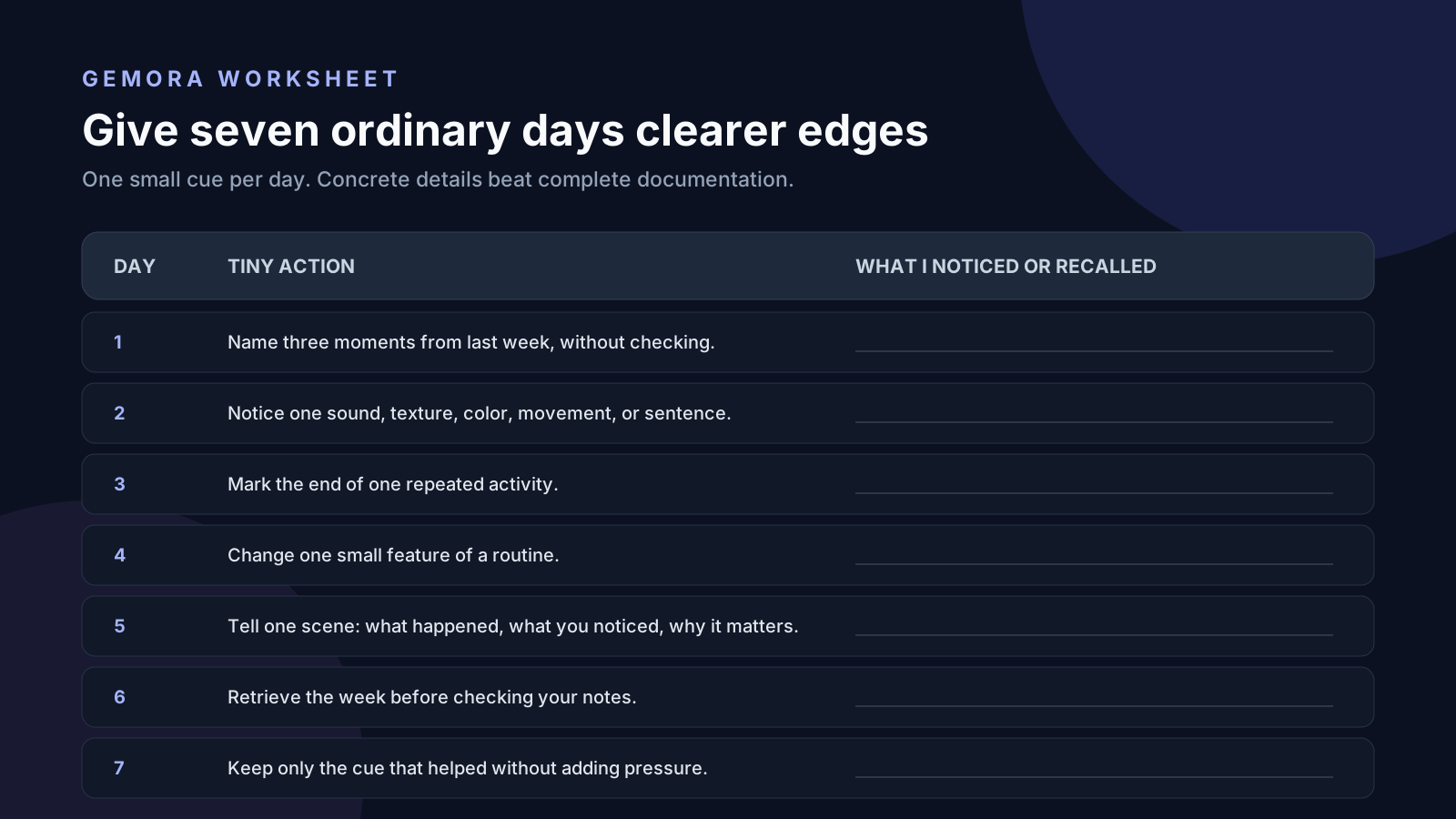
Open the worksheet at full size if you want to print it or keep it beside your notes.
You can use the worksheet on screen, print it, or copy only the row you need. At the end, ask three questions:
- Which moment came back without checking the worksheet?
- Which cue made that moment easier to retrieve?
- Which part felt helpful enough to repeat without becoming a burden?
That final question protects the practice from turning into exhaustive life logging. Remembering more of everyday life does not require documenting everything.
Writing versus reflection through conversation
Traditional journaling and conversation can both support recall. The better format is the one you will actually use and can control. The important difference is not “paper versus AI”; it is how much structure and response you need in the moment.
| If you need… | A short written note | A reflection conversation |
|---|---|---|
| Maximum privacy and offline control | Often the simplest choice | Depends on the service and its current controls |
| A fast record with no follow-up | Write one scene or sentence | May add unnecessary interaction |
| Help getting past a blank page | Use a fixed prompt | A follow-up question can narrow the focus |
| Space to revise your interpretation | Reread and annotate later | Ask for another possible reading or a counterexample |
| Continuity across several days | Review entries yourself | A product may connect selected context, subject to its design and your settings |
Writing has a useful friction: you decide every word and can keep the record entirely local. Conversation has a different advantage: a good follow-up can move from “the day was busy” to a retrievable scene. For example:
You: Today was basically the same as yesterday.
Follow-up: What is one moment that could only have happened today?
You: The power went out halfway through lunch, so everyone opened the windows and talked instead of scrolling.
The second answer contains a boundary, sensory context, people, and an interruption. It is easier to distinguish without requiring a long entry. For more formats, use the weekly self-reflection prompts or the guide to reflecting through conversation instead of writing.
A realistic Gemora workflow—and its limits
Gemora is designed around continuing conversations, not filling a blank journal page. One practical workflow for this problem is:
- Start a conversation at the end of the day and say, “Help me find one scene that made today different from yesterday.”
- Answer one follow-up with concrete details before asking for an interpretation.
- Ask Gemora to summarize the scene in one sentence and name what remains uncertain.
- Decide whether that context is worth carrying forward. Avoid including another person's sensitive details.
- At the end of the week, ask for help reviewing the moments you chose to keep, then correct anything inaccurate.
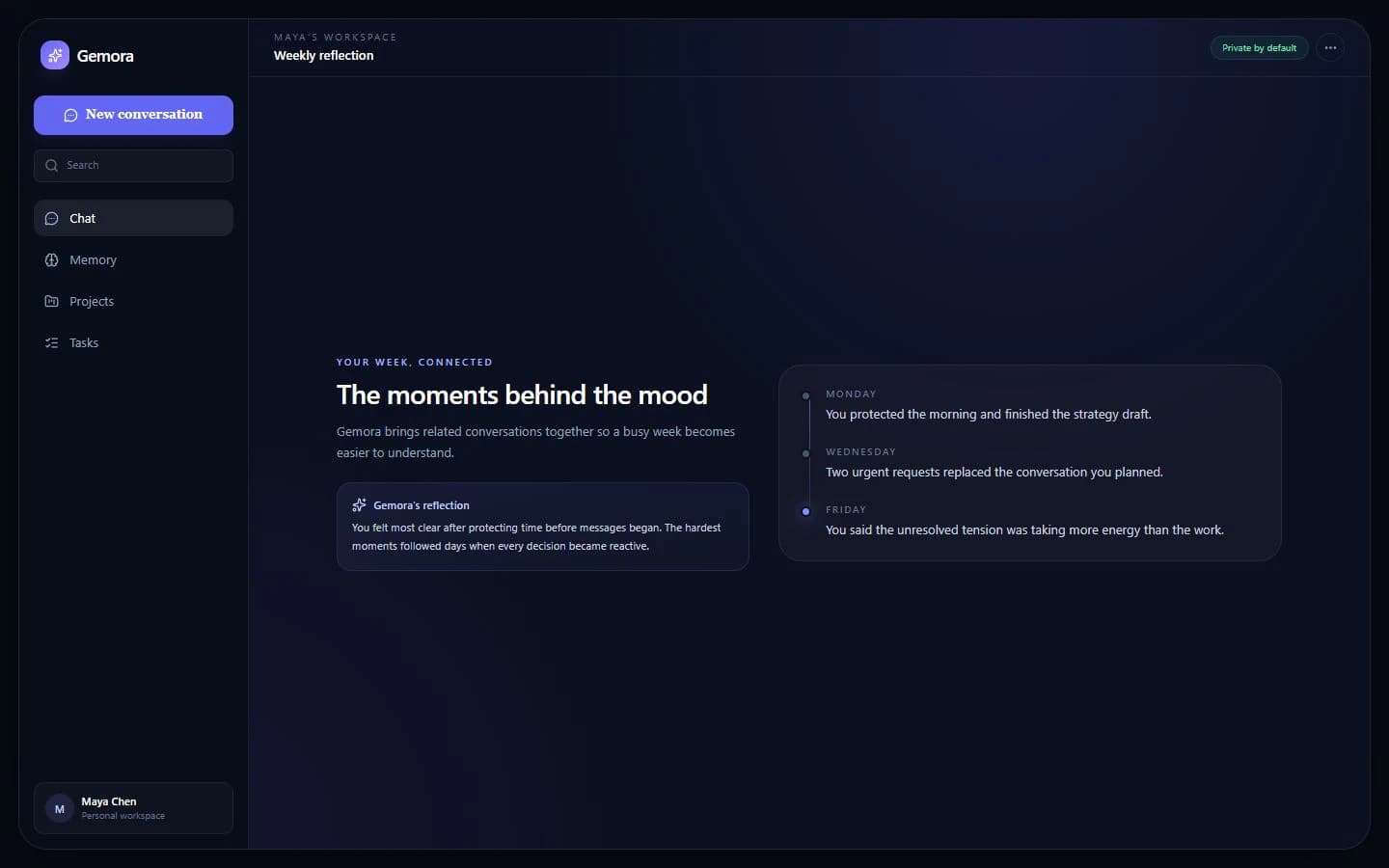
The product has real limits. Gemora cannot determine why your days feel blurred, diagnose a health condition, recover details you never shared, or guarantee perfect recall. AI summaries can be incomplete or wrong. Treat generated interpretations as proposals to review, not facts about your identity or mental state. Check the current privacy information and memory controls before adding sensitive material.
This is also why the recommended prompt asks for one scene rather than “analyze my life.” A narrow request produces something you can inspect. It keeps the person—not the system—in charge of what the moment means.
How to tell whether the practice is working
Do not measure success by the number of notes created. After seven days, compare your baseline with your unaided Day 6 recall. Look for a modest change:
- You can name two or three specific scenes instead of only saying “I was busy.”
- You remember roughly when a moment happened because a transition or location anchors it.
- Reviewing the week takes less effort.
- The practice adds clarity without creating pressure to archive everything.
If none of those changed, that is useful information. You might need a different cue, less tracking, more rest, or a conversation with a qualified professional about the broader context. Do not keep adding complexity just because a seven-day exercise did not help.
When a blurred week deserves more than a reflection exercise
Everyday memory varies, and occasional lapses are common. But a self-guided practice is not the right response to every situation. Seek qualified medical advice if memory changes are sudden, worsening, interfering with daily tasks or safety, or noticed by people close to you. The US National Institute on Aging provides a general overview of signs that warrant discussion with a clinician; local medical guidance should take priority for your circumstances.
If the feeling is connected with persistent low mood, hopelessness, severe anxiety, or an inability to function, reach out to a qualified mental-health professional or an appropriate local support service. The point of this article is to make ordinary days easier to distinguish—not to explain away distress.
The smallest useful next step
Tonight, do only Day 2: name one detail that could belong only to today. Say it aloud, write it on paper, or use a conversation. Tomorrow, try to retrieve it before checking the record.
If that tiny act gives the day a clearer edge, continue the experiment. If it does not, you have lost two minutes, not failed a habit. A life does not become meaningful because it is fully documented. Sometimes one remembered scene is enough to stop a week from disappearing into a label.
Continue the thread
Try a two-minute end-of-day reflection
Tell Gemora one concrete scene from today and ask one follow-up question. Save only the context you want to carry forward.
Start freeFrequently asked questions
What does it mean when days blur together?
It usually describes a retrospective feeling that several days are difficult to distinguish because they share similar cues or few moments received deliberate attention. It is a description, not a diagnosis.
Why does every day feel the same?
Repeated settings and sequences can make days feel similar, while divided attention leaves fewer details available for later recall. Stress, fatigue, mood, and health can also affect experience, so no single explanation fits everyone.
How do I stop days from blending together?
Start small: notice one specific detail, mark one transition, and briefly retrieve one scene at the end of the day. If memory changes are persistent, worsening, or affecting daily life, seek qualified medical advice.
Sources and further reading
Written by Khai Tran and reviewed under the Gemora Editorial Policy.