how to use AI for a weekly life review without journaling
How to Use AI for a Weekly Life Review Without Journaling
Build a weekly AI life review without daily journaling by combining conversations, calendar events, photos, tasks, decisions and memories in 15–30 minutes.
Methodology: Analysis based on official product documentation and public feature descriptions listed in the sources, reviewed on 2026-10-23.
Original contribution: A low-friction weekly workflow that combines ambient life evidence without requiring a daily writing habit.

In this guide
- The short answer
- First: weekly review is not the same as weekly journaling
- Journaling starts with a blank page
- AI-assisted review starts with evidence
- The goal is not a perfect record
- Why AI is useful for weekly reviews
- 1. Reconstructing scattered context
- 2. Summarizing without starting from zero
- 3. Finding repeated topics
- 4. Comparing this week with last week
- 5. Bringing back unresolved threads
- 6. Preserving good moments too
- What existing AI reflection products teach us
- The no-journal weekly review model
- Layer 1: raw evidence
- Source 1: AI conversations
- Source 2: calendar
- Source 3: photos
- Source 4: tasks
- Source 5: notes
Related reading: memory vs history · apps with recall · long-term assistants · memory controls.
A weekly life review does not need seven polished journal entries. It needs enough honest context from the week to reconstruct what happened, what changed, and what still matters. Source: Gemora.
You want to reflect on your life.
You do not want to become someone who writes:
“Dear journal…”
every night at 10:17 PM.
Reasonable.
Daily journaling works for many people.
It also fails for many people for a very simple reason:
they do not want to journal every day.
They forget.
They are tired.
Nothing dramatic happened.
Too much happened.
They do not enjoy writing.
They open the journal app, stare at the empty page, and immediately discover that reorganizing the kitchen drawer has become an urgent strategic priority.
The result is predictable.
No daily entries.
No weekly reflection.
Another abandoned self-improvement system joins the graveyard beside habit trackers, morning routines, and the Notion dashboard with seventeen databases you built one Sunday.
AI gives you another option.
Instead of:
Live
↓
Write daily journal
↓
Write more on Sunday
↓
Reflect
you can use:
Live normally
↓
Leave traces naturally
↓
AI gathers the week
↓
You review and correct
↓
Reflect
Those traces may already exist in:
- AI conversations,
- calendar events,
- photos,
- tasks,
- notes,
- messages you deliberately include,
- project updates,
- decisions,
- voice notes,
- things you remembered at review time.
Then, once a week, AI helps answer:
What actually happened?
What mattered?
What changed?
What am I still carrying?
What should I pay attention to next week?
That is a weekly life review without traditional journaling.
Not “zero reflection.”
Not outsourcing your self-awareness to a chatbot.
Just removing the requirement that reflection must begin with seven days of disciplined writing.
The short answer
A good AI weekly life review can be done in 15–30 minutes.
Use this flow:
1. Gather the week's evidence
2. Reconstruct meaningful events
3. Correct the AI's summary
4. Identify what changed
5. Review decisions and open loops
6. Notice recurring themes
7. Keep a few moments worth remembering
8. Choose 1–3 priorities for next week
Your weekly inputs can be:
AI conversations
+ calendar
+ photos
+ tasks
+ notes
+ decisions
+ your memory of the week
You do not need all of them.
The smallest useful version is:
5 minutes:
"What happened this week?"

5 minutes:
"What changed?"

5 minutes:
"What is still unresolved?"

5 minutes:
"What matters next week?"
That is enough.
First: weekly review is not the same as weekly journaling
Traditional weekly journaling often looks like:
“Sit down and write about your week.”
That is still journaling.
This guide uses AI differently.
The AI helps reconstruct the week from context that already exists.
Your role becomes:
- confirm,
- correct,
- add missing meaning,
- decide what matters.
The difference is subtle but important.
Journaling starts with a blank page
You have to generate the raw material.
Example:
“How did this week feel?”
Now write.
AI-assisted review starts with evidence
The system may already have:
- conversations from Monday,
- a trip on Calendar,
- photos from Wednesday,
- completed tasks,
- a note about a decision,
- a conversation from Friday.
It can begin:
“Here are the main things that seem to have happened this week. What is missing or wrong?”
That is a much lower-friction starting point.
The goal is not a perfect record
You do not need to reconstruct every hour.
A weekly review is not forensic accounting.
You are looking for:
- meaningful events,
- decisions,
- changes,
- recurring themes,
- people who mattered,
- unfinished situations,
- positive moments,
- next priorities.
If Monday lunch is not relevant, leave Monday lunch alone.
It has suffered enough.
Why AI is useful for weekly reviews
AI is good at a few specific parts of the process.
1. Reconstructing scattered context
Your week is rarely stored in one place.
Example:
Monday:
Conversation about career

Tuesday:
Calendar interview

Wednesday:
Photo from coworking space

Thursday:
Task "send follow-up" completed

Friday:
Conversation: "I think I want the role"
AI can connect those into one thread.
2. Summarizing without starting from zero
Instead of asking:
“What happened this week?”
and trying to remember everything,
you can ask AI to propose a first draft.
That reduces blank-page friction.
3. Finding repeated topics
You may not notice that you mentioned:
launch stress
four times.
Or:
one specific relationship
in several unrelated conversations.
Frequency is not proof of importance.
But it is a useful signal.
4. Comparing this week with last week
This is where AI becomes more useful than a static journal entry.
It can help answer:
“What became more important?”
“What disappeared?”
“What changed status?”
“What did I finally decide?”
The best weekly review question is often not:
What happened?
It is:
What changed?
5. Bringing back unresolved threads
A useful AI can surface:
“Last week you said you would revisit this after the meeting. The meeting happened, but I do not see a decision yet.”
That is a real continuity benefit.
6. Preserving good moments too
People disproportionately talk to AI when something is wrong.
That creates a distorted history.
A weekly review should deliberately ask:
“What was good?”
“What felt easier?”
“What surprised me in a good way?”
Otherwise your AI history slowly becomes a very competent archive of problems.
What existing AI reflection products teach us
AI journaling products already show why weekly synthesis is useful.
Rosebud, for example, currently generates weekly reports from journal entries that include:
- writing statistics,
- emotional landscape,
- key themes,
- significant people,
- up to five key insights.
Source: Rosebud Weekly Report

Rosebud demonstrates how a week of raw material can be compressed into themes, people, and higher-level insights. Source: Rosebud.
Reflection launched dedicated Weekly and Monthly Reviews in 2026, summarizing:
- themes,
- wins,
- moods,
- shifts.
Source: Reflection — Weekly & Monthly Reviews
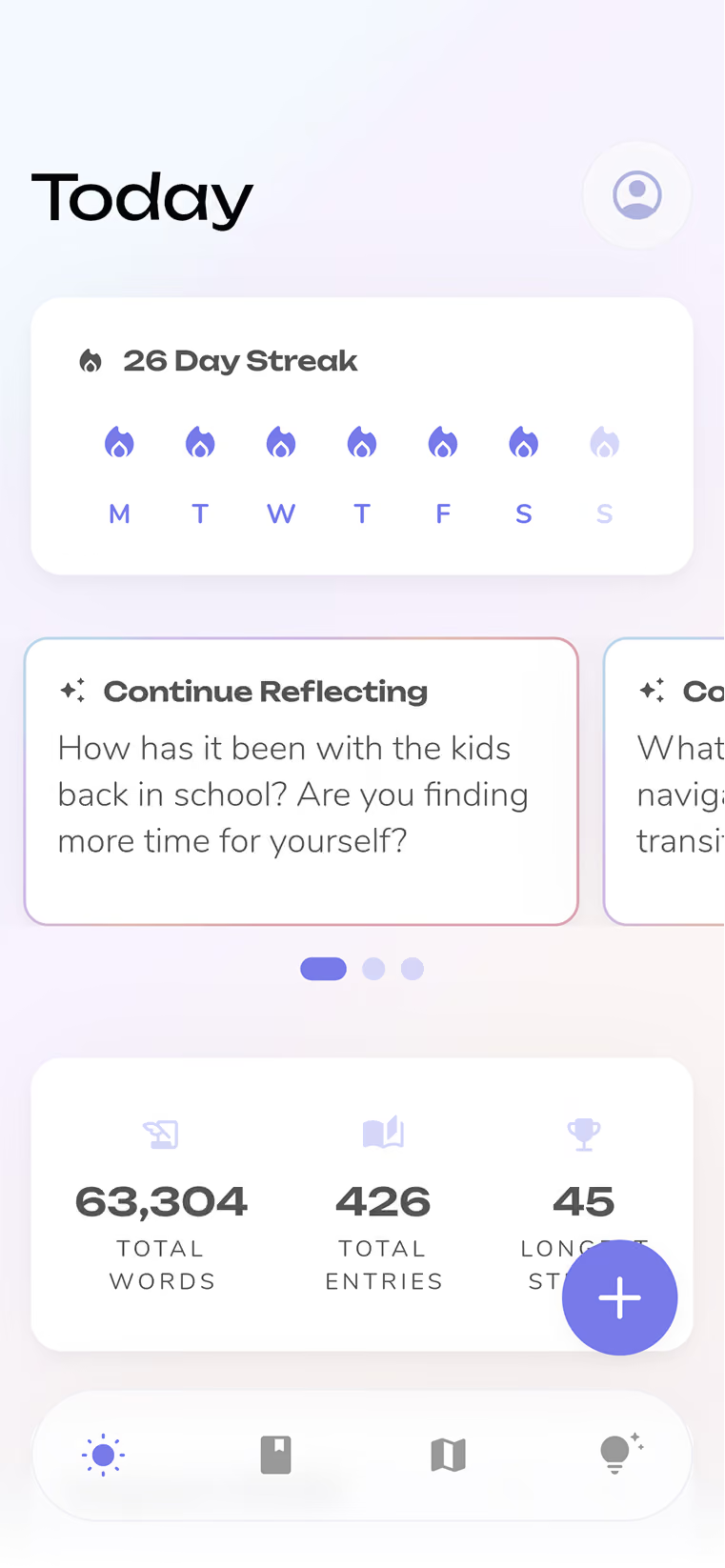
Reflection's weekly-review model shows the value of stepping above individual entries to look for themes and shifts. Source: Reflection.
The idea is strong.
But the raw material does not have to be a daily journal.
You can build the same reflection layer from the traces you already create.
The no-journal weekly review model
A practical model has four layers:
Layer 1:
Raw evidence

Layer 2:
Week reconstruction

Layer 3:
Reflection

Layer 4:
Carry-forward context
Let's build each.
Layer 1: raw evidence
This is not “your life.”
It is evidence about the week.
Good sources include:
- AI chats,
- Calendar,
- photos,
- tasks,
- notes,
- voice messages you choose to include,
- project updates,
- manually remembered events.
The AI should never assume the source is complete.
If nothing appears in your calendar, that does not mean nothing happened.
Source 1: AI conversations
If you already talk to AI during the week, those conversations are one of the richest reflection sources.
They capture:
- problems,
- decisions,
- changing thoughts,
- plans,
- questions,
- reactions.
ChatGPT Memory now automatically uses useful context from conversations when enabled, helping reduce the need to re-explain recurring context.
Source: OpenAI Memory FAQ

ChatGPT's Memory Summary is one example of compressing many conversations into a higher-level view of relevant context. Source: OpenAI.
Gemini can also use memory of past chats to understand more about the user and their world when eligible settings are enabled.
Source: Gemini Help — Memory of Past Chats
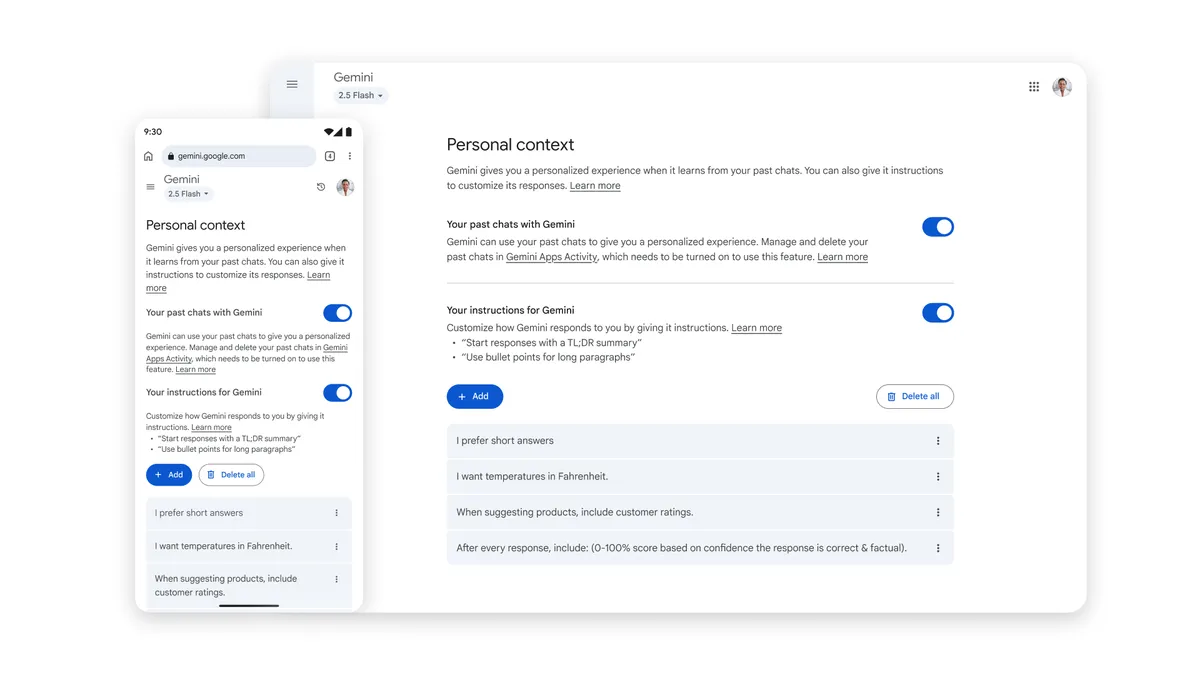
Gemini Personal Context settings (source image)
Gemini can reference previous conversations as part of ongoing personalization. Source: Google.
This means conversation itself can become low-friction capture.
Source 2: calendar
Calendar tells you:
- what was scheduled,
- which days were busy,
- trips,
- meetings,
- appointments,
- deadlines.
It is excellent for reconstructing chronology.
It is terrible at telling you meaning.
A calendar event called:
“Coffee”
could be:
- forgettable,
- life-changing,
- or actually not coffee.
Use calendar as evidence.
Not interpretation.
Source 3: photos
Photos can answer:
“What did I do?”
and:
“Where was I?”
They can surface moments you forgot.
Useful weekly prompts include:
“Which photos from this week are worth remembering?”
or:
“What happened around these three photos?”
But do not let AI infer emotions from facial expressions as fact.
A smile in a photo is not a mood database.
Source 4: tasks
Completed tasks reveal:
what moved.
Incomplete tasks reveal:
what may still be open.
A weekly review might identify:
Completed:
Production checklist

Still open:
Store screenshots
Distribution experiment
Useful.
But task volume is not life quality.
Do not turn:
“You completed 38 tasks.”
into:
“Excellent week.”
Perhaps the week was awful.
Perhaps the tasks were nonsense.
Humans remain inconveniently non-linear.
Source 5: notes
Notes are useful because they catch:
- ideas,
- decisions,
- reminders,
- worries,
- spontaneous observations.
They often contain the one sentence that explains the whole week.
Source 6: your memory
Yes, this still matters.
AI is helping you reflect.
It is not replacing your memory with a query engine.
At the beginning of the review, ask yourself:
“What are the first three things I remember from this week?”
Those three may matter more than the 200 items AI can retrieve.
How much input do you actually need?
Less than you think.
A minimum weekly review can use:
3 meaningful conversations
3 calendar events
3 photos
5 completed/open tasks
3 things you remember
That is enough to reconstruct a surprisingly good week.
Do not wait until you have a perfect data pipeline.
The weekly review is a reflection habit.
Not an ETL project.
The 15-minute AI weekly life review
Here is the simplest version.
Minute 0–3: reconstruct the week
Ask:
Using the context available from this week, help me reconstruct the week.

Start with only:
- meaningful events
- important conversations
- decisions
- people who mattered
- notable positive moments
- unresolved situations

Do not interpret yet.

Separate:
FACT
from
POSSIBLE INTERPRETATION.

If you are unsure whether something happened this week, say so.
Then correct the list.
Minute 3–6: ask “What changed?”
Prompt:
Compare the beginning and end of this week.

What changed in:
- priorities
- active projects
- decisions
- relationships or ongoing situations
- plans
- what I seemed to care about

Do not treat a single comment as a permanent change.
Use cautious language for inferred changes.
This is the most valuable section.
Minute 6–9: review open loops
Ask:
What appears unresolved from this week?

Separate:
1. decisions not yet made
2. tasks not completed
3. conversations I may need to continue
4. questions I keep returning to
5. things I explicitly said I would revisit
Now your review becomes forward-looking.
Minute 9–12: preserve the week
Ask:
Pick up to 5 moments from this week worth keeping.

Do not choose only achievements.

Include:
- meaningful moments
- good moments
- surprising moments
- moments that may matter later

Explain each in one sentence.
This prevents your history from becoming an endless action log.
Minute 12–15: choose next week
Finish with:
Based on this review, suggest:
- 1 thing to continue
- 1 thing to stop or reduce
- 1 unresolved issue to close
- up to 3 priorities for next week

Do not invent new goals.
Base them on what already mattered this week.
Done.
You reflected.
No daily journal was harmed.
The 30-minute deeper version
If you want more depth, use five sections.
1. What happened?
2. What changed?
3. What mattered?
4. What is unresolved?
5. What should carry forward?
Let's make each better.
Part 1: What happened?
Do not ask AI to “summarize my week” immediately.
That encourages generic compression.
Instead ask for categories.
Reconstruct the week in chronological order.

For each meaningful event include:
- date/day if known
- what happened
- people involved
- project/life area
- source
- confidence

Skip routine events unless they affected something important.
This creates a factual layer first.
Part 2: What changed?
Compare states.
Examples:
Monday:
Unsure whether to launch.

Friday:
Launch decision made.
or:
Start of week:
Fundraising felt urgent.

End of week:
Distribution became more important.
This is more useful than seven daily summaries.
Part 3: What mattered?
Now bring interpretation in.
Use:
From the factual timeline, propose the 3–5 things that seem most significant.

For each:
- why it may matter
- supporting events
- whether this is fact or interpretation
- confidence

Do not rank something as important only because I mentioned it many times.
This avoids a common AI mistake:
repeated = important.
Sometimes repeated = annoying.
Part 4: What is unresolved?
This section is critical.
Life reflection is useful partly because humans carry open loops badly.
Ask:
Which threads remain open?

For each:
- current state
- last relevant event
- what decision/action is missing
- whether it actually needs attention next week

Do not turn every unfinished thought into a task.
That last rule is important.
Not every emotion needs an action item.
Part 5: What should carry forward?
This is where a weekly review becomes personal context.
Ask:
Which 3–7 pieces of context from this week are likely to improve future conversations?

Classify them as:
- current priority
- decision
- ongoing situation
- changed preference
- important person/context
- completed milestone
- unresolved question

Do not carry temporary moods or one-off comments forward unless I explicitly mark them important.
Now the weekly review can feed future AI conversations.
The “zero daily writing” setup
If you want to do absolutely no daily journaling, use passive or natural sources only.
Your system can be:
During week:
Use AI normally
Use calendar normally
Take photos normally
Use task manager normally
Write notes only when needed

Weekend:
AI reconstructs week
You correct
You reflect
This is the lowest-friction model.
A better version: the one-sentence capture
If zero capture feels too sparse, use one sentence only when something matters.
Examples:
“Remember this for the weekly review: I finally submitted the app.”
“Weekly review: conversation with Sam changed my mind about onboarding.”
“Keep for Friday: today felt surprisingly good.”
That is not journaling.
It is dropping breadcrumbs.
Three or four breadcrumbs can dramatically improve a weekly review.
The conversation-first weekly review
This is especially useful if AI is already where you think.
You might naturally say during the week:
“I am worried about launch.”
“I think this is the wrong strategy.”
“Today went better than expected.”
“They messaged me again.”
“I finally decided.”
Those conversations already contain reflection material.
The weekly job is simply to connect them.
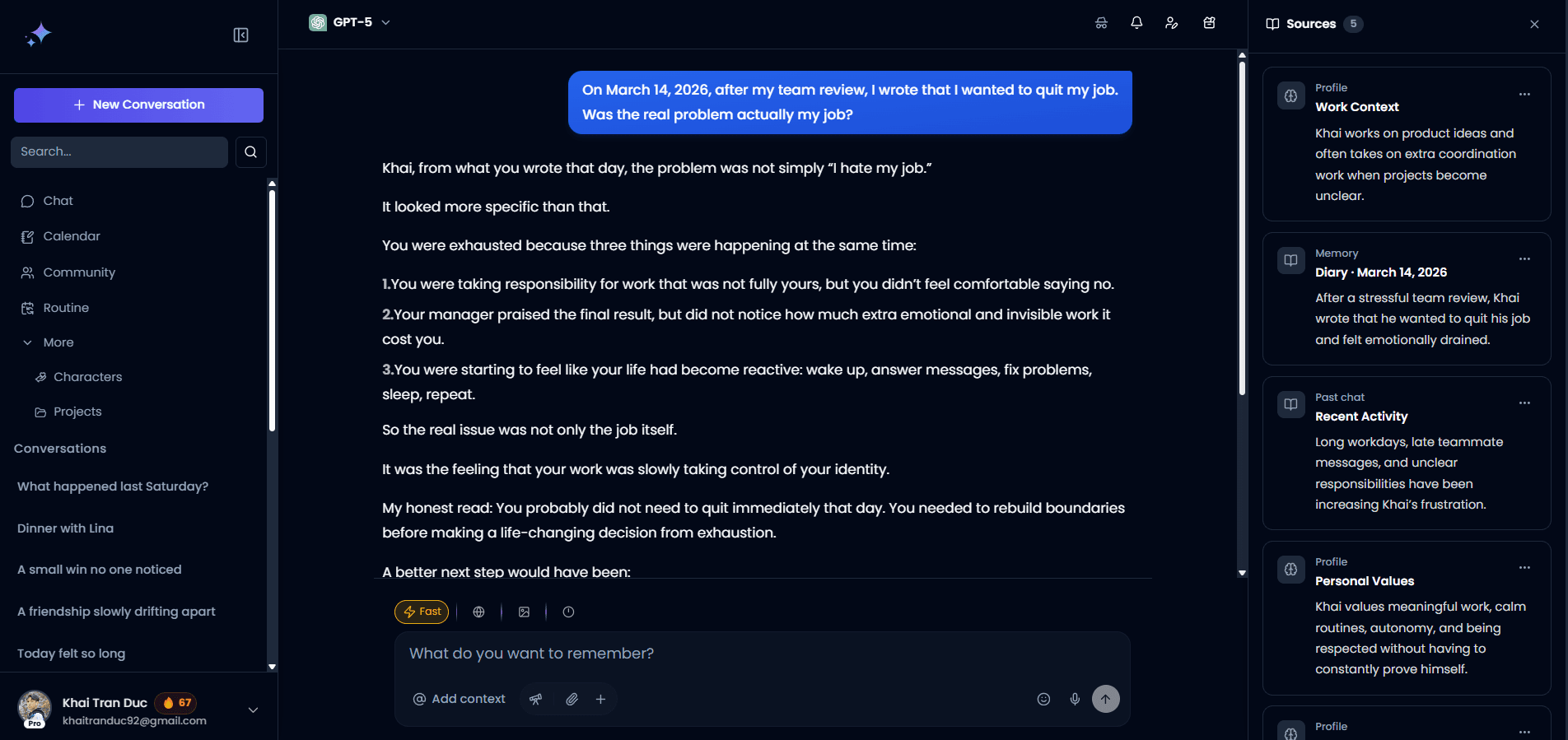
Gemora is centered on talking through everyday life first, then making useful context easier to revisit. Source: Gemora.
The user does not need to stop and create a formal entry.
Conversation itself is capture.
What Gemora's Recap model gets right
Gemora's Recap experience represents a useful design principle:
organize reflection around time, not around a pile of chat titles.
Day- and calendar-oriented recap makes it easier to remember “that week” instead of remembering the exact chat where something was said. Source: Gemora.
People often remember:
“That happened on Tuesday.”
or:
“It was the week before launch.”
They do not remember:
“It was in Untitled Chat 47.”
Temporal organization makes personal history more natural.
Use Memories for return, not hoarding
A useful weekly review may create a few durable memories.
Not 70.

Useful memory is about resurfacing what matters later, not maximizing the number of stored facts. Source: Gemora.
Good candidates:
- meaningful decision,
- important milestone,
- changed priority,
- relationship change,
- memorable moment,
- ongoing context likely to matter next week.
Bad candidate:
“Ate noodles Wednesday.”
Unless those noodles altered the strategic direction of your life, allow them to fade.
Use Insights for patterns, not verdicts

Weekly context becomes more valuable when multiple weeks can reveal recurring themes or changes over time. Source: Gemora.
An AI might notice:
“Work stress came up three weeks in a row.”
Useful.
It should not leap to:
“Therefore your job is the root cause of your mental health.”
That is not reflection.
That is a machine discovering confidence before evidence.
Use AI for:
- pattern proposals,
- comparisons,
- source-backed observations.
Keep interpretation cautious.
How to use ChatGPT for a weekly life review
ChatGPT is strong for this workflow if you already use it regularly.
OpenAI says Memory can use useful context from:
- conversations,
- files,
- supported connected apps,
when enabled.
Source: OpenAI Memory FAQ
That makes ChatGPT useful for:
- reconstructing conversations,
- identifying recurring topics,
- remembering current projects,
- comparing recent state with older context.
Start with source-aware reconstruction
Ask:
Review the conversations and context you have from the last 7 days.

First give me a factual reconstruction.

For every item, tell me whether it came from:
- a recent chat
- memory
- a file
- another connected source

If you are uncertain, say so.
ChatGPT's Memory Sources can help make some personalization sources visible.

Source visibility helps turn a weekly review into grounded reconstruction rather than confident invention. Source: OpenAI.
Then ask for change
Do not stop at summary.
Ask:
“What is different now from the beginning of the week?”
This pushes the review from recap toward reflection.
How to use Gemini for a weekly life review
Gemini can use memory of past chats for personalization when:
- you are 18+,
- using a personal Google Account,
- Keep Activity is enabled,
- the feature is available in the current product surface.
Source: Gemini Help
Google also lets users explicitly ask Gemini about past chats by topic or timeframe.
Source: Gemini Help — Find and Manage Recent Chats
A useful prompt is:
Use my Gemini conversations from this week as source material.

Reconstruct:
- major events
- decisions
- plans
- recurring topics

Then tell me which previous chats you referenced.
Gemini can show Previous chats in Sources and related content when it uses them.
That is useful for weekly review provenance.
Gemini Personal Context (source image)
Past-chat memory gives Gemini a foundation for weekly reconstruction without requiring a separate daily journal. Source: Google.
Gemini's broader Personal Intelligence can make weekly review richer
Google's personalization stack can also incorporate supported connected Google apps where eligible and explicitly connected.
That can make a weekly review potentially aware of:
- calendar,
- email,
- photos,
- other Google context.
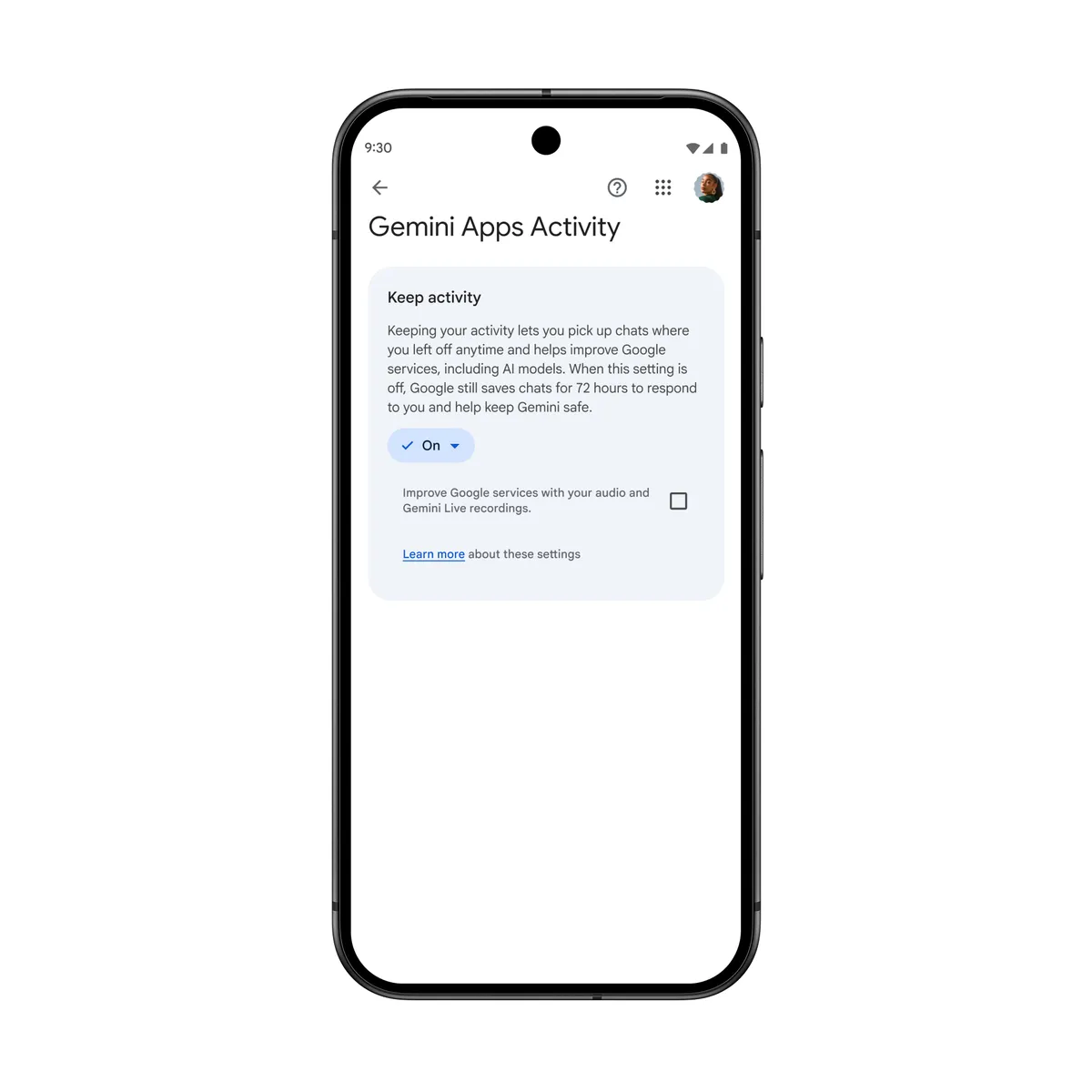
Gemini activity and personalization controls (source image)
Connected personal context can reduce manual recap, but it also makes permission boundaries more important. Source: Google.
The right workflow is:
use connected data as evidence,
not:
let the AI define your week from your Google exhaust.
Why journal apps still matter as a benchmark
This article is about not journaling.
Journal apps still show useful review patterns.
Rosebud's weekly reports include key themes and significant people.

Rosebud uses accumulated entries as the raw material for higher-level weekly reflection. Source: Rosebud.

The useful lesson is the synthesis layer, not necessarily the requirement to write every day. Source: Rosebud.
Reflection similarly emphasizes weekly and monthly recaps over:
- themes,
- wins,
- moods,
- shifts.
Source: Reflection
You can borrow that structure without borrowing the daily-writing requirement.
The best weekly review template
Here is a strong reusable format.
 # Weekly Life Review

Week:
[DATE RANGE]

 ## 1. What happened
- 3–7 meaningful events

 ## 2. What changed
- priorities
- decisions
- plans
- active situations
- preferences

 ## 3. What mattered
- 3–5 meaningful moments or developments

 ## 4. People
- who meaningfully appeared this week
- what changed, if anything

 ## 5. Decisions
- decisions made
- decisions still open
- why

 ## 6. Wins
- progress
- good moments
- things that became easier

 ## 7. Friction
- recurring problems
- unnecessary stress
- things that repeatedly blocked progress

 ## 8. Open loops
- unresolved tasks
- unresolved conversations
- unresolved decisions

 ## 9. What I want to remember
- up to 5 moments

 ## 10. Next week
Continue:
Stop/reduce:
Close:
Top 3 priorities:
That is enough structure.
Do not add 24 more sections because you saw a productivity influencer with a pleasing font.
Add one section most weekly reviews miss: “What stopped mattering?”
This is an excellent reflection question.
Ask:
What was important last week that barely mattered this week?
Possible answers:
- a problem was solved,
- interest disappeared,
- attention shifted,
- a worry was exaggerated,
- priorities changed.
This reveals change.
It also stops the AI from only accumulating new context forever.
Add another: “What became easier?”
People notice problems more readily than reduced friction.
Ask:
“What was difficult recently but felt easier this week?”
Examples:
- talking to someone,
- coding a feature,
- waking earlier,
- handling uncertainty,
- making decisions.
Progress is often a decrease in friction, not a trophy.
Add another: “What am I avoiding?”
Use carefully.
Prompt:
Based only on things I explicitly postponed, repeated, or left unresolved, are there any topics I may be avoiding?

Do not infer avoidance from silence alone.
Show the evidence.
That second sentence is essential.
If the AI sees no conversation about taxes, it should not conclude you are repressing your relationship with taxation.
Use “decision review” instead of endless introspection
One of the most useful weekly sections is:
Decision made:
Why:
What information caused it:
Is it reversible?
Revisit when:
Example:
Decision:
Pause fundraising.

Why:
Need stronger retention signal.

Revisit when:
Production is live and repeat usage is clearer.
Now a future weekly review can say:
“The condition for revisiting this decision may now be true.”
That is extremely useful continuity.
Track changes in active goals
For each goal:
Goal:
Status:
What moved this week:
What blocked it:
Next step:
Still important? yes/no/unsure
That final field is more important than progress percentage.
A goal can be 60% complete and no longer matter.
Weekly review should catch that.
Track people carefully
A weekly review can ask:
“Who mattered this week?”
But avoid turning people into analytics.
A useful representation is:
Person:
Sam

Why they appeared:
Product decision

What changed:
Agreed on new onboarding approach

Source:
Tuesday conversation
Not:
Sam mention count: 14
Sentiment score: -0.38
Please allow relationships to remain human for at least a few more product cycles.
Build a “moments worth keeping” layer
Weekly reviews often become:
- productivity,
- problems,
- goals.
That misses life.
Ask:
“Which moments from this week might I want to remember in a year?”
Examples:
- funny conversation,
- good meal,
- first user message,
- a walk,
- an unexpected compliment,
- a family moment,
- finishing something.
Reflection works better when it preserves moments as well as problems and goals. Source: Gemora.
Use a “one photo, one sentence” review
If you hate text-heavy reviews, do this.
Choose 3–5 photos from the week.
For each:
Photo:
[image]

Sentence:
What this moment meant to me.
Then ask AI:
“Using these photos plus my conversations from the week, what story do they tell together? Keep interpretation cautious.”
This produces a surprisingly rich review with almost no writing.
Use voice instead of writing
Another no-journal option:
Record a 3-minute voice dump.
Say:
- what happened,
- what surprised you,
- what bothered you,
- what you are thinking about next week.
Then ask AI to combine the transcript with the week context.
You are reflecting.
You are just not typing a diary entry.
This matters because the real goal is expression and review.
Not preserving the sacred ritual of keyboards.
The “three questions only” version
If every system eventually becomes too complicated, reduce it to:
1. What changed this week?
2. What is still unresolved?
3. What matters next week?
That is a complete weekly review.
Everything else is optional enrichment.
The “bad week” version
When the week was exhausting, do not force a high-effort review.
Use:
I do not want a deep review.

Help me do a 5-minute version.

Give me:
1. what happened
2. what I got through
3. what can wait
4. one thing worth remembering
5. one thing to make next week easier
Reflection should reduce cognitive load.
Not become another obligation you failed to complete.
The “great week” version
When things went well, do not skip reflection.
Ask:
This was a good week.

Help me understand:
- what went well
- what conditions helped
- what I should preserve
- which moments are worth remembering
- what I should avoid over-optimizing or turning into a rigid routine
Success also contains information.
The “nothing happened” version
Sometimes the week feels empty.
Ask:
This week felt uneventful.

Do not force significance.

Help me identify:
- small moments
- routines that continued
- things that felt stable
- anything that became easier
- anything I stopped worrying about
Ordinary weeks are still life.
They do not need an inspirational plot twist.
Compare week-over-week, not only week in isolation
Once you have several reviews, use AI for longitudinal comparison.
Prompt:
Compare the last 4 weekly reviews.

Show:
- recurring themes
- issues that resolved
- issues that keep returning
- priorities that changed
- people/situations that changed
- positive patterns
- things I repeatedly said I would do but did not

For every observation:
- cite the relevant weeks
- separate fact from interpretation
- include confidence
This is where weekly review becomes much more valuable.
Build a four-week “life pulse”
You can summarize each week into five fields:
Main theme
Main decision
Main friction
Best moment
Current priority
Example:
Week 1:
Theme: Launch
Decision: Delay 1 week
Friction: Onboarding
Best moment: First tester feedback
Priority: Stability

Week 2:
Theme: Distribution
Decision: Publish
Friction: Store review
Best moment: First organic signup
Priority: Acquisition
Now you can see movement.
Not only memories.
Do not ask AI to assign your mood from your data
This is worth emphasizing.
AI may see:
- calendar density,
- wording,
- task completion,
- photos.
It should not confidently conclude:
“You were depressed Tuesday.”
If you explicitly said:
“I felt terrible Tuesday,”
that is your report.
If the system infers:
“Mood: -7.3,”
we have wandered into spreadsheet astrology.
Use mood only if:
- you explicitly record it,
- or the AI labels its interpretation as uncertain.
Facts vs interpretations
Every weekly review should separate these.
Fact
“You postponed the launch twice.”
Interpretation
“You may be avoiding shipping.”
Those are not the same.
Maybe:
- the app crashed,
- Play Store rejected something,
- payment broke,
- timing changed.
The AI should present interpretation as a hypothesis.
Fact
“You mentioned fundraising in four conversations.”
Interpretation
“Fundraising dominated your attention.”
Probably reasonable.
Still an interpretation.
Fact
“You stopped mentioning the issue after Wednesday.”
Bad interpretation
“You resolved it.”
Silence is not resolution.
This is one of the most important rules for AI reflection.
A strong system uses confidence labels
Example:
Observation:
Distribution became more important this week.

Evidence:
- Tuesday: discussed acquisition channels
- Thursday: paused fundraising
- Friday: created distribution plan

Confidence:
High
Example:
Observation:
You may feel more optimistic about launch.

Evidence:
- positive wording in two chats
- no explicit statement

Confidence:
Low

Needs confirmation:
Yes
Now the user stays in control.
Create a carry-forward summary
At the end of the review, create one compact context block for next week.
 # Carry Forward

 ## Current priorities
1.
2.
3.

 ## Active situations
-

 ## Decisions made
-

 ## People/context likely to matter
-

 ## Open loops
-

 ## Recently changed
-

 ## Do not carry forward
- temporary moods
- resolved one-off details
This is one of the highest-value outputs.
It stops next week from beginning at zero.
Why the carry-forward summary is more useful than the full review
The full review is for reflection.
The carry-forward is for action.
Full review:
historical.
Carry-forward:
current context.
This distinction mirrors the difference between:
- timeline,
- memory,
- active state.
For a deeper architecture, see:
What Is Personal Intelligence in AI?
Use a personal timeline for long-term review
After several weeks, important events can enter a personal timeline.
Weekly reviews become more powerful when selected events can be compared across months rather than disappearing after Sunday. Source: Gemora.
A timeline might store:
Week:
Sep 1–7

Decision:
Distribution before fundraising

Milestone:
Android production submitted

Change:
Launch became primary focus

Moment:
First encouraging tester message
Then future questions become possible:
“When did distribution become the priority?”
“What happened in the month before launch?”
For the full workflow, see:
How to Build a Personal Timeline With AI
A privacy-first weekly review
If you do not want broad AI access to your personal data, use a manual evidence packet.
Example:
Weekly input:

Calendar:
- interview Tuesday
- dinner Thursday

Tasks:
- shipped feature
- did not finish article

Notes:
- thinking more about distribution

Conversations:
- paste 2 excerpts you choose

Photos:
- 3 selected photos
Then run the review only on that packet.
This gives you:
- selective disclosure,
- less data access,
- clearer provenance.
You lose automation.
You gain control.
That tradeoff is completely reasonable.
A local-first version
For higher privacy, keep a local Markdown folder:
weekly-reviews/
├── 2026-W35.md
├── 2026-W36.md
└── 2026-W37.md
Each file contains only the final review.
You can choose when to provide it to an AI.
That creates a portable history without depending entirely on provider-specific memory.
What not to include automatically
Do not automatically feed:
- passwords,
- security secrets,
- medical records,
- confidential third-party data,
- private messages from other people,
- full financial records,
just because:
“more context makes AI better.”
Selective context makes AI better.
Maximum ingestion makes lawyers busier.
Reflection should not become surveillance
There is a line.
Useful:
“You mentioned work pressure several times.”
Creepy:
“Your communication frequency with Sam decreased 17%, suggesting relational withdrawal.”
Unless you explicitly asked for that kind of analysis and understand the data, do not let your weekly review become behavioral surveillance.
The goal is:
understand your week.
Not:
create a private intelligence agency whose only target is you.
Weekly review without journaling vs journaling
Neither is universally better.
Traditional journaling is better if:
- you enjoy writing,
- the writing itself helps you think,
- you want detailed subjective records,
- reflection during the day matters to you.
AI weekly review is better if:
- you dislike daily writing,
- you already talk to AI,
- your life context exists across several sources,
- blank-page friction stops you,
- you care more about weekly patterns than daily prose.
Hybrid is often best
Example:
During week:
Talk naturally + one-sentence captures

Weekend:
AI weekly review

When something truly matters:
Write a longer reflection
Now journaling becomes optional.
Not mandatory infrastructure.
How weekly review fits Personal Intelligence
A good weekly review is not just a report.
It updates the AI's understanding of:
- what is current,
- what changed,
- what is finished,
- what still matters.
That means it can function as a maintenance loop for Personal Intelligence.
Example:
Old context:
Fundraising is current priority.

Weekly review:
Fundraising paused.

Carry-forward:
Distribution is current priority.
This prevents stale personalization.
For more, see:
What Is Personal Intelligence in AI?
How weekly review fits AI memory
Memory can become messy over time.
Weekly review gives it a natural maintenance rhythm.
Ask:
Based on this week's review:

Which existing memories are now:
- outdated
- completed
- incorrect
- less relevant

Which new pieces of context are durable enough to carry forward?

Do not save every event.
That is much better than infinite memory accumulation.
How weekly review fits Gemora
Gemora's positioning is:
talk through life, keep useful context connected, look back, and understand yourself better over time.
Weekly review fits naturally inside that loop.
The user does not need to:
become a journaler.
They can:
talk normally.
Then the system helps organize:
- days,
- moments,
- people,
- decisions,
- memories,
- changes.
Conversation-first reflection lowers the friction between living something and later being able to revisit it. Source: Gemora.
The weekly review becomes:
Talk
↓
Week accumulates
↓
Recap
↓
What changed?
↓
What matters?
↓
Carry context forward
That is a very different experience from:
Please fill in today's journal template.
And for many people, a much more realistic one.
A reusable master prompt
Here is the full prompt.
Help me run a weekly life review.

Use only context that I provide or that you can legitimately access from this week.

STEP 1 — RECONSTRUCT
List the meaningful events from the week.

For each:
- day/date if known
- factual description
- people involved
- project/life area
- source
- confidence

Do not interpret yet.

STEP 2 — WHAT CHANGED
Compare the beginning and end of the week.

Identify changes in:
- priorities
- plans
- decisions
- active projects
- ongoing situations
- preferences

Do not treat a one-off comment as a permanent change.

STEP 3 — WHAT MATTERED
Propose the 3–5 most meaningful developments.

For each:
- supporting events
- why it may matter
- FACT or INTERPRETATION
- confidence

STEP 4 — GOOD MOMENTS
Identify up to 5 positive, meaningful, funny, peaceful, or memorable moments worth keeping.

Do not focus only on achievements.

STEP 5 — OPEN LOOPS
List:
- decisions not made
- conversations to continue
- unresolved tasks
- things I explicitly said I would revisit

Do not turn every unfinished thought into a task.

STEP 6 — PATTERNS
Identify only patterns supported by multiple pieces of evidence.

Do not diagnose me.
Do not infer causes from correlation.
Do not infer meaning from silence.

STEP 7 — CARRY FORWARD
Create a compact context block containing:
- current priorities
- active situations
- decisions made
- important people/context
- recently changed information
- open loops

Exclude:
- temporary moods
- one-off details
- resolved context that no longer matters

STEP 8 — NEXT WEEK
Suggest:
- one thing to continue
- one thing to reduce or stop
- one open loop to close
- up to three priorities

Do not invent goals that were not already present.

Before finalizing, ask me to correct anything factually wrong.
This is more than enough for a weekly review system.
A 5-minute prompt
Give me a 5-minute weekly review.

Use this week's available context.

Tell me:
1. What happened?
2. What changed?
3. What went well?
4. What is unresolved?
5. What should matter next week?

Keep facts separate from interpretation.
Do not invent significance.
A voice-review prompt
After recording a voice note:
This transcript is my quick weekly voice review.

Combine it with the other context from this week.

Do not rewrite it into motivational language.

Extract:
- key events
- decisions
- changes
- open loops
- moments worth keeping
- next-week priorities

If my voice account conflicts with another source, show the conflict rather than choosing one silently.
A photo-review prompt
These are selected photos from my week.

For each:
- identify only visible or provided factual context
- let me explain what the photo meant

Then combine my explanations with the rest of the weekly review.

Do not infer mood, relationships, or significance from appearance alone.
A monthly review built from weekly reviews
After four or five weeks:
Review the weekly reviews from this month.

Do not start from raw daily data unless needed.

Show:
- biggest changes
- important decisions
- recurring themes
- things that resolved
- things that remained unresolved
- priorities that rose or fell
- moments worth remembering
- what seems different about the end of the month vs the beginning

Cite the relevant weeks.
This creates a clean hierarchy:
Raw week
↓
Weekly review
↓
Monthly review
↓
Quarterly / yearly reflection
A yearly review without 365 journal entries
This is one of the biggest benefits.
If you produce 52 weekly reviews, your annual review does not need:
365 daily entries.
It has:
52 structured summaries.
Even 30–40 completed weekly reviews can provide a rich history.
The annual review can ask:
- what changed,
- which decisions mattered,
- what disappeared,
- what returned,
- which people became more important,
- which goals survived,
- which did not.
That is much more realistic than maintaining a perfect diary.
How to know whether the weekly review is working
After four weeks, ask:
“Has this system helped me remember, understand, or act on something I would otherwise have missed?”
Look for outcomes such as:
- remembered a good moment,
- closed an old loop,
- noticed a priority changed,
- stopped carrying outdated context,
- saw a recurring issue,
- entered next week more clearly.
If none of those happened:
simplify the review.
Do not add more data.
What to avoid
Avoid over-quantifying
You do not need:
happiness score 7.2.
Avoid motivational filler
You do not need:
“You are on an incredible journey.”
You had a week.
Calm down.
Avoid fake psychological depth
Do not let AI invent childhood causes for a missed deadline.
Avoid exhaustive capture
The point is reflection, not completeness.
Avoid turning every problem into action
Some things need understanding.
Not optimization.
Avoid storing every review forever without cleanup
Some context should become historical.
Only selected context should stay active.
The best weekly review question
If you remember one question from this entire article, use:
What changed this week?
Why?
Because “what happened?” gives you events.
“What changed?” gives you:
- movement,
- decisions,
- endings,
- beginnings,
- evolving priorities,
- changing relationships,
- changing beliefs.
And the purpose of reflection is not only to remember the week.
It is to understand where you are now because the week happened.
Final answer
You do not need to journal every day to reflect on your life every week.
Your week already leaves traces.
In:
- conversations,
- calendar,
- photos,
- tasks,
- notes,
- decisions,
- memories.
AI can help turn those traces into a first draft.
Then your job is to do the part that still matters most:
decide what it meant.
A good weekly life review is not:
“AI, tell me who I am.”
It is:
Show me what seems to have happened.
↓
Let me correct it.
↓
Show me what changed.
↓
Help me see what remains open.
↓
Let me decide what matters next.
That is reflection without the blank page.
The simplest useful system is:
Live normally
↓
Talk naturally
↓
Review once a week
↓
Keep a few meaningful moments
↓
Carry only relevant context forward
No seven-day journaling streak required.
No 42-field life dashboard.
No guilt because Wednesday received zero written documentation.
The point is not to document your life perfectly.
The point is to stop moving through week after week without ever looking back.
You do not need to write your life down every day for it to stay connected. Gemora is built around everyday conversations, days, memories, and changes becoming easier to revisit and understand over time. Start talking with Gemora.
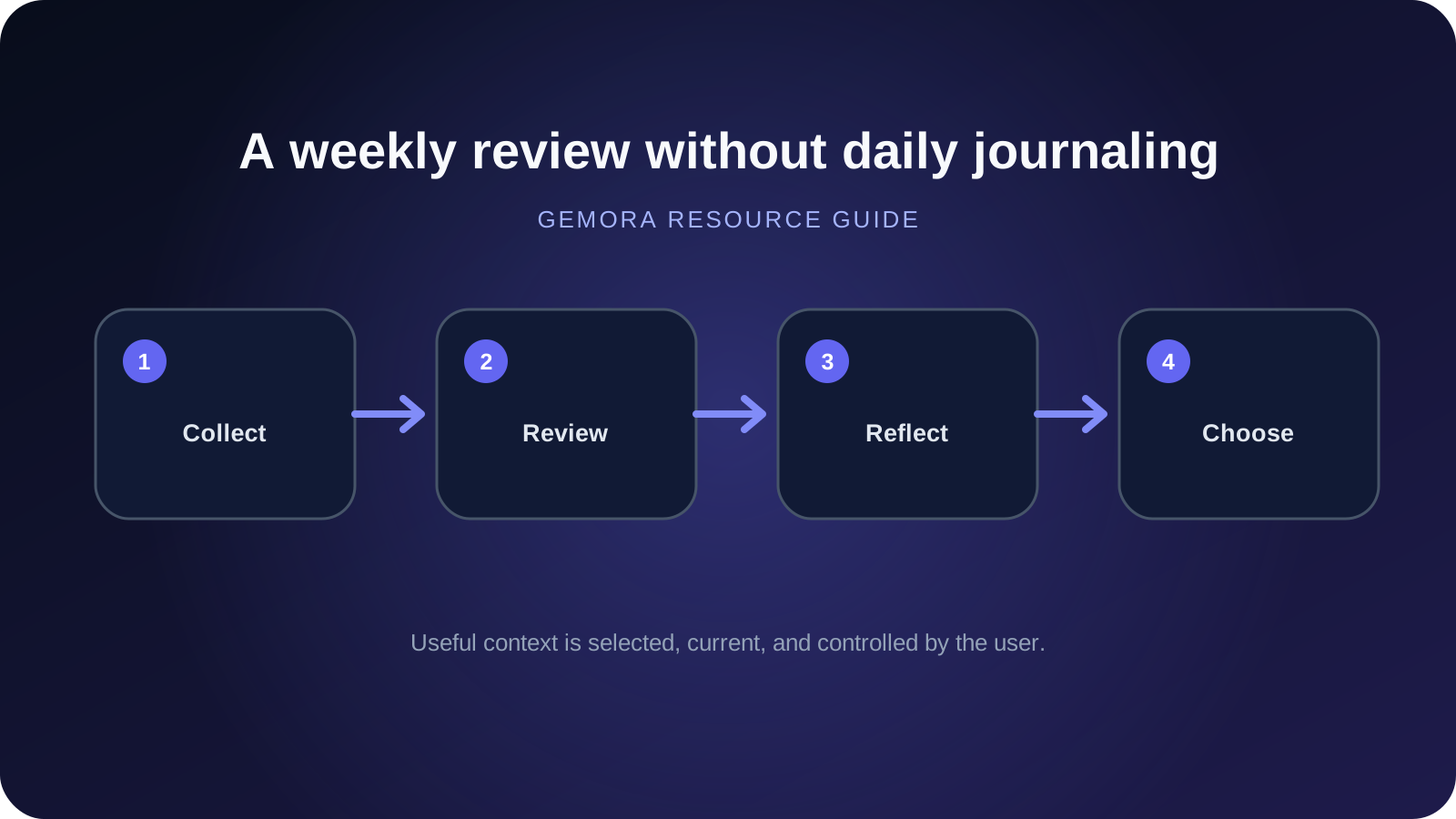
Continue the thread
Start a connected weekly life review
Connect conversations, useful context, reflections, projects, and tasks in one personal workspace.
Start freeFrequently asked questions
Can I do a weekly life review with AI without journaling?
Yes.
What is an AI weekly life review?
An AI weekly life review is a structured reflection process where AI helps reconstruct and synthesize the week from available context.
Do I need to write every day?
No.
Sources and further reading
Written by Khai Tran and reviewed under the Gemora Editorial Policy.