why AI gives generic advice about your life
Why AI Gives Generic Advice About Your Life — and How to Get Better Answers in 2026
Learn why AI gives generic life advice, what missing or stale context has to do with it, and how to get answers that better fit your real situation.
방법론: The guide uses before-and-after decision examples to isolate missing goals, constraints, history, recency, and requested help style.
독창적 기여: A three-layer framework for separating known facts, tentative interpretation, and the decision that remains with the user.

이 가이드에서는
- The short answer
- The same model can give a generic answer or a personal one
- A before-and-after example: “Should I quit my job?”
- Why “better prompting” only solves part of the problem
- How to get less generic advice from AI
- More memory does not automatically mean better advice
- Good personal context has at least five properties
- Why Gemini's Personal Intelligence is relevant
- Why generic advice is especially common in emotional conversations
- Personalized does not mean flattering
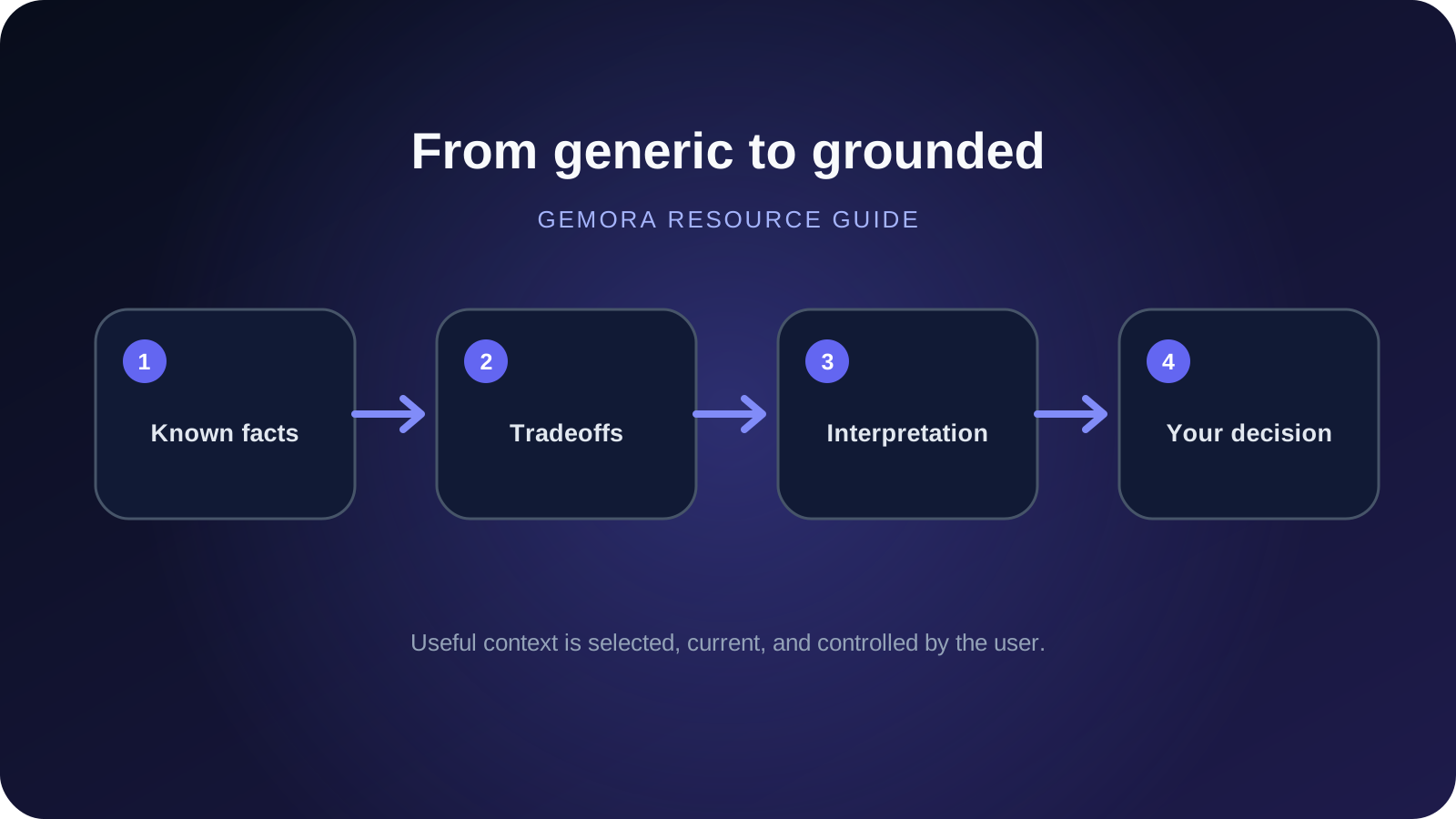
- The three layers of useful personal advice
- Where Gemora fits
- A reusable prompt for getting better personal advice
- When you should not ask AI for a personalized answer
- Final answer
Related reading: memory vs history · apps with recall · long-term assistants · memory controls.
Good personal advice depends on more than a smart model. It depends on whether the AI understands enough of the life around the question. Source: Gemora.
You ask an AI:
“Should I quit my job?”
It replies:
“Consider your financial situation, career goals, work-life balance, and long-term opportunities. You may want to make a pros and cons list before deciding.”
Technically reasonable.
Also almost completely useless.
You already knew money matters.
You were aware that careers have goals.
The revelation that decisions contain “pros and cons” has somehow survived several centuries of human civilization without requiring a large language model.
So why does an AI that can write code, analyze scientific papers, and explain obscure legal concepts suddenly sound like a motivational blog when you ask about your own life?
The short answer is:
Because the model knows far more about the world than it knows about the situation behind your question.
The quality of personal advice depends on context such as:
- what you actually want,
- what you are afraid of,
- what has already happened,
- what you have tried,
- who else is involved,
- what tradeoffs matter to you,
- what changed recently,
- what you said about the same problem before,
- and which constraints are real in your life.
Without that information, the safest thing an AI can do is give advice that would be reasonable for many people.
That is exactly what generic advice is.
In 2026, major AI assistants are increasingly trying to solve this with memory, past-chat retrieval, Personal Intelligence, files, and connected apps. ChatGPT can carry useful context across conversations, Claude can maintain editable memory topics and search old chats, and Gemini can use previous conversations and connected Google data for personalization. (OpenAI, Anthropic, Google)
But memory alone does not magically produce good life advice.
To understand why, we need to separate intelligence from context.
The short answer
AI gives generic advice about your life for six main reasons:
- It only sees a small part of your situation.
- It does not automatically know your values or priorities.
- It may not understand the history behind the question.
- Even when memory exists, the relevant context may not be retrieved.
- Old context can be incomplete, stale, or wrong.
- When uncertain, general-purpose AI often falls back to broadly safe advice.
The model can be extremely intelligent and still give a generic answer.
A useful way to think about it is:
Model intelligence
        +
Relevant personal context
        +
Correct understanding of the current situation
        =
Useful personal answer
If the second and third parts are weak, making the model smarter does not necessarily fix the result.
The same model can give a generic answer or a personal one
OpenAI's own 2026 memory research provides a simple demonstration.
A user asks for takeout.
Without the right personal context, the model gives one kind of answer.

When the AI has the wrong or stale context, an otherwise capable answer can be poorly matched to the user's actual situation. Source: OpenAI.
With relevant, up-to-date context, the answer changes.

The underlying model can become much more useful when the surrounding personal context is correct and current. Source: OpenAI.
That example is about recommendations, but the same principle applies to life advice.
Consider:
“Should I move to another city?”
The model can give a generic list:
- cost of living,
- career opportunity,
- family,
- lifestyle,
- housing,
- social network.
Now give it context:
- you have wanted to leave your current city for two years,
- your partner recently found a local job they love,
- you are building a remote company,
- you have enough savings for nine months,
- being close to your parents has become more important recently,
- and the new city solves a career problem you no longer actually have.
Same model.
Different context.
Completely different conversation.
Reason 1: the AI sees the question, not the life around it
Humans use enormous amounts of background context when giving advice.
Imagine a close friend asks:
“Do you think I should go?”
You might know immediately what “go” means.
You know:
- the event,
- who will be there,
- why they are hesitant,
- what happened last time,
- which person they are trying to avoid,
- and whether they have been regretting staying home too much lately.
The sentence itself is tiny.
The context behind it is huge.
AI conversations often begin with the opposite structure.
The model receives:
“Should I go?”
and almost none of the hidden background.
So it has two choices.
It can ask questions.
Or it can answer from general principles.
Many AI systems do some combination of both.
When the assistant answers too quickly, the result sounds generic because it effectively has to solve:
“What advice would be reasonable for an unknown person in an unknown situation?”
That is not your actual question.
It is merely the best approximation available from the information provided.
Generic advice is often the statistically reasonable answer
Large language models learn patterns across huge amounts of text.
When context is missing, the model gravitates toward advice that appears broadly useful across many similar situations.
For example:
Relationship problem
Generic answer:
Communicate openly, set boundaries, and consider the other person's perspective.
Career problem
Generic answer:
Think about your goals, finances, growth opportunities, and work-life balance.
Stress
Generic answer:
Prioritize sleep, exercise, breaks, and stress-management techniques.
Difficult decision
Generic answer:
Make a pros and cons list and consider the long-term consequences.
None of this is necessarily wrong.
That is the problem.
Generic advice survives because it is rarely catastrophically wrong.
It is also rarely enough.
Personal advice requires choosing between reasonable principles.
Maybe “communicate openly” is the wrong next step because you have already communicated the same boundary five times.
Maybe “think about financial stability” is less important because you deliberately saved enough money to take a risk this year.
Maybe “take a break” is not useful because the thing making you anxious is an unresolved decision you keep postponing.
The model needs context to know which general principle should matter more for you.
Reason 2: the AI does not automatically know what you value
A lot of life decisions have no objectively correct answer.
Should you take the higher-paying job?
It depends.
Should you stay in the relationship?
It depends.
Should you move abroad?
It depends.
Should you spend another year building the startup?
Again, deeply inconveniently, it depends.
The missing variable is often values.
Suppose two people receive the same offer:
Current job:
$70,000
Stable
Remote
Low growth

New job:
$105,000
Office-based
High growth
Requires relocation
For one person, the new job is obviously better.
For another, it is obviously worse.
Why?
Because they value different things.
One person may optimize for:
- career acceleration,
- income,
- challenge,
- network.
The other may optimize for:
- autonomy,
- location,
- family,
- predictable time,
- side projects.
If the AI does not know which tradeoff matters more, it has to produce a neutral answer.
Neutrality sounds like:
“Both options have advantages and disadvantages.”
An astonishing discovery.
Personal advice requires a priority function
A useful AI should gradually understand things like:
- what you tend to regret,
- which constraints are non-negotiable,
- what goals are currently important,
- what you explicitly do not want,
- and which values matter more when they conflict.
This is why persistent personal context matters more than simply knowing demographic facts.
Knowing:
“The user is 27.”
may not change the answer much.
Knowing:
“The user has repeatedly said that independence matters more than maximizing salary this year.”
can change it dramatically.
Reason 3: the AI may not know the history behind the question
Some life problems are impossible to understand from the latest message.
Consider:
“Should I give him another chance?”
The important information is probably historical.
- How many chances have there already been?
- What happened?
- Did behavior change?
- What did you decide last time?
- Why are you reconsidering?
- What boundary was previously set?
The answer can change entirely depending on that history.
A one-shot AI conversation tends to flatten all of this into:
“Consider whether trust can be rebuilt and whether the relationship is healthy.”
Again, reasonable.
Again, generic.
Cross-conversation context can improve this because the AI does not have to treat every interaction as an isolated event.
ChatGPT's current memory system is explicitly designed to learn preferences, projects, and constraints so future conversations can begin from shared context. (OpenAI)

ChatGPT's newer memory system synthesizes useful context from previous conversations rather than requiring every detail to be manually reintroduced. Source: OpenAI.
Claude now also carries context across chats and exposes remembered information as editable topics. (Anthropic)

Claude can carry remembered context into future conversations instead of making every discussion begin from zero. Source: Anthropic.
History does not guarantee insight.
But without history, many personal questions are missing the most important evidence.
Reason 4: memory can exist without the right memory being used
This is one of the most important distinctions in personal AI.
Stored is not the same as retrieved.
An AI system may technically contain a useful piece of context from a previous conversation.
That does not guarantee that the context appears when you need it.
Imagine the AI has these memories:
- You are planning to move.
- You dislike hot weather.
- You are learning Spanish.
- You are considering changing jobs.
- Your sister recently had a baby.
- You prefer concise answers.
- You are trying to spend less money.
- You once discussed buying a bicycle.
You ask:
“Should I visit Barcelona next month?”
Which memories matter?
Probably:
- budget,
- weather preferences,
- Spanish,
- maybe schedule.
Probably not:
- your sister's baby,
- the bicycle,
- your job situation.
A useful memory system has to rank context by relevance.
This is retrieval.
It is one reason “our AI has infinite memory” is not the same as “our AI gives great personal advice.”
Infinite irrelevant context would be an impressive way to make every answer worse.
ChatGPT now exposes some memory sources
OpenAI's Memory Sources interface helps users see some of the context used to personalize an answer.

Memory Sources can make personalization easier to inspect by showing some of the context that contributed to a response. Source: OpenAI.
This matters because if the answer feels wrong, you can sometimes identify whether the system relied on irrelevant or outdated context.
Claude makes remembered topics unusually visible

Claude exposes remembered context as Topics that users can inspect, edit, or delete. Source: Anthropic.
That transparency helps solve a different part of the same problem:
“What does the AI currently believe about me?”
But even a perfectly accurate memory database still needs good retrieval.
Reason 5: the AI may remember an old version of you
Memory creates a new failure mode.
Without memory:
the AI forgets you.
With bad memory:
the AI confidently remembers someone you used to be.
That can be worse.
You may have said:
“I want to become a manager.”
A year later, you realize management is making you miserable.
If the AI keeps optimizing advice around:
“Your long-term goal is management.”
its answers become systematically wrong.
The information was once accurate.
The context is now stale.
Time changes the meaning of memory
OpenAI specifically highlights this problem in its 2026 memory architecture.
The system is designed to update context as time passes.
A future trip should eventually become a past trip.
A current project may become completed.
A temporary location should stop being treated as your home.
Source: OpenAI — Better Memory for ChatGPT
This sounds obvious.
It is technically difficult.
Personal context is not a list of permanent facts.
It is a timeline.
Consider:
January: “I want to move to London.”
March: “I am less sure about moving.”
June: “I decided to stay near my family.”
All three statements are true historically.
Only one should strongly influence advice today.
A good personal AI has to understand:
- what happened,
- when,
- what changed,
- and what appears current.
Reason 6: the AI may not know what kind of help you actually want
Users often ask:
“What should I do?”
But that sentence can mean several different things.
Meaning 1: decide for me
“Tell me which option you think is better.”
Meaning 2: help me think
“Ask questions so I can figure out what I actually want.”
Meaning 3: challenge me
“Tell me what I might be rationalizing.”
Meaning 4: emotional processing
“I already know what I should do. I need to talk through why it is hard.”
Meaning 5: planning
“I have made the decision. Help me execute it.”
If the AI cannot infer which mode you want, it tends to choose a safe middle:
acknowledge feelings + list considerations + suggest next steps.
That format is responsible for an enormous percentage of generic AI life advice.
It is not necessarily a reasoning failure.
It is an intent ambiguity problem.
One sentence can improve the conversation dramatically
Try adding:
“Do not give me advice yet. Ask me questions until you understand what is making this difficult.”
or:
“I want your actual recommendation, not a neutral list.”
or:
“Challenge my current interpretation.”
or:
“I have already decided. Help me turn the decision into a plan.”
This tells the model what role the conversation should play.
Reason 7: the AI does not experience the consequences
There is another limit that memory cannot fix.
The AI does not live your life.
It does not:
- wake up in your apartment,
- work with your manager,
- know how your partner actually behaves outside your descriptions,
- feel your financial pressure,
- experience your social environment,
- or personally absorb the consequences of the decision.
It only receives representations.
Your messages.
Your files.
Your history.
Potentially connected app data.
This matters because people often leave out the part of a situation that feels too obvious to mention.
For example:
“Should I take the promotion?”
Maybe the promotion comes with constant travel.
You do not mention this because everyone at your company already knows.
The AI does not.
A human friend might.
The AI can only reason from accessible context.
That is why personal context reduces generic advice but does not create omniscience.
Reason 8: safe advice is often generic advice
General-purpose AI systems are designed to behave carefully in areas where confident advice can cause harm.
That is sensible.
It also creates a recognizable tone:
“Consider speaking with someone you trust.”
“Every situation is different.”
“It may help to weigh your options carefully.”
“Ultimately, the decision is yours.”
These statements can be appropriate.
Repeated too often, they feel like the AI is backing slowly toward the exit.
The deeper issue is uncertainty.
When the model lacks enough context to justify a strong recommendation, caution is rational.
The answer becomes more useful when the AI has:
- concrete constraints,
- clear goals,
- relevant history,
- and permission to make a recommendation within those boundaries.
The solution is not:
“Make the AI reckless.”
It is:
Give the system enough context to distinguish a specific judgment from irresponsible certainty.
A before-and-after example: “Should I quit my job?”
Generic prompt
“Should I quit my job?”
Likely answer:
Consider your finances, career goals, work-life balance, and whether you have another opportunity lined up.
This is correct in the same way “water is wet” is correct.
Better context
“I have been unhappy in this job for about eight months. The work itself is fine, but I dislike managing people and I have repeatedly told you I want to move back toward individual-contributor work. I have 10 months of expenses saved. I am building a product on the side and want to give it six months of serious attention. My main fear is not money. It is that I am using the startup as an excuse to escape a job I dislike. I want you to challenge that possibility and then tell me what you would do.”
Now the AI can reason about:
- duration,
- recurring preference,
- financial runway,
- alternative plan,
- motivation,
- risk of rationalization,
- and the actual decision mode you want.
The answer can become personal.
Example: “Should I text them?”
Generic prompt
“Should I text them?”
Likely answer:
Think about your intentions, respect their boundaries, and consider how sending the message might make you feel.
Fine.
Not useful.
Better context
“We ended things six weeks ago. I was the one who asked for no contact because every conversation restarted the same argument. They sent me a casual message yesterday. I miss them, but the underlying problem has not changed. I am tempted to reply because I am lonely tonight, not because I think the relationship is different. Help me decide whether replying is consistent with the boundary I set.”
Now the question is not:
“Is texting good?”
It is:
“Is this action consistent with a previous decision and current reality?”
That is a context problem.
Example: “What should I do this weekend?”
This question is almost comically dependent on personal context.
A useful answer might depend on:
- location,
- weather,
- budget,
- energy level,
- who you are with,
- what you have been doing lately,
- whether you need rest,
- whether you have been isolated,
- what events are happening,
- and what you enjoy.
Without any of this, the AI says:
Visit a museum, go for a hike, try a new restaurant, or spend time with friends.
Humanity thanks the machine for rediscovering Saturday.
With context, the answer might become:
“You have spent the last three weekends working, and you said yesterday that you feel socially disconnected. I would not use Saturday for another solo productivity day. Meet someone in the afternoon, then keep Sunday mostly empty.”
The model did not become smarter about weekends.
It understood more of the life around this one.
Example: “Why am I unmotivated?”
This question is especially dangerous for generic interpretation because “unmotivated” can describe very different situations.
It could mean:
- tired,
- bored,
- afraid,
- overwhelmed,
- unconvinced the goal matters,
- unclear what to do next,
- distracted,
- discouraged by lack of progress,
- or simply in need of rest.
A generic AI may respond:
Break the goal into smaller steps, create a routine, remove distractions, and reward yourself.
Sometimes useful.
Sometimes completely wrong.
If the history shows:
- the user was extremely motivated three months ago,
- motivation dropped after the project direction changed,
- they repeatedly question whether the goal is still theirs,
- and they complete difficult tasks just fine in other areas,
the problem may not be discipline.
It may be misalignment.
Life context helps distinguish:
“I cannot make myself do this.”
from:
“I no longer want this, and I have not admitted it yet.”
That is exactly the kind of distinction one isolated prompt is bad at making.
Why “better prompting” only solves part of the problem
A lot of advice about generic AI answers is:
“Write a better prompt.”
That helps.
But it does not solve the entire problem.
You can write:
“Act as an expert life coach and give me highly personalized advice.”
The AI still does not magically know your life.
Fancy role instructions cannot manufacture missing facts.
A better prompt can improve:
- intent,
- response style,
- depth,
- structure,
- and reasoning mode.
It cannot replace context that does not exist.
Compare:
“Be highly personalized.”
with:
“I care more about autonomy than salary this year. I have nine months of savings. I previously tried management and disliked it. I am deciding between staying in my current role and taking six months to build my product.”
The second prompt works because it contains relevant information.
Not because it contains more adjectives.
How to get less generic advice from AI
You do not need to write an autobiography before every question.
A small amount of the right context is enough.
Use this framework.
1. Explain the actual decision, not just the topic
Weak:
“What should I do about my job?”
Better:
“I am deciding whether to stay for another year or leave in the next three months.”
The model now knows the shape of the decision.
2. State what matters most
Add:
“My top priorities are autonomy and time. Salary matters, but I am willing to earn less for both.”
This immediately changes the recommendation function.
3. Give the constraints
Examples:
- “I cannot relocate.”
- “I need at least $3,000 per month.”
- “I have six months of savings.”
- “I cannot work weekends.”
- “I have already tried talking to them twice.”
- “I need to make the decision by Friday.”
Constraints turn broad advice into actionable advice.
4. Tell the AI what you already tried
Generic advice often repeats obvious steps because it has no idea you already attempted them.
Instead of:
“My manager keeps changing priorities.”
add:
“I have already asked for written priorities twice and proposed a weekly planning meeting. Neither changed the behavior.”
Now the AI should not recommend:
“Try communicating clearly with your manager.”
because you already did.
5. Include what changed recently
Personal advice depends heavily on change.
Examples:
“The salary stopped mattering as much after I paid off my debt.”
“I used to want to move, but being near my family has become more important.”
“The relationship improved for two months and then the same pattern returned.”
“I was excited about the project until the target customer changed.”
This prevents the AI from optimizing around an outdated version of you.
6. Say what kind of help you want
Try one of these:
“Ask questions before giving advice.”
“Give me your recommendation.”
“Challenge my current reasoning.”
“Tell me what assumption I may be making.”
“Do not solve it yet. Help me understand why I am stuck.”
“Compare this with what I said about the same topic before.”
The mode of the conversation matters.
7. Ask the AI to separate facts from interpretation
A useful prompt:
“Separate what I know happened from what I am assuming it means.”
This is particularly useful for:
- relationships,
- workplace conflict,
- ambiguous messages,
- fear about future outcomes,
- and emotionally loaded decisions.
It reduces the chance that the AI simply reinforces your framing.
8. Ask it what context is missing
One of the best anti-generic prompts is:
“Before answering, tell me which pieces of context would materially change your advice.”
This makes the AI identify uncertainty instead of hiding it behind a polished generic response.
For example, it may ask:
- How much savings do you have?
- Is the conflict new or recurring?
- What outcome do you want?
- Have you already tried discussing it?
- Is there a deadline?
- What would make the decision clearly wrong for you?
Answer only the questions that matter.
Now the final response has better inputs.
9. Use past conversations when they are relevant
Modern AI systems increasingly support this.
ChatGPT
ChatGPT can automatically use useful context from previous conversations when Memory is enabled.
Its 2026 memory architecture is designed to keep the context more relevant and current over time. (OpenAI)
Claude
Claude can remember topics across conversations and, on supported paid plans, search previous chats when you ask it to continue an older discussion. (Anthropic Help)

Claude lets users directly correct remembered topics when old context no longer reflects reality. Source: Anthropic.
Gemini
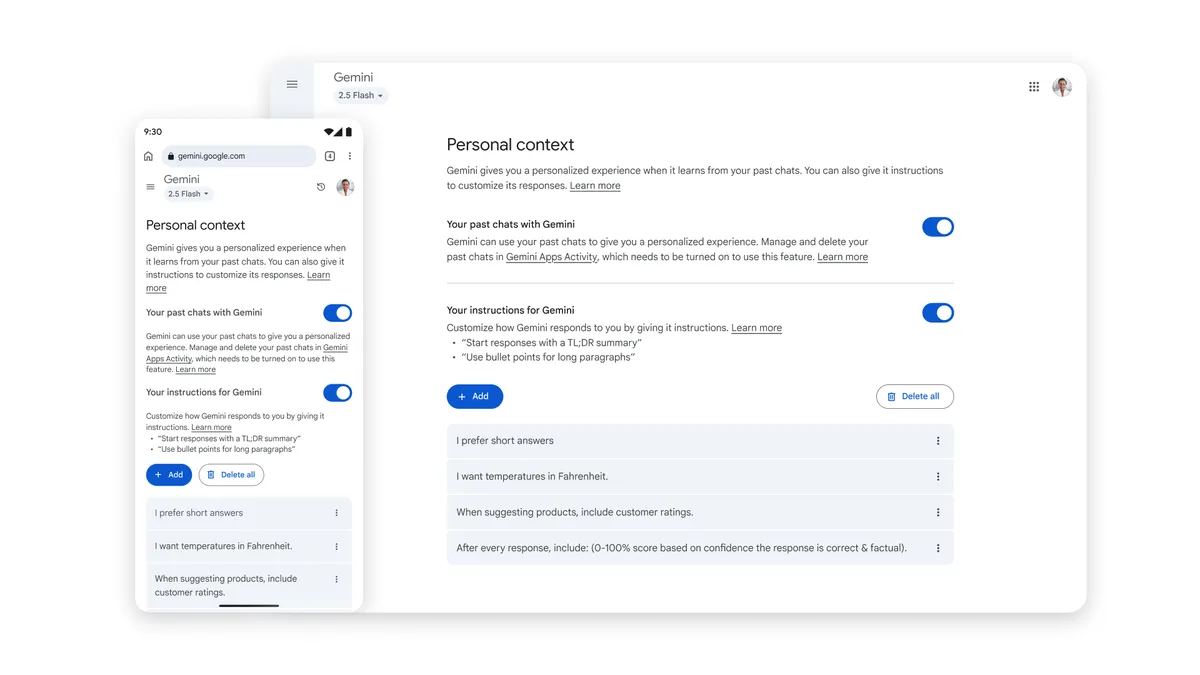
Gemini can use memory of previous chats and connected Google apps for personalization when those features are available and enabled. (Google)
Gemini Personal Context settings for past chats (source image)
Gemini's Personal Intelligence can use previous conversations as part of the context behind a new response. Source: Google.
This is useful when the problem has history.
Do not assume the AI automatically retrieved everything relevant.
You can explicitly say:
“Use what we discussed previously about this decision.”
or:
“Search our old chats before answering.”
10. Correct the AI when its understanding is wrong
Personalization can compound mistakes.
If the AI assumes:
“You care most about career growth.”
and that is wrong, correct it.
Do not merely ignore the sentence.
Say:
“That is outdated. Right now I care more about flexibility and time than promotion.”
Then, where the product allows it, update the memory.
Claude makes this particularly explicit through editable Topics.
ChatGPT allows memory corrections and provides a Memory Summary.
Gemini lets users correct remembered information directly in chat, while deleting remembered information may require deleting the underlying chats or connected source. (Google)
The more personal the AI becomes, the more important correction becomes.
More memory does not automatically mean better advice
This deserves its own section because the AI industry loves turning every hard problem into a storage metric.
“10x more memory.”
“Infinite memory.”
“Never forget anything.”
Wonderful.
But imagine a human friend who never forgot anything you ever said.
Every bad opinion.
Every temporary obsession.
Every incorrect prediction.
Every joke.
Every person you dated for three weeks in 2019.
That is not wisdom.
That is an extremely committed archive.
Useful personal AI needs to know:
- what matters,
- what no longer matters,
- what changed,
- what was temporary,
- what was hypothetical,
- and what should stay private or forgotten.
The quality of advice depends on context selection, not memory volume.
Good personal context has at least five properties
1. Relevant
It actually changes the current answer.
2. Current
It still reflects your situation.
3. Grounded
The system knows where the information came from.
4. Correctable
You can tell the system when it misunderstood you.
5. Selective
Not every personal detail is injected into every conversation.
This is the broader idea behind a personal context layer for AI.
For a deeper explanation, see:
What Is a Personal Context Layer for AI?
Why Gemini's Personal Intelligence is relevant
Google's current direction shows how personal advice may extend beyond chat memory.
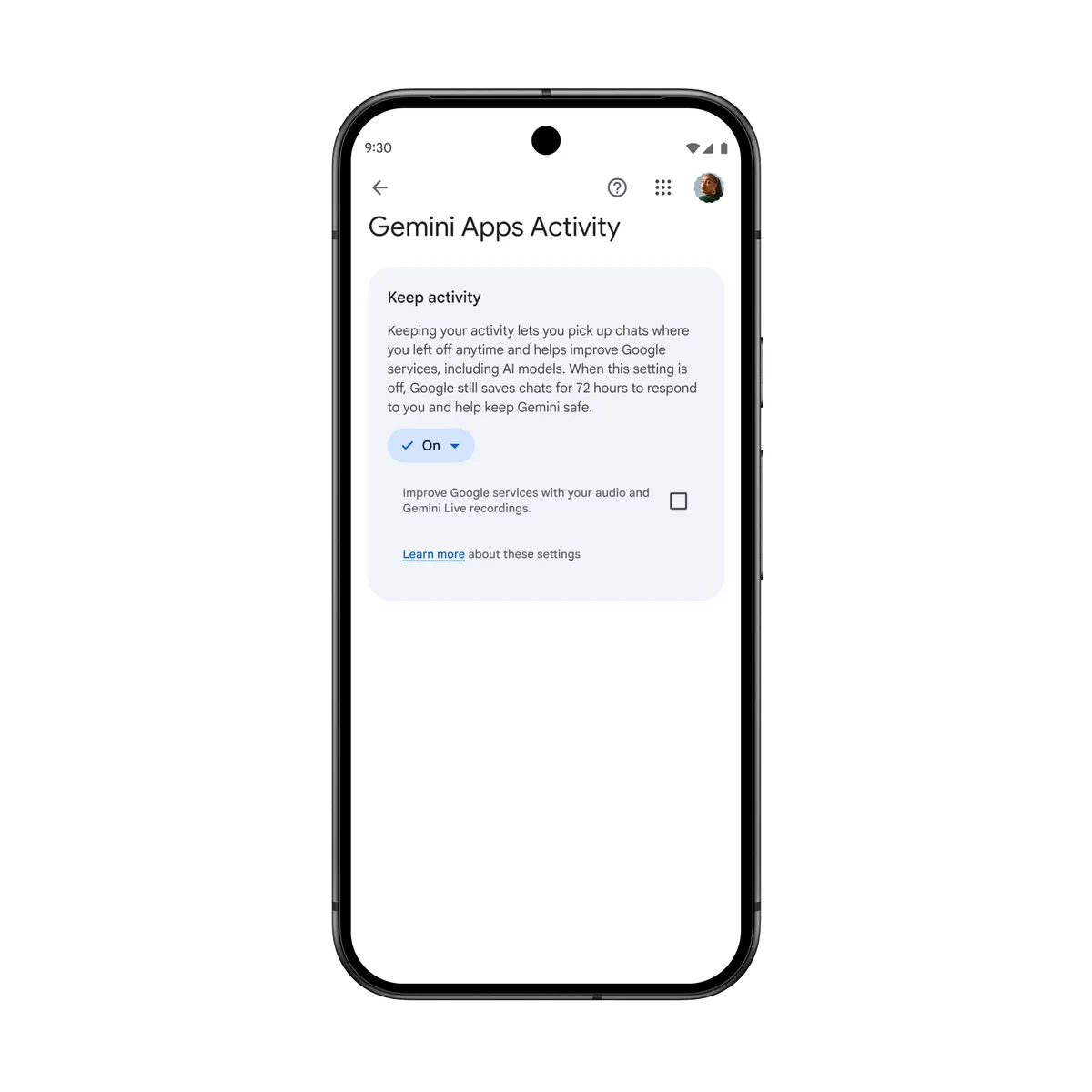
Gemini can personalize from:
- previous chats,
- instructions,
- and supported connected Google apps.
Source: Google Gemini Help — Personalization
That means a question could potentially benefit from context that was never explicitly stated in an AI conversation.
For example:
“Can I realistically fit this trip into next month?”
Relevant context might live in:
- your calendar,
- Gmail,
- previous Gemini discussions,
- or saved activity.
Gemini connected-app personalization controls (source image)
Google is expanding personalization beyond chat history into a broader Personal Intelligence model with user-controlled activity and connected sources. Source: Google.
This is a major shift.
The AI advice problem becomes less:
“How do I write a better prompt?”
and more:
“How does the AI get the right context with the right permission?”
Why importing personal context matters too
What happens when one AI finally understands you and then you switch products?
Usually:
you explain everything again.
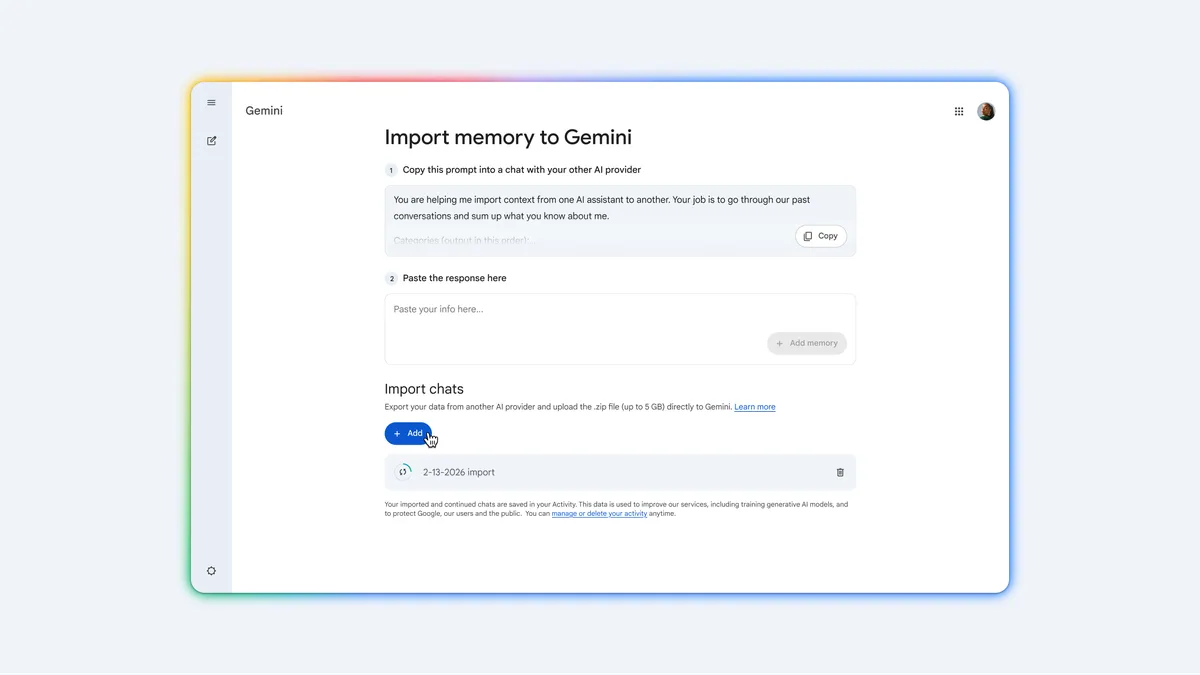
Google is beginning to address this with memory and chat-history import into Gemini.
Gemini Import Memory interface (source image)
Gemini can import a structured memory summary from another AI assistant so users do not necessarily have to rebuild all personal context from scratch. Source: Google.
Google also supports full chat-history imports in supported flows.
Gemini Import Chat History interface (source image)
Gemini can also import prior AI conversation history, preserving more of the source context behind the user. Source: Google.
This matters because better personal advice becomes partly dependent on accumulated context.
If that context is trapped inside one provider, switching creates a personal reset.
The long-term opportunity is context that follows the user.
Why generic advice is especially common in emotional conversations
Emotional questions often contain less explicit information than practical questions.
Compare:
“What size server do I need for 50,000 monthly users?”
with:
“Why do I feel like this?”
The first question points toward measurable variables.
The second may involve:
- relationships,
- recent events,
- expectations,
- sleep,
- work,
- identity,
- uncertainty,
- conflict,
- disappointment,
- or something the user has not identified yet.
The AI has fewer objective anchors.
So it may respond with broad emotional language.
This is also an area where an AI should be careful not to pretend it has perfect psychological insight.
A useful reflective response often does not need to diagnose the cause.
It can instead help the user examine:
- what happened,
- what changed,
- what they are assuming,
- what keeps recurring,
- and which interpretation best fits the evidence.
That is more grounded than confidently announcing:
“You feel this way because of your fear of abandonment.”
after four messages.
Sometimes generic caution is healthier than fake depth.
Personalized does not mean flattering
There is another way AI advice can become useless.
It learns enough context to mirror you perfectly.
Then every response becomes:
“You are right.”
That is not personalization.
That is high-resolution agreement.
Good personal advice should understand your context and still be able to disagree with your interpretation.
A useful instruction is:
“Use what you know about me, but do not assume my current framing is correct.”
Or:
“Tell me the strongest argument against the conclusion I seem to want.”
Or:
“What would someone who knows my situation but disagrees with me say?”
Personal context should improve reasoning.
It should not turn the AI into a sophisticated applause machine.
The three layers of useful personal advice
A practical way to think about this is:
Layer 1: World knowledge
What generally happens?
Examples:
- career tradeoffs,
- relationship patterns,
- financial principles,
- communication strategies,
- behavioral research.
General AI is already strong here.
Layer 2: Situational context
What is happening right now?
Examples:
- the decision,
- constraints,
- timeline,
- people involved,
- recent events.
This usually comes from the current conversation.
Layer 3: Personal context
Why is this situation different for this person?
Examples:
- preferences,
- previous decisions,
- recurring patterns,
- goals,
- history,
- relationships,
- what changed,
- what the user tends to regret.
Generic advice often happens when Layer 1 is strong but Layers 2 and 3 are thin.
That is why a smarter model alone does not solve personalization.
Where Gemora fits
Gemora is built around a simple observation:
A lot of the questions people ask about their lives do not make sense in isolation.
“Should I do it?”
“Why am I thinking about this again?”
“I finally talked to them.”
“I think I changed my mind.”
The useful meaning sits in the conversations that came before.
Gemora is a personal AI for talking through everyday life, including:
- relationships,
- work,
- goals,
- decisions,
- stress,
- trips,
- ordinary moments,
- and whatever keeps coming back.
The point is not to collect an impressive number of memories.
The point is to make later conversations less generic because more of the relevant life context is available.

Gemora Recap helps make the surrounding days and moments easier to revisit, rather than leaving everything buried inside isolated chat sessions. Source: Gemora.
The value is continuity
Imagine talking about a difficult decision over several weeks.
A generic assistant repeatedly gives:
“Consider the pros and cons.”
A context-aware conversation can eventually become:
“At first, your biggest concern was money. Over the last two weeks, you have barely mentioned money and keep returning to autonomy. That seems like the tradeoff that changed.”
That is much closer to the kind of reflection people actually want.

Gemora is designed so relevant past context can become easier to rediscover when it matters later. Source: Gemora.
Advice becomes better when change is visible
One of the hardest parts of giving advice is distinguishing:
“This person always wanted this.”
from:
“This person used to want this.”
Life context needs time.

Longitudinal context makes it possible to notice patterns and changes that one isolated conversation cannot show. Source: Gemora.
That is why Gemora's positioning is not:
“AI with a bigger memory.”
It is closer to:
talk through life, keep the thread, and understand yourself better over time.
Generic advice starts where context ends. Gemora is built so conversations about your life do not have to begin from zero every time. Start talking with Gemora.
A reusable prompt for getting better personal advice
You do not need this exact wording every time, but this structure works well:
I want help thinking through a real-life decision.

Situation:
[What is happening?]

What has already happened:
[Relevant history.]

What I care about most:
[Your priorities or values.]

Constraints:
[Money, time, relationships, deadlines, location, etc.]

What I have already tried:
[Actions that should not be suggested again.]

What changed recently:
[Anything that makes older context less relevant.]

What I want from you:
[Ask questions / challenge me / give a recommendation / help me plan.]

Before answering:
1. Tell me what you think the real tradeoff is.
2. Tell me which assumptions in my framing might be wrong.
3. Ask only the questions that would materially change your advice.
4. Then give me your recommendation and explain why it fits my situation.
This works because it gives the AI a decision model, not merely a topic.
A shorter version when you do not want to write all that
Use:
“Before giving advice, ask me the 3–5 questions that would most change your recommendation. Then use my answers to give me a specific recommendation rather than general principles.”
This is one of the easiest ways to improve generic answers.
It forces the model to surface missing context.
A better prompt when the AI already knows your history
If memory or past-chat access is available:
“Use the relevant context from our previous conversations about this. Tell me what you believe has changed since the last time we discussed it, then give me your recommendation. If any important context is missing or uncertain, ask before answering.”
This shifts the task from:
answer my question
to:
understand where this question sits in an ongoing situation.
That is the important difference.
When you should not ask AI for a personalized answer
There are situations where generic caution is appropriate.
For example, when:
- the AI lacks critical facts,
- consequences are high,
- professional expertise is required,
- the situation involves people the AI only knows through your perspective,
- or you are asking the system to make a decision that depends on values you have not clarified.
In those cases, the better use of AI may be:
- organizing information,
- identifying questions,
- comparing options,
- challenging assumptions,
- or helping prepare for a conversation with a relevant human expert.
The goal of personalization is not to make AI confidently decide everything for you.
It is to make the conversation more relevant to reality.
Final answer
AI gives generic advice about your life because it usually starts with an asymmetry.
It knows a huge amount about:
the world
and much less about:
you inside the world.
So when you ask:
“Should I quit?”
“Should I text them?”
“Why am I stuck?”
“What should I do next?”
the system fills the missing context with broadly reasonable principles.
That produces advice that is often correct.
And often useless.
Better personal answers require more than a smarter model.
They require context about:
- what happened,
- what matters to you,
- what you already tried,
- who is involved,
- what changed,
- what constraints are real,
- and how the current question connects to previous ones.
Memory helps.
Past-chat search helps.
Connected apps can help.
Better prompts help.
But the deeper shift is toward AI that can maintain relevant personal context across time.
The goal is not for an AI to know everything about you.
It is for the right part of your context to be available when it changes the answer.
That is the difference between:
“Here are some things to consider.”
and:
“Given what you actually want, what you already tried, and what changed, this is the tradeoff that matters most.”
Generic advice starts where context ends.
Your life already has the context. Your AI should not make you rebuild it every time. Gemora is built around conversations about everyday life staying connected, so later conversations can begin with more understanding. Start talking with Gemora.
생각 이어가기
Move from generic advice to grounded reflection
하나의 개인 작업 공간에서 대화, 유용한 컨텍스트, 반성, 프로젝트 및 작업을 연결하세요.
무료로 시작하세요자주 묻는 질문
Why does AI give such generic advice?
The model often sees the immediate question without the goals, constraints, history, and recent changes that would distinguish one reasonable answer from another.
Can better prompting fix generic advice?
It can help, but repeatedly reconstructing your life context is costly; current, user-controlled context can reduce that repeated setup.
Does personalized advice mean the AI should agree with me?
No. Useful personalization should make tradeoffs more relevant and disagreement more specific, not make every answer flattering.
출처 및 추가 읽을거리
작성자 Khai Tran 및 다음 기준에 따라 검토 Gemora 편집 정책.