AI journaling vs traditional journaling
AI Journaling vs Traditional Journaling: What Actually Changes?
Compare AI and traditional journaling across prompts, memory, privacy, authorship, pattern detection, reflection quality and everyday writing friction.
Methodology: Analysis based on official product documentation and public feature descriptions listed in the sources, reviewed on 2026-10-16.
Original contribution: A direct comparison of authorship, privacy, pattern detection, friction, and the long-term usefulness of both methods.

In this guide
- The short answer
- Traditional journaling is not obsolete
- The biggest difference: who asks the questions?
- Traditional journaling
- AI journaling
- What changes with prompts?
- Blank-page friction changes dramatically
- Day One makes this distinction explicit
- AI journaling makes voice much more useful
- Reflection uses voice as a first-class journal input
- What changes when the journal remembers?
- Traditional journal memory
- AI journal memory
- The archive becomes queryable
- Mindsera pushes this even further
- AI changes the unit of reflection
- Reflection automatically creates weekly and monthly reviews
- Rosebud does the same at weekly scale
- Pattern detection becomes automatic
- Pattern detection can become pattern invention
Related reading: memory vs history · apps with recall · long-term assistants · memory controls.
Traditional journals preserve what you wrote. AI journals increasingly let you question, compare, and synthesize that history. Source: Reflection.
AI journaling is often described as:
traditional journaling, but with AI.
That is technically true.
It is also not very useful.
A smartphone is technically:
a phone, but with software.
The interesting part is what changes once the software becomes central.
The same thing is happening to journaling.
Traditional journaling usually looks like:
You experience something
↓
You decide to write
↓
You choose what matters
↓
You find the words
↓
You reread later, if ever
AI journaling can look like:
You experience something
↓
You write, speak, or chat
↓
AI asks follow-up questions
↓
AI remembers older entries
↓
AI connects related moments
↓
AI summarizes the week
↓
You ask your history questions later
That is not a minor interface improvement.
The role of the journal changes.
A traditional journal is primarily:
a place where you think in writing.
An AI journal is increasingly:
a system that participates in how you capture, retrieve, interpret, and revisit your own history.
That creates genuine advantages.
It also introduces new problems.
AI can reduce blank-page friction.
It can surface patterns you missed.
It can search years of entries in seconds.
It can ask better follow-up questions.
But it can also:
- influence what you think is important,
- overinterpret patterns,
- flatten ambiguity into summaries,
- create privacy risks,
- encourage dependence on prompts,
- tell you a story about yourself that is persuasive and wrong.
So the useful question is not:
“Is AI journaling better than traditional journaling?”
It is:
“Which parts of journaling improve when AI becomes involved, and which parts become weaker?”
That is what this guide answers.
The short answer
Traditional journaling is strongest when you want:
- uninterrupted self-expression,
- complete control over the page,
- no algorithmic interpretation,
- slower thinking,
- stronger privacy,
- handwriting or physical ritual,
- a record that means exactly what you wrote and nothing more.
AI journaling is strongest when you want:
- easier prompts,
- voice or conversational capture,
- help getting unstuck,
- long-term memory,
- natural-language search,
- automatic weekly/monthly review,
- pattern detection,
- links between old and new entries,
- help revisiting decisions and recurring themes.
The simplest comparison is:
| Traditional journaling | AI journaling |
|---|---|
| You ask the questions | AI can ask questions too |
| You create the structure | AI can structure for you |
| You remember the past | AI can retrieve it |
| You spot patterns manually | AI can propose patterns |
| You summarize periods yourself | AI can synthesize them |
| Meaning stays mostly yours | Meaning becomes partly co-produced |
| Privacy can be fully offline | Privacy depends on product architecture |
| Friction is higher | Friction can be much lower |
| Slowness can be a feature | Speed is often the feature |
| Archive is passive | Archive becomes queryable |
Neither side wins every row.
That is the point.
Traditional journaling is not obsolete
Before comparing the AI layer, it helps to avoid a stupid assumption:
new technology did not suddenly make writing to yourself useless.
Traditional expressive writing has a research history much older than AI journaling.
A 2023 meta-analysis of 31 randomized studies involving 4,012 participants found a small but significant overall effect of expressive writing on depression, anxiety, and stress symptoms, with effects appearing more clearly at follow-up rather than immediately.
Source: PubMed — Expressive Writing Meta-Analysis
Other reviews have found mixed or context-dependent results, which is important.
Journaling is not magic.
It is not therapy in notebook form.
But the act of putting thoughts into words can itself be useful.
AI does not replace that mechanism.
At best, it changes how easily you reach it and what becomes possible afterward.
The biggest difference: who asks the questions?
Traditional journaling begins with agency.
You decide:
what should I write about?
Maybe you use a prompt.
But the page itself does not respond.
AI journaling changes that.
Traditional journaling
You write:
“Work was strange today.”
The page says:
nothing.
You decide whether to continue.
That silence can be powerful.
It forces you to generate the next thought yourself.
AI journaling
You write:
“Work was strange today.”
The AI may ask:
“What felt different from usual?”
or:
“Was it something that happened, or something about how you reacted?”
Now the journal is participating.
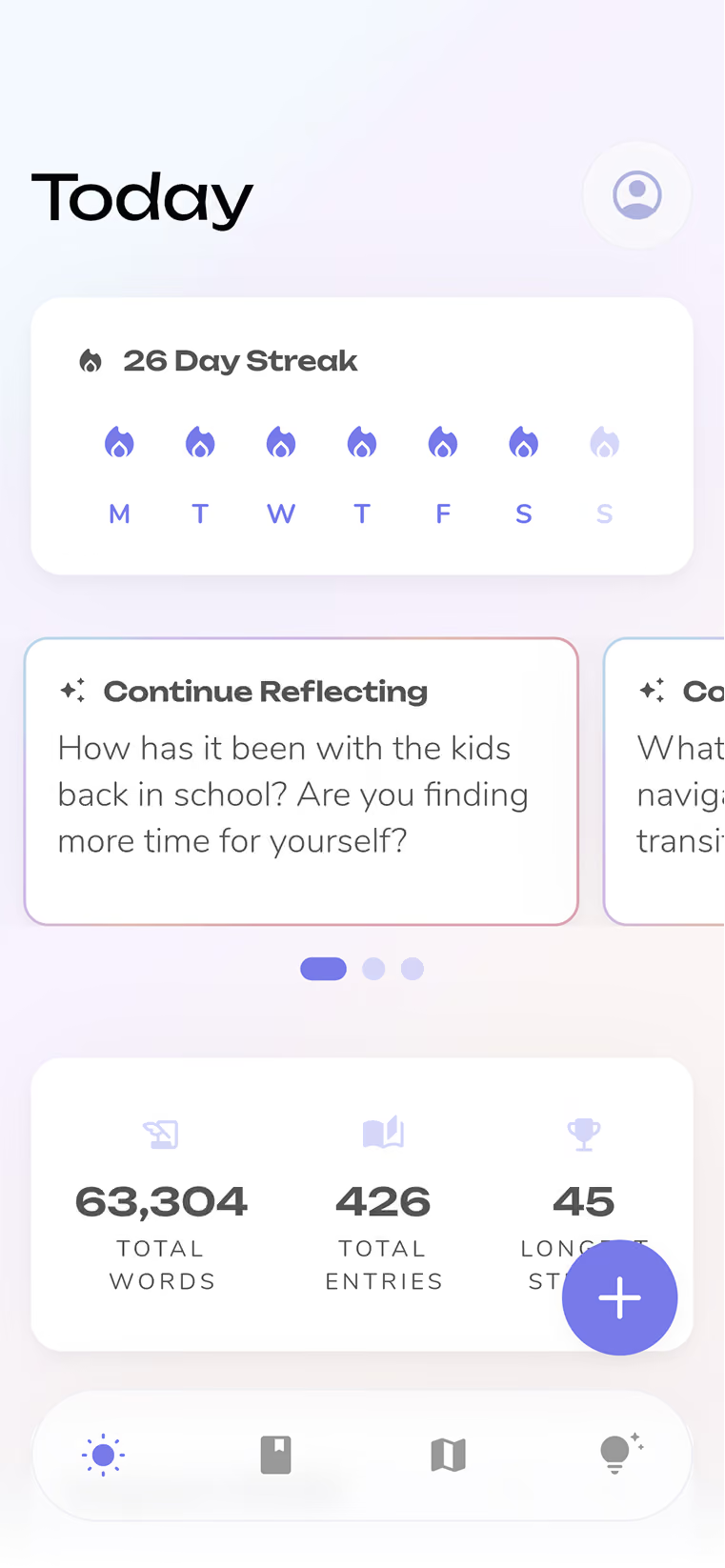
Modern AI journals increasingly respond during reflection rather than waiting passively for the user to finish. Source: Reflection.
That can help you go deeper.
It can also steer you.
That tradeoff appears throughout AI journaling.
What changes with prompts?
Traditional prompts are static.
Example:
“What are you grateful for today?”
An AI prompt can be contextual.
Example:
“Last week you said this meeting made you doubt the project. Did today's conversation change that?”
That is much more personal.
But it requires:
- memory,
- retrieval,
- interpretation.
Which means the system has more influence.
Blank-page friction changes dramatically
One of the clearest advantages of AI journaling is reducing:
“I do not know what to write.”
Day One's 2026 Daily Chat was built explicitly around this problem.
The product describes blank-page journaling as requiring energy to convert lived experience into words, then offers a guided conversation that becomes a journal entry.
Source: Day One — Introducing Daily Chat

Day One Daily Chat turns conversational reflection into an editable journal entry. Source: Day One.
This is a major behavioral change.
Traditional:
create the entry.
AI:
have a conversation, then let software shape it into an entry.
Day One makes this distinction explicit
Its current Daily Chat supports:
- guided conversation,
- personalized questions,
- return-to-chat during the day,
- automatic conversion into a journal entry.
Source: Day One — Daily Chat Guide
The journal entry is now partly:
generated from an interaction.
That changes authorship.
We will come back to that.
AI journaling makes voice much more useful
Voice journals existed before generative AI.
The difference is what happens after you speak.
Traditional voice note:
Record 4 minutes
↓
Audio file exists
AI voice journal:
Record 4 minutes
↓
Transcribe
↓
Structure
↓
Summarize
↓
Extract themes
↓
Ask follow-up
↓
Connect to old context
That is a much bigger workflow shift.
Reflection uses voice as a first-class journal input
Reflection's current product supports voice journaling and AI-assisted reflection.
Its weekly/monthly system can then synthesize those accumulated entries.
Source: Reflection — Weekly & Monthly Reviews

Once speech becomes structured journal data, it can participate in the same review and memory systems as written entries. Source: Reflection.
This matters because the barrier to reflection becomes lower.
You can journal:
- while walking,
- after a meeting,
- during a commute,
- when typing feels like work.
What changes when the journal remembers?
This may be the single biggest change.
Traditional journals preserve history.
AI journals can retrieve history.
Those are not the same thing.
Traditional journal memory
You wrote:
“I want to change jobs.”
Six months later, that entry still exists.
But to use it, you need to:
- remember it exists,
- know roughly when,
- search manually,
- reread.
AI journal memory
Six months later, ask:
“When did I first start thinking about leaving?”
The system can search your history.
Reflection's Ask Your Journal is designed for exactly this.
It searches across previous writing and lets users ask about:
- patterns,
- people,
- earlier periods,
- how they felt before.
Source: Reflection — Ask Your Journal
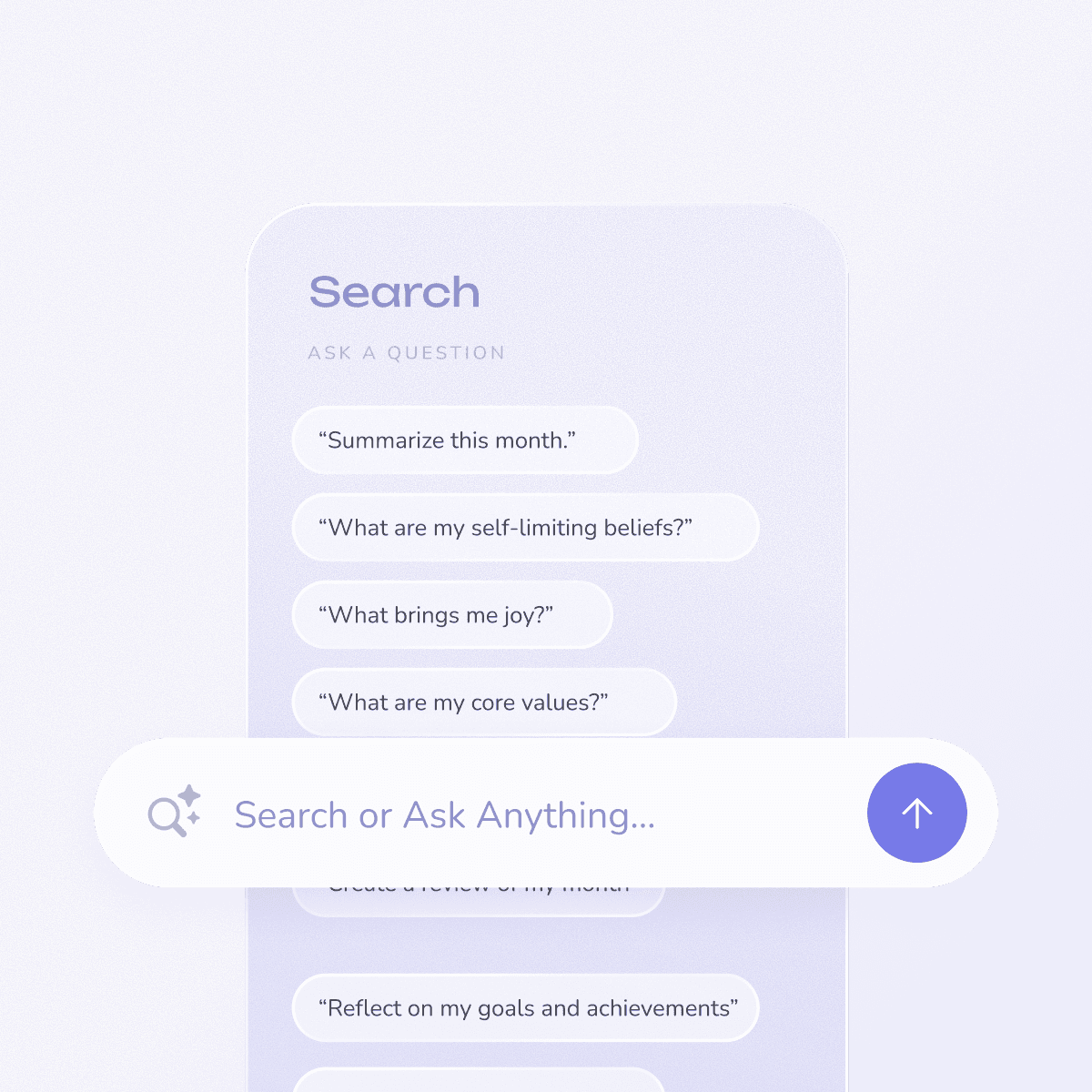
Ask Your Journal turns an archive into a natural-language memory interface. Source: Reflection.
That is not merely convenient search.
It changes the usefulness of the entire archive.
The archive becomes queryable
Traditional journal:
“Here is what I wrote.”
AI journal:
“Ask what you want to know about what you wrote.”
Examples:
“What kept coming up around my birthday last year?”
“How did my view of this person change?”
“What was I worried about before the launch?”
“When did this goal become important?”
This is a fundamental difference.
Mindsera pushes this even further
Mindsera's current Ask Your Journal can use all journal entries and lets users limit analysis to a specific timeframe.
Source: Mindsera — Ask Your Journal
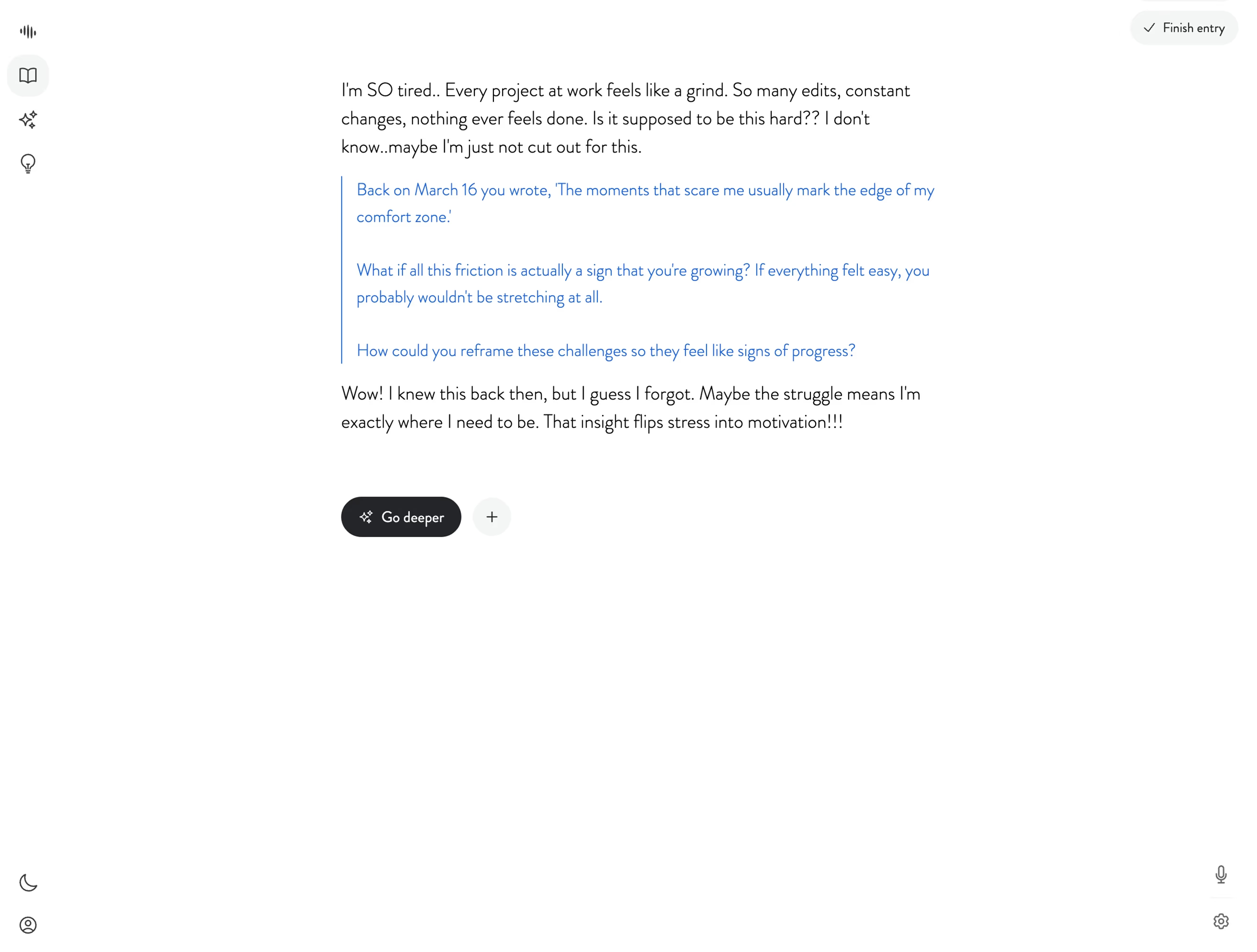
Mindsera combines conversational reflection with history-aware analysis. Source: Mindsera.
Its search also works in natural language even when the user does not remember the exact wording.
Source: Mindsera — Entries & Highlights
This changes an old journal from:
storage
into:
searchable personal knowledge.
AI changes the unit of reflection
Traditional journaling usually reflects at the entry level.
You write about today.
Maybe you reread later.
AI can move reflection to larger timescales.
Entry
↓
Day
↓
Week
↓
Month
↓
Year
That matters.
Reflection automatically creates weekly and monthly reviews
Reflection currently synthesizes entries into reviews containing:
- themes,
- wins,
- moods,
- shifts.
Source: Reflection — Weekly & Monthly Reviews
AI can move journaling from isolated entries toward period-level reflection. Source: Reflection.
Traditional journaling can do this too.
But you must perform the synthesis.
AI makes it cheap enough to happen automatically.
Rosebud does the same at weekly scale
Rosebud's current weekly report analyzes entries and surfaces:
- writing activity,
- emotional landscape,
- key themes,
- significant people,
- up to five insights.
Source: Rosebud — Weekly Report

Rosebud automatically compresses a week of writing into higher-level patterns and people. Source: Rosebud.
This is where journaling changes from:
“What happened today?”
toward:
“What happened across time?”
Pattern detection becomes automatic
Traditional journaling can reveal patterns.
But you need to notice them.
AI journals can actively search for them.
Mindsera currently offers:
- recurring-topic detection,
- long-term emotion analysis,
- entry analysis,
- Story View,
- weekly reviews.
Source: Mindsera
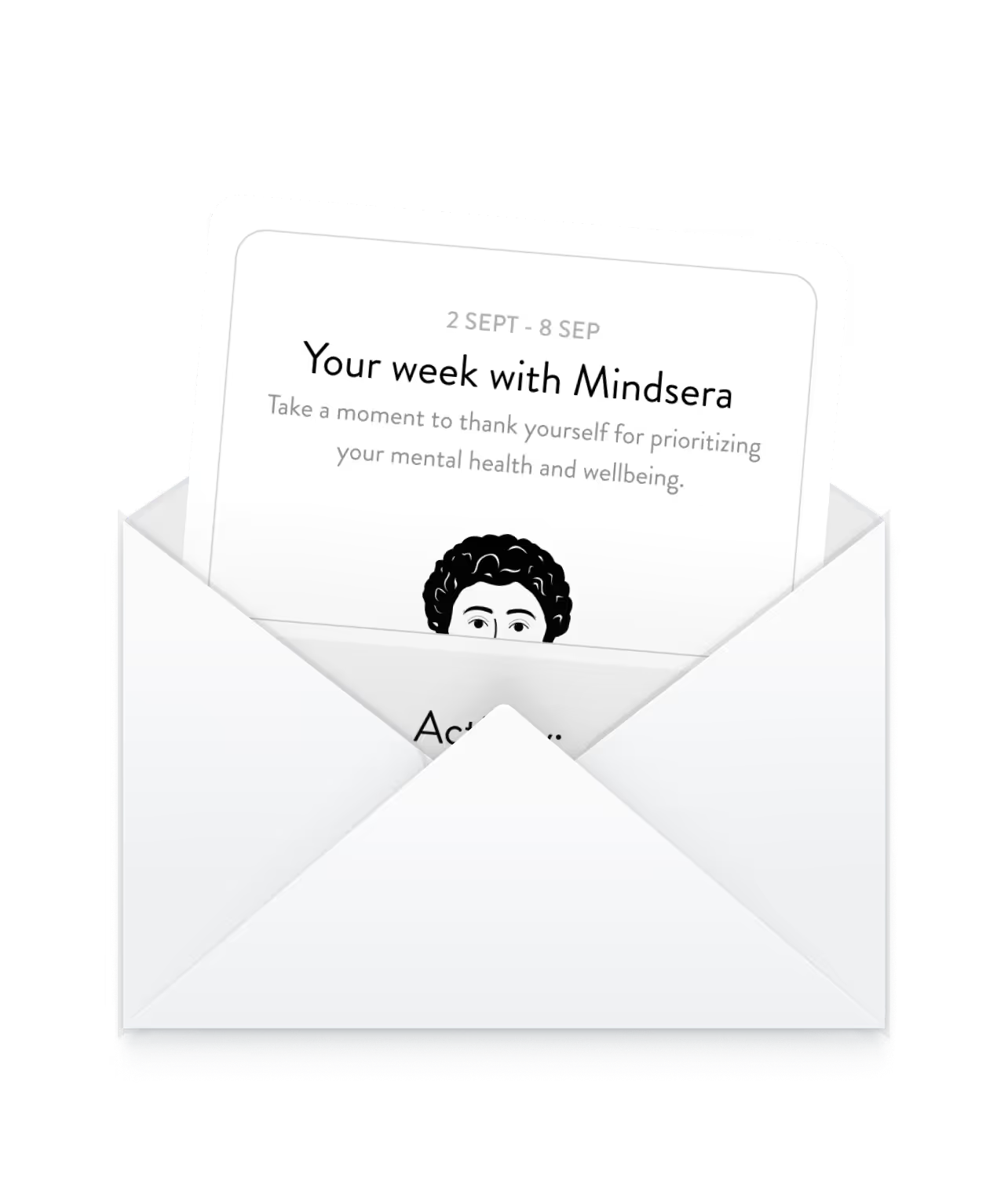
AI journals can surface patterns across a larger history than most users would manually reread. Source: Mindsera.
This is useful.
It is also where AI journaling becomes most dangerous.
Pattern detection can become pattern invention
Suppose you mention:
work stress
four times.
AI says:
“Work stress is a recurring theme.”
Reasonable.
Then it says:
“You have a deep fear of authority.”
Much less reasonable.
The first is supported by text.
The second may be an imaginative leap.
Traditional journaling does not interpret you unless you do
This is one of its biggest advantages.
A paper notebook cannot confidently tell you:
“Your attachment style is causing this.”
Bless it.
It lacks venture funding.
An AI system may generate plausible psychological narratives.
Those narratives can feel insightful precisely because they are personalized.
That does not make them true.
AI changes the relationship between observation and interpretation
A useful AI journal should distinguish:
OBSERVATION:
You mentioned this person in six entries this month.

INTERPRETATION:
This relationship may be taking more attention lately.
Not:
TRUTH:
This relationship is the core emotional issue in your life.
That distinction matters enormously.
Memory changes from passive to active
Rosebud gives a clear example of this.
Its current product explicitly emphasizes:
“Connect the dots.”
The app can reference previous journal context while responding to a new entry.
Source: Rosebud

Rosebud can bring older journal context into today's reflection instead of waiting for the user to search manually. Source: Rosebud.
This creates continuity.
Traditional:
old writing waits for you.
AI:
old writing can return to you.
That can feel much more personal
Example:
Today:
“I feel nervous about presenting.”
AI:
“You described something similar before your interview in July. Is the fear similar?”
That is more useful than:
“Why do you feel nervous?”
But the system now participates in deciding:
which part of your past matters today.
That is a powerful editorial role.
AI changes what “remembering yourself” means
Traditional journaling relies on:
rereading.
AI journaling adds:
retrieval.
That means your memory can become partially mediated by software.
You may ask:
“What was I like last year?”
and receive an AI-generated summary.
That summary can be useful.
It is not the same thing as rereading your own words.
Summary vs source is a critical distinction
Imagine 120 entries.
The AI says:
“Last year you were mostly focused on career uncertainty.”
Maybe true.
But perhaps the source entries also contained:
- joy,
- friends,
- travel,
- small moments.
The summary may compress the year around the most repeated topic.
Human life does not necessarily deserve lossy compression.
Traditional journals preserve ambiguity better
You may write:
“I want to leave. I also do not want to leave. I am tired. Maybe none of this means anything.”
A human rereading that later sees ambiguity.
An AI summary may produce:
“You were considering leaving.”
Correct.
Incomplete.
The messy wording may have been the meaningful part.
Slowness changes
Traditional writing is slower.
People usually treat this as a disadvantage.
It is sometimes the benefit.
Writing by hand forces thoughts to move at:
writing speed.
That can produce:
- more deliberate wording,
- pauses,
- less immediate response.
AI journaling often optimizes the opposite:
speed.
Talk.
Get prompt.
Get summary.
Get insight.
Move on.
Faster is better when friction is the problem
If you never journal because writing is too slow:
AI wins.
A five-minute conversation is better than an empty notebook.
Slower is better when the thinking is the point
If the value comes from:
wrestling with the sentence,
then having AI finish, reframe, or summarize too quickly can remove part of the useful work.
This is a subtle problem.
Sometimes confusion should not be optimized away immediately.
Authorship changes
This is one of the least discussed differences.
Traditional journal entry:
entirely yours.
AI-assisted journal entry may include:
- AI questions,
- AI summary,
- AI title,
- AI reframing,
- AI-generated entry from conversation.
Whose artifact is it?
Usually:
partly yours, partly system-shaped.
Day One handles this relatively well
Daily Chat turns your conversation into a draft that you can review and edit before saving.
Source: Day One — Daily Chat
Day One treats the AI-generated entry as something the user can review and make their own. Source: Day One.
That distinction is healthy.
The AI can structure.
The user retains final authorship.
Why authorship matters later
Imagine reading an entry five years from now.
If it says:
“I realized I need to prioritize deeper relationships.”
Did you write that?
Did AI summarize you that way?
Did it generate the sentence from a conversation?
Future-you may not remember.
That is why AI journals should ideally distinguish:
- original text,
- transcript,
- AI summary,
- AI insight.
Do not blur them into one voice.
AI journaling changes editing
Traditional journaling often values:
unedited truth.
AI products introduce the temptation to:
- improve wording,
- organize,
- polish,
- summarize.
That can make the journal easier to reread.
It can also sanitize it.
A raw entry:
“This sucks. I have no clue.”
may later matter more than:
“I felt uncertain and frustrated about the situation.”
The second is cleaner.
The first is yours.
AI changes the meaning of prompts
Traditional prompt:
same question for everyone.
AI prompt:
potentially generated from your own history.
This makes prompts much more relevant.
It also risks reinforcement.
The personalization loop can become narrow
Suppose you often journal about work.
The AI learns:
work matters.
It asks more work questions.
You write more about work.
The system becomes increasingly confident:
work is your central theme.
This is a feedback loop.
Traditional blank pages do not have that problem.
They also do not help you when you are stuck.
A good AI journal should sometimes broaden, not only personalize
Useful:
“Work has come up several times. Is there anything important outside work that this journal is missing?”
That is much healthier than endless optimization around existing themes.
AI journaling changes habit formation
Traditional journaling habits often depend on:
- time,
- place,
- physical ritual.
Example:
notebook beside bed.
AI journaling can use:
- reminders,
- push notifications,
- conversational prompts,
- quick capture,
- voice.
That lowers friction.
But lower friction can create more data than reflection
If the app makes it effortless to log:
- every mood,
- every thought,
- every event,
you may accumulate huge quantities of personal data.
More capture is not automatically more understanding.
At some point the system becomes:
a life telemetry platform.
Humans have managed to turn inner life into observability infrastructure. Naturally.
AI changes search
Traditional digital journaling already had search.
AI changes the query language.
Traditional:
exact keyword.
AI:
semantic question.
Mindsera currently supports natural-language search even when users do not remember the exact wording.
Source: Mindsera — Entries & Highlights
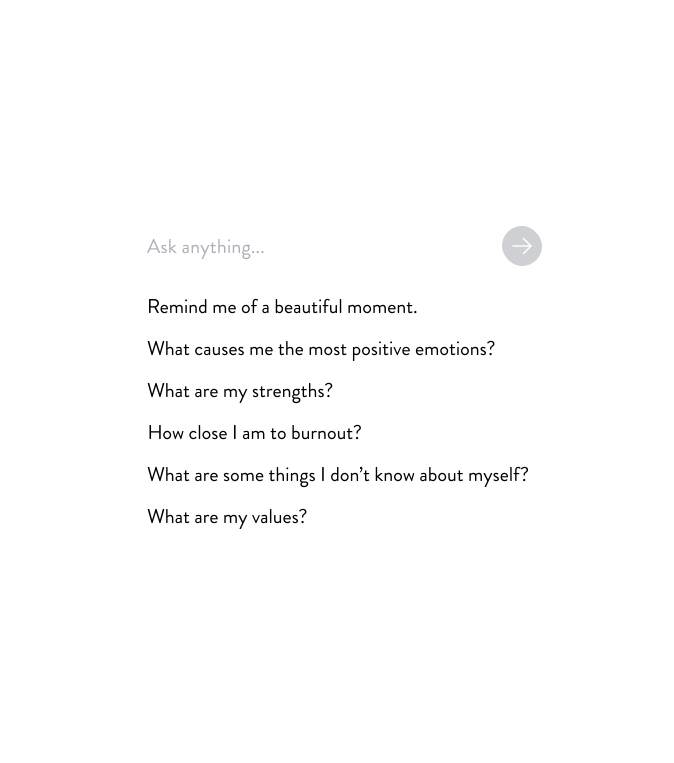
Natural-language search lets users retrieve memories by meaning rather than exact wording. Source: Mindsera.
This is a genuine improvement.
Human memory is semantic.
Our search tools are finally becoming semantic too.
AI changes longitudinal reflection
A traditional journal gives you snapshots.
AI can compare snapshots.
Example:
January:
“I want more stability.”
June:
“I am bored.”
September:
“Autonomy matters more now.”
AI can potentially answer:
“How did my priorities change?”
That is very powerful.
It is also directly relevant to Personal Intelligence.
AI journaling becomes a temporal context system
A mature AI journal is no longer just:
dated text.
It begins to contain:
- current goals,
- historical goals,
- changing preferences,
- people,
- decisions,
- recurring themes,
- milestones.
This starts to resemble:
a personal context layer.
For the broader architecture, see:
What Is Personal Intelligence in AI?
Traditional journals preserve the past better than current state
A journal entry from 2024 remains exactly what it was.
That is good history.
But if an AI uses it today, it needs to know:
historical, not current.
This is where AI journals need additional structure.
Example:
2025:
Wants to move abroad.

2026:
Staying near family is now more important.
The journal should preserve both.
The personalization layer should use the second as current.
AI changes forgetting
A paper journal does not forget.
But it also does not actively use old entries.
AI memory creates a new problem:
what should remain active?
Maybe an entry is historically important but no longer relevant to current recommendations.
A strong AI journal needs:
archive everything the user wrote
+
activate selectively
Those are different jobs.
Traditional journaling gives you stronger default privacy
A paper notebook can be:
- offline,
- local,
- not analyzed,
- not transmitted.
That is hard to beat.
Digital traditional journals can also offer strong encryption.
AI adds processing.
That usually means additional systems touch the content.
Privacy becomes an architecture question
Ask:
- Is AI processing local or cloud-based?
- Are entries used to train models?
- Is derived memory stored?
- Can AI be disabled?
- Can an entry be excluded from AI?
- Can you export your history?
- Can you delete generated insights?
- Which model provider processes the text?
These questions do not matter much to a paper notebook.
They matter a lot to an AI journal.
Reflection provides unusually explicit controls
Reflection says:
- entries are encrypted with AES-256 at rest,
- TLS in transit,
- journal data is not used to train AI models,
- users can export data.
Source: Reflection — Ask Your Journal
It also offers Private entries that can be excluded from AI-based features.
That is the kind of control AI journaling increasingly needs.
Day One offers another privacy path: on-device AI
On supported Apple devices, some Day One AI tools can use Apple Intelligence locally.

On-device AI shows one way journals can gain AI functionality without sending every reflection to a cloud model. Source: Day One.
That is strategically important.
The future of AI journaling does not have to mean:
every private thought in cloud inference.
Rosebud is another example of memory-heavy cloud journaling
Rosebud says finished entries across mobile and web share:
- memory,
- insights.
It also says user data is encrypted in transit and at rest.
Source: Rosebud Knowledge Base

AI memory makes journal privacy more consequential because the system is not only storing entries, but building higher-level context from them. Source: Rosebud.
This is the broader pattern.
AI journals store:
text.
They may also derive:
- themes,
- patterns,
- people,
- preferences,
- emotional trends.
Derived data deserves privacy controls too.
Traditional journaling wins on interpretive sovereignty
This phrase sounds dramatic.
The idea is simple.
With a normal journal:
you decide what your writing means.
With an AI journal:
software may suggest what your writing means.
That can be helpful.
It can also become influential.
AI insight feels more authoritative than it should
Example:
“You seem to repeatedly avoid conflict.”
Because the sentence is generated from months of personal writing, it may feel:
evidence-based.
But perhaps:
- the retrieval set was incomplete,
- the model overgeneralized,
- the journal contains mostly difficult moments,
- happy periods were under-recorded.
The AI has a dataset.
It does not have your complete life.
Journals are biased samples of life
People often journal when:
- upset,
- confused,
- reflective,
- something happened.
They may not journal when:
- everything is fine,
- they are busy enjoying life.
Therefore an AI trained on your journal may conclude:
life is more troubled than it actually is.
Traditional journaling has the same sampling bias.
AI makes the bias easier to turn into confident conclusions.
AI changes the feedback loop
Traditional:
Experience
↓
Write
↓
Think
AI:
Experience
↓
Write
↓
AI interprets
↓
You react to interpretation
↓
Write more
↓
AI learns from the new writing
This is a recursive system.
That is why design matters.
The journal can begin shaping the person it models
Suppose AI repeatedly describes you as:
“someone who values stability.”
You may begin thinking:
“I am someone who values stability.”
Even if the original evidence was weak.
Personalization can become identity reinforcement.
A good system should phrase uncertain inferences cautiously.
Traditional journaling is better for contradictions
Human beings contain them.
Example:
“I love this job.”
and:
“I hate this job.”
Both can be true on different days.
A notebook is perfectly comfortable with this.
An AI may try to reconcile:
“You have a complicated relationship with work.”
Possibly.
But sometimes the contradiction itself is the truth.
AI changes the value of rereading
Traditional rereading is slow.
That is sometimes useful.
You encounter:
- forgotten details,
- strange wording,
- irrelevant moments,
- surprises.
AI summary removes much of that noise.
It also removes serendipity.
Search retrieves what you ask for
Rereading shows what you forgot to ask.
This is a profound difference.
If you ask:
“How did my career thinking change?”
AI finds career entries.
You may miss:
the random dinner entry where you sounded happier than you had in months.
Manual rereading can reveal things outside your query.
The best system probably needs both
Use AI to:
- search,
- compare,
- summarize.
Use original entries to:
- verify,
- rediscover,
- preserve nuance.
AI should be:
map.
Not:
territory.
Does AI make journaling less authentic?
Sometimes.
Not automatically.
The answer depends on how much AI writes for you.
Low AI involvement
You write.
AI helps search later.
Authenticity impact:
low.
Medium AI involvement
You write.
AI asks follow-up questions.
AI summarizes.
Authenticity impact:
moderate.
High AI involvement
You chat.
AI generates the journal entry.
AI titles it.
AI extracts lessons.
Now the artifact is clearly co-produced.
That can still be useful.
Just do not confuse:
AI-generated narrative
with:
untouched self-expression.
Traditional journaling is better when wording matters
Examples:
- memoir,
- creative writing,
- grief writing,
- letters to future self,
- preserving your actual voice.
If you care about the texture of your thoughts:
write them yourself.
AI journaling is better when continuity matters
Examples:
- recurring decision,
- ongoing project,
- relationship reflection,
- weekly review,
- comparing months,
- remembering what you said earlier.
That is where AI adds capabilities traditional journaling does not naturally have.
AI journaling is better for people who never keep a journal
This is an underrated point.
The comparison is often framed:
AI journal vs a disciplined traditional journaling habit.
But for many people the real comparison is:
AI journaling
vs
no journaling
If conversational prompts and voice make the practice sustainable:
AI wins by existing.
Traditional journaling is better for people who already love writing
If you genuinely enjoy:
- handwriting,
- long entries,
- quiet,
- rereading old notebooks,
adding an AI coach may solve no problem.
You do not need technology merely because it has arrived.
An astonishing concept.
AI journaling vs traditional journaling by use case
| Use case | Better fit |
|---|---|
| Free-form self-expression | Traditional |
| Getting past blank page | AI |
| Handwritten ritual | Traditional |
| Voice reflection | AI |
| Searching years of entries | AI |
| Preserving exact personal voice | Traditional |
| Weekly/monthly synthesis | AI |
| Maximum offline privacy | Traditional |
| Pattern discovery | AI |
| Avoiding algorithmic influence | Traditional |
| Revisiting ongoing decisions | AI |
| Creative writing | Traditional |
| People who hate journaling | AI / conversation-first |
| People who love journaling | Traditional or hybrid |
The most interesting option is hybrid journaling
You do not actually have to choose.
A strong hybrid workflow is:
Write freely
↓
Keep raw entry
↓
Let AI index it
↓
Use AI for retrieval and weekly review
↓
Return to original source when something matters
This preserves:
- authorship,
- nuance,
- privacy options,
while gaining:
- search,
- memory,
- synthesis.
Hybrid model 1: traditional writing + AI search
Best if:
you love writing.
Workflow:
- write entries yourself,
- no AI intervention while writing,
- AI indexes them afterward,
- ask questions later.
This gives the least intrusive AI layer.
Hybrid model 2: AI prompt + human writing
Workflow:
- AI asks one contextual question,
- you answer in your own words,
- AI stops.
Useful if blank-page friction is the problem.
Hybrid model 3: human capture + AI weekly review
Workflow:
During week:
Write normally.

Weekend:
AI summarizes:
- themes
- changes
- unresolved threads
- moments worth keeping
This is one of the highest-value combinations.
Hybrid model 4: conversation + selected formal entries
This is closer to Gemora's direction.
During ordinary life:
talk naturally.
When something truly matters:
preserve it more intentionally.
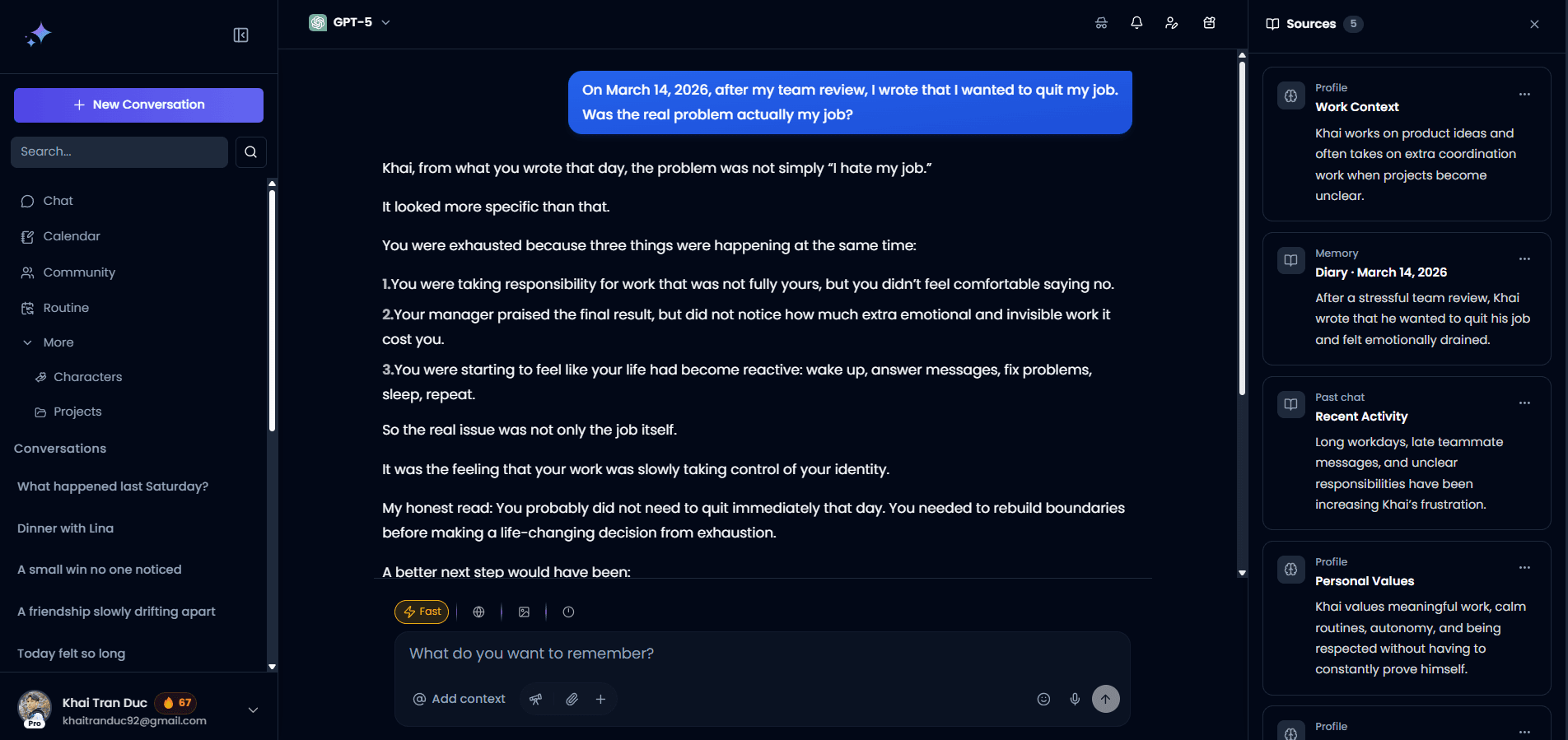
Conversation-first personal AI shifts the capture layer away from formal journaling while preserving the possibility of later reflection. Source: Gemora.
This avoids requiring:
every meaningful life event become a journal entry.
Where Gemora fits
Gemora is not a traditional journaling app.
Its thesis is broader:
conversations about everyday life can become useful personal context over time.
That makes it relevant to the evolution of journaling without requiring users to think:
“I am journaling now.”
Traditional journal flow
Experience
↓
Open journal
↓
Write entry
↓
Archive
Gemora-style conversation flow
Experience
↓
Talk naturally
↓
Useful context remains connected
↓
Recap / memory / insight later
Gemora Recap organizes conversational life context by time rather than requiring every memory to begin as a formal entry. Source: Gemora.
This is why AI journaling as a category matters for Gemora.
The future of reflection may involve:
less explicit journaling,
not merely:
better journal apps.
Memories become the bridge

The memory layer can preserve meaningful threads without turning every conversation into a polished diary entry. Source: Gemora.
A user can say:
“I finally did it.”
The system may understand:
- what “it” refers to,
- how long it has been discussed,
- why it mattered.
That is reflection through continuity.
Insights become longitudinal instead of entry-based

The larger opportunity is not AI-generated prose, but understanding how moments, priorities, and recurring themes change across time. Source: Gemora.
This leads to a bigger category shift:
Traditional journaling:
document life

AI journaling:
interact with documented life

Personal AI:
carry life context into future conversations
These overlap.
They are not identical.
AI journaling vs traditional journaling on privacy
Here is the blunt comparison.
Paper journal
Can be:
- completely offline,
- no account,
- no server,
- no AI provider.
Hard to beat.
Local digital journal
Can also be very private.
Cloud journal
Requires trust in:
- storage,
- encryption,
- account security.
AI cloud journal
Adds:
- model inference,
- derived context,
- embeddings/search indexes,
- AI memory,
- possibly third-party model providers.
Every layer adds capability.
Every layer also adds a privacy surface.
What should you check before using an AI journal?
- Is your writing used for training?
- Is data encrypted at rest and in transit?
- Can AI features be disabled?
- Can selected entries be excluded?
- Can you export your journal?
- Can you permanently delete your data?
- Is any AI processing local?
- Who provides the underlying models?
- Are generated insights stored?
- Can you inspect or delete derived memory?
This is more work than buying a notebook.
Technology continues delivering convenience in fascinatingly circular ways.
AI journaling vs traditional journaling on memory
Traditional
Memory is:
chronological archive.
AI
Memory can be:
- searchable,
- semantic,
- synthesized,
- proactive.
This is probably AI's clearest advantage.
For a deeper product comparison, see:
Best AI Journals That Remember What You Wrote Before
AI journaling vs traditional journaling on reflection depth
This is not obvious.
AI can ask deeper questions faster.
Traditional journaling can produce deeper thinking because:
no answer arrives.
Sometimes the useful experience is sitting with uncertainty.
If AI instantly says:
“It sounds like you value autonomy,”
you may skip the process of discovering that yourself.
AI can accelerate insight
Good.
AI can also prematurely label ambiguity.
Less good.
A useful system should know when to:
ask,
not:
conclude.
AI journaling vs traditional journaling on habit difficulty
Traditional:
higher friction.
AI:
lower friction.
For most users who repeatedly fail to journal, this matters more than theoretical purity.
A practice that is imperfect but used can beat the perfect notebook that has been blank since February.
AI journaling vs traditional journaling on long-term value
Traditional journals often become more valuable with age.
AI journals may become more usable with age.
Difference:
value vs accessibility.
A 10-year paper archive is meaningful.
A 10-year AI-indexed archive can answer:
“How did my thinking about work evolve across the decade?”
That is a new capability.
It also creates a profoundly sensitive dataset.
The long-term question is ownership
If your AI journal becomes:
the best model of your personal history,
what happens when you leave the app?
Can you export:
- raw entries?
- timestamps?
- images?
- AI summaries?
- tags?
- memories?
- relationships?
- timeline?
- inferred context?
This will matter more as AI journal memory improves.
Traditional journals are naturally portable
A notebook does not have an API.
It also does not shut down because a startup missed Series B.
There are advantages.
Digital AI journals need:
export.
Prefer products with usable formats such as:
- Markdown,
- JSON,
- CSV,
- PDF.
The future: AI journal or Personal Intelligence?
AI journaling may eventually become one input into something larger.
Your personal context may come from:
- conversations,
- journal entries,
- photos,
- calendar,
- projects,
- decisions,
- files.
The AI journal is then:
one source.
The broader system is:
Personal Intelligence.
That system asks:
what relevant context from your life matters right now?
For a full explanation:
What Is Personal Intelligence in AI?
The category evolution
A rough timeline:
Paper diary
↓
Digital journal
↓
Searchable journal
↓
AI-assisted journal
↓
Memory-aware journal
↓
Conversational journal
↓
Personal context system
This does not mean earlier forms disappear.
Paper still works.
Digital journals still work.
The category becomes wider.
What AI does not change
This is important.
AI does not change the core requirement:
you need honest input.
If you hide what matters:
the AI cannot recover it.
If you only record bad days:
the history is biased.
If you write what you think you should feel:
the model learns the performance.
Garbage in, personalized narrative out.
AI does not make reflection automatically true
A beautiful insight can be wrong.
A repeated theme can be coincidental.
A summary can omit the important part.
A journal is evidence.
Not total reality.
AI does not replace human relationships
An AI journal may help you think before a difficult conversation.
It is not the conversation.
It may help you understand your own reaction.
It does not know the other person's internal state.
AI does not turn journaling into therapy
Journaling can support reflection.
Research on expressive writing shows possible benefits, but effect sizes and outcomes vary across populations and studies.
Source: PubMed
AI journaling should not be treated as a replacement for qualified mental-health care when professional support is appropriate.
Which should you choose?
Choose traditional journaling if:
- you enjoy writing,
- privacy matters most,
- you want zero AI influence,
- handwriting is part of the value,
- preserving your exact voice matters,
- you prefer discovering meaning yourself.
Choose AI journaling if:
- blank-page friction stops you,
- voice/chat is easier,
- you want history search,
- you want automatic reviews,
- you want older entries connected to current reflection,
- you want help noticing patterns.
Choose a hybrid system if:
- you want your words to remain yours,
- but you also want AI memory and retrieval.
Choose a conversation-first personal AI if:
- you want reflection and continuity,
- but the formal journal habit itself feels artificial.
A practical 30-day test
If you are unsure, do both.
Week 1: traditional only
Write without AI.
Notice:
- how easy it is to start,
- how deeply you think,
- how much you write,
- whether you reread.
Week 2: AI prompts
Use AI only for:
- opening questions.
Write answers yourself.
Week 3: AI memory
Let the system:
- search old entries,
- connect related writing,
- create a weekly review.
Week 4: hybrid
Decide per entry:
silent writing
or:
AI conversation.
At the end ask:
- Which method made me more honest?
- Which helped me notice more?
- Which did I actually use?
- Which made me feel more understood?
- Which made me feel more influenced?
- Which archive would I trust myself to reread in five years?
That will tell you more than feature lists.
Five rules for using AI journaling without losing the benefits of journaling
Rule 1: keep the raw entry
Do not replace your original words with AI summaries.
Rule 2: ask for evidence
If AI claims a pattern, ask:
“Which entries support that?”
Rule 3: distinguish old from current
Historical thoughts are not permanent preferences.
Rule 4: let some entries remain private from AI
Not every thought needs analysis.
Rule 5: occasionally journal without assistance
This checks whether the AI's framing has started dominating your own.
A good AI journal prompt
Respond as a reflection partner, not an authority.

Do not diagnose me or tell me what I secretly believe.

When you notice a pattern:
- state the observation
- show the supporting entries
- separate fact from interpretation
- include uncertainty

Ask one useful follow-up question at a time.

Do not rewrite my original words unless I ask.
This keeps AI in a healthier role.
A good weekly review prompt
Review this week's journal entries.

Show:

1. What happened
2. What changed
3. Recurring themes
4. Important people
5. Decisions
6. Good moments
7. Unresolved threads

For every interpretation:
- cite the entries behind it
- label confidence
- do not infer meaning from silence

Keep my original wording where it matters.
A good “compare with the past” prompt
Compare my current thinking about [TOPIC] with older entries.

Separate:
- what stayed consistent
- what changed
- what may simply be situational

Use dates.

Do not collapse contradictory entries into one personality statement.
Final verdict
Traditional journaling and AI journaling are not two versions of the same notebook.
They optimize different parts of reflection.
Traditional journaling protects:
the act of thinking for yourself.
AI journaling improves:
what your past writing can do for you later.
Traditional journaling asks you to:
- choose the question,
- find the words,
- create the structure,
- notice the patterns.
AI journaling can help with all four.
That makes reflection:
easier, more searchable, more connected, more longitudinal.
It also makes the journal:
less neutral.
The software now participates in:
- what gets asked,
- what gets remembered,
- what gets summarized,
- what gets interpreted.
That is the real change.
Not:
“AI writes journal entries faster.”
The deeper shift is:
your personal archive can now talk back.
For some people, that will unlock a reflection practice they never sustained before.
For others, the silence of a traditional journal will remain the feature.
And the most interesting future probably combines both:
Your words
+
AI retrieval
+
AI memory
+
periodic synthesis
+
clear boundaries
The writing stays yours.
The history becomes easier to use.
The future of journaling may be less about writing more and more about keeping the right parts of your life connected. Gemora is built around everyday conversations, memories, moments, and changes carrying forward so reflection does not have to begin with a blank page every time. Start talking with Gemora.
Continue the thread
Choose a reflection method that fits
Connect conversations, useful context, reflections, projects, and tasks in one personal workspace.
Start freeFrequently asked questions
What is the difference between AI journaling and traditional journaling?
Traditional journaling is primarily self directed writing.
Is AI journaling better than traditional journaling?
Not universally.
Is traditional journaling still useful in 2026?
Yes.
Sources and further reading
- PubMed — The Delayed, Durable Effect of Expressive Writing on Depression, Anxiety and Stress
- PMC — Expressive Writing vs Positive Writing: Systematic Review and Meta Analysis
- PubMed — Expressive Writing for Adult Trauma Survivors
- Day One — Introducing Daily Chat
- Day One — Daily Chat Guide
- Day One — Daily Chat Feature
- Day One — 2026.7 AI Features
- Day One — On Device Apple Intelligence
- Reflection — Ask Your Journal
- Reflection — Weekly & Monthly Reviews
- Reflection — AI Journal
- Reflection — Journal Frequency
Written by Khai Tran and reviewed under the Gemora Editorial Policy.