how personal context makes AI answers more useful
How Personal Context Makes AI Answers More Useful
See how personal context helps AI replace generic answers with responses shaped by your goals, history, relationships, constraints, and current situation.
Metodologia: Examples compare context-free and context-aware responses while separating current facts, inferred preferences, and user-controlled memory.
Original contribution: Ten before-and-after use cases showing where context changes the answer and where it should not personalize.

In questa guida
- The short answer
- What counts as personal context?
- Context changes the question before it changes the answer
- Personal context reduces repetitive onboarding
- Personal context can make AI more proactive
- Personal context can make answers shorter
- Why ChatGPT, Claude, and Gemini are all moving toward context
- Personal context can come from more than chat memory
- Portability makes personal context more valuable
- More personal context does not automatically mean better answers
- Where Gemora fits
- Personal context vs better prompting
- How much personal context does AI actually need?
- How to give an AI useful personal context manually
- How to know whether personal context improved the answer
- What personal context cannot fix
- The next step: context that belongs to the user
- Final answer
Related reading: memory vs history · apps with recall · long-term assistants · memory controls.
The same AI becomes more useful when it understands the context around the person asking the question. Source: Gemora.
Two people can ask the same AI the same question and need completely different answers.
Take:
“What should I do this weekend?”
For one person, the right answer might be:
“Stay home. You have had three exhausting weeks and your calendar is finally empty.”
For another:
“Go out. You have spent the last month working alone and keep saying you miss seeing people.”
For someone else:
“Do not plan anything Saturday morning. Your flight lands late Friday, and you already said jet lag hits you hard.”
The question is identical.
The useful answer changes because the personal context changes.
That is the core idea behind personalized AI.
A general AI model brings world knowledge, reasoning, language, and tools.
Personal context tells the system:
- who is asking,
- what matters to them,
- what has already happened,
- what they prefer,
- what they are trying to accomplish,
- which constraints are real,
- who else is involved,
- and what has changed since the last conversation.
When those two layers work together, AI stops sounding like it is answering an imaginary average person.
It can give an answer that fits this person, in this situation, now.
In 2026, this is no longer just a theoretical direction. OpenAI says ChatGPT can pull relevant context from past chats, saved memories, files, and, where available, connected Gmail to make responses more personalized and continuous. Anthropic lets Claude carry memory across conversations and exposes editable memory Topics. Google’s Personal Intelligence can combine memory of past Gemini chats with information from connected Google apps to provide personalized recommendations and multi-step help. (OpenAI, Anthropic, Google)
But “personal context” is broader than memory alone.
To understand why it changes AI answers so much, it helps to look at what context actually contains.
The short answer
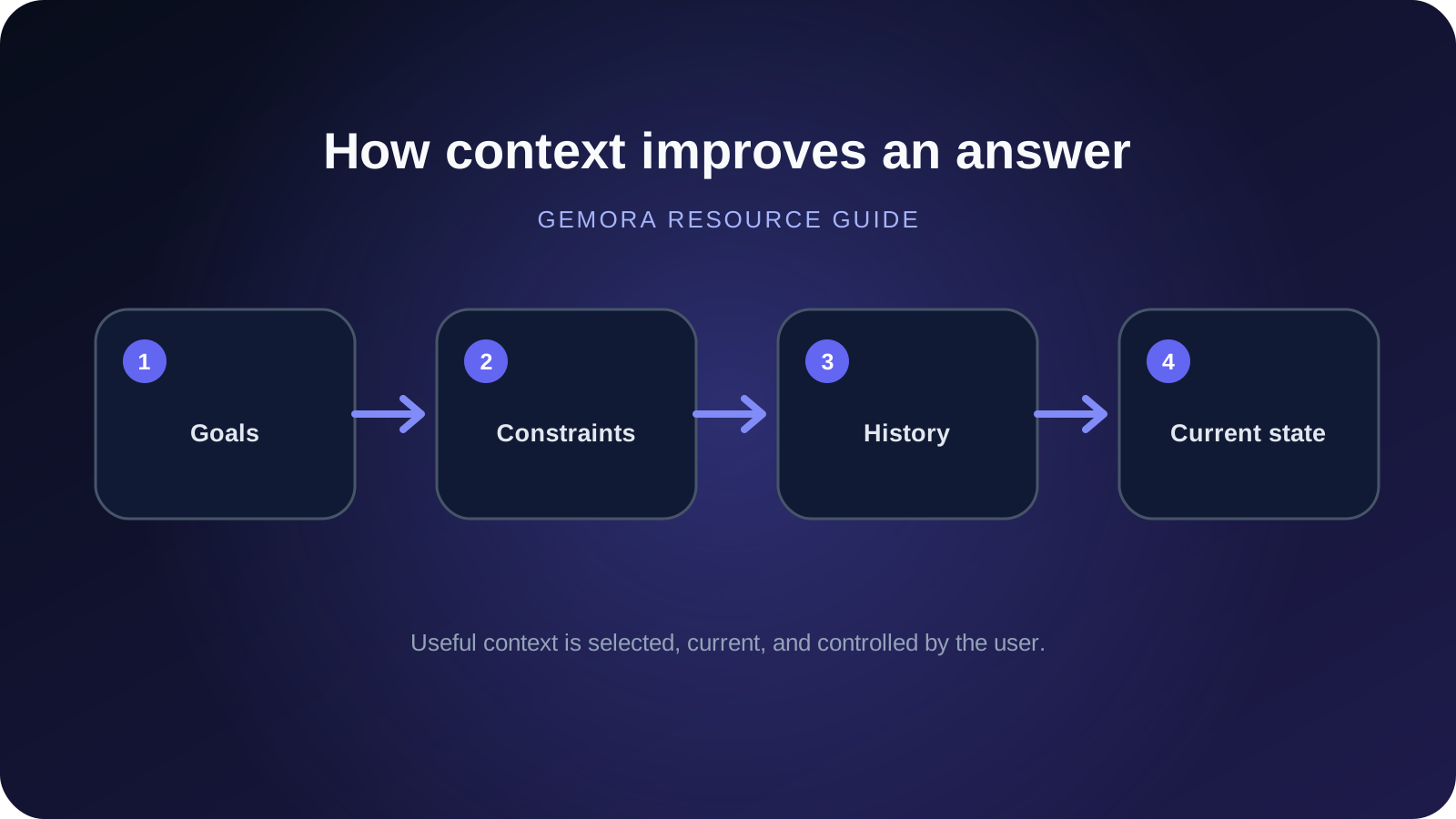
Personal context makes AI answers more useful by helping the system answer five questions before it responds:
- Who is this answer for?
- What is happening around the question?
- What has already happened?
- What matters most to this person?
- What has changed since the last time this topic came up?
Without those answers, AI tends to fall back to general principles.
With them, the same model can become much more specific.
A simple way to think about it is:
General AI capability
        +
Relevant personal context
        ↓
More useful answer for this person
Personal context does not make the model omniscient.
It gives the model a better starting point.
What counts as personal context?
Personal context is not one giant “About Me” paragraph.
It can come from several different layers.
Preferences
Examples:
- you prefer concise answers,
- you like quiet restaurants,
- you usually travel slowly,
- you dislike aggressive sales tactics,
- you prefer Android to iOS,
- you want practical recommendations over abstract theory.
Goals
Examples:
- launching a product,
- learning a language,
- saving for a home,
- changing careers,
- improving a relationship,
- preparing for an exam,
- becoming more consistent with exercise.
Constraints
Examples:
- budget,
- location,
- time,
- schedule,
- family responsibilities,
- visa requirements,
- technical limitations,
- deadlines,
- things you have explicitly ruled out.
History
Examples:
- what you already tried,
- previous decisions,
- conversations from last month,
- past failures,
- previous recommendations,
- events that led to the current situation.
People and relationships
Examples:
- who your partner is,
- which coworker you are referring to,
- what happened with a friend,
- who is involved in a decision,
- what boundaries already exist.
Current state
Examples:
- you are tired this week,
- a project is delayed,
- a trip is coming up,
- your priorities recently changed,
- you are between jobs,
- you are preparing for a launch.
Time
Examples:
- what used to be true,
- what is true now,
- when something changed,
- whether a plan is upcoming or already finished.
Connected information
Where users explicitly allow it, personal context may also come from:
- email,
- calendar,
- files,
- notes,
- tasks,
- photos,
- search activity,
- or other connected services.
Google's Personal Intelligence is one of the clearest mainstream examples of this broader model. Gemini can, for eligible users who connect supported apps, use information across Google Workspace, Photos, Search services, YouTube, and previous chats to personalize answers and complete multi-step requests. (Google)
Context changes the question before it changes the answer
This is the important part.
Personal context does not merely add decoration to an answer.
It often changes what the system believes the actual question is.
Consider:
“Should I stay?”
Without context, this might mean:
- stay at a job,
- stay in a relationship,
- stay in a city,
- stay at an event,
- stay on a project.
With context, the AI may understand:
“The user is asking whether to stay in a job they have been thinking about leaving for eight months.”
Now the system is solving a different problem.
The visible prompt has not changed.
The interpreted task has.
That is why personal context can improve answers even when the user writes fewer words.
Example 1: personal context makes recommendations more relevant
Suppose you ask:
“Where should I eat tonight?”
Without personal context
The AI may recommend:
- popular restaurants,
- highly rated places,
- several cuisines,
- something near the city center.
Reasonable.
But generic.
With personal context
Now imagine the AI knows:
- you prefer quiet places,
- you are vegetarian,
- you are meeting someone you have not seen in months,
- your budget is moderate,
- and you recently said you are tired of crowded restaurants.
The recommendation criteria change.
The system may prioritize:
- lower noise,
- table spacing,
- vegetarian options,
- places suited to conversation,
- moderate price,
- easy booking.
The useful answer is no longer:
“Here are the best restaurants.”
It becomes:
“Here are the best restaurants for this dinner.”
That final phrase is the whole point of personal context.
Example 2: personal context makes travel planning less repetitive
Travel is one of the clearest examples of why context matters.
A generic travel assistant often begins by asking:
- budget?
- dates?
- interests?
- hotel style?
- food preferences?
- who are you traveling with?
- have you been before?
Nothing is wrong with those questions.
But if you use AI regularly, answering them every time becomes tedious.
With useful personal context, the system may already know:
- your home city,
- who you usually travel with,
- that you prefer slower itineraries,
- that you dislike extreme heat,
- that you value walkable areas,
- that you prefer local food to nightlife,
- and which destinations you already visited.
Now:
“Where should we go for a week in October?”
can produce a much more useful first answer.
The same model, different context
OpenAI's 2026 memory research shows exactly this principle: a generic recommendation changes materially when the system has relevant and current user context.

Without the right personal context, a capable model can still return a poorly matched recommendation. Source: OpenAI.

With relevant, current context, the recommendation becomes much more specific to the user's preferences and situation. Source: OpenAI.
The underlying intelligence did not suddenly improve between the two screenshots.
The context did.
Example 3: personal context makes decisions less generic
Ask:
“Should I take the job?”
A generic response will discuss:
- salary,
- growth,
- culture,
- commute,
- stability,
- work-life balance.
Those are reasonable categories.
But advice is not useful because it mentions every possible factor.
It becomes useful when it knows which factors matter more to you.
Imagine the AI knows:
- you spent two years trying to leave management,
- the new job is management-heavy,
- the salary is 30% higher,
- you have enough savings that income is not urgent,
- autonomy is currently your top priority,
- and your long-term goal is to build something independently.
Now the model has evidence that the obvious salary upgrade may conflict with your actual direction.
Instead of:
“The higher salary is a major advantage.”
it might say:
“The job solves the least important problem you currently have while moving you back toward a role you have repeatedly said you want to leave.”
That is a much more useful decision frame.
Again, not because the AI became wiser overnight.
Because it can see the decision in context.
Example 4: personal context stops AI from recommending things you already tried
One of the fastest ways AI becomes annoying is repetition.
You say:
“My manager keeps changing priorities.”
The AI says:
“Try having a clear conversation about expectations.”
You already did.
So you return next week:
“The priorities changed again.”
The AI says:
“You may want to communicate clearly with your manager.”
Wonderful.
The machine has rediscovered your previous failure as a fresh idea.
Personal history changes this.
If the AI knows:
- you already asked for written priorities,
- you proposed a weekly planning meeting,
- you documented the issue,
- and none of those interventions changed the behavior,
the next answer should move forward.
For example:
“You have already tried improving communication and planning structure. The remaining question is whether this is a fixable process problem or simply how this manager operates.”
That is progress.
A useful personal AI should not repeatedly send you back to Step 1.
Example 5: personal context makes follow-up questions more natural
Human conversations are full of references that only make sense because of shared history.
“It happened again.”
“I finally did it.”
“She replied.”
“I think I changed my mind.”
“I am worried about the same thing.”
These are terrible standalone prompts.
They are perfectly normal human messages.
The usefulness of AI in everyday life increases dramatically when the user does not need to convert every thought into a fully self-contained API request.
Conversation without continuity
User:
“I finally did it.”
AI:
“That's great! What did you do?”
Conversation with relevant context
User:
“I finally did it.”
AI:
“You told me you had been postponing that conversation with your manager for two weeks. How did it go?”
The second interaction feels more natural because the burden of continuity is shared.
That is one of the biggest user-facing benefits of personal context.
Example 6: personal context makes reflection more meaningful
Ask:
“Why have I been feeling off lately?”
A one-shot AI has very little to work with.
It may suggest:
- sleep,
- stress,
- exercise,
- workload,
- relationships.
Those are possible explanations.
Also approximately the contents of every wellness article ever published.
Now imagine the system can see recent context:
- work has appeared repeatedly in your conversations,
- your sleep schedule has not changed much,
- you stopped mentioning a project that used to excite you,
- you have spent less time with friends,
- and you recently said your current routine feels “flat.”
The AI still should not diagnose you.
But it can help you ask better questions.
For example:
“The strongest change in what you have been talking about is not sleep or workload. It is that the project that used to give you energy has mostly disappeared from your week, while work has taken more space. Is that worth exploring?”
That is reflection grounded in context rather than generic speculation.
For more on this use case, see Best AI Apps for Personal Reflection and Life Context.
Example 7: personal context improves planning
Planning is often treated like a pure optimization problem.
It is not.
A realistic plan depends on the person doing it.
Ask:
“Make me a plan to learn Spanish.”
A generic plan might include:
- 30 minutes daily,
- flashcards,
- listening practice,
- conversation,
- weekly review.
Good advice.
Now add context:
- you have tried daily study plans three times and abandoned them,
- you commute for 45 minutes,
- you enjoy podcasts,
- you dislike flashcards,
- your partner speaks Spanish,
- and you are traveling to Mexico in four months.
The plan should change.
Maybe:
- listening during the commute,
- two conversation nights per week,
- travel-specific vocabulary,
- no flashcards,
- one weekly review,
- four-month milestone.
Personal context turns “best practice” into something this person might actually do.
Example 8: personal context improves search and research
Personalization is not only for emotional conversations.
It can change information retrieval too.
Suppose you ask:
“Find me a laptop.”
A generic AI may optimize for:
- benchmark performance,
- battery,
- display,
- price,
- review scores.
A personal AI may know:
- you travel often,
- you prioritize battery over gaming,
- your main tools run on Windows,
- you dislike heavy laptops,
- your previous laptop failed because of heat,
- and your budget ceiling is $1,500.
Now the assistant does not need to return the objectively “best” laptop.
It needs to return:
the best fit for your constraints.
This is a subtle but important shift from search ranking to personal relevance.
Example 9: personal context improves shopping recommendations
Shopping recommendations are usually weak when they optimize for popularity.
The most popular product is not necessarily the best product for you.
A useful AI might know:
- your size,
- devices you already own,
- brands you dislike,
- previous purchases,
- budget,
- accessibility needs,
- return preferences,
- aesthetic preferences,
- and which tradeoffs you normally choose.
Then:
“Which headphones should I buy?”
becomes less about listing the five most famous headphones on Earth.
It becomes:
“Which one fits how I actually use headphones?”
Google's Personal Intelligence direction is particularly relevant here because connected Search and Shopping data can become part of personalization for eligible users who opt in. (Google)
Example 10: personal context improves work assistance
General AI is already excellent for work.
Personal context makes it more efficient.
Imagine asking:
“Draft the update.”
Without context:
“What update? For whom? What tone? What changed?”
With project context:
- the AI knows the project,
- current deadline,
- stakeholders,
- latest blocker,
- previous update style,
- and what changed since last week.
Now:
“Draft the update.”
can be enough.
Claude's project and memory model is especially relevant here because Claude can carry context into new conversations and Cowork tasks, while paid users can also search previous chats for relevant information. (Anthropic)

Claude can carry remembered context into later conversations and cloud Cowork sessions. Source: Anthropic.
Personal context reduces repetitive onboarding
This may be the least glamorous benefit and one of the most important.
Today, users repeatedly explain:
- who they are,
- what they are working on,
- what happened before,
- what they prefer,
- what they already tried.
That repetition is friction.
Every time you have to write:
“For context…”
the assistant is asking you to rebuild the state of the relationship manually.
Good personal context reduces this cost.
OpenAI describes the goal of ChatGPT memory as allowing future conversations to begin from shared context rather than from scratch. (OpenAI)

ChatGPT's Memory Summary gives users a view into context that can carry forward across conversations. Source: OpenAI.
The benefit is not that the AI can brag:
“I remember 1,247 things about you.”
The benefit is that the user can type less and still receive a better answer.
Personal context can make AI more proactive
There is another shift once the AI has enough context.
Instead of only answering explicit questions, it can sometimes identify useful next steps.
Google says Gemini Memory may suggest help based on previous conversations, such as:
- next steps for a project,
- planning a trip previously discussed,
- or comparing products the user had already been considering. (Google)
That is a small example of proactive assistance.
A more mature personal AI could recognize:
“You said you wanted to submit this application by Friday, and it is Thursday.”
or:
“You have talked about this decision four times without making progress. Would it help to define what would actually change your mind?”
Proactivity is only useful when it is relevant.
Without context, proactive AI becomes notifications from a stranger.
With context, it can become timely assistance.
Personal context can make answers shorter
This seems counterintuitive.
More context can lead to less text.
When the system knows the user already understands the basics, it does not need to repeat them.
Example:
Without context:
“When launching an Android app, you should first make sure the app is stable, prepare store assets, create a privacy policy, test with users, monitor crashes…”
With context:
“Your store assets and privacy policy are already done. The remaining launch blockers are crash rate and the closed-testing requirement.”
The second answer is shorter because the AI knows what not to explain.
This is an underrated benefit of personalization.
Useful AI is not always AI that says more.
Sometimes it is AI that skips what you already know.
Personal context helps AI choose the right level of explanation
Two users can ask:
“Explain embeddings.”
One is a beginner.
One has built three RAG systems.
The correct explanation should not be identical.
Personal context can help the AI calibrate:
- terminology,
- depth,
- examples,
- assumptions,
- and how much background to include.
This is not only convenient.
It improves learning.
An explanation that is too basic becomes boring.
An explanation that assumes too much becomes confusing.
Personalized teaching lives in that gap.
Personal context helps AI know which tradeoff matters
Most difficult decisions are not hard because the options are unknown.
They are hard because the values conflict.
For example:
Option A:
More money
Less autonomy

Option B:
Less money
More autonomy
Generic AI says:
“Consider your priorities.”
Personal context may already know the priorities.
Or at least know the evidence.
If the user has repeatedly said:
- they want control over their time,
- they left a previous role because of micromanagement,
- and they currently have enough financial runway,
the AI has a stronger basis for weighting autonomy more heavily.
This is where personalization becomes much more than “remember my favorite restaurant.”
It changes the decision function.
Personal context can reveal contradictions
A good personal AI should not merely use context to agree with you.
It can also use context to notice when your current story conflicts with previous behavior.
Example:
Today:
“Money is the only reason I am considering this.”
Past context:
- user previously said status mattered,
- user repeatedly compares job titles,
- user talked about feeling behind peers.
A thoughtful response might say:
“You are describing this as a money decision, but status and career progression have come up repeatedly in earlier conversations too. Are you sure money is the only thing pulling you toward it?”
That is more useful than flattery.
Personal context can help the AI challenge the user with their own history.
It should do this carefully.
But when grounded correctly, it is one of the most powerful forms of personalization.
Personal context makes follow-up over time possible
A lot of life cannot be solved in one conversation.
Relationships unfold.
Projects evolve.
Goals change.
Plans fail.
People change their minds.
Without context, AI repeatedly offers static snapshots.
With continuity, the assistant can move through time with the user.
Week 1:
“I am thinking about quitting.”
Week 3:
“I talked to my manager.”
Week 5:
“Things improved, but I still feel the same.”
Week 8:
“I got another offer.”
A useful personal AI can treat those as four stages of the same situation.
That changes the relationship between conversation and time.
Why ChatGPT, Claude, and Gemini are all moving toward context
The three largest mainstream AI assistants are converging on the same broad problem from different directions.
ChatGPT: automatic synthesis
OpenAI is investing heavily in memory that can synthesize useful context across large numbers of conversations and multi-year time horizons.
The emphasis is on:
- freshness,
- correctness,
- continuity,
- and automatically carrying useful preferences, projects, and constraints into future conversations. (OpenAI)
OpenAI also introduced Memory Sources so users can see some of the context that helped personalize a response.

ChatGPT can show some of the personal context sources behind a response and let users correct irrelevant information. Source: OpenAI.
Claude: visible, editable context
Anthropic's newer memory system exposes what Claude remembers as individual Topics.
Users can:
- inspect,
- edit,
- delete,
- and separate memory by context.

Claude exposes remembered context as editable Topics. Source: Anthropic.
This makes the context model unusually legible.

Users can directly correct or remove a Claude memory Topic when circumstances change. Source: Anthropic.
Gemini: connected Personal Intelligence
Google is broadening context beyond the chat itself.
Gemini can use:
- memory of past chats,
- user instructions,
- and data from supported connected Google apps
for eligible users who opt in. (Google)
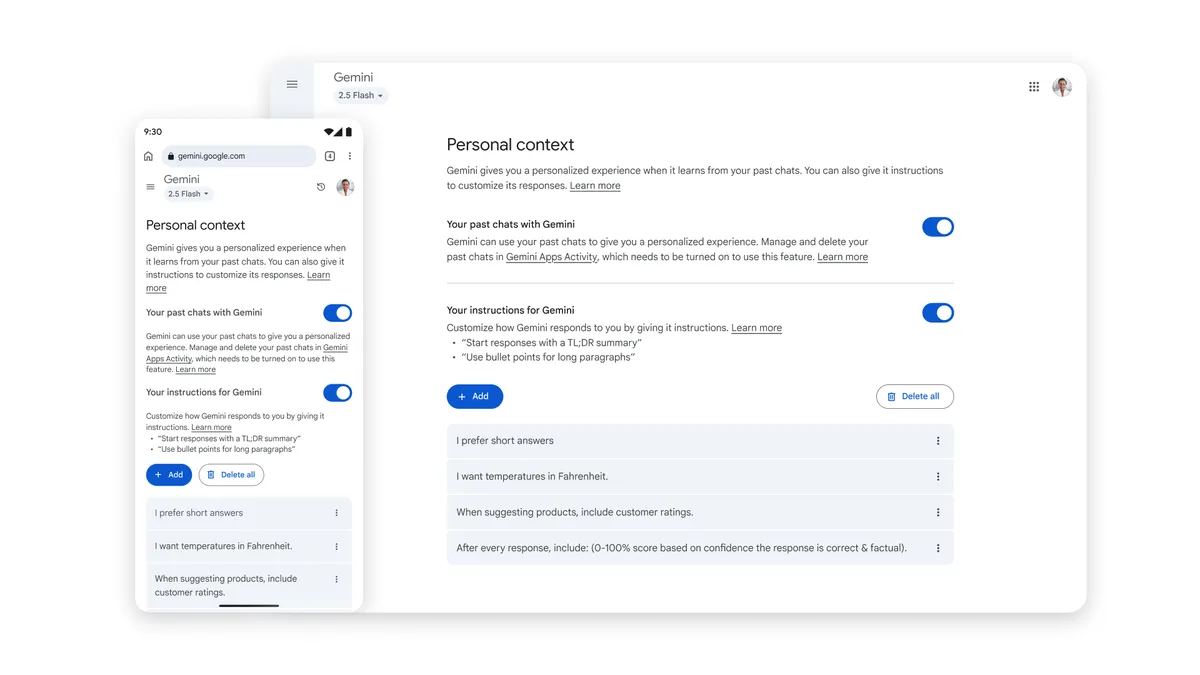
Gemini Personal Context settings (source image)
Gemini's Personal Context settings allow previous conversations to personalize future responses. Source: Google.
This is a broader context vision because the relevant information may exist outside the AI conversation entirely.
Personal context can come from more than chat memory
This is one of the biggest misconceptions.
If the only context source is old chat messages, the AI still sees a narrow version of your life.
Consider planning a week.
Useful context may live in:
- your calendar,
- tasks,
- email,
- previous chats,
- project documents,
- travel bookings.
Google's Personal Intelligence explicitly connects information across supported apps.
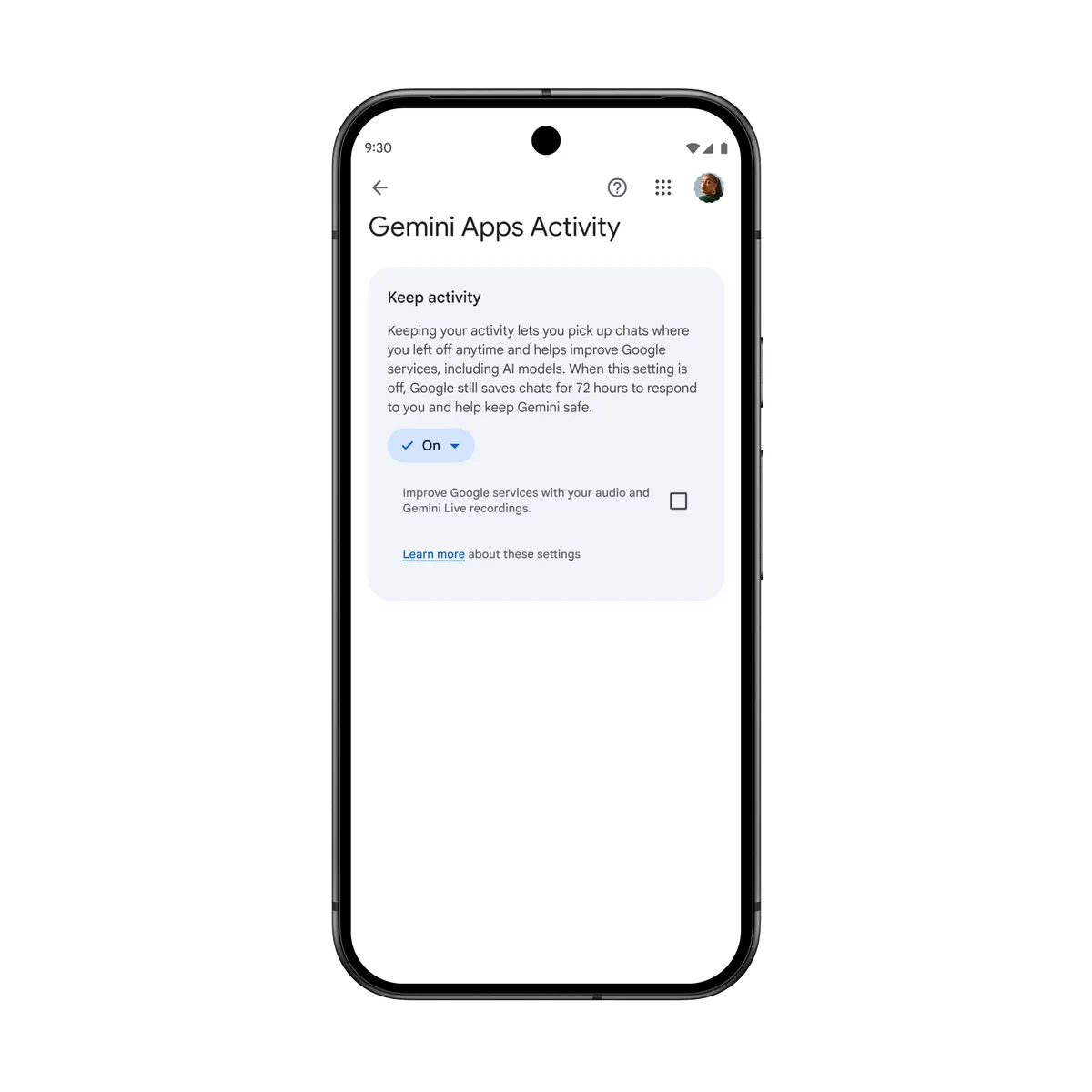
Gemini Connected Apps / activity controls (source image)
Personal Intelligence can draw from connected Google services, subject to user settings and availability. Source: Google.
This is moving AI from:
conversation memory
toward:
personal context infrastructure.
For a deeper explanation, see What Is a Personal Context Layer for AI?.
Portability makes personal context more valuable
There is a problem with context that lives inside one AI provider.
You spend months building it.
Then you switch tools.
The new AI knows nothing.
This creates a form of context lock-in.
Google has started addressing this directly.
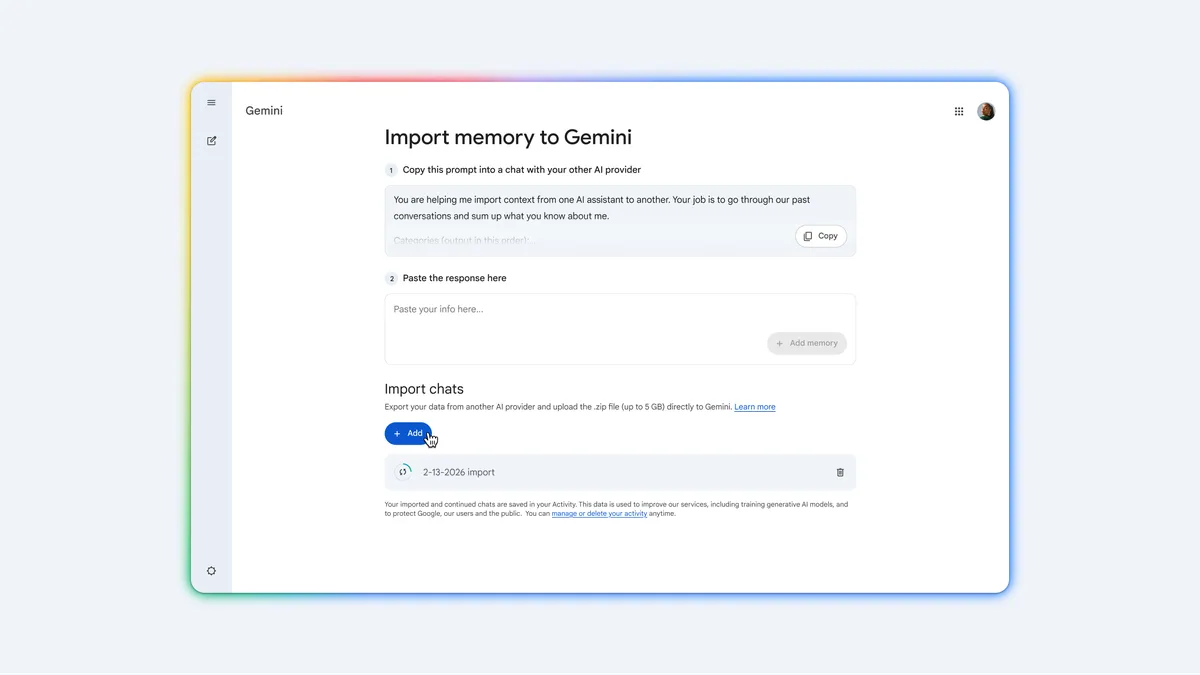
Gemini can import a structured memory summary from another AI service.
Gemini Import Memory interface (source image)
Gemini can import a structured summary of preferences and personal context from another AI provider. Source: Google.
Google also supports importing full chat-history exports in supported flows.
Gemini Import Chat History interface (source image)
Gemini can import previous AI chat-history archives so users can carry more source context into a new assistant. Source: Google.
That is an important signal.
The future of personal AI may not be:
“Pick one model and teach it your life forever.”
It may be:
“Own your context and use the best model for the task.”
More personal context does not automatically mean better answers
This is the obvious trap.
If relevant context helps, why not give the AI everything?
Because context has a cost.
Too much irrelevant personal information can make answers worse.
Imagine asking:
“Which phone should I buy?”
The AI retrieves:
- your relationship history,
- a holiday from four years ago,
- your favorite childhood movie,
- every phone you ever owned,
- your last ten shopping searches,
- a conversation about work stress,
- your sleep schedule.
Most of that is noise.
The system should retrieve:
- budget,
- current device,
- operating-system preferences,
- photography needs,
- battery needs,
- size preferences,
- purchase history.
The hard problem is not storage.
It is selection.
The best personal context is the smallest set of information that materially improves the current answer.
Good context has to be current
Imagine the AI remembers:
“You want to move to London.”
That was true last year.
Today you want to stay near family.
If the old memory remains dominant, personalization makes the answer worse.
This is why time matters.
A useful context system should distinguish:
Previous goal:
Move to London

Current goal:
Stay near family

Changed:
June 2026
OpenAI's newer memory system explicitly focuses on staleness and temporal correctness for this reason. (OpenAI)
Personal context is not a permanent biography.
It is a changing state.
Good context needs provenance
Personalized answers become easier to trust when the user can understand:
“Why does the AI think that?”
Possible sources include:
- something the user explicitly said,
- a previous chat,
- a file,
- a connected calendar,
- email,
- an inference,
- a manually saved preference.
Those are not equally reliable.
If the AI thinks:
“You like golf”
because it saw many golf-related photos, that may be a weak inference.
Maybe your son plays golf and you hate it.
Google has publicly used a similar example to describe the risk of over-personalization and incorrect inference in Personal Intelligence. (Google)
The system should be able to distinguish:
known
from:
inferred.
And the user should be able to correct both.
Good context needs user control
Personal context can become extremely sensitive.
That means useful personalization requires controls around:
- what is remembered,
- what is ignored,
- what is deleted,
- what is temporary,
- which connected apps are allowed,
- and when personalization is turned off.
ChatGPT provides memory controls and Temporary Chat.
Claude exposes memory Topics and supports separate sensitive-topic settings.
Gemini lets eligible users manage Memory, Personal Intelligence, connected apps, and Temporary Chat.
Different products make different tradeoffs.
The important principle is the same:
Personal context should serve the user, not trap the user.
Personal context should help the AI know when not to personalize
This sounds strange.
It is essential.
Suppose you ask:
“How do I boil an egg?”
The AI does not need to mention:
- your startup,
- your relationship,
- your travel history,
- your long-term goals,
- or the fact that you prefer concise explanations beyond simply answering concisely.
Using personal context when it is irrelevant can feel invasive.
Good personalization is partly invisible.
The best system knows when context changes the answer.
And when it does not.
Personal context can reduce hallucinated assumptions
When an AI lacks context, it may fill gaps.
Sometimes it asks.
Sometimes it guesses.
Personal context can reduce the number of assumptions required.
For example:
User:
“Can I afford it?”
Without context, the AI has no idea:
- what “it” is,
- income,
- expenses,
- budget,
- priorities.
With relevant context, it may know the user is referring to a trip discussed earlier and that a budget was already defined.
That reduces speculative reasoning.
It does not eliminate hallucination.
But it gives the system more grounded inputs.
Personal context improves recommendations by changing ranking
This is worth making explicit.
Personalized AI does not necessarily generate different options.
It may rank the same options differently.
Imagine four job offers.
A generic model might rank by:
- salary,
- company prestige,
- growth,
- benefits.
For a specific user, the ranking function might become:
- autonomy,
- remote work,
- learning,
- salary.
The candidate jobs are unchanged.
The ordering changes.
That is often what “personalized advice” really means.
Not better universal knowledge.
A better utility function for this person.
Personal context improves explanations by choosing better examples
Suppose an AI explains probability.
For a founder, it might use:
- conversion funnels,
- A/B testing,
- churn.
For a gamer:
- loot drops,
- critical hits,
- matchmaking.
For a student:
- exam questions,
- sampling,
- grades.
The mathematical idea is the same.
The example is personalized.
This matters because understanding often depends on the bridge between the new idea and something familiar.
Personal context improves writing assistance
Ask:
“Write this in my style.”
Without examples or history, the model guesses.
With personal context, it may understand:
- typical sentence length,
- formality,
- preferred vocabulary,
- structure,
- whether you use humor,
- what you normally avoid.
Similarly:
“Draft a reply.”
becomes more useful if the AI understands:
- who the recipient is,
- previous relationship,
- current situation,
- how direct you normally are,
- what outcome you want.
Personalization changes communication from generic tone matching to contextual communication.
Personal context improves prioritization
Ask:
“What should I focus on today?”
A generic AI may produce a productivity framework.
A contextual AI can potentially know:
- deadlines,
- ongoing goals,
- current blockers,
- what was unfinished yesterday,
- calendar commitments,
- and the user's declared top priority.
The answer can become:
“Finish the Play Store crash fixes first. The screenshots are already done, and the investor deck does not block tomorrow's release.”
That is useful because it incorporates current state.
Not because it knows a better productivity framework.
Personal context can make AI answers more consistent over time
Without persistent context, every new chat may produce a slightly different recommendation because the assistant sees a different slice of the situation.
Monday:
“Focus on distribution.”
Thursday:
“Maybe you should raise funding.”
Saturday:
“You should focus on product.”
All three may be defensible from isolated prompts.
Context can improve consistency by preserving:
- previous decisions,
- stated priorities,
- why a choice was made,
- what evidence would justify changing it.
The AI can still update its recommendation.
But the update should be explainable:
“Last week distribution was the right priority. The new retention data changes that because…”
That is much better than strategy roulette.
Personal context also makes disagreement more useful
A personal AI should not merely mirror you.
Context gives it better material for constructive disagreement.
Imagine:
“I think I should add five more features before launching.”
The AI knows:
- you have delayed launch twice,
- testers are already waiting,
- the current bugs are mostly fixed,
- and you previously decided to prioritize distribution.
A useful answer might say:
“This sounds inconsistent with the launch decision you made last week. The new features may be useful, but they do not appear to solve the blocker you identified then.”
That is personalized disagreement.
It is much more valuable than:
“Here are the pros and cons of adding features.”
Where Gemora fits
Gemora is built around the idea that personal context should make conversations about real life more useful over time.
Not because memory itself is fascinating.
Memory is infrastructure.
The user-facing benefit is:
“I do not have to rebuild the story every time.”
Gemora is designed around conversations about:
- people,
- relationships,
- work,
- study,
- goals,
- stress,
- decisions,
- travel,
- ordinary days,
- and the things that keep coming back.
Source: Gemora

Gemora Recap helps users return to the days and moments around their conversations rather than leaving context buried inside isolated chats. Source: Gemora.
Context makes reflection less isolated
A user may talk about the same issue across several weeks.
The useful question is not only:
“What did you say?”
It is:
“What changed between those conversations?”

Gemora Memories is designed to make relevant older context easier to rediscover when it matters later. Source: Gemora.
Context makes patterns visible
One conversation can show a thought.
Many connected conversations can show a pattern.

Longitudinal context can help users notice recurring themes and changes that are difficult to see in one isolated chat. Source: Gemora.
This is where the phrase:
answers for you, not for everyone
becomes concrete.
The model may be the same model available elsewhere.
The difference is the context around the question.
The answer becomes more useful when the AI understands more of what the question means in your life. Gemora is built around keeping that useful context connected across conversations and time. Start talking with Gemora.
Personal context vs better prompting
These are complementary.
They are not substitutes.
Better prompting helps the AI understand the current task
For example:
“Challenge my reasoning rather than agreeing with me.”
Personal context helps the AI understand the person and history around the task
For example:
“You previously said autonomy matters more than salary, and you left your last role because of micromanagement.”
One tells the model how to think.
The other gives it what to think with.
A strong AI experience needs both.
Personal context vs memory
Memory is one source of context.
Personal context is broader.
Memory may preserve:
“The user prefers quiet hotels.”
Personal context may also include:
- upcoming travel dates,
- calendar availability,
- past destinations,
- current budget,
- who is traveling,
- email confirmations,
- recent conversations,
- and which preference is actually relevant now.
For the full distinction, see:
What Is a Personal Context Layer for AI?
Personal context vs chat history
Chat history answers:
“What did we talk about?”
Personal context answers:
“Which part of what we talked about matters now?”
A user may have 1,000 old conversations.
Sending all 1,000 into every new request would be impractical and harmful.
The system has to retrieve the relevant pieces.
This is why personal AI is partly a retrieval problem.
Personal context vs profile data
A profile might say:
Age: 28
City: Hanoi
Job: Designer
Useful.
But limited.
Personal context can say:
Current goal:
Move into product design.

Recent situation:
Interviewed with two startups.

Constraint:
Does not want to relocate this year.

Priority:
Learning opportunity currently matters more than salary.

Relevant history:
Left previous company because role became too managerial.
The profile tells the AI who you are generally.
Context tells it what is happening now.
How much personal context does AI actually need?
Less than “everything.”
More than “nothing.”
The ideal amount is:
the minimum context that materially changes the answer.
For a restaurant recommendation:
- dietary needs,
- location,
- budget,
- vibe,
- who you are with.
For career advice:
- goals,
- history,
- financial constraints,
- current role,
- priorities.
For a coding question:
- tech stack,
- codebase,
- architecture,
- constraints.
For reflection:
- relevant past conversations,
- people involved,
- timeline,
- recurring themes.
Good context is selective.
A personal AI should not inject your entire biography into a question about CSS.
How to give an AI useful personal context manually
You do not need an advanced memory system to benefit from this idea.
Use a compact structure.
Context:
[The facts that materially affect this question.]

History:
[What happened before or what I already tried.]

What matters to me:
[Priorities and values.]

Constraints:
[Time, money, people, deadlines, boundaries.]

What changed:
[New information that makes old assumptions outdated.]

What I want from you:
[Recommendation / challenge / questions / plan / reflection.]
Example:
Context:
I'm deciding whether to leave my current job.

History:
I've been unhappy for 8 months and already tried changing teams.

What matters to me:
Autonomy and time matter more than maximizing salary this year.

Constraints:
I have 9 months of savings. I don't want to relocate.

What changed:
My side project has started getting real users.

What I want from you:
Challenge my reasoning, then tell me what you would do.
This will usually outperform:
“Should I quit my job?”
by an absurd margin.
How to ask AI to use context without overfitting to it
There is a danger in personalization.
The AI may treat old context as destiny.
Use instructions like:
“Use my previous context, but assume I may have changed.”
“Tell me if older information conflicts with what I am saying now.”
“Do not infer a stable preference from one past conversation.”
“Use past context as evidence, not as unquestionable truth.”
“If personalization changes your recommendation, tell me which context mattered.”
These instructions encourage useful personalization without turning memory into fate.
How to know whether personal context improved the answer
Ask four questions.
1. Is the answer more specific?
Does it reference the actual constraints of your situation?
2. Did it remove irrelevant advice?
Did it avoid recommending steps you already tried?
3. Did it change the ranking of options?
Did it explain why one choice fits your priorities better?
4. Can you trace why the answer changed?
Do you understand which context mattered?
If the answer merely includes your name and repeats the same generic advice, that is not meaningful personalization.
It is mail merge with a language model.
What personal context cannot fix
Personal context is powerful.
It does not solve every problem.
Bad reasoning
A model can have perfect context and still reason poorly.
Missing reality
The AI only knows what it can access.
It does not directly observe your life.
One-sided information
In relationship or workplace situations, the AI often knows only your account.
High-stakes expertise
Personalization does not turn a general AI into a licensed doctor, lawyer, financial professional, or other specialist.
False confidence
More context can sometimes make an answer sound more authoritative than it deserves.
Emotional overreliance
An AI that remembers you well can feel unusually personal.
That does not make the relationship human or reciprocal.
The goal should be better assistance.
Not pretending context erased the fundamental limits of the system.
The next step: context that belongs to the user
Today, most personal context is tied to individual AI products.
ChatGPT builds one understanding.
Claude builds another.
Gemini builds another.
Specialized apps build their own.
That creates fragmentation.
Google's 2026 import tools are an early sign of a different direction: users can bring summarized memory and chat history from another AI service into Gemini.
The broader opportunity is a user-owned personal context layer.
Instead of:
ChatGPT → ChatGPT context
Claude  → Claude context
Gemini  → Gemini context
a future system could look like:
             USER-OWNED CONTEXT
                    ↓
      ┌─────────────┼─────────────┐
      ↓             ↓             ↓
   ChatGPT        Claude        Gemini
Each AI could receive the context the user explicitly authorizes.
Different model.
Same person.
That would make personalization portable rather than provider-specific.
Final answer
AI becomes more useful when it knows enough about the person behind the prompt.
A model may already know:
- the best restaurants,
- career frameworks,
- travel destinations,
- productivity methods,
- relationship advice,
- technical solutions.
What it often lacks is:
- which option fits you,
- what you already tried,
- what matters most,
- what changed,
- which constraints are real,
- and why this question matters now.
That is what personal context adds.
It turns:
“Here are the best options.”
into:
“Here are the best options for you.”
It turns:
“Here are some things to consider.”
into:
“Given what you value and what already happened, this tradeoff matters most.”
It turns:
“Can you give me more context?”
into:
“I know what situation you are referring to. What changed?”
The model still matters.
Reasoning still matters.
Tools still matter.
But as AI systems become broadly capable, context increasingly determines whether an answer feels generic or genuinely useful.
The goal is not an AI that knows everything about you.
It is an AI that can use the right part of your context at the right time.
Better answers do not always need a smarter model. Sometimes they need more of the right context. Gemora is built around conversations about everyday life staying connected, so later answers can fit more of the life behind the question. Start talking with Gemora.
Continua il thread
Get answers shaped by the context that matters
Collega conversazioni, contesto utile, riflessioni, progetti e attività in un unico spazio di lavoro personale.
Inizia gratisDomande frequenti
How does personal context improve AI answers?
It helps the AI rank options, choose examples, respect constraints, and connect follow-up questions to what has already changed.
Is personal context the same as memory?
No. Memory can supply personal context, but current projects, files, connected data, and explicit instructions can also contribute.
Can more context make an answer worse?
Yes. Stale, irrelevant, or overconfident context can distort an answer, so freshness, provenance, and user correction matter.
Fonti e approfondimenti
Written by Khai Tran and reviewed under the Gemora Editorial Policy.