ChatGPT Memory vs Claude Memory vs Gemini Memory
ChatGPT Memory vs Claude Memory vs Gemini Memory: Which Remembers You Best in 2026?
Compare ChatGPT, Claude, and Gemini memory in 2026 across recall, past-chat search, transparency, freshness, privacy controls, and portability.
Metodología: Overview based on official memory, search, temporary-chat, import, and privacy documentation reviewed on 2026-09-04.
Contribución original: A nine-round overview separating automatic personalization, exact-history search, transparency, freshness, and portability.

En esta guía
- A note on how we compared them
- The biggest difference in one sentence
- ChatGPT Memory in 2026
- Claude Memory in 2026
- Gemini Memory in 2026
- Head-to-head: which system wins each memory test?
- Final scorecard
- Which is best for your use case?
- What none of these systems does perfectly
- What this memory race means for personal AI
- Where Gemora fits into this
- How to test ChatGPT, Claude, and Gemini memory yourself
- Privacy and control comparison
- Final verdict: Which remembers you best?
Related reading: memory vs history · apps with recall · long-term assistants · memory controls.
The three biggest general-purpose AI assistants now all remember you.
But they do not remember you in the same way.
ChatGPT increasingly builds an automatic, continuously updated picture of useful context from your conversations.
Claude stores memory as visible topics you can inspect and edit, while also letting paid users search exact past chats and jump back to the source.
Gemini combines past-chat memory with Google's broader Personal Intelligence system and, unusually, can import memories and full chat-history exports from other AI services.
So the question is no longer:
“Which one has memory?”
All three do.
The more useful question is:
Which memory system actually makes the AI feel like it knows me better over time?
Our answer in September 2026:
ChatGPT has the strongest overall automatic memory experience.
Claude gives you the clearest control and the best exact retrieval of previous conversations.
Gemini has the broadest potential personal-context ecosystem and the strongest migration story.
That makes this much closer than a simple “ChatGPT wins” comparison.
Quick verdict
| Category | Winner | Why |
|---|---|---|
| Best overall memory | ChatGPT | Strong automatic synthesis across conversations, improved freshness, and broad personalization |
| Best passive personalization | ChatGPT | Learns useful context without requiring you to explicitly manage every memory |
| Best memory transparency | Claude | Memories are exposed as individual editable Topics |
| Best exact past-chat retrieval | Claude | Can search previous chats and cite the original conversations |
| Best at keeping memory current | ChatGPT | 2026 memory architecture is explicitly optimized for freshness and time-aware updates |
| Best project separation | Claude | Each project can have its own separate memory space and project summary |
| Best sensitive-memory controls | Claude | Sensitive topics are excluded by default and can be separately opted into |
| Best Google ecosystem personalization | Gemini | Personal Intelligence can combine past chats with connected Google services |
| Best memory portability | Gemini | Can import memory summaries and full chat-history ZIP exports from other AI services |
| Best memory import/export flexibility | Claude / Gemini | Claude supports experimental memory import/export; Gemini goes further with full chat history import |
| Best “just know me without making me manage it” experience | ChatGPT | The most automatic of the three |
The shortest possible answer
Choose ChatGPT if you want the AI to quietly learn useful things about you and carry them into future conversations.
Choose Claude if you want to know exactly what the AI remembers, correct it directly, and retrieve old discussions when you need them.
Choose Gemini if your personal context already lives across Google or you care about moving context in from another AI assistant.
A note on how we compared them
This is an editorial comparison based on the products and official documentation available as of September 4, 2026.
We are not claiming that we ran a controlled multi-month recall benchmark that proves one system remembers exactly 14.7% more than another.
Memory quality is difficult to reduce to one number because “good memory” includes several different behaviors:
- carrying useful context into a new chat,
- remembering preferences,
- finding an exact old conversation,
- updating information when circumstances change,
- keeping unrelated contexts separate,
- letting the user inspect and correct memory,
- and knowing when not to remember something.
A system can be excellent at one of these and mediocre at another.
So instead of manufacturing a suspiciously precise score, we compare the actual product behavior.
The biggest difference in one sentence
If you remember only one thing from this comparison, make it this:
ChatGPT synthesizes you. Claude exposes you. Gemini connects you.
That is slightly simplified, but it captures the product philosophies surprisingly well.
ChatGPT tries to maintain a useful, evolving synthesis of what it has learned across your conversations.
Claude turns much of its memory into visible topics that you can read, edit, or delete.
Gemini increasingly treats memory as one source of Personal Intelligence alongside the rest of your Google context.
Those differences become obvious once you look at the products side by side.
ChatGPT Memory in 2026
What ChatGPT is trying to do
ChatGPT's current memory system is built around one core idea:
future conversations should begin from shared context rather than from scratch.
OpenAI first introduced saved memories in 2024.
That early system worked more like a notebook.
You could say:
“Remember that I am vegetarian.”
and ChatGPT could carry that forward.
The problem was obvious after enough time.
A notebook can become stale.
You change.
Projects end.
Trips happen and then stop being future trips.
Preferences evolve.
In 2025, OpenAI expanded memory so ChatGPT could reference broader context from past conversations rather than depending only on a small list of explicitly saved facts.
Then in June 2026, OpenAI introduced a significantly more capable memory architecture built around what it calls dreaming: a background process that synthesizes relevant context across many chats and keeps that context more current.
Source: OpenAI — Dreaming: Better memory for a more helpful ChatGPT
ChatGPT's biggest advantage: memory happens in the background
You do not have to decide which sentence deserves to become a memory every time you chat.
ChatGPT can learn useful context naturally.
Suppose you have repeatedly talked about:
- the product you are building,
- the kind of answers you prefer,
- the tools you use,
- a trip you are planning,
- the kinds of places you like,
- and what constraints matter to you.
Later, you can ask a much shorter question.
The AI can use relevant parts of what it already knows.
That is the experience OpenAI is optimizing for.
Not:
“Here is my database of memories.”
But:
“I should not have to re-explain myself.”

ChatGPT's Memory Summary provides a high-level view of the context ChatGPT has synthesized about the user. Source: OpenAI.
The Memory Summary is not the entire memory
This is an important detail.
ChatGPT's Memory Summary shows the highlights of what ChatGPT knows about you.
It does not necessarily show every piece of context that can influence personalization.
OpenAI says the current memory system is based on a continually updated synthesis of past context, which can be broader than the individual items visible in the summary.
That means the interface is useful for understanding the memory state, but it is not a perfect database dump.
If you want to know whether ChatGPT remembers something specific, OpenAI recommends asking it directly.
Source: OpenAI Memory FAQ
You can correct ChatGPT's memory directly
One of the useful 2026 improvements is that the memory summary is editable conversationally.
You can:
- type a correction,
- highlight text and correct a specific detail,
- add new information,
- tell ChatGPT what should or should not come up,
- or ask ChatGPT directly to change what it remembers.
This makes memory less static than the original saved-memory system.
Memory Sources make personalization more explainable
ChatGPT can also expose memory sources underneath a personalized response.
The source panel can show context from things such as:
- memory,
- previous chats,
- custom instructions,
- files,
- and other supported personal sources.

ChatGPT can show memory sources behind a personalized response and lets users flag context as irrelevant or incorrect. Source: OpenAI.
This is a meaningful improvement.
A memory system becomes frustrating when the AI says something oddly specific and you have no idea where it came from.
Sources give you a way to ask:
“Why did you use that?”
and then fix it.
ChatGPT is unusually focused on freshness
OpenAI's 2026 memory work puts a lot of emphasis on time.
A traditional saved memory might say:
“The user is traveling to Singapore in July.”
That is useful before July.
It becomes wrong after the trip.
OpenAI says the newer system can update time-sensitive context so a future trip becomes a past trip rather than remaining frozen forever.
This sounds like a small thing.
It is not.
Personal AI becomes annoying very quickly when it remembers your history but has no model of when anything was true.

In OpenAI's example, a response without relevant personal memory produces a more generic recommendation. Source: OpenAI.

With memory, ChatGPT can tailor the same request around preferences previously learned from the user. Source: OpenAI.
What can ChatGPT remember?
In practice, ChatGPT memory can include useful context such as:
- preferences,
- recurring constraints,
- personal interests,
- ongoing projects,
- work context,
- travel preferences,
- people you mention,
- how you prefer responses,
- and other information that helps later answers become more relevant.
The current system can automatically decide what matters instead of requiring the user to explicitly save every item.
Where ChatGPT is strongest
ChatGPT is strongest when you do not want memory to become a separate activity.
You simply use the product.
Over time, later conversations become more contextual.
That makes ChatGPT the strongest of the three for passive personalization.
Where ChatGPT is weaker
The tradeoff is transparency.
The Memory Summary is helpful, and Memory Sources are a big improvement.
But Claude's memory model is still easier to inspect item by item because Claude exposes remembered information as individual editable topic files.
ChatGPT's synthesis is more automatic and more abstract.
That can be better when it works.
It can also make it harder to understand the full internal picture the system has formed.
ChatGPT Memory verdict
Best at: automatic cross-conversation personalization.
Main strength: the least memory management required from the user.
Main weakness: less explicit and granular than Claude's topic-based memory model.
Claude Memory in 2026
Claude went from “work memory” to one of the most transparent systems
Claude's memory changed substantially in August 2026.
Anthropic now says Claude's memory is shared between normal Chat and cloud-based Claude Cowork.
More importantly, Claude saves remembered context as individual topics while you chat.
You can open Memory settings and see those topics directly.
Source: Anthropic — Claude's memory works everywhere, and you decide what's in it

Claude now uses the same memory across Chat and cloud Cowork sessions. Source: Anthropic.
Claude's biggest advantage: you can see what it remembers
Anthropic exposes Claude's memory as a list of Topics.
These are not vague categories such as:
“Work stuff”
unless that is genuinely what the memory says.
You can open a topic, read it, edit it, or delete it.

Claude lists remembered information under Topics so users can inspect what carries into future conversations. Source: Anthropic.
This is currently the clearest memory-management interface among the three.
You are not merely asking:
“What do you remember?”
You can inspect the actual memory entries.
One edit can fix future conversations
Suppose Claude remembers:
“The company is launching Project Atlas in October.”
The date changes to December.
You can edit the relevant memory topic once.
Future conversations then use the corrected information.

Individual Claude memory topics can be edited or deleted directly. Source: Anthropic.
This is simple, visible, and surprisingly powerful.
Claude has something ChatGPT does not expose as directly: explicit past-chat search
Claude memory and Claude chat search are separate features.
On paid plans, you can ask Claude:
“What did we discuss about onboarding?”
“Find the conversation where we compared those two architectures.”
“Let's continue where we left off on that project.”
Claude can search previous chats using retrieval and bring relevant details into the new conversation.
Even better, when Claude references those older conversations, Anthropic says it can show citations linking back to the original chats.
Source: Claude Help — Chat Search and Memory
This matters because memory and retrieval solve different problems.
Memory answers:
“What should Claude know about me now?”
Past-chat search answers:
“Where exactly did we talk about this?”
Claude is the strongest of the three at combining those two workflows.
Claude separates project memories
Each Claude project can maintain its own memory space and project summary.
This prevents context from one project bleeding unnecessarily into another.
For professional work, that is excellent.
Imagine using Claude for:
- a startup,
- a university research project,
- a consulting client,
- and personal writing.
You may want each context to remain coherent without mixing them.
Claude's project separation is one of its strongest design choices.
Claude remembers as you chat
Anthropic says the newer memory system saves topics during the conversation rather than waiting to synthesize everything only after the conversation ends.
So if you say:
“The deadline moved to September.”
your next conversation can already use that update.
That is a major improvement over slow batch-style memory refresh.
Sensitive memory is handled differently
Claude is the most conservative of the three by default about sensitive categories.
Anthropic says Claude does not save certain sensitive personal topics by default, including categories such as:
- health,
- race,
- ethnicity,
- religion,
- politics,
- and gender identity.
Users can opt into saving some sensitive categories if they want that continuity.
Some information remains excluded even with sensitive memory enabled, including certain identification, financial, criminal-history, and immigration-status information.
This makes Claude the strongest of the three if your priority is explicit consent around sensitive memory.
Claude also supports Incognito chats
Incognito chats:
- do not appear in normal chat history,
- do not contribute to Claude's memory,
- and are not pulled into previous-chat search.
That gives users a clear way to separate a one-off discussion from future context.
Claude can import and export memory
Anthropic now supports experimental memory transfer.
Users can import memory from another AI assistant or export Claude memory for backup or migration.
Source: Claude — Import Memory

Claude can import preferences and context summarized by another AI provider. Source: Anthropic.

Claude's memory-import flow is designed to let users move personal context between AI assistants. Source: Anthropic.
This is an important shift.
The memory competition is beginning to move beyond:
“Who remembers me best?”
toward:
“Who owns the context I spent months building?”
Claude is one of the companies explicitly treating memory as something users may want to move.
Where Claude is strongest
Claude wins when memory needs to be:
- visible,
- editable,
- separable by project,
- traceable back to source chats,
- and explicitly controlled.
Where Claude is weaker
Claude's automatic personalization is excellent, but ChatGPT's 2026 system is more aggressively optimized around synthesizing a broad, evolving view of the user across many conversations and time horizons.
Claude also reserves explicit past-chat search for paid plans.
And Gemini can pull from a broader external ecosystem than Claude.
Claude Memory verdict
Best at: transparency, exact retrieval, and user control.
Main strength: the user can see and edit what Claude remembers with unusual precision.
Main weakness: slightly more structured and work-oriented than ChatGPT's broader passive personalization.
Gemini Memory in 2026
Gemini's advantage is bigger than chat memory
If ChatGPT's question is:
“What have I learned about this user?”
and Claude's question is:
“What should I explicitly remember and retrieve?”
Gemini's bigger question is:
“What personal context already exists across this user's Google world?”
That is why Gemini is the hardest system to compare directly.
Memory of past Gemini chats is only one part of the personalization story.
Google's broader Personal Intelligence system can, where supported and with user permission, combine information from:
- past Gemini chats,
- Gmail,
- Photos,
- Search-related activity,
- YouTube,
- and other connected Google sources.
Source: Google — Personalization in Gemini
Gemini can learn from your past chats
Google's memory feature lets Gemini learn from earlier conversations and use them to personalize later responses.
This can include things such as:
- projects you have discussed,
- interests,
- preferences,
- products you compared,
- trips you mentioned,
- and other context that may be useful later.
Source: Google Gemini Help — Memory of past chats
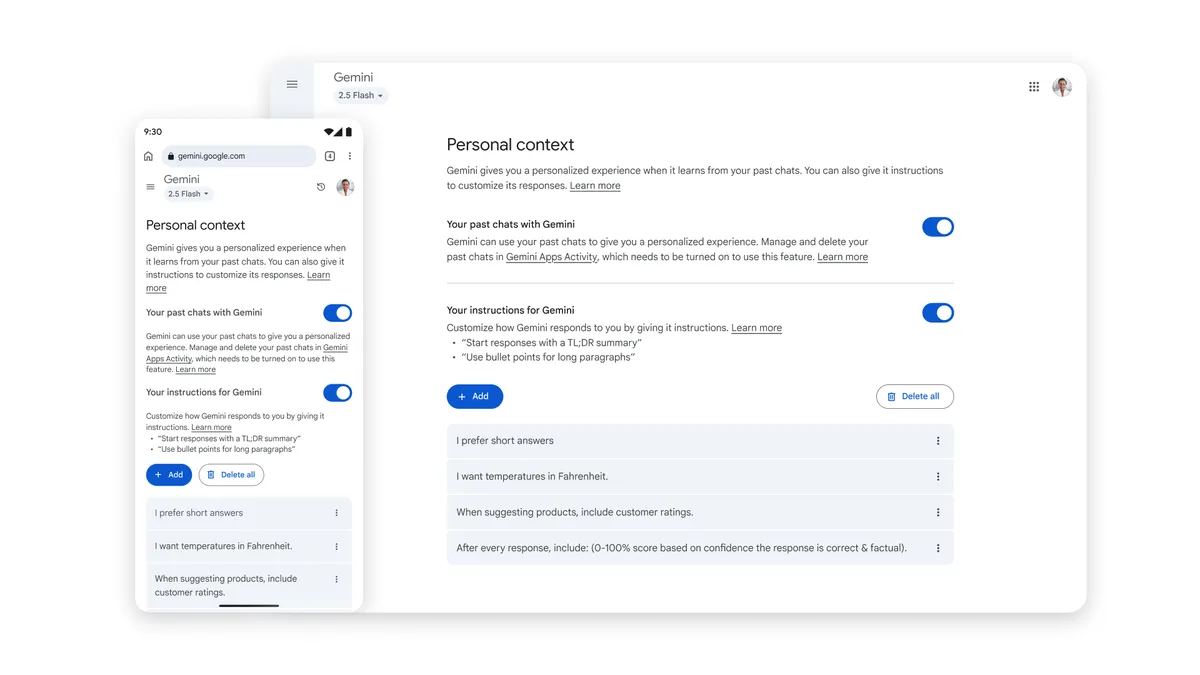
Gemini Personal Context settings (source image)
Gemini's Personal Context / Memory settings control whether past chats can personalize future responses. Source: Google.
You can ask Gemini whether it used a past chat
Google gives users a very simple audit mechanism.
You can ask:
“Did you use any info from past chats?”
When Gemini explicitly references old conversations in supported experiences, “Previous chats” may appear under Sources and related content.
That is useful because it gives the user some visibility into when conversation history actually influenced an answer.
Gemini can search past chats by topic or timeframe
In a new chat, Google says you can ask things like:
“Summarize our discussions about the solar system.”
or:
“What gift did we decide on for my son's classmate?”
Gemini can reference relevant previous conversations and identify them as previous-chat sources.
Source: Google Gemini Help — Find and manage recent chats
That makes Gemini more similar to Claude than many users realize.
The biggest Gemini advantage: connected personal context
Past chats are useful.
But Google has something neither OpenAI nor Anthropic can replicate as easily:
an enormous existing consumer ecosystem.
If you give permission, Gemini Personal Intelligence can combine chat context with information from connected Google services.
This changes the memory problem.
Suppose you are planning a trip.
A chat-only assistant might remember that:
You prefer quiet hotels.
Gemini could potentially combine that preference with relevant information from:
- an old conversation,
- a Gmail booking,
- Photos from a previous trip,
- Search behavior,
- or other connected sources.
That is not merely chatbot memory.
It is a broader personal-context layer.
Gemini's second major advantage: importing memory from other AI assistants
In March 2026, Google introduced tools for bringing memory into Gemini from other AI products.
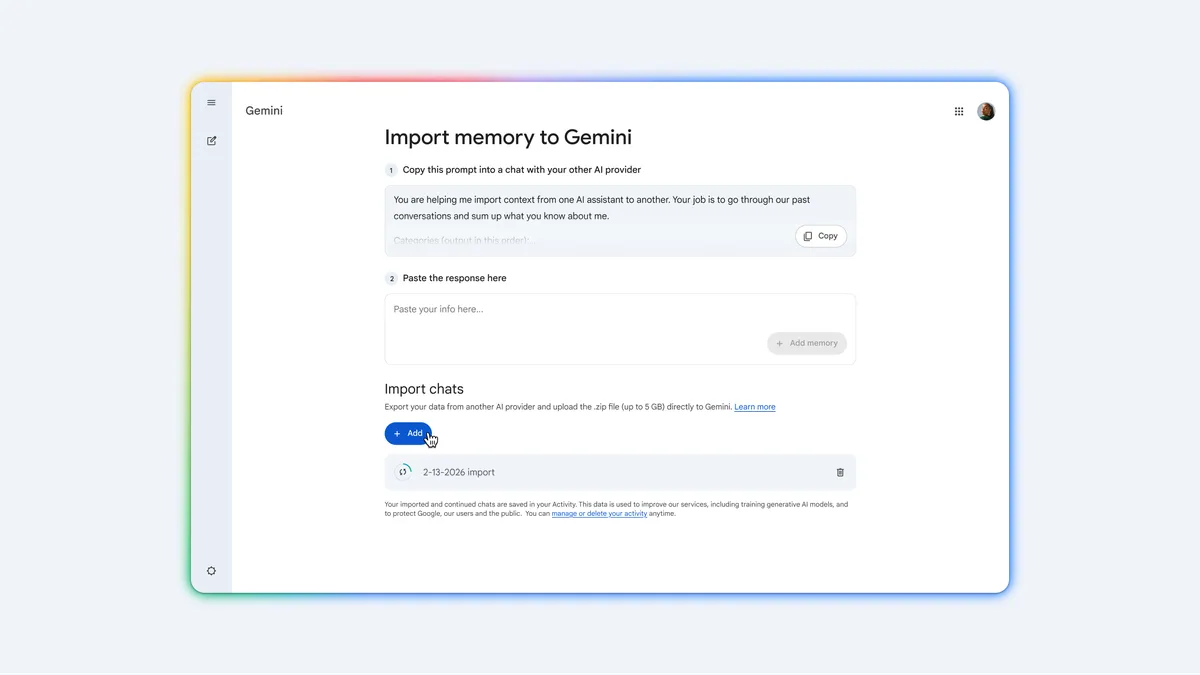
The workflow is straightforward:
- Gemini gives you a prompt.
- You paste it into your current AI assistant.
- That AI produces a structured summary of important context.
- You paste the summary back into Gemini.
- Gemini adds the information to your context.
Gemini Import Memory (source image)
Gemini can import key preferences, relationships, and personal context summarized by another AI assistant. Source: Google.
That directly attacks one of the biggest problems in personal AI:
switching costs created by accumulated context.
Gemini can import your full AI chat history too
Google went further than a memory summary.
Users can upload a ZIP export of previous conversations from another AI provider.
Gemini can then let them search and continue those old threads inside Gemini.
Gemini Import Chat History (source image)
Gemini can import full chat-history exports from other AI services. Source: Google.
Among ChatGPT, Claude, and Gemini, this gives Gemini the strongest full-history migration story right now.
Claude can import and export memory.
Gemini can import both memory and the underlying conversation archive.
Gemini also has Temporary Chat
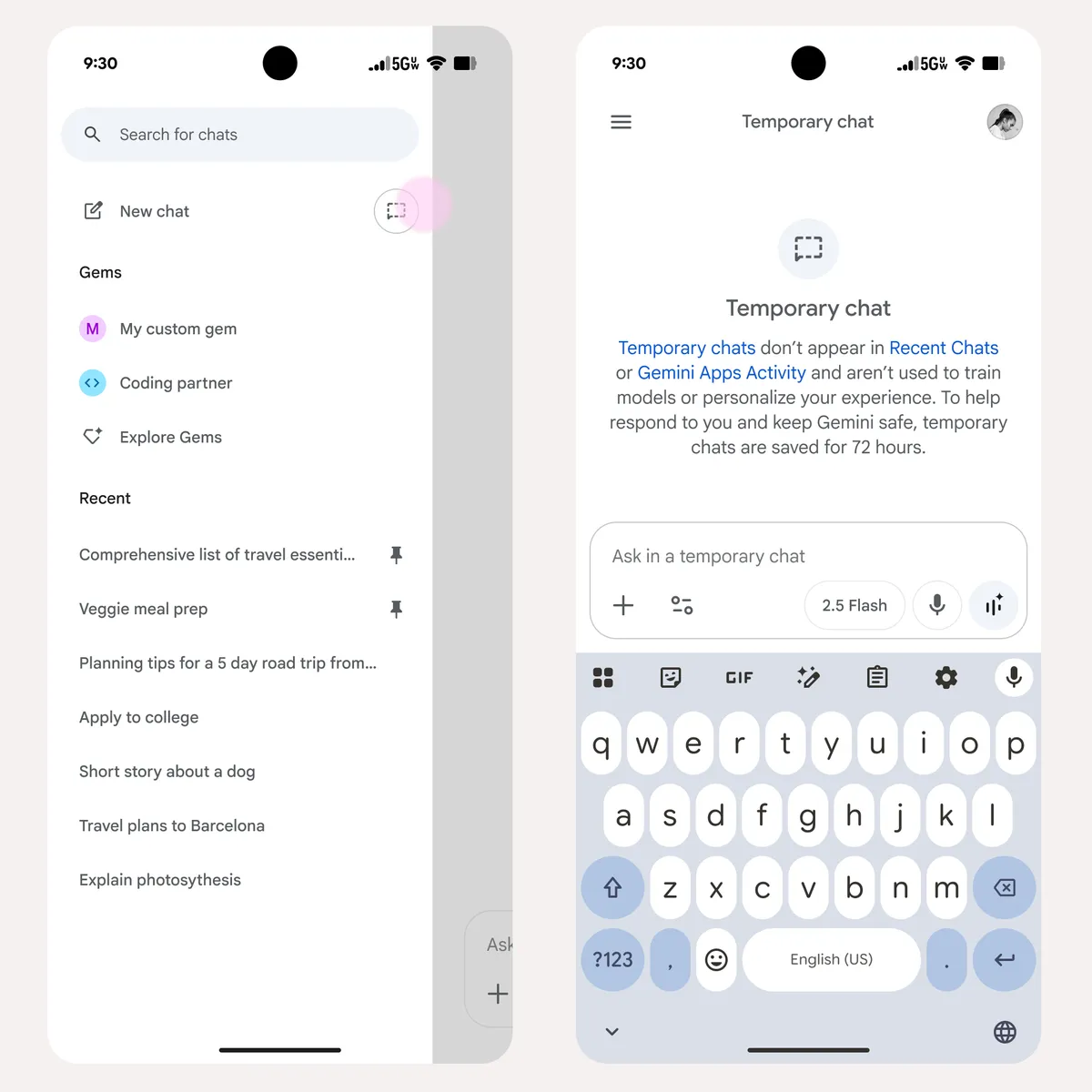
When you do not want a conversation contributing to future personalization, Gemini supports Temporary Chat.
Gemini Temporary Chat (source image)
Temporary Chat gives Gemini users a way to have one-off conversations that do not personalize future chats. Source: Google.
Google says Temporary Chats do not appear in recent chats or normal Gemini Apps Activity and are not used for personalization.
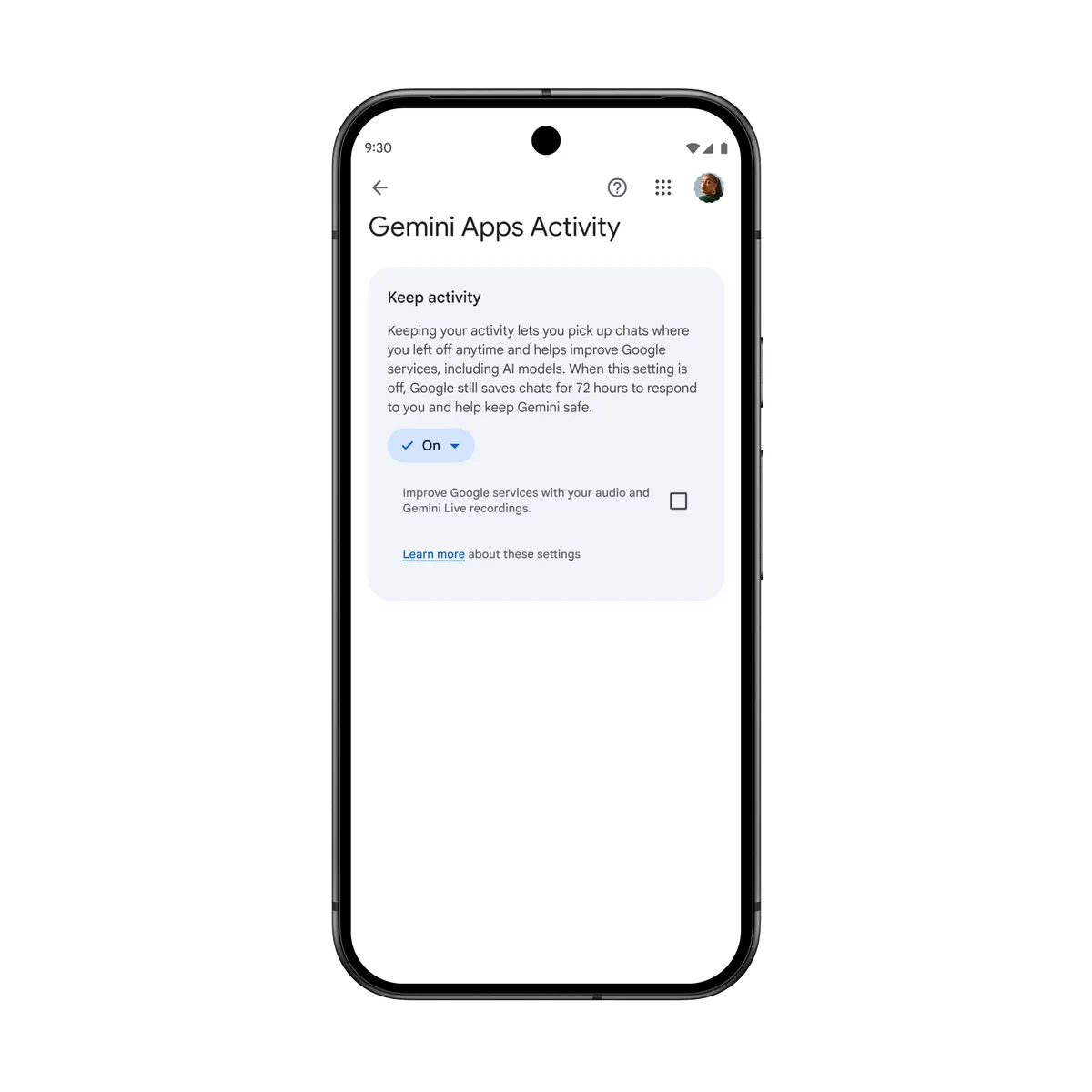
Gemini Keep Activity and personalization controls (source image)
Gemini exposes broader activity controls alongside personalization settings. Source: Google.
Gemini's memory controls are less granular than Claude's
This is the biggest weakness in the comparison.
Gemini can learn from previous conversations, but Google does not currently expose the same clean list of individually editable topic memories that Claude does.
If Gemini knows something incorrect, Google's support guidance says you can correct it in chat.
To delete remembered information originating from past chats, you may need to delete the relevant conversations from Gemini Apps Activity.
And if the information also exists in a connected Google app, you may need to address both the chat and the connected source.
That is logical from a data-provenance perspective.
It is also more complicated than opening Claude's Topics list and changing one memory file.
Gemini's availability is the most conditional
Gemini memory currently has several eligibility requirements.
Google says past-chat memory requires:
- age 18+,
- a personal Google Account,
- Keep Activity enabled.
It is not available for work, school, or supervised Google Accounts.
Some personalization features also vary by region, product surface, and rollout status.
Memory is currently available in supported Gemini mobile and web experiences, Gemini in Chrome in supported countries, and some other surfaces, but not everywhere, including certain modes such as Gems or Live for direct memory behavior.
So Gemini may have the broadest vision, but availability is also the least uniform.
Gemini Memory verdict
Best at: ecosystem context and portability.
Main strength: memory can extend beyond chat history into the broader Google ecosystem.
Main weakness: memory management is less granular and more dependent on account eligibility and rollout.
Head-to-head: which system wins each memory test?
Now we can compare them directly.
Round 1: Which one remembers useful context automatically?
Winner: ChatGPT
All three can use previous context automatically.
ChatGPT currently feels the most explicitly designed around passive synthesis.
OpenAI's 2026 memory architecture continuously builds and updates a useful memory state in the background.
The user does not need to decide which chat should be searched or which topic file needs attention for every interaction.
Claude is increasingly automatic too.
Gemini also learns from past chats.
But if the desired experience is:
“I just keep using the AI and it gradually knows more about how to help me,”
ChatGPT has the strongest product design around that goal.
Winner: ChatGPT
Round 2: Which one is best at finding a specific old conversation?
Winner: Claude
This is Claude's cleanest victory.
On paid plans, you can explicitly ask Claude to search past chats.
It retrieves relevant conversations and can cite the original chat.
That gives you both:
- remembered context,
- and the source material.
Gemini can also reference previous chats by topic or timeframe.
ChatGPT has chat-history search and broad past-chat memory.
But Claude integrates retrieval most directly into the active conversation.
Winner: Claude
Round 3: Which one lets you inspect what it remembers most clearly?
Winner: Claude
Claude exposes individual Topics.
You can open them.
Read them.
Edit them.
Delete them.
ChatGPT's Memory Summary is a strong interface and easier to understand than the old saved-memory list, but OpenAI explicitly says the summary does not necessarily contain everything that may influence personalization.
Gemini exposes settings and past-chat sources, but not an equally granular editable memory list.
Winner: Claude
Round 4: Which one handles outdated information best?
Winner: ChatGPT, with Claude close behind
This is an area where independent benchmark data would be valuable.
Based on the product designs and official documentation, ChatGPT has the strongest explicit focus on time-aware memory freshness.
OpenAI's 2026 work specifically evaluates:
- carrying context forward,
- following preferences,
- and staying current as time passes.
Claude's new system is also strong because memory topics update while you chat and users can directly correct them.
Gemini can be corrected conversationally, but its memory-management model is less explicit.
Winner: ChatGPT
Round 5: Which one is best for work and project context?
Winner: Claude
Claude's separate project memory is extremely useful.
Each project can maintain its own context rather than letting every part of your work collapse into one giant user profile.
This is particularly valuable if you use AI across several unrelated clients, products, courses, or research areas.
ChatGPT also has project-specific context features in supported configurations.
Gemini can use project-related past chats.
But Claude currently explains and exposes project isolation most clearly.
Winner: Claude
Round 6: Which one is best for sensitive memory control?
Winner: Claude
Claude deserves this one because Anthropic makes the distinction explicit.
Sensitive categories are excluded from memory by default.
Users can separately opt into some categories if they want them remembered.
The system also tells users when sensitive information is being saved.
ChatGPT provides memory controls and Temporary Chat, while OpenAI says sensitive information may appear in memory if users share it and advises turning memory off or using Temporary Chat when necessary.
Gemini offers Temporary Chat and personalization settings.
But Claude provides the most explicit sensitive-topic memory model.
Winner: Claude
Round 7: Which one is best if you want to move your memory to another AI?
Winner: Gemini
Claude deserves credit here.
It now supports experimental memory import and export.
That is a meaningful step toward user-owned context.
But Gemini currently goes further.
Google can import:
- a structured memory summary,
- and a full ZIP archive of prior AI conversations.
That second piece is important.
A memory summary contains distilled context.
A full history preserves the original source material too.
Winner: Gemini
Round 8: Which one has the broadest possible personal context?
Winner: Gemini
If we limit the comparison strictly to chats, this is close.
If we include the broader products, Gemini wins clearly.
Personal Intelligence can incorporate relevant information from connected Google services where users grant permission and the feature is supported.
That means Gemini is not limited to:
“What did you tell me in an AI conversation?”
It can potentially reason over more of your digital life.
For some users, that is incredibly powerful.
For others, it is far more personal data access than they want.
The capability is still the broadest.
Winner: Gemini
Round 9: Which one feels most like it “knows me”?
Winner: ChatGPT
This is subjective, but it is also the question behind the title.
Claude can be more transparent.
Gemini can access broader personal context.
Yet ChatGPT's automatic synthesis is currently the strongest fit for the feeling:
“I did not explicitly remind you of that, but you knew it mattered.”
That is what makes memory feel natural.
The system is increasingly designed to maintain a current picture across a large number of conversations without asking the user to consciously operate a memory database.
Winner: ChatGPT
Final scorecard
| Memory behavior | ChatGPT | Claude | Gemini |
|---|---|---|---|
| Automatic personalization | Best | Excellent | Excellent |
| Past-chat search | Strong | Best | Strong |
| Links back to original chats | Limited / source-dependent | Best | Strong |
| Inspecting memory | Strong | Best | Moderate |
| Editing memory directly | Strong | Best | Moderate |
| Staying current over time | Best | Excellent | Strong |
| Project isolation | Strong | Best | Moderate |
| Sensitive memory controls | Strong | Best | Strong |
| Temporary / incognito chats | Yes | Yes | Yes |
| Memory import | Limited compared with rivals | Yes | Yes |
| Memory export | Data export / controls | Yes | Chat history ecosystem dependent |
| Full external chat-history import | No comparable consumer flow | No comparable full-history flow | Best |
| Connected external personal context | Growing connected sources | Connectors / work context | Best |
| Overall “remembers me” experience | Best overall | Best controlled | Best ecosystem |
ChatGPT vs Claude Memory: which is better?
If you only care about ChatGPT and Claude, the choice is fairly clean.
Choose ChatGPT if you want memory to be invisible infrastructure.
You talk.
It learns.
The system keeps a synthesized picture updated over time.
Choose Claude if you want memory to be a thing you can inspect like files.
You can see the Topics, change them, delete them, search old chats, and jump back to the original conversation.
ChatGPT is better for:
- broad everyday personalization,
- automatically learning useful context,
- applying preferences without prompting,
- time-aware personal context,
- people who do not want to manage memory manually.
Claude is better for:
- professional projects,
- explicit memory control,
- past-chat retrieval,
- source traceability,
- project separation,
- sensitive-topic memory settings.
Neither approach is universally superior.
They optimize for different kinds of trust.
ChatGPT asks you to trust the synthesis.
Claude lets you inspect more of it directly.
ChatGPT vs Gemini Memory: which is better?
This comparison is about depth vs breadth.
ChatGPT has the more mature chat-native memory system.
Gemini has the broader external context opportunity.
ChatGPT is better for:
- automatic cross-chat personalization,
- a continually synthesized understanding of your preferences,
- keeping temporal context current,
- a more mature dedicated memory experience.
Gemini is better for:
- Google users,
- connected personal data,
- importing memory from another assistant,
- importing full external chat history,
- users who want Personal Intelligence across several Google services.
If your life already runs through Gmail, Photos, Search, YouTube, Maps, and Android, Gemini's long-term advantage is obvious.
If most of the context you care about was built through conversations with the AI itself, ChatGPT currently has the stronger memory-first experience.
Claude vs Gemini Memory: which is better?
Claude gives you more control.
Gemini gives you more reach.
Claude's Topics are easier to inspect.
Claude's old-chat retrieval is clearer.
Claude's project separation is excellent.
Gemini's connected ecosystem is much broader.
Gemini's ability to import full AI chat history is a major advantage for switching.
Choose Claude if:
you want to understand exactly what your AI remembers and keep professional contexts clean.
Choose Gemini if:
you want your AI memory to connect to the wider digital context already stored in Google.
Which is best for your use case?
“I hate repeating myself.”
Choose ChatGPT.
This is the purest expression of ChatGPT's current memory philosophy.
“I need to find what we discussed three months ago.”
Choose Claude.
Past-chat search plus citations back to the original conversation is difficult to beat.
“I want to see exactly what the AI thinks it knows.”
Choose Claude.
Topics make memory unusually legible.
“I use Gmail, Photos, YouTube, Search, and Android for everything.”
Choose Gemini.
The ecosystem advantage matters more than the standalone chatbot comparison.
“I want to switch AI apps without starting over.”
Choose Gemini first, Claude second.
Gemini's full-history import is the strongest migration feature of the three.
Claude's memory import/export is also useful and philosophically important.
“I want the most personal default experience.”
Choose ChatGPT.
Its automatic synthesis currently does the best job of making personalization feel like part of normal conversation rather than a separate feature.
“I work across several completely different projects.”
Choose Claude.
Separate project memory reduces context pollution.
“I want sensitive information remembered only when I explicitly allow it.”
Choose Claude.
Anthropic's sensitive-memory control is the clearest.
What none of these systems does perfectly
All three products have made memory dramatically better.
None has solved it.
There are still fundamental problems.
1. Remembered does not mean retrieved
A piece of information may exist somewhere in the system and still fail to appear when it matters.
Storage is not retrieval.
2. More memory can produce worse answers
An AI that remembers too much can pull in irrelevant context.
Imagine asking for a restaurant and receiving recommendations shaped by a food preference you mentioned once four years ago and no longer care about.
That is technically personalized.
It is also annoying.
3. Context can become stale
All three companies are working on this.
None can perfectly infer every life change.
You still need correction mechanisms.
4. Deleting the source and deleting the memory are not always the same action
This is one of the least intuitive parts of modern AI memory.
A fact may exist:
- in a chat,
- in synthesized memory,
- in a file,
- in a connected app,
- or in several of those at once.
Deleting one source may not immediately remove every derived context path.
Read the product's current controls if the information matters.
5. “Knowing you” is not the same as understanding you
A system can know:
- your city,
- your job,
- your favorite food,
- your current project,
- your preferred writing style.
That does not automatically mean it understands:
- why your priorities changed,
- how two events relate,
- what keeps repeating in your life,
- or what a new situation means in the context of everything else.
That is the larger personal-AI problem.
Memory is necessary.
It is not sufficient.
What this memory race means for personal AI
The most interesting part of ChatGPT vs Claude vs Gemini memory is not the feature comparison itself.
It is what all three companies are converging on.
A few years ago, AI competition was primarily:
“Which model gives the smartest answer?”
Now the products increasingly compete on:
“Which AI understands enough about you to know which answer is useful?”
That is a major shift.
The underlying model matters.
But as frontier models become more capable, the difference between a generic excellent answer and a genuinely useful personal answer increasingly comes from context.
A generic assistant can tell anyone:
“Here are five good career options.”
A personal AI should be able to understand:
- what you have already tried,
- what you said you wanted six months ago,
- what changed,
- which constraints are still real,
- which priorities are no longer real,
- and why this question is coming up now.
That is where memory turns into continuity.
And continuity is where AI begins to feel less like a sequence of isolated prompts.
Where Gemora fits into this
Gemora is not trying to beat OpenAI, Anthropic, or Google at having the largest foundation model.
The more interesting problem for Gemora is what happens after an AI can remember context.
If someone talks about their real life every day, the useful question is not only:
“Can the AI remember that this happened?”
It is:
“Can later conversations make sense of what changed?”
That is why Gemora is built around conversations about everyday life staying connected across time, rather than treating memory as the end product.
The distinction is:
Remember the fact
versus
understand the thread.
For a broader comparison of AI products built around persistent personal context, see:
Best Personal AI Assistants With Long-Term Memory in 2026
And for products specifically focused on using previous conversations in later chats:
Best AI Apps That Remember Past Conversations
The useful part is not that an AI stored what you said. It is that the next conversation can begin with more understanding than the last one. Start talking with Gemora.
How to test ChatGPT, Claude, and Gemini memory yourself
You do not need to trust this article.
Run the same small test on all three.
It takes about a week and tells you more than a marketing page.
Test 1: the stable preference
Tell each AI:
“I strongly prefer quiet restaurants where I can actually have a conversation. I usually avoid loud bars.”
Do not explicitly say “remember this.”
A few days later, in a new conversation, ask:
“Where should I take a friend for dinner?”
See whether the preference influences the answer.
This tests automatic personalization.
Test 2: the changed fact
Tell each one:
“I am launching my project in October.”
Later, update it:
“The launch moved to December.”
Then start a fresh chat a few days later and ask:
“What should I prioritize before launch?”
Check which date or timeline the AI behaves as though it believes.
This tests freshness.
Test 3: exact retrieval
After a few unrelated chats, ask:
“Find the conversation where I explained why the launch date changed.”
Claude should be especially interesting here because past-chat search is a distinct product capability on supported paid plans.
Gemini can also reference previous chats.
With ChatGPT, compare automatic memory with normal chat-history search.
Test 4: ambiguous reference
Tell each assistant about a difficult decision.
Later, start a new chat and say:
“I think I finally decided.”
This is harder than asking directly about the old topic.
It tests whether the AI carries enough context for a natural human-style reference.
Test 5: correction
Tell the AI something is wrong.
For example:
“You keep saying I prefer Windows. That is outdated. I switched to macOS.”
Then inspect whether the correction persists.
Claude's editable Topics make this easiest to audit.
ChatGPT's Memory Summary and correction controls make it possible there too.
Gemini can be corrected conversationally.
Test 6: privacy boundary
Start a Temporary Chat or Incognito Chat.
Say something distinctive.
Later, ask the normal assistant about it.
The detail should not behave like ordinary persistent context.
Test 7: ask what it knows
Ask:
“What do you currently remember about me?”
Then compare the answers.
Do not judge only by how many facts appear.
Judge by:
- relevance,
- correctness,
- freshness,
- and how easy mistakes are to fix.
A 300-item memory list is not impressive if 80 of those items are wrong.
Privacy and control comparison
Memory is useful precisely because it is personal.
That means controls matter.
| Control | ChatGPT | Claude | Gemini |
|---|---|---|---|
| Turn memory off | Yes | Yes | Yes |
| One-off non-memory chat | Temporary Chat | Incognito Chat | Temporary Chat |
| View remembered context | Memory Summary | Individual Topics | Past-chat / personalization controls |
| Edit memory | Yes | Yes, topic by topic | Correct in chat / manage source data |
| Delete individual memory | Yes | Yes | More source-dependent |
| Search old chats | Chat-history search | Integrated conversational search on paid plans | Can reference past chats |
| Source visibility | Memory Sources | Past-chat citations | Previous chats in Sources |
| Sensitive-topic memory controls | General controls | Separate opt-in model | General personalization controls |
| Import memory | More limited | Yes, experimental | Yes |
| Import full external chat history | No comparable flow | No comparable flow | Yes |
No table can tell you which privacy model is “best” for your personal comfort.
But Claude currently gives users the most granular memory inspection.
Gemini potentially has access to the broadest personal context if connected services are enabled.
ChatGPT sits between them: broad automatic personalization with increasingly visible sources and correction controls.
Final verdict: Which remembers you best?
If we have to choose one overall winner in September 2026, it is ChatGPT.
Not because it exposes the most memory controls.
Claude does that better.
Not because it has access to the widest possible personal ecosystem.
Gemini does that better.
ChatGPT wins because its current memory system is the most complete expression of automatic continuity.
You keep using the product.
It builds a current picture of useful context.
Future conversations increasingly start with more shared understanding.
That is the experience most people mean when they say:
“I want an AI that remembers me.”
But the gap is small, and the more specific answer is more useful:
Choose ChatGPT for automatic personalization.
Choose Claude for memory you can inspect, edit, and trace.
Choose Gemini for context that can extend across your Google life and move in from other AI tools.
The long-term winner may not be the assistant that remembers the most facts.
It may be the one that best answers three harder questions:
What still matters?
What changed?
And which part of the past is relevant right now?
That is when AI stops merely storing your context.
It starts using it well.
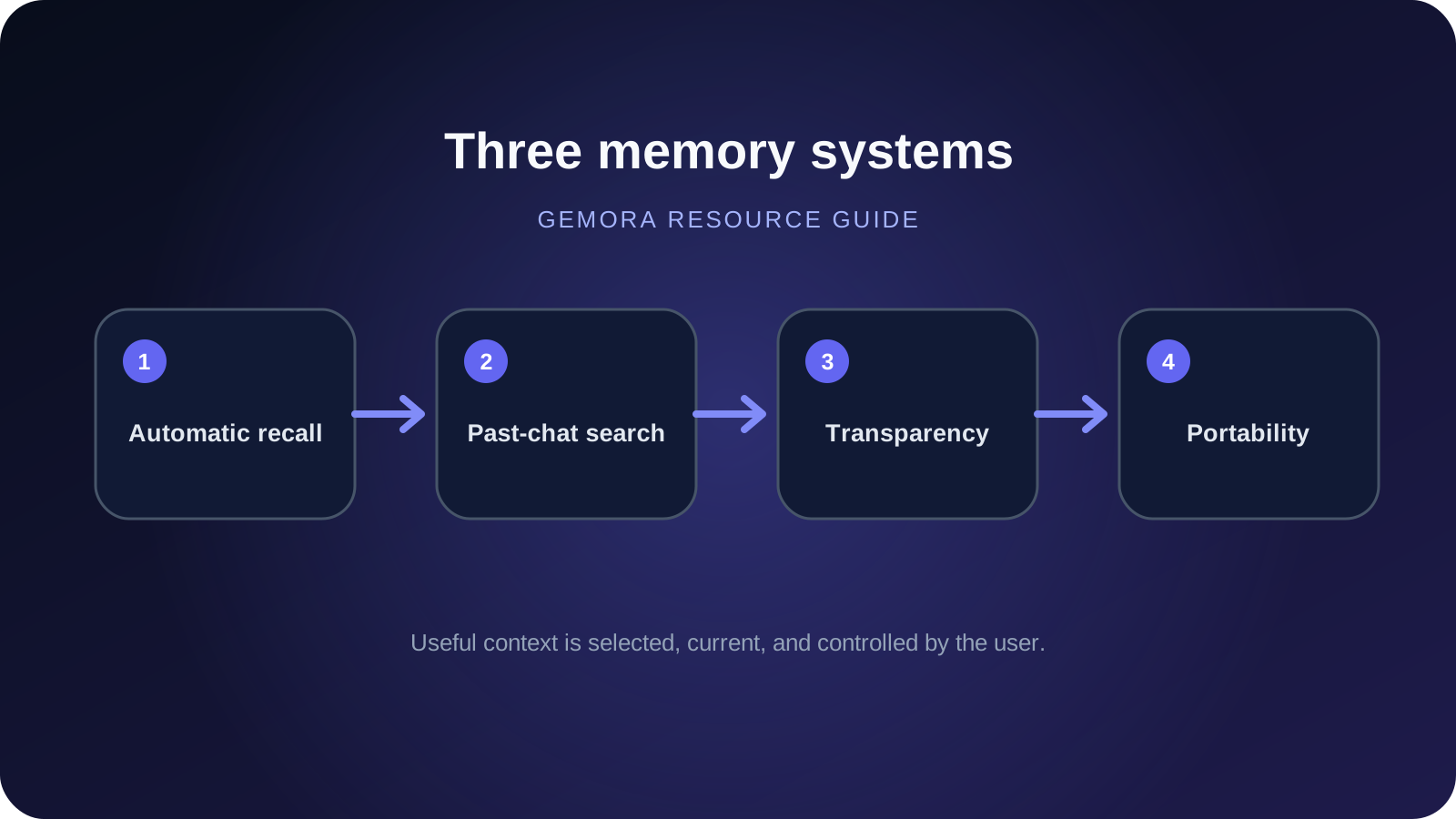
Continúa el hilo
Choose memory by the job it needs to do
Conecte conversaciones, contexto útil, reflexiones, proyectos y tareas en un espacio de trabajo personal.
Empieza gratisPreguntas frecuentes
Which AI has the best memory in 2026?
There is no universal winner: ChatGPT emphasizes automatic continuity, Claude makes memory easier to inspect and edit, and Gemini can draw on a broad Google context.
Which assistant is best at finding an exact old conversation?
Exact retrieval depends on product search and account settings, and should be evaluated separately from synthesized long-term memory.
Can I move memory between ChatGPT, Claude, and Gemini?
Import and export options are improving, but they do not yet create one continuously synchronized cross-provider memory.
Fuentes y lecturas adicionales
Escrito por Khai Tran y revisado según la Política editorial de Gemora.