
notice emotional patterns
How to Notice Emotional Patterns Without Labeling Yourself
Notice emotional patterns by comparing specific situations, conditions, and exceptions—without turning tentative observations into fixed labels about yourself.

이 가이드에서는
핵심 요점
- Collect episodes, not adjectives
- Compare conditions
- Search deliberately for exceptions
Three hard conversations can begin to look like a verdict: I am bad at conflict. But place them side by side and the edges differ. One arrived without warning. One happened while exhausted. In one, you spoke clearly and the relationship held.
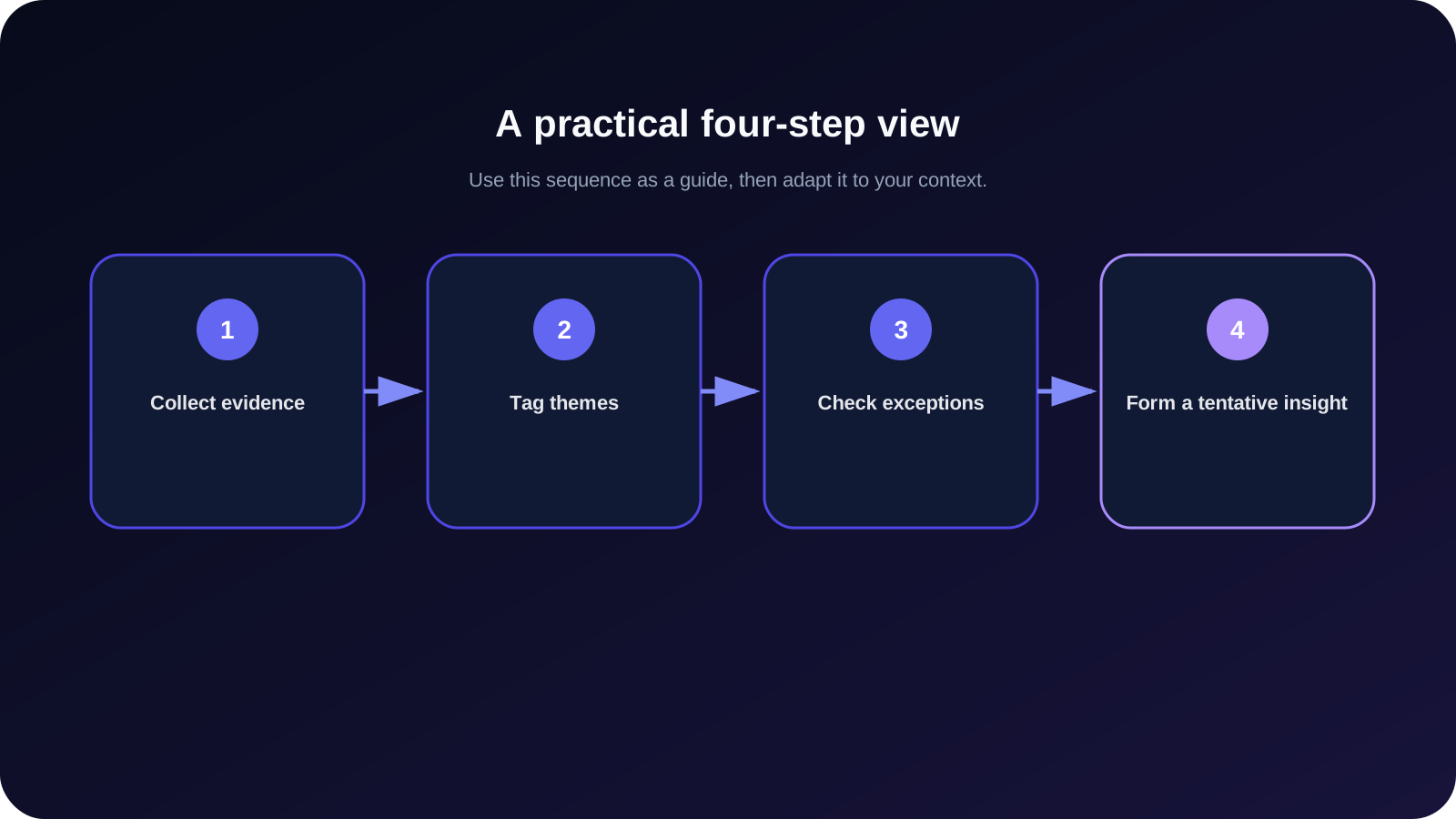
Notice emotional patterns by comparing several specific episodes, identifying shared conditions, and actively searching for exceptions. Describe the pattern as a testable observation—“I become tense when expectations are unclear”—rather than an identity—“I am an anxious person.”
This guide approaches notice emotional patterns as an everyday practice, not a diagnosis, a claim of perfect recall, or a demand for constant self-analysis. It will help you learn from repetition without shrinking identity while resisting the pressure to turn a handful of entries into a diagnosis.
In brief for How to Notice Emotional Patterns Without Labeling Yourself: Begin with one concrete scene, notice before interpreting, save only what will remain useful, and let uncertainty stay visible.
Collect episodes, not adjectives
Start with at least three scenes that can be located in time and context. General labels erase the conditions that make a pattern useful.
The aim here is to learn from repetition without shrinking identity, not to turn a handful of entries into a diagnosis. “Overwhelmed” separates into a rushed request, unclear ownership, and no recovery time.
For “collect episodes, not adjectives,” hold the first explanation beside the concrete scene: “Overwhelmed” separates into a rushed request, unclear ownership, and no recovery time.
Try it in a real situation: Write what happened before, during, and after each episode. For a different angle on notice emotional patterns, read How to Review Your Week Without Tracking Everything.
Complete “Write what happened before, during, and after each episode.” in language you would naturally use with someone you trust. If the wording feels staged, simplify it until it supports the real aim: to learn from repetition without shrinking identity.
Compare conditions
Look at place, people, uncertainty, stakes, sleep, timing, and prior events. The same emotion may arise through different pathways.
The aim here is to learn from repetition without shrinking identity, not to turn a handful of entries into a diagnosis. Tension may cluster around ambiguous deadlines rather than work itself.
Tension may cluster around ambiguous deadlines rather than work itself. The value of compare conditions is the extra precision it creates, not a conclusion that sounds impressive.
Try it in a real situation: Circle the condition shared by most—not necessarily all—examples. Within how to notice emotional patterns without labeling yourself, the next practical layer is 25 Daily Reflection Questions That Do Not Feel Forced.
After trying “Circle the condition shared by most—not necessarily all—examples.,” name what became clearer and what stayed unresolved. That distinction keeps the exercise oriented toward the modest goal to learn from repetition without shrinking identity.
Search deliberately for exceptions
An exception protects against confirmation bias and often reveals the condition that matters most. The goal is a more precise pattern, not a perfect one.
The aim here is to learn from repetition without shrinking identity, not to turn a handful of entries into a diagnosis. A difficult meeting felt manageable when the agenda and decision owner were clear.
Return once more to the ordinary detail: A difficult meeting felt manageable when the agenda and decision owner were clear. If a different fact would change the meaning, write that fact down too; uncertainty belongs inside search deliberately for exceptions, not outside it.
Try it in a real situation: Find a similar situation where the expected emotion did not appear. [emotional reflection ai] explores the same question from a different side](/solutions/emotional-reflection-ai).
If “Find a similar situation where the expected emotion did not appear.” feels too large, reduce it until it can happen in two minutes. A practice that survives an ordinary day is more useful than one that only works under ideal conditions; the purpose is to learn from repetition without shrinking identity.
Use conditional language
Patterns should be written as relationships between context and response. Conditional wording leaves room for change and avoids identity claims.
The aim here is to learn from repetition without shrinking identity, not to turn a handful of entries into a diagnosis. “When plans change late, I often withdraw, especially when I have not slept.”
Notice how little drama the example requires: “When plans change late, I often withdraw, especially when I have not slept.” That restraint is useful. It allows use conditional language to remain connected to evidence instead of becoming a story that grows more certain with every retelling.
Try it in a real situation: Use “When X, I often notice Y, especially if Z.” Before applying how to notice emotional patterns without labeling yourself to sensitive material, review Gemora’s privacy information and keep another person’s details out of the record.
Treat “Use “When X, I often notice Y, especially if Z.”” as a one-day experiment. Compare the result with what you expected, then revise the method rather than judging yourself; the intended outcome is simply to learn from repetition without shrinking identity.
Test one gentle change
A pattern becomes useful when it suggests a small experiment. The experiment should alter a condition without claiming to fix the person.
The aim here is to learn from repetition without shrinking identity, not to turn a handful of entries into a diagnosis. Ask for the decision criteria before the next meeting and compare the result.
Imagine reviewing this scene a month later: Ask for the decision criteria before the next meeting and compare the result. Preserve the detail that would help you understand test one gentle change, and leave out anything that merely makes the record longer.
Try it in a real situation: Change preparation, recovery, clarity, or support once. A useful companion to how to notice emotional patterns without labeling yourself is How to Review Your Week Without Tracking Everything.
Before you act on “Change preparation, recovery, clarity, or support once.,” decide what information is necessary and what is private. The smallest honest version is usually enough to learn from repetition without shrinking identity.
Why the sources do not provide a personal verdict
A reader asking “What is the difference between a pattern and a label?” deserves an answer that remains honest about uncertainty. For notice emotional patterns, the references support background and boundaries; they do not assign motives, diagnose a condition, or guarantee a product result.
In the context of how to notice emotional patterns without labeling yourself, Event perception and memory: a review is relevant to the relationship between event perception, memory, and routine; it cannot determine why one individual week felt vivid or blurred. Its role in how to notice emotional patterns without labeling yourself is to mark the handoff from a grounded general statement back to observation, consent, and the user’s right to revise the answer.
For How to Notice Emotional Patterns Without Labeling Yourself, NIST AI Risk Management Framework provides a careful reference point for a risk-management lens for transparency, privacy, and user control; it is a framework, not a certification of any product. For notice emotional patterns, proportionality means returning to the FAQ question “How many examples make a pattern?” rather than stretching the source into a promise it never made.
The guide also relies on Gemora Privacy Policy when discussing Gemora’s first-party description of data and memory handling; it should be read as product policy rather than independent evidence of outcomes. That distinction matters for how to notice emotional patterns without labeling yourself, because a plausible explanation can still become misleading when it is presented without the limits of its evidence.
This evidence base is enough for an everyday method, not for certainty. Revisit “How many examples make a pattern?” after trying the practice once. If the answer changes with context, preserve that change instead of forcing the experience back into the first explanation.
A small practice to try today
Return to the image at the beginning of this guide: three hard conversations can begin to look like a verdict: i am bad at conflict. The exercise below moves from “Choose three episodes with a similar feeling.” to “Test one environmental change and review without judgment..” That arc is intentionally small. It is designed to learn from repetition without shrinking identity without asking you to turn a handful of entries into a diagnosis.
- Choose three episodes with a similar feeling.
- List the conditions around each.
- Find one counterexample.
- Write a conditional pattern statement.
- Test one environmental change and review without judgment.
Use “Write a conditional pattern statement.” as the quality check. A trustworthy result should help you learn from repetition without shrinking identity while leaving room for correction. Anything that claims more—especially language that starts to turn a handful of entries into a diagnosis—belongs in a question, not a permanent conclusion about notice emotional patterns.
The practical boundary is simple: context may persist when it remains useful, accurate, and yours to keep. Gemora can connect that context, while “Test one environmental change and review without judgment.” protects the equally important choice not to turn notice emotional patterns into permanent storage.
생각 이어가기
Explore patterns without becoming a label
하나의 개인 작업 공간에서 대화, 유용한 컨텍스트, 반성, 프로젝트 및 작업을 연결하세요.
무료로 시작하세요자주 묻는 질문
How many examples make a pattern?
There is no magic number. Use several episodes across time and keep the conclusion tentative, especially when the stakes are high.
What is the difference between a pattern and a label?
A pattern connects a response to conditions and exceptions. A label treats the response as a fixed fact about identity.
Can AI diagnose emotional patterns?
AI may help organize entries or surface possible themes, but it cannot establish a diagnosis and may miss context or counterexamples.

