
monthly life review
Monthly Life Review: A 30-Minute Template to See What Changed
Use a 30-minute monthly life review to gather evidence, notice what changed, name priorities, close open loops, and choose one clear next move.

このガイドでは
- Minute 0–5: collect evidence
- Minute 5–10: name the highlights and the cost
- Minute 10–15: review decisions and turning points
- Minute 15–20: check energy and people
- Minute 20–25: close one unresolved loop
- Minute 25–30: choose an intention and carry it forward
- Connect the review to a longer story
- Frequently asked questions
要点
- Minute 0–5: collect evidence
- Minute 5–10: name the highlights and the cost
- Minute 10–15: review decisions and turning points
A monthly life review is a 30-minute pause to see what changed before the next month fills the calendar. It is not a productivity scorecard. The goal is to gather evidence, notice meaning, close one loop, and choose a small intention.
Use a journal, calendar, task list, photo roll, or personal workspace. Review only what you can hold with care. If a question creates pressure or shame, rewrite it until it helps you observe rather than perform.
Minute 0–5: collect evidence
Open your calendar, journal entries, photos, messages, and task list. Scan for dates rather than trying to remember the month perfectly. Write quick fragments under six headings: highlights, decisions, energy, people, unresolved loops, and surprises.
Do not interpret yet. “Three late nights,” “called Dad,” and “postponed the launch” are evidence. The meaning comes later. If you use Gemora, move from Calendar to the relevant entries and keep the source visible while you review.
Minute 5–10: name the highlights and the cost
Choose up to three moments that gave you energy, connection, progress, or relief. Then name one cost: a commitment that drained you, a conversation you avoided, or a pattern that made the month harder than it needed to be.
A highlight is not necessarily a public achievement. Cooking for a friend or taking one honest evening off may be the most important evidence. The cost is not a failure; it is a constraint to plan around.
Minute 10–15: review decisions and turning points
List decisions you made, delayed, or reversed. For each, write the information you had at the time and what you know now. This keeps hindsight from pretending the choice was obvious.
Ask: “Which decision changed the shape of the next month?” Put a star beside one. If no decision stands out, record that too. A quiet month can still reveal a boundary or a value.
Minute 15–20: check energy and people
Sketch your energy across the month as low, medium, or high. Add a sentence about sleep, focus, movement, or recovery only if it helps you understand the pattern. This is observation, not a medical assessment.
Then review the people who mattered. Who gave support? Who needed a clearer boundary? Which relationship deserves an intentional next conversation? Do not turn people into a score. Notice reciprocity, distance, and gratitude.
Minute 20–25: close one unresolved loop
Choose one open loop that can become a visible action: send the email, schedule the appointment, archive the document, ask the question, or decide to let it go. A review becomes useful when it changes the next calendar, not when it produces the longest summary.
- Name the loop in one sentence.
- Choose the smallest action that creates movement.
- Put a date or reminder on the calendar.
Minute 25–30: choose an intention and carry it forward
Write one sentence beginning “Next month, I want to make more room for…” Keep it directional, not absolute. “More unhurried mornings” is easier to use than “never feel rushed.” Add one supporting action and one thing you will protect.
| Prompt | Example answer |
|---|---|
| Evidence | Four evenings became work catch-up. |
| Meaning | I am underestimating transition time. |
| Next action | Block a no-meeting Wednesday afternoon. |
| Protection | Keep Sunday morning free of admin. |
Copyable monthly review template
Month:
Highlights (up to 3):
One cost or drain:
Decisions made / delayed / reversed:
Energy pattern:
People and conversations:
Unresolved loop:
Smallest next action + date:
What I want more room for next month:
What I will protect:
Save the completed review where you can compare it later. After three months, read only the intention and unresolved-loop lines. That small sample often reveals a pattern more clearly than rereading every daily entry.
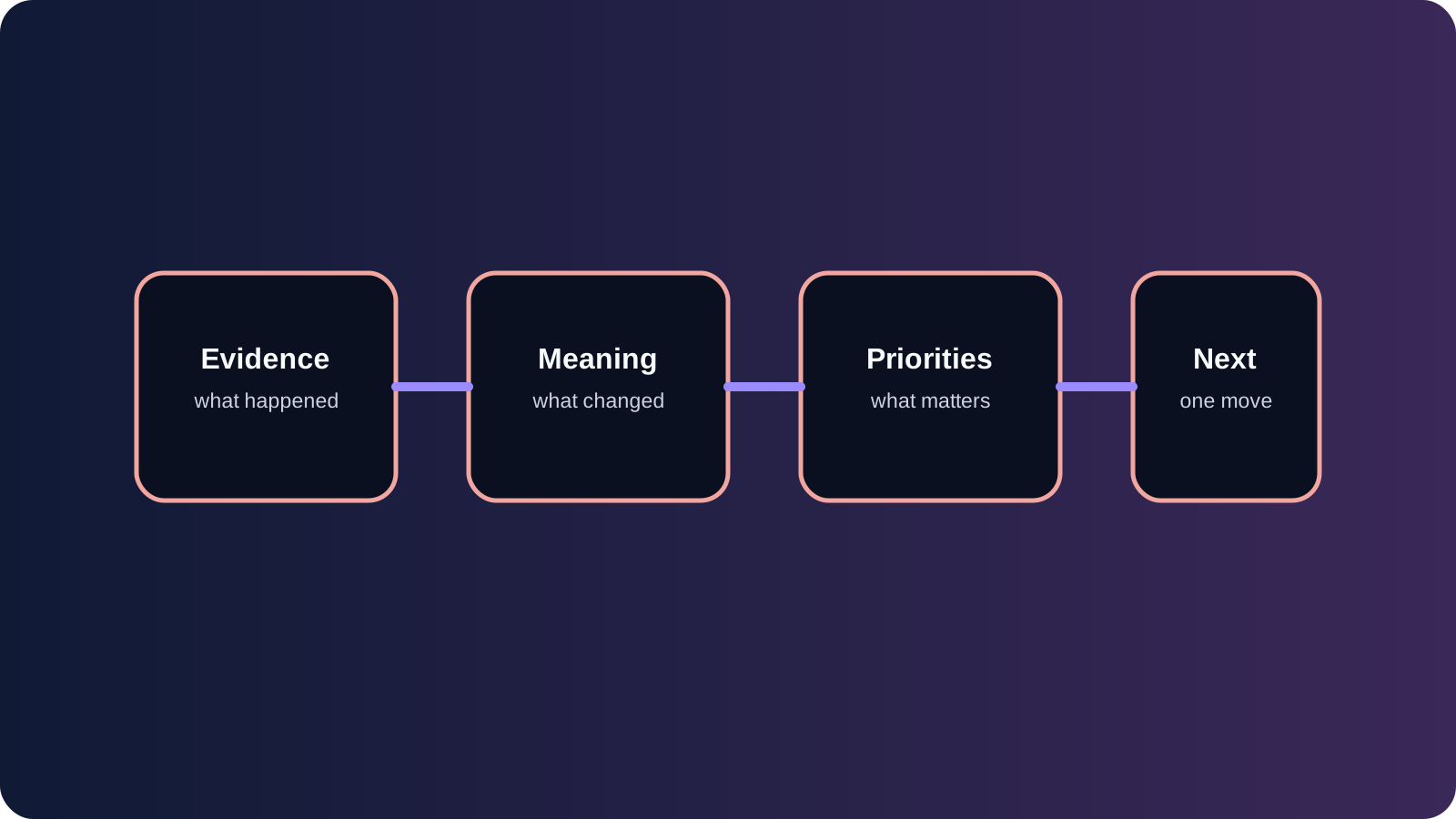
If you prefer a visual review, draw four boxes on paper: evidence, meaning, choice, and next move. Put fragments in the first box before moving anything into the others. This simple separation prevents a difficult week from becoming a global story about your character. It also makes it easier to change an interpretation without losing the evidence that prompted it.
Add one “not on the list” note. It might be rest, play, a new idea, or a relationship that did not produce a measurable outcome. Monthly reviews can accidentally reward only visible productivity. A quiet observation protects the parts of life that are valuable precisely because they do not become tasks.
When a month contains a major change, shorten the review rather than forcing a complete account. Choose one reliable source, such as the calendar, and one reflective source, such as a journal entry. Record what you do not know. You can return to the gap later with more distance. A review should create orientation, not demand an explanation on schedule.
For teams or shared projects, keep the personal review separate from a work retrospective. The questions may overlap, but your energy, relationships, and private decisions deserve a space that is not evaluated by a manager or a metric. You can carry one next action from the personal review into a work plan without exposing the rest of the reflection.
Finally, make the next review easy to begin. Put a recurring 30-minute block on the calendar, link to the template, and leave the previous review nearby. The ritual is successful when the first five minutes require almost no setup. Consistency turns isolated snapshots into a record of how your life actually changed.
If you do not know what to write, begin with the calendar’s negative space: the time you expected to have but did not, the plan that moved, or the evening that became recovery instead of output. Missing time is evidence too. Describe it without blame, then decide whether next month needs a boundary, a buffer, or simply acceptance.
Keep a “pattern to watch” line separate from your intention. A pattern is an observation that needs more evidence; an intention is a direction you choose now. For example, “late meetings seem to reduce sleep” is a pattern to watch, while “protect two early evenings” is an intention. Separating them prevents a tentative observation from becoming a rigid rule.
Your review can include gratitude without becoming a positivity exercise. Name the person, place, or choice that made the month more possible, and say what you will do with that knowledge. Thanking a friend may lead to a message; noticing a quiet park may lead to another visit. Let appreciation create a next action when one is natural.
At the end, give the review a title that describes the month in your own language, such as “learning to leave space” or “a month of careful starts.” Titles make later retrieval easier and preserve the texture that a list of tasks cannot. If the title feels too definitive, add a question mark.
Use daily reflection prompts when you need more detail between reviews, and use Gemora Memory only for context you intentionally want to revisit. A review is stronger when it respects the difference between a passing feeling and a durable memory.
A completed example
Month: August
Highlights: finished the prototype; two long walks with a friend; cooked at home more often.
One cost: late meetings turned three mornings into catch-up days.
Decisions: delayed a non-urgent launch; chose to ask for clearer scope.
Energy pattern: strong on quiet mornings, scattered after back-to-back calls.
People: received useful help from Sam; owe a reply to Lin.
Unresolved loop: decide whether to renew a recurring commitment.
Smallest next action + date: send two questions before Friday.
What I want more room for: unhurried starts and one creative afternoon.
What I will protect: Sunday morning without admin.
The example is specific without pretending to be a complete account of the month. It names evidence, then chooses a next action that can be seen on a calendar. If the same late-meeting pattern appears again, it becomes stronger evidence for a boundary; if it disappears, the observation can remain a one-month exception. That is why a review should be repeated rather than treated as a verdict.
If you review with another person, read the evidence aloud before offering interpretations. Each person can then add a separate meaning line without competing over whose story is official. For a private review, do the same internally: write the observation first, then give yourself a short pause before deciding what it means. That pause is often where a kinder, more accurate next move appears.
Connect the review to a longer story
Monthly reviews are snapshots. A personal timeline shows how snapshots connect across a season. A daily reflection captures the detail that a monthly scan will miss. Gemora Memory can help you revisit recurring themes, but keep your own judgment in the loop and delete context you no longer want stored.
Frequently asked questions
What if I missed most of the month? Review the evidence you do have and label the gaps. A partial review is still a useful snapshot.
Should I review every goal? No. Review the areas that mattered or changed. The purpose is orientation, not a monthly performance report.
Can I do this in ten minutes? Yes. Keep the six headings, write one fragment under each, and choose one action. Thirty minutes gives more context, but consistency matters more than duration.
Write that next move in language you can recognize when the month gets busy. “Ask for scope by Friday” is easier to act on than “communicate better,” and the completed action gives the next review evidence to work with.
A good review leaves you oriented, not judged. You should finish knowing one thing that changed, one loop you can close, and one small piece of life you want to protect.
Then put the next review on the calendar before you close the page.
The reminder is not a demand for perfect consistency. It is a small invitation to return, look again, and let the next month provide better evidence than the last one had. Small returns add up over time. The practice becomes a gentle record of change. That is enough for one month. Done.
続きを考える
Review the month without turning it into a score
会話、役立つコンテキスト、考察、プロジェクト、タスクを 1 つの個人用ワークスペースに接続します。
無料で始めるよくある質問
What is a monthly life review?
It is a short, structured pause to look at what happened, what changed, what mattered, and what deserves attention next month.
How long should a monthly review take?
Thirty minutes is enough for the template in this guide. Stop when you have a clear observation and one next move rather than filling every minute.
Should a monthly review track mood or productivity?
Only if that helps you notice something real. Use observations, decisions, relationships, energy, and unfinished loops alongside any simple rating you choose.

