
conversational journaling
What Is Conversational Journaling?
Conversational journaling uses responsive questions instead of a blank page, helping you explore one real moment while keeping your own meaning and voice.

En esta guía
Puntos clave
- A journal that responds
- Good follow-ups stay close to evidence
- Your answer can change the path
A blank page waits without blinking. A conversation does something different: it leans forward. It asks what happened next, notices when a word carries more weight than the rest, and gives you somewhere to place the half-formed thought you could not turn into a polished paragraph.
Conversational journaling is reflection through an exchange of questions and answers. Instead of writing alone from a static prompt, you describe a moment and respond to follow-ups that help clarify detail, emotion, meaning, or next steps. You remain the author; the conversation supplies movement, not truth on your behalf.
This guide approaches conversational journaling as an everyday practice, not a diagnosis, a claim of perfect recall, or a demand for constant self-analysis. It will help you reduce blank-page friction while protecting personal agency while resisting the pressure to outsource self-knowledge to a fluent system.
In brief for What Is Conversational Journaling?: Begin with one concrete scene, notice before interpreting, save only what will remain useful, and let uncertainty stay visible.
A journal that responds
Traditional entries wait for you to decide where to go. Conversational journaling reacts to what you have already said and can ask for the missing detail. The response creates momentum, especially when you know something matters but cannot yet name why.
The aim here is to reduce blank-page friction while protecting personal agency, not to outsource self-knowledge to a fluent system. “I went quiet when the plan changed” invites a more grounded follow-up than “Why am I anxious?”
For “a journal that responds,” hold the first explanation beside the concrete scene: “I went quiet when the plan changed” invites a more grounded follow-up than “Why am I anxious?”
Try it in a real situation: Begin with an event rather than a category of feeling. For a different angle on conversational journaling, read Conversational Journaling vs Traditional Journaling.
Before you act on “Begin with an event rather than a category of feeling.,” decide what information is necessary and what is private. The smallest honest version is usually enough to reduce blank-page friction while protecting personal agency.
Good follow-ups stay close to evidence
The strongest questions clarify sequence, words, sensations, and competing interpretations. Weak questions leap toward a diagnosis or a dramatic hidden meaning. A useful conversation helps you see your own material more clearly without claiming authority over it.
The aim here is to reduce blank-page friction while protecting personal agency, not to outsource self-knowledge to a fluent system. A careful follow-up may reveal that frustration began after a broken promise, not at the start of the meeting.
A careful follow-up may reveal that frustration began after a broken promise, not at the start of the meeting. The value of good follow-ups stay close to evidence is the extra precision it creates, not a conclusion that sounds impressive.
Try it in a real situation: Prefer “What made that moment stand out?” over “Is this caused by your childhood?” Within what is conversational journaling?, the next practical layer is How to Reflect Through Conversation Instead of Writing.
Complete “Prefer “What made that moment stand out?” over “Is this caused by your childhood?”” in language you would naturally use with someone you trust. If the wording feels staged, simplify it until it supports the real aim: to reduce blank-page friction while protecting personal agency.
Your answer can change the path
Conversation is adaptive: a brief answer may invite detail, while a boundary such as “I do not want to explore that” should redirect the exchange. This flexibility is valuable only when the user remains able to pause, correct, and refuse.
The aim here is to reduce blank-page friction while protecting personal agency, not to outsource self-knowledge to a fluent system. Someone may want to name grief tonight, not turn it into a productivity plan.
Return once more to the ordinary detail: Someone may want to name grief tonight, not turn it into a productivity plan. If a different fact would change the meaning, write that fact down too; uncertainty belongs inside your answer can change the path, not outside it.
Try it in a real situation: State what kind of help you want: witness, clarification, options, or a summary. [ai journaling] explores the same question from a different side](/solutions/ai-journaling).
After trying “State what kind of help you want: witness, clarification, options, or a summary.,” name what became clearer and what stayed unresolved. That distinction keeps the exercise oriented toward the modest goal to reduce blank-page friction while protecting personal agency.
Memory should be chosen, not assumed
A reflective conversation can contain intimate information that is useful in the moment but unnecessary later. Saving everything increases privacy risk and can make future personalization feel intrusive rather than caring.
The aim here is to reduce blank-page friction while protecting personal agency, not to outsource self-knowledge to a fluent system. Keep “I prefer quiet time after conflict”; discard the raw details of another person’s private story.
Notice how little drama the example requires: Keep “I prefer quiet time after conflict”; discard the raw details of another person’s private story. That restraint is useful. It allows memory should be chosen, not assumed to remain connected to evidence instead of becoming a story that grows more certain with every retelling.
Try it in a real situation: At the end, decide what—if anything—would genuinely help next time. Before applying what is conversational journaling? to sensitive material, review Gemora’s privacy information and keep another person’s details out of the record.
If “At the end, decide what—if anything—would genuinely help next time.” feels too large, reduce it until it can happen in two minutes. A practice that survives an ordinary day is more useful than one that only works under ideal conditions; the purpose is to reduce blank-page friction while protecting personal agency.
Conversation is a practice, not therapy
Responsive prompts can support everyday reflection, but they do not establish clinical truth, assess risk reliably, or replace trained care. Clear limits make the practice safer and more trustworthy.
The aim here is to reduce blank-page friction while protecting personal agency, not to outsource self-knowledge to a fluent system. A supportive question can help someone prepare for a counseling session without pretending to be the counselor.
Imagine reviewing this scene a month later: A supportive question can help someone prepare for a counseling session without pretending to be the counselor. Preserve the detail that would help you understand conversation is a practice, not therapy, and leave out anything that merely makes the record longer.
Try it in a real situation: Use conversational journaling for noticing and organizing; seek qualified help when distress is intense, persistent, or unsafe. A useful companion to what is conversational journaling? is Conversational Journaling vs Traditional Journaling.
Treat “Use conversational journaling for noticing and organizing; seek qualified help when distress is intense, persistent, or unsafe.” as a one-day experiment. Compare the result with what you expected, then revise the method rather than judging yourself; the intended outcome is simply to reduce blank-page friction while protecting personal agency.
Read the guidance with these limits in view
The FAQ asks “Is conversational journaling the same as AI journaling?” and “Should every conversation be saved?” Those are different kinds of questions: one may concern a practice, while the other may require personal, technical, or professional context beyond an article.
A second kind of check comes from Emotional and physical health benefits of expressive writing: findings from studied expressive-writing settings; those findings do not mean writing suits every person or replaces professional care. For what is conversational journaling?, use the reference to test certainty and revisit “Should every conversation be saved?” without forcing an ordinary experience into a clinical or technical frame.
In the context of what is conversational journaling?, NIST AI RMF trustworthiness characteristics is relevant to a risk-management lens for transparency, privacy, and user control; it is a framework, not a certification of any product. Its role in what is conversational journaling? is to mark the handoff from a grounded general statement back to observation, consent, and the user’s right to revise the answer.
For What Is Conversational Journaling?, Gemora Privacy Policy provides a careful reference point for Gemora’s first-party description of data and memory handling; it should be read as product policy rather than independent evidence of outcomes. For conversational journaling, proportionality means returning to the FAQ question “Is conversational journaling the same as AI journaling?” rather than stretching the source into a promise it never made.
No citation can make a reconstructed memory complete or an AI response infallible. The useful standard for what is conversational journaling? is whether the claim is specific, reviewable, proportionate, and open to correction by the person whose life or data it describes.
A small practice to try today
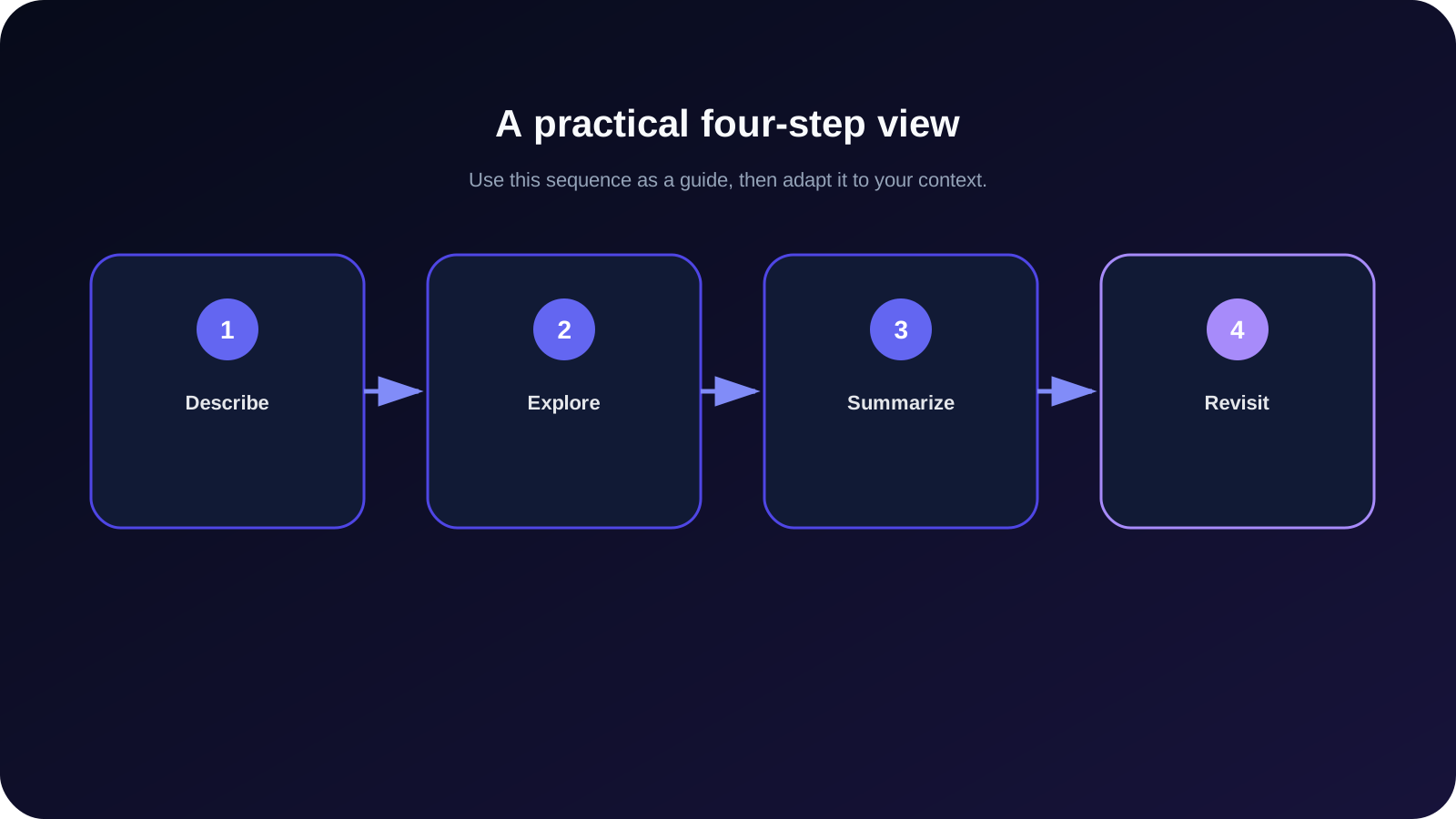
Return to the image at the beginning of this guide: a blank page waits without blinking. The exercise below moves from “Describe one specific moment in three sentences.” to “Choose whether the summary should be saved, edited, or discarded..” That arc is intentionally small. It is designed to reduce blank-page friction while protecting personal agency without asking you to outsource self-knowledge to a fluent system.
- Describe one specific moment in three sentences.
- Ask for one factual follow-up and answer it.
- Ask what interpretation has the strongest evidence.
- Name a boundary or uncertainty.
- Choose whether the summary should be saved, edited, or discarded.
Imagine encountering this note during a different week. Keep the sentence that would clarify conversational journaling and the condition captured in “Ask for one factual follow-up and answer it..” Remove the rest if it would encourage you to outsource self-knowledge to a fluent system; brevity is useful when the real purpose is to reduce blank-page friction while protecting personal agency.
Before saving anything through the related Gemora experience, explain in one sentence how it would help you reduce blank-page friction while protecting personal agency. If no answer appears, complete “Choose whether the summary should be saved, edited, or discarded.” and allow the moment to close without building another archive.
Continúa el hilo
Try reflection as a real conversation
Conecte conversaciones, contexto útil, reflexiones, proyectos y tareas en un espacio de trabajo personal.
Empieza gratisPreguntas frecuentes
Is conversational journaling the same as AI journaling?
AI can provide the responsive side of the exchange, but conversational journaling can also happen with a person or through self-guided question and answer.
What makes a good conversational journal prompt?
It should be specific, nonjudgmental, and responsive to what you actually said rather than forcing a predetermined lesson.
Should every conversation be saved?
No. Save only context that is useful, appropriate, and worth carrying forward, and use review and deletion controls.

