
best AI companion apps with memory
Best AI Companion Apps With Long-Term Memory in 2026
Compare AI companion apps with long-term memory by continuity, correction and deletion controls, voice, privacy, relationship style, platform, and price.
Methodik: Editorial comparison based on public product, pricing, privacy, and app-store information reviewed on 2026-08-11; Gemora was checked directly, while unverified competitor claims are omitted.

In diesem Ratgeber
- Companion or personal workspace: start with the relationship
- Nomi: best for a relationship that feels continuous
- Kindroid: best for customization and roleplay continuity
- Replika: best for a familiar companion format
- Character.AI: best for character variety, not a life archive
- 4mi and Hina: evaluate the documentation as carefully as the tone
- Gemora: best for reflection connected to a personal workspace
- How to choose without over-sharing
Wichtigste Punkte
- Companion or personal workspace: start with the relationship
- Nomi: best for a relationship that feels continuous
- Kindroid: best for customization and roleplay continuity
An AI companion with memory can feel continuous, but continuity alone is not the same as a trustworthy personal archive. The right choice depends on the relationship you want, the kind of context you are comfortable sharing, and whether you can inspect what the system remembers.
This comparison covers Nomi, Kindroid, Replika, Character.AI, 4mi, Hina, and Gemora using public product, pricing, privacy, and app-listing information reviewed on August 11, 2026. Gemora was checked directly. We do not describe competitor products as hands-on tested; their claims are limited to what their public materials support.
Companion or personal workspace: start with the relationship
“Memory” can describe several different things: a recent chat window, a profile summary, a list of facts, or a searchable history. Those mechanisms create very different experiences. A roleplay companion may remember a favorite story detail so the relationship feels coherent. A personal workspace may connect a decision from March to a project you are reviewing in October.
Neither goal is automatically better. Confusing them creates poor comparisons. If you want an expressive character, evaluate personality, continuity, voice, and boundaries. If you want a life record, evaluate source attribution, search, editing, export, retention, and whether the system helps you review your own words.
| App | Best fit | Memory question to ask |
|---|---|---|
| Nomi | Relationship-style conversation | How are remembered preferences reviewed and managed? |
| Kindroid | Customizable companion and roleplay | Which backstory, journal, and chat details persist? |
| Replika | Familiar companion experience | What continuity is available on the current plan? |
| Character.AI | Many character-led conversations | How much continuity is character-specific versus account history? |
| 4mi | Companion-oriented daily interaction | Can you see and remove stored personal context? |
| Hina | Guided, emotionally warm companion use | What privacy and retention details are documented? |
| Gemora | Memory-connected personal workspace | Can memories, projects, and reflections be reviewed together? |
Nomi: best for a relationship that feels continuous
Nomi’s public positioning emphasizes an AI relationship with personality, conversation, and remembered context. That makes it relevant when the desired outcome is companionship rather than a formal journal. The meaningful test is not whether a bot can repeat a fact; it is whether the interaction remains coherent without making the user feel watched or over-interpreted.
Look for explanations of what is stored, how long it remains available, and whether a user can correct a mistaken detail. Also separate conversational warmth from factual reliability. A companion can be emotionally engaging while still getting dates, plans, or personal history wrong.
Best for: an ongoing conversational relationship. Investigate: memory controls, current plan limits, and how account deletion affects derived context.
Kindroid: best for customization and roleplay continuity
Kindroid appeals to users who want to shape a companion’s backstory, tone, and interaction style. Customization can make memory feel intentional because the user defines the starting context. It can also make the system more complex: a backstory, long-term memory, journal, and recent conversation may each behave differently.
Before choosing it for personal reflection, map those layers. Which content is authored by you? Which is generated? Can you keep a private journal separate from character instructions? A clear map prevents a roleplay premise from becoming an accidental description of your real life.
Best for: detailed character configuration. Investigate: context limits, persistence across chats, and deletion/export paths.
Replika: best for a familiar companion format
Replika has long centered on a companion product with conversation, personalization, and optional relationship framing. Its strongest fit is someone who wants a consistent conversational presence, not necessarily a structured life dashboard.
Evaluate the current product rather than relying on older reviews. Features, plans, and relationship settings can change. Ask whether memory is visible as a list, inferred in the background, or represented only through conversation. If you want to use a companion for journaling, keep a separate copy of important entries so your personal record does not depend on one chat account.
Best for: a recognizable companion experience. Investigate: plan-specific features and the boundary between chat history and lasting memory.
Character.AI: best for character variety, not a life archive
Character.AI’s public appeal is the breadth of characters and scenarios available for conversation. That variety is useful for creativity, practice, and entertainment. It is a weaker fit when the main job is preserving an accurate, searchable history of your own life.
Character continuity may be tied to a specific character or conversation rather than a cross-workspace personal memory. Treat generated responses as improvisation, not as a reliable record. If you use it to think through a decision, save your own conclusion elsewhere.
Best for: exploratory character conversations. Investigate: conversation privacy, retention, and whether a character can maintain context beyond its intended interaction.
4mi and Hina: evaluate the documentation as carefully as the tone
4mi and Hina sit in the companion category where a warm, approachable interaction is part of the value proposition. Public pages and app listings can explain the intended experience, but they may not answer every operational question about memory. That is a signal to slow down, not to fill the gaps with assumptions.
For each product, look for a privacy policy, account controls, subscription terms, and a clear explanation of whether chats train models or are retained for service operation. If those answers are difficult to find, share less sensitive information and use a trial account without identifying details.
Best for: users whose priority is a gentle companion flow. Investigate: documented controls before building a long personal history there.
Gemora: best for reflection connected to a personal workspace
Gemora is designed around conversation, memory, and structured personal context. In a direct check of the current experience, the useful distinction is that a reflection can sit beside projects, routines, calendar moments, and a memory browser rather than disappearing into an endless chat transcript.
That model is intentionally less like a fictional relationship. The goal is to help you notice patterns and retrieve context while keeping boundaries visible. Use the Gemora Memory guide to understand the memory model, then compare it with the workflow in daily reflection prompts.
Best for: people who want a personal workspace with conversational capture. Investigate: which memories are saved, how to edit or remove them, and which modes should remain private or temporary.
How to choose without over-sharing
Start with a low-risk prompt that contains no names, account numbers, health details, or confidential work information. Ask the companion to summarize what it believes about the conversation. Then ask what would be remembered, how you would change it, and how you would delete it. The answers reveal more than a feature list.
Next, run a continuity check over several sessions. Does the product retrieve the right context? Does it explain why the context appeared? Can you distinguish your original words from an AI-generated interpretation? Record the result in a separate note so you can compare products consistently.
Finally, decide what kind of relationship you want. Entertainment and roleplay call for different safeguards than a workspace holding plans, decisions, and family memories. For a more deliberate archive, read how to create a personal timeline and monthly life review.
Use the same rubric for every product instead of letting the most charming demo win. Score continuity separately from control. A companion that remembers a favorite band but cannot show you the source of a personal claim has continuity without accountability. A workspace that can retrieve a dated note but feels emotionally flat may be excellent for planning and a poor fit for evening conversation. Writing down those trade-offs keeps the comparison honest.
Pricing also needs context. Free tiers may limit messages, voice, model choice, memory length, or the number of characters. Paid tiers may change the amount of context available without changing the deletion policy. Record the plan name and review date beside every price you quote. If you are evaluating a product for a family member, check age guidance and shared-device behavior before creating an account.
The safest companion habit is selective continuity. Let the product remember a preference you intentionally supplied, but keep highly sensitive details in a separate place until you understand the controls. Revisit the memory list after a week. If the system has inferred something inaccurate, correct it or remove it immediately. That small audit is more informative than a polished onboarding screen.
Also compare the emotional contract. Some products invite a relationship narrative; others present themselves as characters, coaches, or general assistants. Read the language you are agreeing to and decide whether it matches your expectations. If you want a neutral place to examine a decision, a roleplay companion may introduce more personality than you need. If you want comfort after a long day, a structured workspace may feel too procedural. Fit is about the interaction you will return to, not only the memory feature in a product tour.
Before you commit, write down your exit plan. Decide where you would save the conversations you want to keep, how you would remove sensitive memories, and which account email you would use for deletion requests. This may feel excessive for an app built around casual conversation, yet an exit plan is what turns privacy language into a practical choice. It also makes it easier to stop using a product when the relationship no longer serves you. Keep it simple.
What “long-term memory” can mean in practice
When a companion says it remembers you, ask which layer is doing the work. Recent context may be a rolling window that disappears when a chat becomes long. A profile may contain a handful of facts you supplied. A summary may be regenerated after each session. A retrieval system may search older conversations. These mechanisms can all produce a feeling of continuity, but they have different failure modes and different deletion requirements.
A useful product should make the layer legible. If you can see a memory entry, ask whether it has a date, a source, and an edit action. If you cannot see it, treat the continuity as a convenience rather than a dependable record. Never use a companion’s confident recollection as proof that an event happened exactly as it says. Keep dates, commitments, and safety-critical information in a source you control.
Voice, boundaries, and emotional fit
Voice can make a companion feel present, especially when a user is tired or does not want to type. It can also increase disclosure because speaking feels less like filling out a form. Start with a short, low-risk call and check what is transcribed, stored, and surfaced later. Ask whether audio is retained separately from text and whether voice settings change the plan or model provider.
Set a boundary for relationship language. A product may use affectionate phrasing, roleplay, or a persistent persona as part of its design. That can be enjoyable, but it can also make an inaccurate inference feel authoritative. You are allowed to ask for a neutral tone, to pause a relationship mode, or to use the companion only for creative play. A healthy fit includes the ability to change the distance of the interaction.
A scenario-based comparison
Imagine three users. Maya wants a character to improvise a science-fiction story every evening; variety, voice, and roleplay controls matter most. Arun wants a calm place to talk through a job decision and retrieve the facts next month; source visibility, export, and project boundaries matter more. Jules wants to record family memories and connect them to dates; a timeline and a durable archive matter more than a simulated relationship.
The same product can be excellent for one scenario and wrong for another. Use the personal timeline guide for Jules, the monthly review template for Arun, and a low-stakes creative prompt for Maya. Evaluate the workflow you will actually run, not a generic five-star ranking.
A companion memory audit
Once a month, ask the product what it remembers, correct one detail, and remove one detail you no longer want stored. Note how long the request takes and whether the answer is understandable without technical knowledge. If the product cannot answer, reduce the sensitivity of what you share. Trust is not a mood; it is the result of repeatable controls.
Score memory quality, not memory quantity
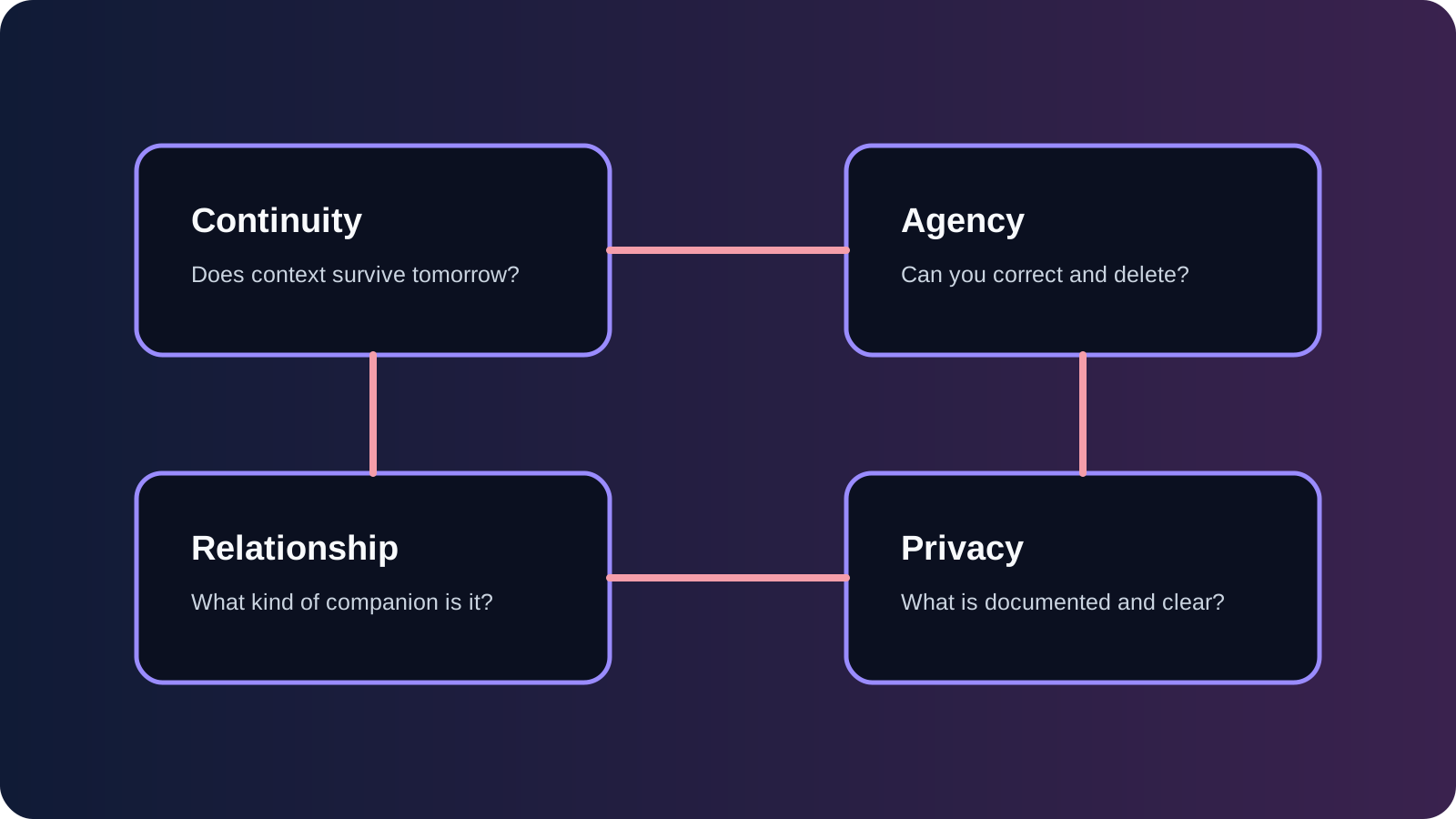
A useful scorecard can be simple. Give each product a low, medium, or high mark for continuity, inspectability, correction, deletion, export, voice, and workspace fit. Add a note explaining every mark. Do not add the numbers into a leaderboard unless the criteria are genuinely comparable; a roleplay app should not lose points merely because it is not a project manager.
For continuity, check whether the companion remembers a detail you intentionally supplied and whether it forgets a detail you removed. For inspectability, ask where the detail appears and how it got there. For correction, supply one harmless correction and see if the product accepts it without arguing. For deletion, ask whether the visible memory, source chat, and derived summary have separate lifecycles. These are small, repeatable checks that protect against marketing language.
Privacy should include the people around the user. A companion may receive stories about a partner, child, client, or colleague who never agreed to be part of an AI profile. Generalize names and locations, avoid uploading private photographs by default, and keep a shared family story in a shared record rather than in one person’s private companion account. Personalization is not permission to collect everything.
Revisit the choice after the novelty fades. The first week rewards novelty and emotional tone; the fourth week reveals friction, repetition, and the real memory boundary. If the product remains useful after the first excitement, document why. If it does not, export what you need and close the account according to the provider’s instructions. A clean exit is part of a good comparison.
Questions to ask before subscribing
Can an AI companion replace therapy? No. A companion can offer conversation or reflection prompts, but it is not a licensed clinician, crisis service, or diagnostic tool. Seek qualified human support for mental-health care or urgent safety concerns.
Is more memory always better? No. Memory should be relevant, inspectable, and removable. A smaller, accurate memory is safer than a large invisible profile.
What is the safest first step? Use a pseudonymous account, share a low-risk topic, read the privacy and deletion documentation, and keep an independent export of anything you want to retain.
Document the date of that exit check too. A memory control that exists today may move behind a menu tomorrow, so a transparent review date is more useful than a timeless promise.
The comparison is strongest when it leaves room for a product to be excellent at companionship without pretending to be a personal archive. That distinction protects readers from buying the wrong kind of memory.
It also keeps the editorial promise fair to smaller products. A new companion may have a narrow, thoughtful workflow without publishing a long feature list. Give it credit for a clear boundary, a readable privacy policy, or an honest export path even when it cannot match a large platform’s voice catalog. Conversely, do not award a mature product a high memory score merely because it has existed longer. The scorecard describes the evidence available on the review date, not a prediction about a company’s future.
Readers can reuse the rubric with any app that is not listed here. Copy the seven criteria, record the public source for each claim, and run the low-risk continuity check before sharing a personal history. This turns a comparison article into a repeatable decision tool rather than a recommendation that expires when a pricing page changes.
Keep a dated copy of the result, especially when you are comparing paid plans. A product can improve its memory controls, change its voice provider, or remove a feature without making older reviews useless; the review date tells readers which version of the experience the evidence describes. That is the difference between a durable editorial comparison and a list of timeless-sounding claims.
Den Gedanken weiterführen
Choose continuity with visible boundaries
Verbinden Sie Gespräche, nützlichen Kontext, Überlegungen, Projekte und Aufgaben in einem persönlichen Arbeitsbereich.
Kostenlos startenHäufig gestellte Fragen
Which AI companion has the best memory?
There is no universal winner because products differ in memory visibility, relationship style, voice, privacy, and platform. Compare the controls and continuity you actually need.
Are AI companion apps the same as personal AI workspaces?
No. Some companions focus on social or character interaction, while personal workspaces connect conversations with notes, projects, reflection, and tasks.
Can an AI companion forget or correct details about me?
Product behavior varies. Look for a visible memory list, correction path, deletion controls, retention documentation, and a way to separate temporary context.

