
best personal AI assistants with long-term memory
8 Best Personal AI Assistants With Long-Term Memory (2026)
Compare the best personal AI assistants with long-term memory in 2026, including ChatGPT, Claude, Gemini, Gemora, Kindroid, Nomi, Replika, and Character.AI.
المنهجية: Comparison based on public product documentation, current memory controls, and official release information available on 2026-09-04; Gemora was checked directly.
Original contribution: A seven-question evaluation framework separating durable memory from context windows and stored chat history.

في هذا الدليل
- Quick answer: the best personal AI assistants with memory
- How we compared these AI assistants
- 1. ChatGPT: best overall personal AI assistant with memory
- 2. Claude: best AI assistant for transparent memory controls
- 3. Gemini: best personal AI memory for Google users
- 4. Gemora: best for personal life continuity and reflection
- 5. Kindroid: best customizable AI companion memory
- 6. Nomi: best for emotionally continuous AI companionship
- 7. Replika: best established AI companion experience
- 8. Character.AI: best for character variety, not deep personal memory
- Which personal AI assistant has the best long-term memory?
- What to look for in an AI assistant with memory
- Long-term memory vs context window vs chat history
- Personal AI memory is becoming the real differentiator
- Final verdict
Most AI assistants can answer a difficult question.
Far fewer can remember why you asked it three weeks ago.
That distinction matters. A useful personal AI should not force you to rebuild your context every time you start a new conversation. It should be able to carry forward relevant preferences, goals, projects, decisions, relationships, and other useful context while still giving you meaningful control over what stays in memory.
In 2026, memory has become a major battleground across personal AI. ChatGPT has expanded automatic memory synthesis, Claude now exposes editable memory topics across Chat and Cowork, and Gemini can personalize replies using previous conversations. Specialized products such as Gemora, Nomi, Kindroid, and Replika approach long-term continuity from very different directions.
Source: OpenAI — Better memory for a more helpful ChatGPT
This guide compares the best personal AI assistants with long-term memory based on what they remember, how memory is controlled, and what each assistant is actually best for.
Quick answer: the best personal AI assistants with memory
| AI assistant | Best for | Memory approach | |---|---|---| | ChatGPT | Best overall general-purpose personal AI | Automatic cross-conversation personalization | | Claude | Best for transparent, editable memory | Topic-based editable memory across Chat and Cowork | | Gemini | Best for the Google ecosystem | Past-chat memory, Personal Intelligence, and import tools | | Gemora | Best for personal life continuity and reflection | Conversations connected with memories, recaps, projects, and tasks | | Kindroid | Best customizable companion memory | Persistent, cascaded, and retrievable memory | | Nomi | Best for relationship continuity | Short-, medium-, and long-term companion memory | | Replika | Best for an established companion experience | Explicit memories plus deeper conversation-derived personalization | | Character.AI | Best for character variety | Pinned conversational memories |
Our overall pick for most people: ChatGPT.
Best if memory transparency matters: Claude.
Best if you want AI centered on your personal life rather than general-purpose work: Gemora.
Best for an ongoing AI relationship: Nomi or Kindroid.
There is no single form of “AI memory.” The assistant that remembers your coding project well may not be the assistant you want to use to reflect on what has changed in your life over six months.
How we compared these AI assistants
We reviewed public product documentation, memory controls, current product pages, and official release information available as of September 2026.
Gemora is included in this comparison and is also the publisher of this guide. Gemora was checked directly. Claims about other products are based primarily on their current official documentation rather than assumptions about undocumented behavior.
We focused on seven questions:
- Does information survive across separate conversations?
- Can the assistant retrieve old context when it becomes relevant?
- Can you inspect what it remembers?
- Can you correct or delete incorrect context?
- Can memory adapt when your situation changes?
- Does memory meaningfully improve everyday use?
- Are the privacy and memory controls clearly documented?
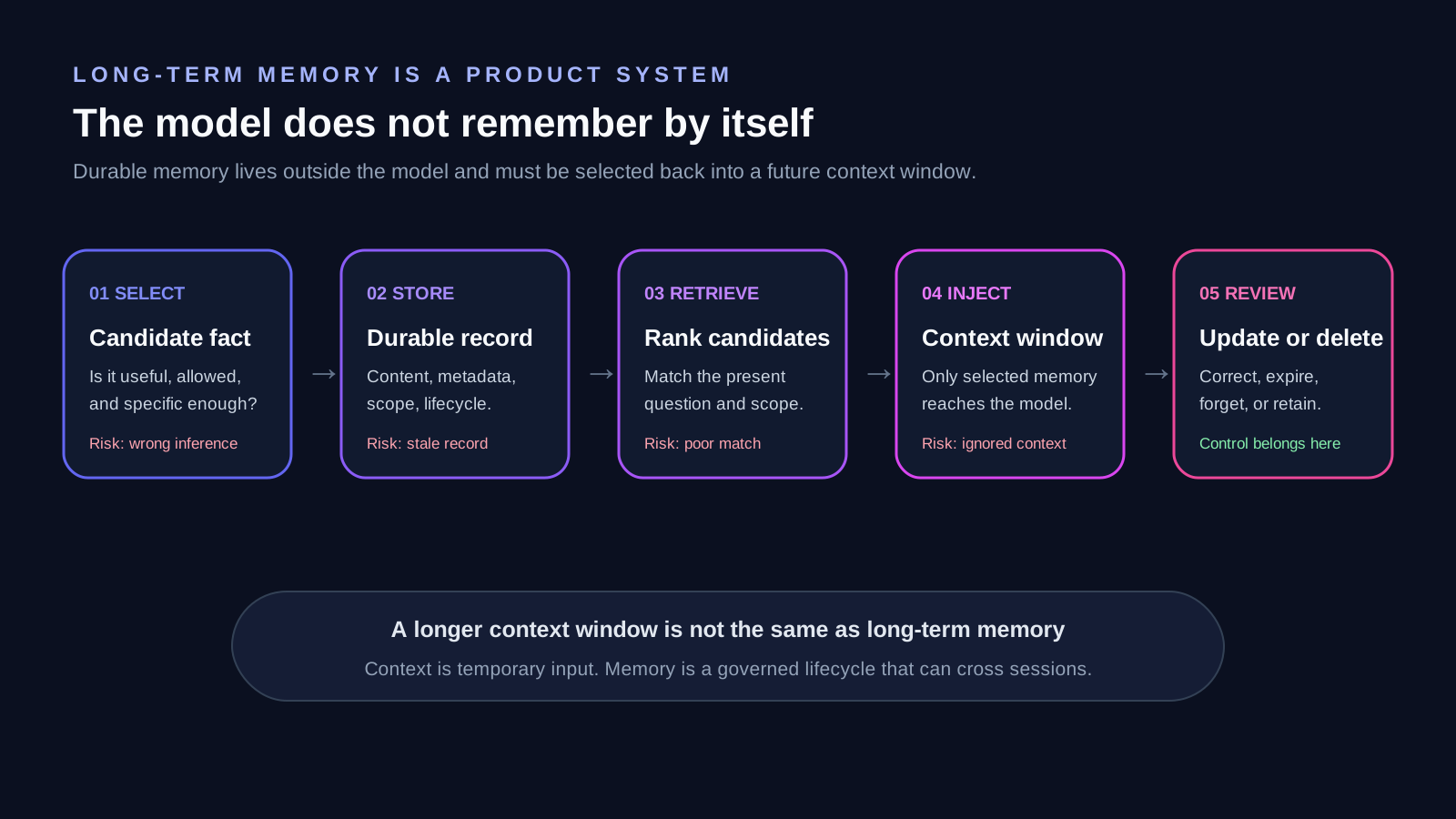
We do not treat a large context window as the same thing as long-term memory.
A context window tells an AI how much information it can consider during a particular interaction. Long-term memory is information that remains available for future interactions after that immediate context is gone.
For a deeper explanation, see What Is Long-Term Memory in AI?.
Then compare AI memory with chat history, use the AI assistant memory evaluation checklist, and review the personal AI memory privacy checklist.
1. ChatGPT: best overall personal AI assistant with memory
Best for
General everyday use, writing, planning, learning, coding, research, and users who want one broad AI assistant that gradually becomes more personalized.
ChatGPT has one of the most mature mainstream implementations of AI memory.
OpenAI describes memory as a way for ChatGPT to learn useful preferences, projects, and constraints so future conversations can begin with shared context rather than repeatedly starting from zero. In June 2026, OpenAI began rolling out a more scalable memory synthesis system designed to improve freshness, continuity, and relevance over longer periods.
Source: OpenAI — Better memory for a more helpful ChatGPT

ChatGPT's Memory Summary lets users review, update, and correct the personal context ChatGPT has synthesized. Source: OpenAI.
ChatGPT can use remembered context such as preferences, interests, goals, and ongoing projects to personalize future responses. OpenAI also provides controls for reviewing memory, disabling memory, and using Temporary Chat when you do not want a conversation to use or create memory.
Source: OpenAI Help — Memory FAQ
Where ChatGPT is strongest
Its biggest advantage is breadth.
You can use the same assistant to discuss a personal decision in the morning, analyze a spreadsheet later, write code in the afternoon, and plan a trip that evening.
Memory makes that broad toolset more personal.
Instead of repeatedly writing:
I am building an Android app. I prefer concise answers. Here is the project context again...
the system can potentially carry useful parts of that context forward.

ChatGPT can expose memory sources behind a personalized answer and let users mark a memory as relevant, not relevant, or incorrect. Source: OpenAI.
Where it is weaker
ChatGPT is still a general-purpose assistant first.
Its memory is intended primarily for useful personal context and preferences rather than functioning as a perfect archive of everything you have ever said. OpenAI explicitly warns that memory should not be relied on to preserve exact templates or large blocks of verbatim text.
That makes it excellent for personalization, but not automatically the best option if your main goal is building a structured, reviewable record of your life.
Bottom line
Choose ChatGPT if you want a powerful general-purpose AI experience with useful personalization layered on top.
2. Claude: best AI assistant for transparent memory controls
Best for
Writing, analysis, knowledge work, projects, and people who want to see and edit what their assistant remembers.
Claude made memory considerably more explicit in 2026.
As of August 25, Anthropic says Claude uses the same memory across Chat and Cowork. Rather than exposing memory as one opaque concept, Claude organizes remembered information into topics that users can inspect, edit, or delete.
Source: Anthropic — Claude's memory works everywhere

Claude now uses the same memory across Chat and Cowork. Source: Anthropic.
Memory is on by default for Free, Pro, and Max plans. Team and Enterprise organizations have different administrative defaults and controls.
Source: Claude Release Notes
Why the topic system matters
Suppose Claude remembers:
The user is preparing a product launch in October.
The launch later moves to November.
An editable memory system gives you a visible place to correct outdated context rather than simply hoping the assistant eventually infers that the older information is wrong.
That becomes increasingly important as AI relationships stretch from days into months and years.

Claude lists saved memories under Topics, where users can inspect and manage remembered context. Source: Anthropic.

Individual Claude memory topics can be edited or deleted so corrections carry forward into future conversations. Source: Anthropic.
Sensitive memories
Anthropic also separates sensitive topics from ordinary memory.
Claude does not store certain sensitive categories by default. Users can choose whether to allow some sensitive topics to enter memory, while Anthropic says some categories remain excluded.
This is one of the clearest examples in the category of memory being treated as something the user should be able to inspect and govern.
Bottom line
Choose Claude if you value strong general AI capability but want unusually visible control over what the assistant remembers.
3. Gemini: best personal AI memory for Google users
Best for
People whose personal digital life already lives inside Google's ecosystem.
Gemini can use previous Gemini conversations to personalize future interactions. Google has also expanded the product with memory import, full chat-history import, and Personal Intelligence.
Source: Google — Bring your AI memories and chat history to Gemini

Gemini's Import Memory flow helps users bring key preferences, relationships, and personal context from another AI service. Source: Google.
This matters because switching AI assistants has traditionally meant starting over.
Google's import flow gives users a prompt to run in another AI service, then lets them bring the resulting summary of preferences and personal context into Gemini.
The bigger advantage: Personal Intelligence
Gemini becomes especially interesting when memory is combined with Google's broader ecosystem.
Personal Intelligence can use relevant information from connected Google services, where the feature is supported and the user grants access, as well as previous Gemini conversations.
Google has also introduced the ability to upload chat-history exports from other AI providers.

Gemini can import a ZIP archive of previous AI conversations so users can search and continue older threads. Source: Google.
That pushes personal AI memory beyond:
What did I tell this chatbot?
toward:
What useful context can move with me between tools and across my digital life?
Limitation
Availability still varies by account, platform, region, and individual feature.
Bottom line
Choose Gemini if you already depend heavily on Google and want personalization to become part of that ecosystem.
4. Gemora: best for personal life continuity and reflection
Best for
People who want conversations, moments, decisions, reflections, goals, and ongoing personal context to remain connected over time.
Gemora approaches memory from a different starting point than ChatGPT, Claude, or Gemini.
General-purpose assistants begin with the question:
What can the AI help you do?
Gemora is more centered on:
What has been happening in your life, and what context would make the next conversation more useful?
Gemora connects conversations with persistent context, daily recaps, memories, reflections, projects, tasks, and other parts of a personal workspace.
Source: Gemora

Gemora brings conversation, memory, and personal context into one workspace. Source: Gemora.
Why this is different
Imagine you discuss:
- whether to leave a job,
- a goal you keep postponing,
- tension with someone close to you,
- an idea you want to pursue,
- or how your priorities have changed.
A general assistant can give an excellent answer to each conversation.
A personal context workspace becomes more useful when those conversations are not isolated events.
The goal is not simply:
remember that I like dark mode.
It is:
understand what has changed since the last time we talked about this.
That is a fundamentally different use of memory.
Daily recap
Gemora's recap experience is designed to make individual days easier to revisit rather than leaving everything buried inside a chronological chat list.

Gemora Recap helps turn individual days into reviewable moments and context. Source: Gemora.
Memories
Gemora also separates remembered context from the raw stream of conversation, making it easier to return to older moments without manually digging through every chat.

Gemora Memories is designed to help users rediscover older context without searching every conversation manually. Source: Gemora.
Insights over time
The longer-term goal of personal memory is not only recall. It is noticing change.

Gemora Insights focuses on patterns and changes across time rather than a single isolated conversation. Source: Gemora.
This is where a personal AI can become meaningfully different from a chatbot that merely remembers a few facts.
Instead of only recalling:
You said you were stressed about work.
a system with useful continuity can help surface:
Work has come up repeatedly in your conversations this month, but the reasons you describe have changed.
That distinction between remembering facts and understanding change is one of the most important directions in personal AI.
Where Gemora is weaker
Gemora does not have the ecosystem scale or general-purpose breadth of ChatGPT, Gemini, or Claude.
If your primary goal is advanced coding, enterprise research, or having one AI perform every possible type of work, one of the large general assistants will usually be the more natural default.
Gemora makes more sense when continuity around your own life is the product rather than a secondary feature.
Bottom line
Choose Gemora if the thing you most want your AI to understand over time is you.
Want an AI that keeps the thread of your life?
Gemora connects conversations, memories, reflections, projects, and next steps so you can continue where you left off instead of rebuilding the context every time.
Start with Gemora for free.
5. Kindroid: best customizable AI companion memory
Best for
People who want a highly customizable AI friend or character with deep conversational continuity.
Kindroid documents one of the most explicit layered memory architectures among companion products.
Its memory system includes:
- persistent memory,
- Cascaded Memory for medium-term continuity,
- retrievable long-term memory,
- journal entries,
- and editable Learned Context.
Source: Kindroid Memory Documentation
Kindroid says long-term memory can span all past interactions, while retrieval is based on relevance and may be less reliable than information in shorter-term or cascaded memory.
That caveat matters. “Infinite memory” sounds impressive on a landing page, but useful memory is not just how much can theoretically be stored. It is whether the right detail returns at the right moment.
Kindroid also allows journal entries to be recalled through key phrases and exposes recalled long-term memories through a memory indicator in the chat interface.
Why Kindroid stands out
Customization and memory work together.
Users can define backstories and personalities, then allow ongoing conversations to build continuity on top of those foundations.
This makes Kindroid particularly strong for users who want a persistent, customizable companion rather than a general productivity assistant.
Bottom line
Choose Kindroid if you want deep customization and a layered companion-memory system rather than a conventional productivity assistant.
6. Nomi: best for emotionally continuous AI companionship
Best for
People looking for an AI friend or relationship-oriented companion that evolves through repeated conversations.
Nomi puts memory at the center of its product positioning.
The company describes short-, medium-, and long-term memory designed to support ongoing relationships and conversational continuity.
Source: Nomi

Nomi explicitly positions long-term memory as part of maintaining a continuous AI relationship. Source: Nomi.
This differs substantially from conventional assistant memory.
A productivity assistant might remember:
You prefer bullet points.
Nomi is designed to remember details that affect the continuity of an ongoing relationship.
Relationship and roleplay continuity
Nomi's memory is built into a broader companion experience that includes individual relationships, roleplay, group chat, and multimodal interactions.

Nomi supports multi-character group conversations and persistent roleplay contexts. Source: Nomi.

Nomi combines persistent conversation with generated selfies, videos, and visual interactions. Source: Nomi.
Where Nomi fits
Nomi is not the obvious choice for writing a technical report, operating a work project, or becoming a universal productivity layer.
That is not its job.
Its strength is making repeated conversation feel like part of one evolving relationship rather than hundreds of unrelated sessions.
Bottom line
Choose Nomi if emotional and relationship continuity matters more than broad productivity features.
7. Replika: best established AI companion experience
Best for
People who want a familiar avatar-based AI companion with conversation, voice, activities, and memory.
Replika has one of the longest histories in consumer AI companionship.
According to its help documentation, Replika can remember profile information, interests, tastes, preferences, and information about people or pets mentioned in conversations. Users can inspect memories and remove individual items.
Source: Replika — What does my Replika remember about me?

Replika presents memory as part of a companion that becomes more personalized through continued interaction. Source: Replika.
Replika's current documentation describes memory as layered: some memories are visible in the Memory tab, while other personalization comes from broader patterns in conversation history.
Source: Replika — How does Replika's memory work?

Replika uses remembered personal context as part of an ongoing companion experience. Source: Replika.

Memory is one part of Replika's larger avatar-based relationship experience. Source: Replika.
Why choose Replika
Replika's appeal is the complete companion experience:
- avatar,
- conversation,
- voice,
- activities,
- relationship modes,
- personalization.
Memory is one component of that larger experience.
Bottom line
Choose Replika if you want an established, visual AI companion rather than memory as a standalone personal knowledge system.
8. Character.AI: best for character variety, not deep personal memory
Best for
Roleplay, fictional characters, and users who value character variety over deep personal continuity.
Character.AI belongs on this list partly because its memory model illustrates the difference between keeping important conversation details available and building a broad personal memory system.
Its Pinned Memories feature lets users pin messages within a chat so important details remain available to the character.
Source: Character.AI — Pinned Memories
Character.AI lets users pin important messages so a character can retain selected details in the conversation. Source: Character.AI.
Pinned memories can also be removed when they are no longer useful. Source: Character.AI.
That is useful.
But it is substantially different from an assistant building and maintaining a broad model of your changing preferences, goals, history, relationships, or projects.
Bottom line
Choose Character.AI for characters and roleplay. If persistent personal context is your main priority, the other products in this guide are stronger fits.
Which personal AI assistant has the best long-term memory?
There is no universal winner because “best memory” depends on what you expect the AI to remember.
Choose ChatGPT if...
You want a powerful general-purpose AI that becomes more personalized over time.
Choose Claude if...
You want strong AI capability plus unusually transparent and editable memory controls.
Choose Gemini if...
Your everyday digital context already lives inside Google, or you want easier migration from another AI service.
Choose Gemora if...
You want conversations about your actual life to connect across days, weeks, and months.
Choose Kindroid or Nomi if...
You want a persistent AI relationship or highly customized companion.
Choose Replika if...
You want an established companion product with avatars, voice, and structured experiences.
Choose Character.AI if...
Your priority is roleplay and a huge variety of characters rather than a deep model of your personal life.
What to look for in an AI assistant with memory
Do not judge memory from the sentence:
“Our AI remembers you.”
Nearly every product can write that.
Instead, test five things.
1. Ask what it remembers
After several conversations, ask:
What do you currently remember about me?
The answer should distinguish stored context from guesses based on the current conversation.
2. Change something
Tell the assistant that an old preference, goal, location, relationship, or project status is no longer true.
Return several days later and see which version it uses.
Updating memory is at least as important as creating it.
3. Test retrieval, not storage
Mention something important once.
Later, ask a question where that information would genuinely matter without explicitly reminding the assistant.
A memory system is useful only when it retrieves the right context at the right time.
4. Look for correction and deletion controls
You should know how to remove information that is:
- wrong,
- outdated,
- too sensitive,
- or no longer useful.
A memory system without correction eventually becomes a misinformation system about one extremely niche subject: you.
5. Separate memory from chat history
Long chat history alone does not guarantee useful long-term memory.
The hard problem is selecting what matters, retrieving it at the appropriate moment, and updating it when reality changes.
Long-term memory vs context window vs chat history
These three concepts are often treated as if they mean the same thing. They do not.
| Concept | What it means | Main limitation | |---|---|---| | Context window | Information available to the model in the current interaction | Temporary and capacity-limited | | Chat history | Stored record of previous conversations | Having an archive does not guarantee relevant retrieval | | Long-term memory | Selected or synthesized context carried into future interactions | Can become stale, wrong, or irrelevant if poorly managed |
A model can have an enormous context window and still provide a poor long-term personal experience.
Likewise, an app can store every conversation you have ever written and still fail to retrieve the one detail that matters to your current question.
Useful memory requires at least four things:
- Selection — deciding what is worth retaining.
- Retrieval — finding the relevant context later.
- Updating — changing memory when reality changes.
- Control — giving the user a way to inspect, correct, or remove information.
That is why raw storage capacity is a weak proxy for memory quality.
Personal AI memory is becoming the real differentiator
The first generation of consumer AI competition was largely about models:
Which model answers better?
The next layer is increasingly about context:
Which AI understands enough about my situation to give the right answer for me?
The major platforms are already moving in that direction.
OpenAI is investing in scalable multi-year memory synthesis. Anthropic has made memory editable and shared across Chat and Cowork. Google is connecting past-chat personalization with Personal Intelligence and tools for importing context from other AI services.
Sources:
- OpenAI — Better memory for a more helpful ChatGPT
- Anthropic — Claude's memory works everywhere
- Google — Bring AI memories and chat history to Gemini
The long-term opportunity is larger than remembering a favorite food or preferred writing style.
Personal AI can become useful when it remembers:
- what you were trying to accomplish,
- why you made a decision,
- what changed afterward,
- what you repeatedly struggle with,
- who and what matters to you,
- and when old context has stopped being true.
That is the point where AI begins to move from answering isolated prompts to helping across time.
Final verdict
The best personal AI assistant with long-term memory depends less on raw model intelligence than on what you want the AI to build continuity around.
For broad everyday AI, ChatGPT remains the strongest default.
For visible control over remembered context, Claude stands out.
For people already deeply invested in Google, Gemini has the most natural ecosystem advantage and one of the clearest migration stories.
For conversations centered on your life, reflections, decisions, and changes over time, Gemora takes a more purpose-built approach.
For customizable and persistent AI relationships, Kindroid and Nomi are stronger fits.
For an established avatar-based companion experience, Replika remains distinctive.
For character variety and roleplay, Character.AI is the more natural choice, but its memory model is not as focused on maintaining a broad, evolving picture of your real life.
The important shift is simple:
A good AI can answer you.
A personal AI should increasingly understand the context behind the question.
Your conversations should become more useful over time.
Talk through what is happening, keep the context that matters, and return to it when it becomes relevant again.
Start free with Gemora.
مواصلة الموضوع
Build continuity around the context that matters
Use Gemora to connect conversations, memories, recaps, and changes over time without treating raw chat history as the whole story.
ابدأ مجانًاالأسئلة المتداولة
What is the best AI assistant with long-term memory in 2026?
ChatGPT is a strong general-purpose choice, Claude emphasizes inspectable memory, and Gemora is purpose-built around continuity in personal conversations and life context.
Is AI memory the same as chat history?
No. Chat history stores earlier conversations, while memory selects, synthesizes, or retrieves context so it can become relevant in a future interaction.
Is a larger context window the same as long-term memory?
No. A context window is temporary information available during an interaction; long-term memory persists beyond that immediate context and can be retrieved later.
Should an AI remember everything?
Probably not. Useful memory should prioritize relevant context and give the user clear ways to inspect, correct, remove, or avoid saving information.
المصادر ومزيد من القراءة
Written by Khai Tran and reviewed under the Gemora Editorial Policy.


